What are Stokes Germany Front Lower Control Arms for Mercedes-Benz GLE V167 and what do they do?
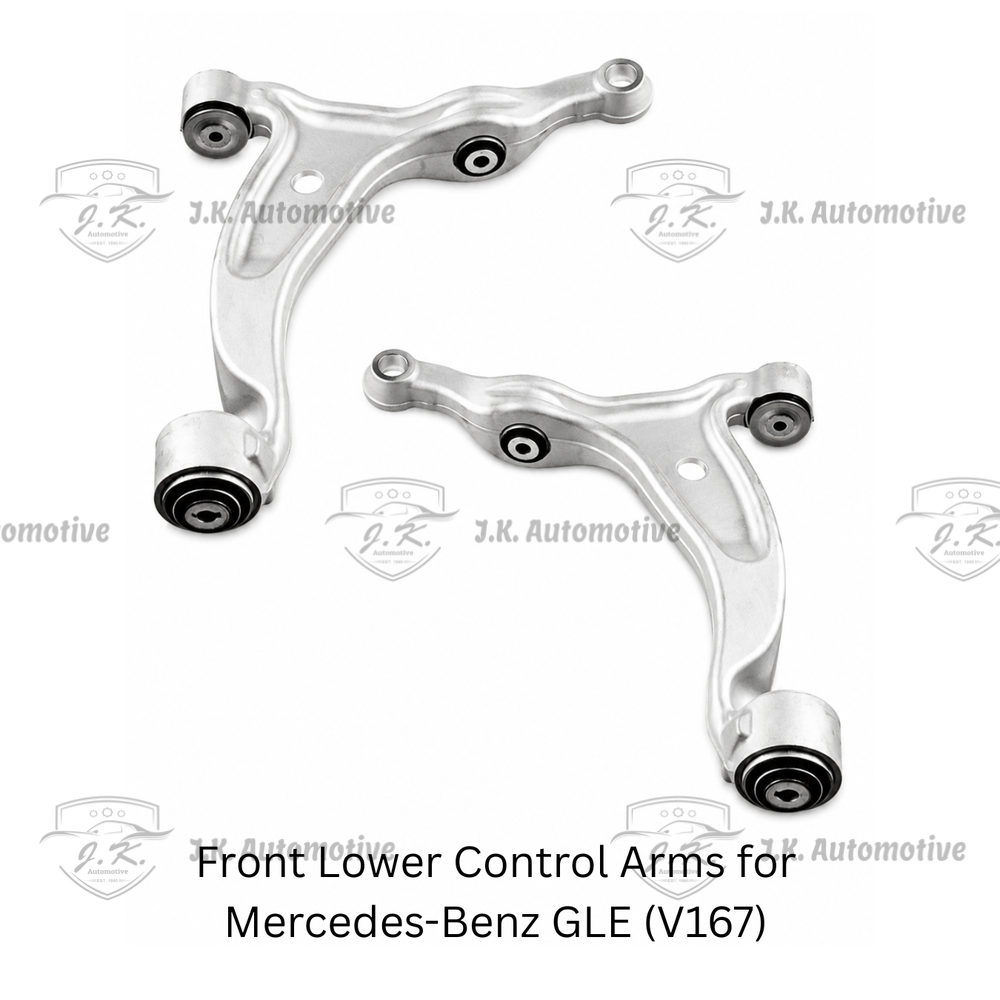
Mercedes-Benz GLE V167 Front Lower Control Arms are major components of the front suspension system that help locate and guide the front wheel assemblies while supporting controlled suspension movement, stable wheel positioning and consistent suspension geometry during everyday driving, braking, acceleration and cornering. This Stokes Germany Front Lower Control Arm Set of 2 for Mercedes-Benz GLE V167 A1673300700 & A1673300800 provides the corresponding left and right lower suspension arms together, with Mercedes-Benz identifying A1673300700 as the lower-left control arm and A1673300800 as the lower-right control arm. The current product application specifies Mercedes-Benz GLE V167 2019–2026, making the model, chassis code, year range and OEM references important details for correct product identification. The lower control arms operate as part of the complete front suspension rather than working independently. They work together with the upper control arms, suspension bushes, steering components, shock absorbers, wheel hubs, wheel bearings, tyres and stabilizer system. When the GLE V167 travels over potholes, speed breakers, road joints or uneven surfaces, the wheel assemblies move vertically while the suspension compresses and extends. The front lower control arms help guide this movement and maintain the intended relationship between the wheel assemblies and chassis. During braking, significant longitudinal forces are transferred through the tyres, wheels and suspension components. During cornering, lateral forces pass through the same system, while acceleration and changing road conditions continuously alter the loads acting on the suspension. The control-arm bushes and applicable joints therefore need to remain mechanically sound so that required suspension movement can occur without excessive unwanted movement. With mileage, ageing and repeated road impacts, control-arm bushes and joints can gradually deteriorate. When excessive movement develops, drivers may notice knocking or clunking from the front suspension, vague or less precise steering, vibration, changes in road handling or uneven tyre wear. However, these symptoms are not unique to the lower control arms, so proper diagnosis is important. Upper control arms, steering tie rod ends, wheel bearings, shock absorbers, tyres and wheels should also be inspected. Sway bar links, Sway links, Anti roll link rods and Stabiliser sway links should be checked when knocking or rattling occurs because worn stabilizer components can create similar suspension noises. When professional inspection confirms excessive wear in the original lower control arms, replacing A1673300700 & A1673300800 can address unwanted movement originating from those specific suspension positions. Professional installation and a wheel alignment check after replacement are recommended.
Are A1673300700 & A1673300800 suitable for Mercedes-Benz GLE V167?
A1673300700 & A1673300800 are documented Mercedes-Benz front lower control-arm references for GLE-Class 167 applications, with A1673300700 corresponding to the lower-left position and A1673300800 corresponding to the lower-right position. Mercedes-Benz's official parts information lists A1673300700 for GLE-Class 167 and identifies it as “Unten links,” meaning lower left, while A1673300800 is identified as “Unten rechts,” meaning lower right, and is likewise listed for multiple GLE 167 configurations. Your Stokes Germany product listing specifies these two OEM references together as a Front Lower Control Arm Set of 2 for Mercedes-Benz GLE V167 2019–2026 and also provides Lemförder cross-references 42827 01 & 44824 01. Correct fitment should nevertheless be confirmed before ordering because Mercedes-Benz suspension specifications can vary according to model configuration, production specification and vehicle equipment. Customers should first confirm that their vehicle is a Mercedes-Benz GLE V167 within the intended application. The original lower control-arm references should then be compared with A1673300700 & A1673300800. If the original numbers cannot be confidently identified, the vehicle's 17-digit VIN should be used for compatibility checking; Mercedes-Benz specifically provides VIN-based compatibility verification on its parts pages. Physical appearance alone should not be used to determine compatibility because two suspension arms can look similar while differing in dimensions, bush arrangement, mounting points or application. The left and right positions should also be observed carefully because A1673300700 and A1673300800 are not two identical interchangeable components. A1673300700 is the corresponding lower-left arm and A1673300800 is the lower-right arm. The replacement reason should also be diagnosed before ordering. A knocking noise does not automatically mean that both lower arms are defective. Upper control arms, ball joints, steering joints and stabilizer components can create similar noises. Vibration may originate from wheel balancing, tyres or wheel bearings. Uneven tyre wear can result from suspension wear, tyre pressure or incorrect wheel alignment. Therefore, the safest purchasing method is to confirm the GLE V167 application, verify A1673300700 & A1673300800 against the vehicle, check the VIN where necessary and have the suspension inspected before replacement.
What are the common symptoms of worn Mercedes-Benz GLE V167 Front Lower Control Arms?
Common symptoms associated with worn Mercedes-Benz GLE V167 Front Lower Control Arms can include knocking or clunking from the front suspension, excessive suspension movement, less precise steering, vibration, changes in braking stability, irregular tyre wear and repeated wheel-alignment concerns, although these symptoms require proper diagnosis because several other suspension, steering, tyre and wheel components can create similar problems. The A1673300700 lower-left and A1673300800 lower-right control arms help locate the front wheel assemblies and guide their movement as suspension loads change. During everyday driving, these components experience continuous mechanical loads. Braking transfers substantial forces through the wheels into the suspension, cornering creates lateral loads, acceleration changes weight distribution and potholes create rapid suspension movement. With mileage and repeated suspension cycles, bushes and applicable joints can gradually deteriorate. A worn bush may allow the lower control arm to move more than intended under braking or while the suspension changes direction. This unwanted movement can sometimes produce a knocking or clunking sound, particularly while travelling over rough roads, potholes, speed breakers or road joints. Another possible symptom is a less precise steering sensation. If suspension movement becomes excessive, wheel positioning can change slightly as loads vary, potentially making the front end feel less controlled. Irregular tyre wear can also occur when worn suspension components contribute to inconsistent wheel geometry, although tyre pressure and incorrect alignment can create similar wear patterns. Vibration requires especially careful diagnosis because tyre imbalance, bent wheels, damaged tyres and worn wheel bearings are common alternative causes. If a driver experiences vibration mainly at a particular speed, wheel and tyre condition should be investigated rather than automatically replacing control arms. Upper control arms should also be inspected because wear in those components can produce steering and suspension symptoms. Steering tie rod ends and related joints should be checked for excessive movement. Shock absorbers should be examined for leakage and damping condition. Sway bar links, Sway links, Anti roll link rods and Stabiliser sway links should be inspected when knocking is present because stabilizer-link joints commonly generate suspension noises when worn. Therefore, the Mercedes-Benz GLE V167 Front Lower Control Arms should be replaced when inspection confirms deterioration or excessive movement in A1673300700 & A1673300800 positions, rather than replacing them solely because a general suspension symptom is present.
Why are Mercedes-Benz GLE V167 Front Lower Control Arms A1673300700 & A1673300800 supplied as a Set of 2?
The Mercedes-Benz GLE V167 Front Lower Control Arms A1673300700 & A1673300800 are supplied as a Set of 2 because the package provides the corresponding left and right front lower suspension positions together rather than supplying two identical interchangeable control arms. Mercedes-Benz identifies A1673300700 as the lower-left arm and A1673300800 as the lower-right arm for GLE-Class 167 applications. The current Stokes Germany product listing combines these references into one Front Lower Control Arm Set of 2 for Mercedes-Benz GLE V167 2019–2026. Supplying both components together can simplify the repair when professional inspection establishes that both corresponding lower control arms require replacement. The left and right suspension arms generally operate for the same overall vehicle mileage, experience similar vehicle loads and perform corresponding functions on opposite sides of the front suspension. However, this does not mean that both components must always wear at exactly the same rate. One side may encounter more potholes, broken roads or kerb impacts than the other. Previous repairs can also mean that one side has already been replaced and therefore has lower operating mileage. For this reason, both lower arms should be inspected rather than assuming automatically that both are defective. When one lower control arm shows substantial bush deterioration or excessive movement, inspecting the corresponding arm on the opposite side is sensible. If both positions are worn, replacing the pair together provides new components across both corresponding lower suspension positions. The technician should also inspect the surrounding suspension system during the repair. Upper control arms should be checked for bush or joint wear. Steering tie rod ends should be checked for excessive movement. Shock absorbers should be inspected for leakage and damping condition. Wheel bearings, tyres and wheels should be checked where vibration or irregular tyre wear is present. Sway bar links, Sway links, Anti roll link rods and Stabiliser sway links should be inspected when suspension noise is part of the complaint. Correct left/right installation is essential because A1673300700 and A1673300800 are position-specific. Once the suspension is mechanically sound, a wheel alignment check is recommended to assess the wheel geometry after replacement.
What are the benefits of replacing worn Front Lower Control Arms on Mercedes-Benz GLE V167?
Replacing worn Mercedes-Benz GLE V167 Front Lower Control Arms can help restore controlled suspension movement, reduce excessive mechanical play associated with deteriorated control-arm bushes or joints and address suspension or steering symptoms when professional diagnosis confirms that the lower arms are responsible. A1673300700 corresponds to the lower-left suspension position and A1673300800 corresponds to the lower-right position, making them the corresponding pair used in this Stokes Germany Front Lower Control Arm Set of 2. When these components and their associated bushes are mechanically sound, they help locate the wheel assemblies and restrict unwanted movement while still allowing the suspension to travel through its intended range. If the original control-arm bushes become worn, additional movement can occur as braking, acceleration, cornering and road impacts change the forces acting through the suspension. If that movement is responsible for knocking or clunking, replacing the worn lower control arms can address the mechanical source of the noise. If excessive lower-arm movement contributes to vague steering or inconsistent wheel positioning, replacement can help restore more controlled movement in those positions. Correcting mechanical suspension wear can also be important before wheel alignment because alignment equipment measures geometry but cannot compensate for excessive play in a suspension bush or joint. However, installing new lower control arms cannot repair every possible front suspension problem. If an upper control arm is worn, it must be repaired separately. Worn steering tie rod ends, wheel bearings, shock absorbers, tyres or other suspension components can continue causing symptoms after the lower arms are replaced. Similarly, knocking caused by Sway bar links, Sway links, Anti roll link rods or Stabiliser sway links will remain until those components are repaired. Existing tyre wear also cannot be reversed by replacing suspension arms, although repairing the mechanical cause and correcting alignment can help prevent continued abnormal wear. The best result therefore comes from diagnosing the complete suspension first, replacing A1673300700 & A1673300800 when confirmed worn, inspecting related components, using proper installation procedures and performing a wheel alignment check after the mechanical repair.
What should be checked before buying Stokes Germany Mercedes-Benz GLE V167 Front Lower Control Arms?
Before buying Stokes Germany Mercedes-Benz GLE V167 Front Lower Control Arms, customers should confirm the exact Mercedes-Benz GLE model, V167 chassis application, year range, original OEM references, left and right suspension positions and vehicle VIN because correct suspension-part identification is more reliable than ordering by vehicle name alone. Your current product is Stokes Germany Front Lower Control Arm Set of 2 for Mercedes-Benz GLE V167 A1673300700 & A1673300800, with the listing specifying Mercedes-Benz GLE V167 2019–2026, a Set of 2 and Lemförder cross-references 42827 01 & 44824 01. Mercedes-Benz confirms A1673300700 as the lower-left control arm and A1673300800 as the lower-right control arm and lists both references for GLE-Class 167 applications. The first check should therefore be whether the original suspension components or the vehicle's parts data correspond with A1673300700 & A1673300800. If there is any uncertainty, VIN-based verification is recommended because Mercedes-Benz's official parts system provides compatibility checking using the 17-digit vehicle identification number. Customers should also confirm why the parts are being replaced. If the vehicle has knocking from the front suspension, the lower control arms should be inspected for bush deterioration, excessive movement and joint wear, but the upper control arms and stabilizer system should also be checked. If the vehicle has vague steering, steering tie rod ends and related joints should be inspected. If vibration is present, wheel balancing, tyres, wheel condition and wheel bearings should be investigated. If uneven tyre wear is present, tyre pressure, wheel alignment and the complete suspension should be examined. Sway bar links, Sway links, Anti roll link rods and Stabiliser sway links should be inspected when rattling or knocking is present. Customers should also confirm that they require both corresponding arms because this product is supplied as a Set of 2. Correct installation should be carried out by a qualified technician, and a wheel alignment check is recommended after replacement. By confirming the GLE V167 application, 2019–2026 range, A1673300700 & A1673300800 OEM references, VIN and actual suspension condition before ordering, customers can substantially reduce the risk of selecting the wrong front lower control-arm set.
Can worn Mercedes-Benz GLE V167 Front Lower Control Arms cause knocking, vibration, loose steering or uneven tyre wear?
Worn Mercedes-Benz GLE V167 Front Lower Control Arms can contribute to knocking or clunking noises, excessive suspension movement, less precise or loose-feeling steering, vibration-related complaints and uneven tyre wear when deterioration in the control-arm bushes, applicable joints or mounting areas allows the front wheel assemblies to move more than intended, although these symptoms should always be professionally diagnosed because several other suspension, steering, wheel and tyre components can produce very similar problems. For this Stokes Germany Front Lower Control Arm Set of 2 for Mercedes-Benz GLE V167 A1673300700 & A1673300800, A1673300700 corresponds to the front lower left position and A1673300800 corresponds to the front lower right position. Mercedes-Benz officially identifies these respective positions and lists the references for GLE-Class 167 applications. The lower control arms experience continuous mechanical loading whenever the vehicle is driven. During braking, longitudinal forces are transmitted through the tyres, wheels and suspension components. During cornering, lateral forces act through the wheel assemblies, while acceleration changes the load distribution across the chassis. Potholes, speed breakers, road joints and broken road surfaces can create rapid suspension movement and additional impact loads. Over time, deterioration in a lower control-arm bush or applicable joint may allow more movement than intended. A knocking or clunking sound may then become noticeable as the suspension compresses and extends over uneven surfaces. If unwanted control-arm movement influences wheel positioning, the steering may also feel less precise and the vehicle may require additional steering correction. Uneven tyre wear can sometimes develop when suspension wear contributes to changes in wheel geometry, although incorrect tyre pressure, wheel alignment and tyre condition can produce similar patterns. Vibration requires particularly careful diagnosis because wheel imbalance, bent wheels, tyre defects and worn wheel bearings are common alternative causes. Upper control arms should also be inspected because wear in these components can produce similar steering or suspension symptoms. Steering tie rod ends and related steering joints should be checked for excessive play. Shock absorbers should be inspected for leakage, damage and damping condition. Sway bar links, Sway links, Anti roll link rods and Stabiliser sway links should also be inspected when knocking or rattling occurs because worn stabilizer-link joints can easily be mistaken for control-arm noise. Therefore, A1673300700 & A1673300800 should not be replaced merely because the vehicle has a generic front suspension noise. They should be replaced when inspection confirms excessive wear or movement in those lower suspension positions. Once the worn components are replaced and the surrounding suspension is confirmed mechanically sound, a wheel alignment check is recommended to assess the wheel geometry after the repair.
Should both Mercedes-Benz GLE V167 Front Lower Control Arms be replaced together?
Both Mercedes-Benz GLE V167 Front Lower Control Arms should be carefully inspected whenever significant wear is found on one side, and replacing A1673300700 & A1673300800 together can be practical when both corresponding lower suspension positions show deterioration, although there is no universal rule that automatically requires a mechanically sound control arm to be replaced simply because the opposite side is worn. This Stokes Germany Front Lower Control Arm Set of 2 supplies the corresponding left and right components together, with A1673300700 identified as the front lower left arm and A1673300800 as the front lower right arm. Both components normally experience the same overall vehicle mileage and operate under broadly similar driving conditions, which means that when substantial age-related bush wear is found on one side, the corresponding opposite-side component deserves careful inspection. However, actual wear can differ considerably. One side of the vehicle may repeatedly encounter deeper potholes, damaged road edges or kerb impacts. Previous accident repairs or suspension maintenance may also mean that one lower control arm has already been replaced and therefore has significantly less operating mileage than the opposite arm. The correct decision should therefore be based on mechanical inspection rather than mileage alone. The bushes should be inspected for cracking, separation, distortion and excessive movement. Applicable suspension joints should be checked for play, physical damage and deterioration of protective boots. Mounting areas should also be inspected. If A1673300700 and A1673300800 positions both show excessive wear, replacing the pair together can restore serviceable components across both corresponding lower suspension positions and avoids leaving another clearly deteriorated arm in service. The Stokes Germany product is already supplied as a Set of 2, making it convenient when both sides require replacement. The current product listing specifies Mercedes-Benz GLE V167 2019–2026 and identifies Lemförder 42827 01 & 44824 01 as cross-references. Related suspension components should also be inspected because replacing both lower control arms will not correct wear elsewhere. Front upper control arms, steering tie rod ends, shock absorbers, wheel bearings, Sway bar links, Sway links, Anti roll link rods and Stabiliser sway links should be checked according to the vehicle's symptoms. Tyres should be examined for irregular wear and wheels for damage or imbalance. If only one lower control arm is confirmed defective while the corresponding opposite-side component remains mechanically sound, the technician should determine whether replacement of both is necessary based on condition, mileage and service history. If both are worn, installing the complete A1673300700 & A1673300800 Set of 2 during the same repair can be a sensible approach, followed by a professional wheel alignment check.
What other suspension parts should be inspected when replacing Mercedes-Benz GLE V167 Front Lower Control Arms?
When replacing Mercedes-Benz GLE V167 Front Lower Control Arms, the complete front suspension and steering system should be inspected because A1673300700 & A1673300800 operate as part of an interconnected suspension assembly, and installing new lower control arms cannot correct excessive wear in another suspension, steering, wheel or tyre component. The front upper control arms should be inspected for bush deterioration, excessive movement or applicable joint wear because the upper and lower suspension links work together to guide the wheel assembly. Steering tie rod ends and related steering joints should be checked for excessive play because worn steering components can contribute to loose steering, knocking or irregular tyre wear. Shock absorbers should be inspected for leakage, physical damage and damping condition because their role in controlling suspension movement is different from that of the control arms, but poor damping can substantially affect the behaviour of the front suspension. Wheel bearings should be checked if humming, vibration or excessive wheel movement is present. Tyres should be inspected for correct pressure, tread condition, physical damage and irregular wear patterns. Wheels should be checked for bends or other impact damage, and wheel balancing should be considered where speed-related vibration is present. Sway bar links, Sway links, Anti roll link rods and Stabiliser sway links deserve particular attention when the original complaint involves knocking over small bumps because worn stabilizer-link joints can generate noises that are easily confused with lower-control-arm problems. Stabilizer mounting bushes should also be inspected where applicable. The condition of the lower control-arm bushes themselves should be evaluated carefully. Independent suspension data for these OEM references identifies corresponding front-lower bush locations, reinforcing that the arm assembly incorporates bush components that play an important role in controlling movement. The mounting locations and applicable fasteners should also be inspected during replacement. A1673300700 and A1673300800 are position-specific components, with the former corresponding to the front lower left and the latter to the front lower right. Correct installation should therefore follow the appropriate vehicle-specific repair procedure and tightening specifications. Suspension components should not be diagnosed only by listening for noise because the source of a knock can travel through the chassis and may appear to come from a different location. A workshop should inspect the suspension under appropriate conditions and identify any excessive play before replacing components. If additional worn parts are discovered, repairing them during the same suspension service can prevent another defective component from continuing to produce symptoms after the new Mercedes-Benz GLE V167 Front Lower Control Arms have been installed. Once the complete front suspension and steering system is mechanically sound, a professional wheel alignment check is recommended.
Is wheel alignment required after replacing Mercedes-Benz GLE V167 Front Lower Control Arms?
A professional wheel alignment check is strongly recommended after replacing Mercedes-Benz GLE V167 Front Lower Control Arms because A1673300700 & A1673300800 are major front suspension components involved in locating and guiding the wheel assemblies, and replacing worn control arms changes the mechanical condition from which the vehicle's wheel geometry is measured. A1673300700 is the front lower left component and A1673300800 is the corresponding front lower right component for applicable GLE-Class 167 vehicles. If the original lower-control-arm bushes or joints have developed excessive movement, the position of the wheel assembly can vary as braking, acceleration and cornering forces change. Performing an alignment while excessive mechanical play remains in the suspension is not an ideal repair approach because alignment equipment measures wheel geometry but cannot repair a deteriorated bush or loose suspension joint. Mechanical suspension faults should therefore be corrected first. After the Stokes Germany Front Lower Control Arm Set of 2 is correctly installed, the technician can check wheel geometry with the repaired suspension components in place. Alignment becomes particularly important when the vehicle previously showed irregular tyre wear, steering pull, inconsistent straight-line behaviour or repeated alignment problems. However, a wheel alignment should not be treated as a substitute for a complete suspension inspection. Before final alignment, front upper control arms should be checked for wear, steering tie rod ends should be checked for excessive play and wheel bearings should be inspected where necessary. Shock absorbers should be checked for leakage or damage. Tyres should be inspected for correct pressure and abnormal wear. Wheels should be checked for impact damage and balancing issues. Sway bar links, Sway links, Anti roll link rods and Stabiliser sway links should also be inspected when suspension noise is present, although these components generally serve the stabilizer system rather than determining alignment adjustment. Correct installation of A1673300700 & A1673300800 is also important. The arms are position-specific, so the left and right components must be installed in their appropriate positions using the correct vehicle-specific procedures. Applicable fasteners should be tightened according to the correct workshop specifications and procedures. After installation and confirmation that the remaining suspension and steering components are mechanically sound, the vehicle should undergo an alignment check so that the relevant geometry can be measured and adjusted where applicable. This complete process helps ensure that the Mercedes-Benz GLE V167 Front Lower Control Arms are installed as part of a properly repaired suspension system rather than simply replacing parts without checking the final wheel geometry.
Why is Stokes Germany a European-quality alternative to Lemförder, FEBI, Meyle and other established brands for Mercedes-Benz GLE V167?
Stokes Germany can be considered as a replacement option when customers are comparing Mercedes-Benz GLE V167 Front Lower Control Arms with Lemförder, FEBI, Meyle and other established suspension brands, but the most useful comparison should be based on exact OEM cross-reference, correct vehicle fitment, package contents, warranty, price, availability and seller support rather than assuming that products from different aftermarket brands are identical or that one brand is automatically superior in every application. For this particular suspension set, the most important references are A1673300700 & A1673300800. Mercedes-Benz officially identifies A1673300700 as the lower-left control arm and A1673300800 as the lower-right control arm for GLE-Class 167 applications. Independent suspension catalogue information also identifies A1673300700 as a front-left lower suspension control arm for GLE-Class applications and pairs it with the corresponding right-side component. The current Stokes Germany product combines both corresponding references into a Front Lower Control Arm Set of 2 for Mercedes-Benz GLE V167 2019–2026. The listing also identifies Lemförder 42827 01 & 44824 01 as cross-references and provides a six-month warranty against manufacturing defects. This gives customers several practical factors to compare when evaluating Stokes Germany against Lemförder, FEBI, Meyle or another available brand. First, the competing component should correspond with the same A1673300700/A1673300800 application rather than merely being advertised for a Mercedes-Benz GLE. Second, customers should compare whether the quoted price is for one individual arm or for both corresponding arms because this Stokes Germany product is supplied as a Set of 2. Third, warranty terms and local product support should be considered alongside purchase price. Brand reputation can also form part of the purchasing decision, but sharing the same OEM cross-reference does not by itself prove that products from different manufacturers use identical materials, manufacturing processes, bush compounds, production facilities or quality-control systems. Likewise, no aftermarket brand should automatically be described as mechanically superior to another without product-specific evidence. Correct fitment remains the first priority. Customers should confirm the GLE V167 application, original A1673300700 & A1673300800 references and vehicle VIN before purchase. When those references are confirmed and professional diagnosis establishes that both lower control arms require replacement, the Stokes Germany Set of 2 can be compared with Lemförder, FEBI, Meyle and other available alternatives on the basis of verified fitment, complete-set pricing, warranty, availability and overall purchase value.

Reviews
There are no reviews yet.