What is the Stokes Germany Front Stabilizer Link Rod Set of 2 for Mercedes-Benz C-Class W204?
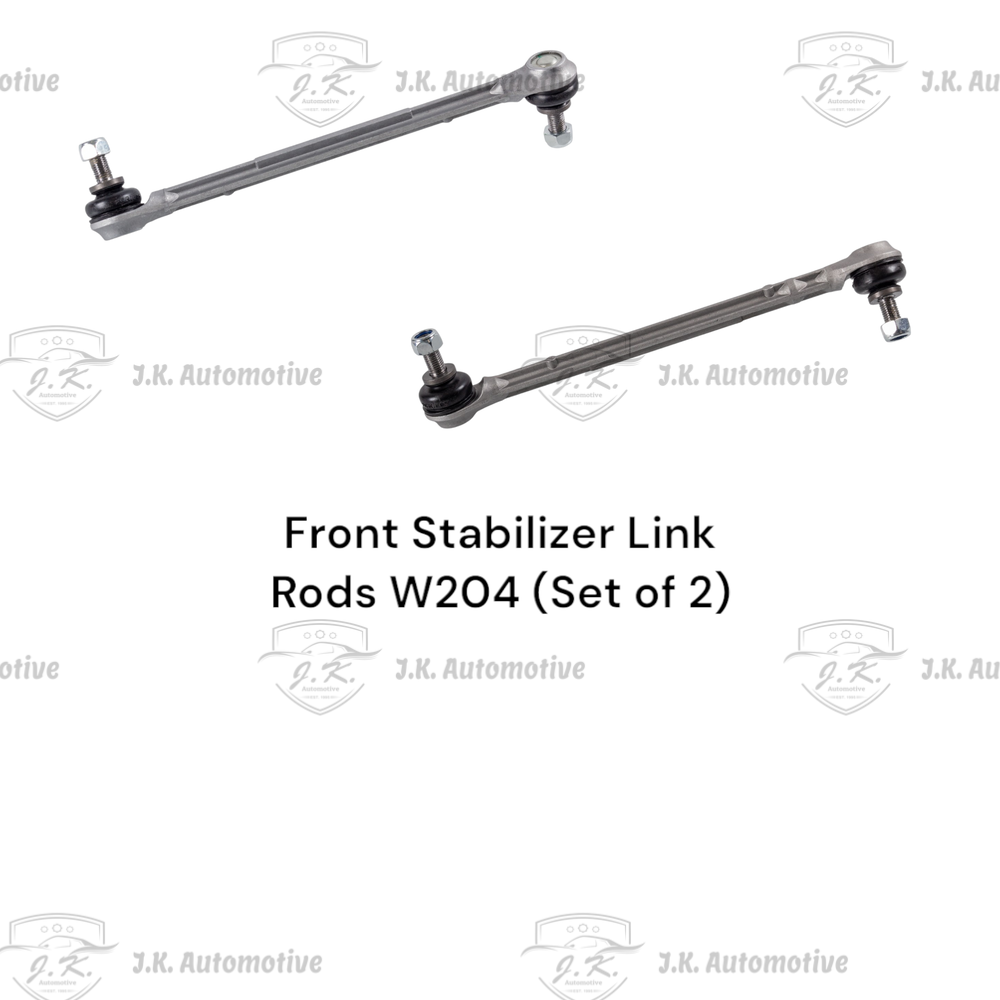
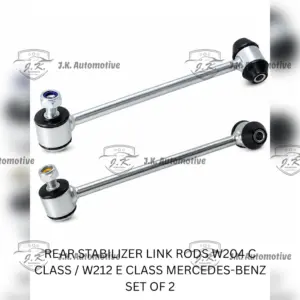
The Stokes Germany Front Stabilizer Link Rod Set of 2 is a premium aftermarket suspension replacement set designed for compatible Mercedes-Benz C-Class W204 models, providing the corresponding front stabilizer links used as part of the vehicle’s front anti-roll-bar and suspension system. These components are commonly known as Sway bar links, Sway links, Anti roll link rods, Stabiliser sway links, front drop links, coupling rods or anti-roll-bar links. On the Mercedes-Benz C-Class W204 front suspension, the stabilizer bar is connected to the suspension strut, and the stabilizer links provide the articulated mechanical connection required for the anti-roll system to operate as the suspension moves. During normal driving, the front suspension continuously compresses and rebounds as the vehicle travels across potholes, speed breakers, broken roads, expansion joints, parking ramps and other uneven surfaces. When one front wheel moves vertically by a different amount from the opposite wheel, the Sway bar links articulate and transfer movement through the stabilizer arrangement. The same system operates during cornering, when the left and right sides of the suspension experience different loading and the anti-roll bar contributes to controlling excessive body roll. Because the Sway links articulate continuously during everyday driving, their joints experience repeated movement, vibration, road impacts and changing mechanical loads throughout their service life. The components are also positioned underneath the vehicle, where they are exposed to dust, dirt, moisture, road water and other environmental conditions. Over extended use, this repeated articulation can gradually create wear within the joints or protective components. Excessive joint clearance in worn Anti roll link rods may contribute to tapping, rattling, knocking or clunking noises from the front suspension, particularly when travelling at lower speeds over potholes, broken surfaces and speed breakers. However, a front suspension noise should not automatically be diagnosed as a defective stabilizer link because control-arm bushes, ball joints, shock absorbers, mounts and other suspension components can produce similar symptoms. Both front Stabiliser sway links and the surrounding suspension should therefore be inspected before replacement. Supplying the Stokes Germany product as a set of 2 is convenient when both corresponding front links require renewal during the same suspension repair, providing one component for each side of the applicable front stabilizer arrangement. One important fitment point must be checked carefully for the W204: independent suspension catalogues show multiple front stabilizer-link references depending on suspension specification. RIW, for example, lists A2043201789 / A2043203789 for Front Left applications and A2043201889 / A2043203889 for Front Right applications, while Orjin likewise identifies A2043203789 / A2043201789 as a Front Left stabilizer-link family for applicable non-4MATIC/non-sport-suspension W204 configurations. Your current JK Automotive listing associates this Stokes Germany set with A2043306711 & A2043306811, but that listing itself now flags that reference for verification because independent catalogue information does not support treating A2043306711 as a W204 stabilizer-link reference. Therefore, before publishing or supplying the product, the exact Stokes Germany part label, physical dimensions and vehicle VIN should be checked to establish the correct W204 front Sway bar link references and suspension application.
What do front sway bar links do on a Mercedes-Benz C-Class W204?
Front sway bar links on a Mercedes-Benz C-Class W204 provide a mechanical connection within the front suspension and anti-roll system. These components are also commonly called front stabilizer links, sway links, anti roll link rods and stabiliser sway links. Although different terminology is used across workshops, parts catalogues and online searches, these names generally describe the links connecting suspension movement to the stabilizer or anti-roll bar. As the W204 travels over the road, each front wheel moves vertically in response to potholes, bumps, depressions, speed breakers and other irregularities. The suspension must accommodate this movement while maintaining vehicle control and tyre contact. During cornering, the suspension on the outside and inside of the vehicle can experience different loads because vehicle weight transfers laterally. The stabilizer or anti-roll bar contributes to controlling excessive body roll under these conditions. The front sway links provide the mechanical connecting path through which relevant suspension movement is transferred to the stabilizer bar. Each link contains articulated joints that allow the required movement while maintaining this connection. When the joints remain in good condition, they can articulate without excessive unwanted clearance. Over time, repeated suspension movement, vibration, road impacts and contamination can contribute to joint deterioration. If excessive free play develops, the link may move through this unwanted clearance as suspension loading changes direction. This can produce knocking, clunking, tapping or rattling noises. Replacing genuinely worn stabilizer links restores the intended mechanical connection; it should not be presented as a performance modification that changes the original Mercedes suspension design. The W204 also has multiple front stabilizer-link references depending on suspension specification. RIW, for example, catalogues A2043201789/A2043201889 and A2043203789/A2043203889 as W204 front stabilizer-link applications. Therefore, the exact suspension specification and actual Stokes component should be verified before installation. Once the correct application is confirmed, the Stokes Germany Front Stabilizer Link Rod Set of 2 provides a complete aftermarket pair for replacing worn Mercedes-Benz C-Class W204 front Sway bar links, Sway links, Anti roll link rods and Stabiliser sway links.
What are the common symptoms of worn front stabilizer links or sway links on a Mercedes-Benz C-Class W204?
Worn front stabilizer links or sway links on a Mercedes-Benz C-Class W204 can be associated with several symptoms, particularly knocking, clunking, tapping or rattling noises from the front suspension. These sounds may become more noticeable while driving over potholes, broken road surfaces, speed breakers or small sharp bumps because such conditions create rapid suspension movement. The front stabilizer links, also known as sway bar links, anti roll link rods and stabiliser sway links, contain articulated joints that continuously move as the suspension compresses and rebounds. When these joints are in serviceable condition, they articulate while maintaining the intended mechanical connection without excessive free play. As mileage increases, repeated movement, vibration and road impacts can gradually wear the internal joint surfaces. Once excessive clearance develops, the joint can move through this unwanted space whenever suspension loading changes direction. This movement may generate the metallic knocking or clunking sound commonly associated with worn sway links. The noise may initially occur only under specific conditions and become more frequent as joint wear progresses. Protective boots around the joints are also important because they help protect the joint from water, dust and road contamination. Torn or deteriorated boots can expose the internal joint area and potentially accelerate deterioration. Indian road conditions involving frequent potholes, uneven surfaces and speed breakers can repeatedly load suspension components. However, a knocking noise from the front suspension does not automatically mean the stabilizer links are defective. Stabilizer-bar bushes, control-arm bushes, ball joints, tie-rod ends, shock absorbers, suspension mounts and other components can produce similar symptoms. A technician should therefore inspect the complete front suspension rather than replacing sway bar links solely on the basis of noise. If excessive play is confirmed in the stabilizer links, replacement can remove the unwanted clearance and restore the intended connection with the anti-roll bar. Correct identification of the replacement components remains essential because several stabilizer-link applications exist for the W204. RIW, for example, lists A2043201789 / A2043203789 for Front Left applications and A2043201889 / A2043203889 for Front Right applications, while Orjin likewise identifies A2043203789 / A2043201789 as a Front Left stabilizer-link family for applicable non-4MATIC/non-sport-suspension W204 configurations.
Are sway bar links, sway links, anti roll link rods and stabiliser sway links the same type of component?
Yes, these terms are commonly used to describe the same general type of suspension component, although exact terminology can vary by manufacturer, country, workshop and parts catalogue. A front stabilizer link may be called a sway bar link because it connects to the sway bar, another common name for the anti-roll or stabilizer bar. The shortened term sway link is frequently used by workshops and parts sellers for the same component. Anti roll link rod refers to its connection with the anti-roll bar, while stabiliser sway link combines two commonly used descriptions. Mercedes-Benz and aftermarket catalogues may instead use terminology such as stabilizer link, link stabilizer, suspension stabilizer bar link or rod. For example, Mercedes-Benz's official US parts catalogue describes W204 reference 2043203889 as a stabilizer link, suspension stabilizer bar link and rod, while identifying it as a front-right component. Teknorot similarly classifies A2043203889 as a "Suspension Stabilizer Bar Link" for the W204. Regardless of terminology, the component's fundamental role is to connect the relevant suspension movement with the stabilizer or anti-roll bar. When customers search online for Mercedes W204 sway bar links, Mercedes W204 sway links, W204 anti roll link rods or Mercedes stabiliser sway links, they may therefore be looking for the same general component category. However, similar terminology does not mean every part number fits every W204. Mercedes used different front stabilizer-link references according to suspension configuration. Left and right components can also have separate references. Correct fitment should therefore be determined using the appropriate OEM reference, suspension specification and vehicle identification information rather than terminology alone. This distinction is particularly important for the supplied A2043306711 reference because independent catalogues classify that number as a control/thrust arm rather than a sway bar link. When one front wheel moves vertically by a different amount from the opposite wheel, the Sway bar links articulate and transfer movement through the stabilizer arrangement. The same system operates during cornering, when the left and right sides of the suspension experience different loading and the anti-roll bar contributes to controlling excessive body roll.
Should both front stabilizer links be replaced together on a Mercedes-Benz C-Class W204?
Replacing both front stabilizer links together on a Mercedes-Benz C-Class W204 can be a practical approach when both original components have accumulated similar mileage or show comparable wear. The two front sway bar links operate within the same anti-roll system and experience repeated articulation whenever the suspension compresses and rebounds. Both components are exposed to vibration, changing suspension loads, potholes, speed breakers, dust, water and other environmental conditions throughout their service life. Because the left and right sway links normally accumulate the same vehicle mileage, age-related wear can develop on both components. One link may become noisy before the other because individual road impacts and suspension loads are not always distributed equally. Therefore, when one stabiliser sway link has developed substantial age-related wear, inspecting the opposite component is sensible. A set of two can be convenient when both links require replacement during the same repair. However, pair replacement should not replace proper diagnosis. If only one component has suffered isolated physical damage while the opposite link remains serviceable, a technician should determine the appropriate repair based on actual condition. Surrounding components should also be inspected because stabilizer-bar bushes, control-arm bushes, ball joints, steering joints and shock absorbers can produce similar noises. Replacing anti roll link rods cannot correct a suspension noise caused by another defective component. Another important consideration on the W204 is that left and right front stabilizer links can have separate OEM references. Independent catalogues list, for example, A2043203789 as a front-left stabilizer link and A2043203889 as front-right, with other variants such as A2043201789/A2043201889 also documented depending on specification. Therefore, a set of two must contain the correct corresponding pair for the vehicle's suspension configuration. Correct fitment verification should always precede installation. Because the Sway links articulate continuously during everyday driving, their joints experience repeated movement, vibration, road impacts and changing mechanical loads throughout their service life. The components are also positioned underneath the vehicle, where they are exposed to dust, dirt, moisture, road water and other environmental conditions.
Why choose Stokes Germany Front Stabilizer Link Rods for a Mercedes-Benz C-Class W204?
Stokes Germany Front Stabilizer Link Rods provide an aftermarket suspension option for customers looking to replace worn front stabilizer links on the corresponding Mercedes-Benz C-Class W204 application. These components may also be searched as sway bar links, sway links, anti roll link rods and stabiliser sway links. When selecting any replacement suspension component, correct vehicle-specific fitment should be the first consideration. A stabilizer link must correspond with the required length, joint configuration, mounting arrangement, material specification and left or right position where applicable. The W204 is particularly important in this respect because multiple front stabilizer-link references are catalogued according to suspension specification. RIW lists A2043201789 and A2043203789 among front-left applications and A2043201889 and A2043203889 among front-right applications. A Mercedes-Benz parts catalogue also identifies 2043203889 as a front-right stabilizer link for specified W204 applications. During operation, sway bar links continuously articulate as the suspension moves, exposing their joints to vibration, road impacts and changing mechanical loads. When wear creates excessive joint clearance, replacement can help restore the intended mechanical connection between the suspension and anti-roll bar. The set-of-two format is convenient when both corresponding front links require renewal. Stokes Germany is an aftermarket replacement brand, so the product should be presented as a Stokes Germany component rather than a Mercedes-Benz Genuine Part. Your JK Automotive catalogue currently lists a Stokes set of two for the W204 under A2043306711 & A2043306811. Because independent technical catalogues identify A2043306711 as a front lower rearward control/thrust arm, that reference should be verified against the physical Stokes product before publishing it as the stabilizer-link OEM cross-reference. This verification will help ensure customers receive accurate fitment information while still allowing the product to be marketed under relevant terms such as front stabilizer links, sway bar links, sway links and anti roll link rods. During normal driving, the front suspension continuously compresses and rebounds as the vehicle travels across potholes, speed breakers, broken roads, expansion joints, parking ramps and other uneven surfaces.
Can worn front stabilizer links cause knocking or clunking noises in a Mercedes-Benz C-Class W204?
Yes, worn front stabilizer links can be one possible cause of knocking, clunking, tapping or rattling noises from the front suspension of a Mercedes-Benz C-Class W204. Front stabilizer links are also commonly called sway bar links, sway links, anti roll link rods and stabiliser sway links. These components provide the mechanical connection between the relevant front suspension components and the stabilizer or anti-roll bar. Whenever the W204 travels over potholes, speed breakers, broken roads or uneven surfaces, the front suspension continuously compresses and rebounds. This movement repeatedly changes the mechanical loads acting through the sway bar links. Each stabilizer link contains articulated joints that allow the required suspension movement while maintaining a connection with the anti-roll bar. When these joints are in good condition, they articulate without excessive unwanted clearance. As vehicle mileage increases, repeated suspension movement, vibration, road impacts and environmental exposure can gradually contribute to joint wear. Once excessive clearance develops inside the joint, it can move through this free play whenever suspension loading changes direction. This unwanted movement may generate a metallic knocking, clunking, tapping or rattling sound. The noise can initially be most noticeable while driving slowly over small bumps, rough roads or speed breakers. As deterioration progresses, the sound may become more frequent. Protective joint boots should also be inspected because damage can expose the joint to water, dust and road contamination. However, a knocking sound should never automatically be diagnosed as a defective stabilizer link. Control-arm bushes, ball joints, stabilizer-bar bushes, steering joints, shock absorbers and suspension mounts can produce similar symptoms. A complete suspension inspection is therefore recommended. If excessive play is confirmed in the sway links, replacing the worn components restores the intended mechanical connection between the suspension and anti-roll bar. The exact W204 stabilizer-link application must still be confirmed because multiple left/right references exist according to suspension specification. When the VIN and original front component confirm A1643201332 / A1643202132, the Stokes Germany set of 2 is the corresponding front stabilizer-link replacement for the Mercedes-Benz GL-Class X164.
Are sway bar links, sway links and anti roll link rods important for the Mercedes-Benz C-Class W204 suspension?
Yes, sway bar links are important connecting components within the Mercedes-Benz C-Class W204 suspension and anti-roll system. They are also commonly called front stabilizer links, sway links, anti roll link rods or stabiliser sway links. Although the terminology differs between workshops, manufacturers and online parts catalogues, these names generally describe components that transfer relevant suspension movement to the stabilizer or anti-roll bar. During normal driving, each front wheel moves vertically as the W204 travels over bumps, potholes, depressions, speed breakers and uneven road surfaces. During cornering, the inside and outside suspension can experience different loads as vehicle weight transfers laterally. The stabilizer bar contributes to managing excessive body movement under these conditions. The stabilizer links provide the mechanical connecting path needed for the anti-roll bar to react to suspension movement. Each link contains articulated joints because the connection must accommodate continuous changes in suspension position. These joints repeatedly articulate during everyday driving and consequently experience vibration, road impacts and changing mechanical loads. When a sway link is in serviceable condition, the joint moves while maintaining the intended connection without excessive unwanted clearance. When joint wear develops, free play can reduce the precision of that connection and may create knocking or rattling noises. Replacement of genuinely worn anti roll link rods restores the intended mechanical connection rather than modifying the original Mercedes-Benz suspension design. It is also important to understand that stabilizer links are only one element of the complete suspension system. Control arms, bushes, ball joints, shock absorbers, springs, steering components, tyres and wheel alignment all influence vehicle behaviour. The W204 uses different front stabilizer-link references depending on specification. Catalogue data includes A2043203789/A2043203889 and A2043201789/A2043201889 as left/right front applications. Correct identification should therefore be completed before installation rather than selecting a component solely because it is described as a W204 sway bar link.
Can replacing worn sway links improve the suspension feel of a Mercedes-Benz C-Class W204?
Replacing genuinely worn sway links can help restore the intended suspension behaviour of a Mercedes-Benz C-Class W204 when excessive joint clearance has developed in the existing components. Sway links, front stabilizer links, sway bar links, anti roll link rods and stabiliser sway links are different commonly used terms for the same general suspension component in this context. These links connect suspension movement with the stabilizer or anti-roll bar. When their articulated joints are in good condition, they allow the necessary movement while maintaining the intended mechanical connection. Over time, repeated articulation, vibration, pothole impacts and general road loading can create wear within these joints. Once excessive clearance develops, the link can move through unwanted free play before transferring force to the stabilizer bar. This may contribute to knocking, clunking or rattling noises. If substantially worn links are replaced, the unwanted joint clearance is removed and the intended connection can be restored. A driver may consequently perceive the front suspension as quieter or tighter when the original stabilizer links were genuinely worn. However, replacement should not be marketed as a performance upgrade. New stabilizer links do not transform the original suspension design or automatically increase handling beyond the vehicle's intended specification. The objective is to restore the normal function of worn components. Overall suspension behaviour also depends on control arms, bushes, ball joints, shock absorbers, springs, steering joints, tyres and wheel alignment. If one of these components is defective, replacing only the sway bar links cannot solve the complete suspension problem. A comprehensive front suspension inspection is therefore advisable when the W204 has persistent noise or handling concerns. Correct replacement selection is equally important because the W204 has multiple front stabilizer-link variants. For example, A2043203789 is independently catalogued as a front-left W204 stabilizer link, paired with A2043203889 on the right. Vehicle specification and the physical components should therefore be checked before installation. These components are also commonly known as Sway bar links, Sway links, Anti roll link rods and Stabiliser sway links, so different workshops or catalogues may use different terminology for the same suspension component. Another useful confirmation is that this application uses the corresponding front link on both Front Left and Front Right positions rather than separate left-hand and right-hand OEM references, which is why the Stokes Germany product is supplied as a set of 2.
How should I confirm the correct Stokes Germany front stabilizer links for my Mercedes-Benz C-Class W204?
The safest way to confirm the correct Stokes Germany front stabilizer links for a Mercedes-Benz C-Class W204 is to use the vehicle VIN, original component references, suspension specification and physical comparison rather than relying only on the model name. The W204 was produced with different suspension configurations, and aftermarket catalogues document multiple front stabilizer-link references. RIW, for example, lists A2043203789 and A2043201789 as front-left stabilizer-link references and A2043203889 and A2043201889 as front-right references for W204 applications. Teknorot specifically identifies A2043203789 as a forged-aluminium front-left stabilizer link for the W204 and pairs it with its front-right M-541 component, which uses A2043203889. Customers may encounter these components under different descriptions such as sway bar links, sway links, anti roll link rods or stabiliser sway links, but the terminology alone is not sufficient to establish exact compatibility. The first step should therefore be checking the OEM reference associated with the existing links. If this cannot be determined reliably, the VIN should be checked against an appropriate Mercedes-Benz parts catalogue. During installation, the replacement components should also be physically compared with the removed links for overall dimensions, mounting arrangement, joint orientation and left/right position. A suspension component should never be forced into position simply because it looks similar. There is a particularly important issue with the product reference supplied here. JK Automotive currently lists A2043306711 and A2043306811 as Stokes front stabilizer links for the W204. However, independent Mercedes parts data identifies A2043306711 as a W204 front-left thrust arm rather than a stabilizer link. Therefore, the actual Stokes product label or manufacturer's internal fitment data should be checked before using A2043306711 as the stabilizer-link OEM reference on the final product page. Before installation, compare the replacement links with the removed original components for overall length, mounting arrangement, ball-joint orientation and thread dimensions; Orjin lists the applicable front link as 205 mm with M14x1.5 specifications, while JIKIU likewise lists A1643201332 / A1643202132 as a Front Left/Right stabilizer application with a 205 mm mounting length and M14x1.50 threads.
Why is Stokes Germany a European-quality alternative to Lemförder, FAG, FEBI Bilstein and Meyle for Mercedes-Benz C-Class W204 suspension parts?
Stokes Germany suspension components are positioned as an aftermarket option for Mercedes-Benz C-Class W204 owners comparing replacement parts with established European brands such as Lemförder, FAG, FEBI Bilstein and Meyle. For stabilizer-link applications, customers may search for the same general component using terms such as sway bar links, sway links, anti roll link rods and stabiliser sway links. According to the manufacturing information provided for Stokes Germany, Stokes components are produced through manufacturing facilities across Germany, Poland, Russia, Turkey and England, including facilities operating within the wider European automotive-component manufacturing network. Stokes Germany states that some manufacturing infrastructure within this network is also used by established automotive-component brands. Sharing manufacturing infrastructure, however, does not automatically establish that Stokes Germany, Lemförder, FAG, FEBI Bilstein or Meyle products are identical. Different brands can specify different materials, dimensions, tolerances, joint construction, protective boots, grease, testing procedures and quality-control requirements. For this reason, the strongest basis for comparing brands is correct vehicle fitment, component specification, manufacturing quality, warranty support and overall value rather than assuming two products are identical because of a manufacturing location. Stokes Germany provides guarantee and warranty support subject to its applicable terms, which can provide additional purchase assurance for customers selecting the brand. For the W204 specifically, established aftermarket catalogues confirm that multiple stabilizer-link applications exist. A2043203789/A2043203889 are one documented left/right pair, while A2043201789/A2043201889 are also catalogued for applicable W204 configurations. Meyle replacement sets are likewise sold against these W204 stabilizer-link references. Customers comparing Stokes Germany vs Lemförder, Stokes Germany vs FAG, Stokes Germany vs FEBI Bilstein or Stokes Germany vs Meyle should therefore first establish the correct W204 component application and then compare warranty, specification and value. For the supplied A2043306711 listing specifically, the OEM reference should be reverified because independent catalogue data identifies that number as a thrust/control arm rather than a stabilizer link.

Reviews
There are no reviews yet.