What is the Range Rover Sport L494 Rear Stabilizer Link Rod Set and what does it do?
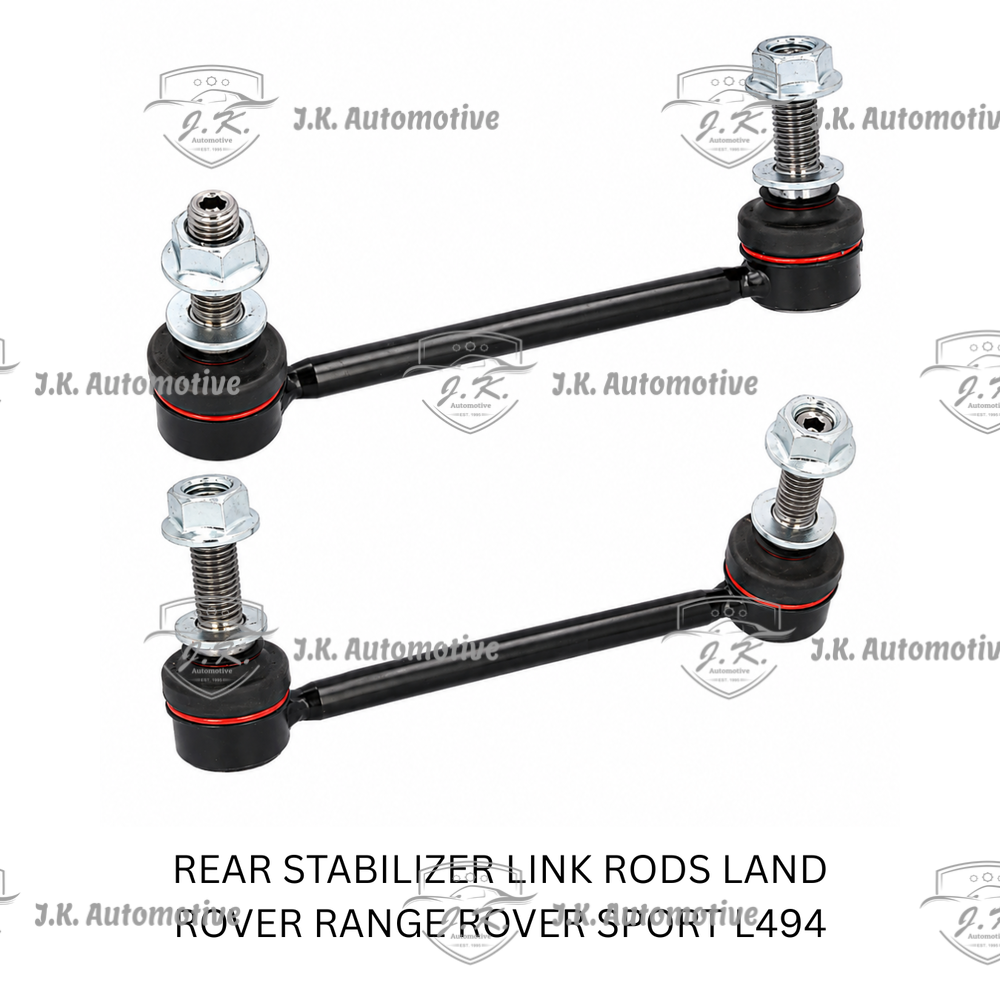
The Range Rover Sport L494 Rear Stabilizer Link Rod Set from Stokes Germany is supplied as a complete Set of 2 rear suspension components with OEM references LR042976 & LR042975 for the Land Rover Range Rover Sport L494. These components form part of the rear stabilizer or anti-roll bar system and provide an important mechanical connection between the rear suspension and stabilizer bar. The set contains the corresponding rear links required for the applicable left and right positions, allowing the stabilizer system to transfer suspension forces as the rear wheels move independently over changing road surfaces. During normal driving, the left and right rear wheels do not always experience identical suspension movement. When the Range Rover Sport L494 enters a corner, crosses an uneven surface or encounters a road irregularity on only one side, the suspension on each side can compress or extend by different amounts. The rear stabilizer links articulate as this movement occurs and transfer mechanical forces into the anti-roll bar system, allowing the stabilizer arrangement to perform its intended function. These components are therefore continuously active during everyday driving rather than operating only during aggressive cornering. Potholes, speed breakers, broken roads, expansion joints, rough surfaces and repeated changes in road height create frequent suspension articulation and continuously load the stabilizer-link joints. Over time, mileage, vibration, environmental exposure and repeated mechanical loading can contribute to deterioration or excessive clearance within the joints. Once unwanted play develops, a worn link may begin producing knocking, clicking, tapping, clunking or rattling noises as the suspension repeatedly loads and unloads the component. These parts may also be described as Sway bar links, Sway links, Anti roll link rods, Stabiliser sway links, rear drop links or rear anti-roll bar links. Regardless of the terminology used, their function remains to connect the applicable rear suspension points with the stabilizer bar. The stabilizer links should not be confused with rear control arms because control arms perform wheel-locating functions, whereas stabilizer links primarily transfer forces into the anti-roll bar system. Consequently, worn stabilizer links can affect the consistency of the stabilizer connection but should not automatically be diagnosed as the cause of every suspension noise or handling complaint. Rear control arms, suspension bushes, anti-roll bar bushes, shock absorbers, suspension mounts, wheel bearings, tyres and wheels can produce similar symptoms. Professional diagnosis is therefore recommended before replacement. For this Stokes Germany product, OEM references LR042976 & LR042975 should be compared with the original components and vehicle VIN before ordering to confirm the exact application.
What is included in the Stokes Germany Rear Stabilizer Link Rod Set of 2 for Land Rover Range Rover Sport L494?
The Stokes Germany Range Rover Sport L494 Rear Stabilizer Link Rod Set is supplied as a complete Set of 2 corresponding rear stabilizer link rods using OEM references LR042976 & LR042975, providing the two components required for the applicable left and right rear positions when both links require replacement. Unlike stabilizer-link applications where the same part number is used on both sides, this Range Rover Sport L494 rear application uses two distinct OEM references for the corresponding rear positions. LR042976 and LR042975 should therefore both be retained when identifying, listing or ordering the complete Set of 2 because they represent the two relevant rear stabilizer-link references. The components operate within the same rear anti-roll bar system and articulate as the rear suspension responds to cornering forces, potholes, speed breakers, uneven roads and differences in vertical wheel movement. Supplying both links together as a Set of 2 is convenient when inspection confirms deterioration on both sides or when paired replacement is appropriate due to the condition and service history of the existing components. However, the Set of 2 should not be interpreted as a complete rear suspension kit. It specifically provides the corresponding rear stabilizer link rods and does not automatically include rear control arms, control-arm bushes, anti-roll bar mounting bushes, shock absorbers, suspension mounts, wheel bearings or other surrounding suspension components. These associated components should nevertheless be inspected during diagnosis because several of them can produce knocking, clunking or rattling similar to worn stabilizer links. Both rear links operate on the same vehicle and experience the same overall vehicle mileage, although their individual wear rates can differ because the left and right wheels may encounter different potholes, road edges and impacts. If one link develops excessive joint play, the opposite component should therefore be inspected rather than automatically assumed to be defective or automatically assumed to remain in perfect condition. The terms Sway bar links, Sway links, Anti roll link rods, Stabiliser sway links and rear drop links may all be encountered when searching for these components. Regardless of terminology, OEM references LR042976 & LR042975, the Rear position, the Range Rover Sport L494 application and vehicle VIN should be checked before ordering. Once fitment and the need for replacement have been confirmed, the Stokes Germany Set of 2 provides the corresponding rear stabilizer links together for servicing the applicable rear anti-roll bar system.
What are the common symptoms of worn Range Rover Sport L494 rear stabilizer link rods?
Common symptoms of worn Range Rover Sport L494 rear stabilizer link rods can include knocking, clicking, tapping, clunking or rattling noises from the rear suspension, particularly when travelling over potholes, broken roads, expansion joints, speed breakers, smaller bumps or uneven surfaces where the rear suspension repeatedly moves through compression and extension. Stabilizer link rods contain articulated joint areas that continuously change position as the suspension operates, and repeated movement combined with road impact, vibration, mileage and environmental exposure can gradually create wear or excessive clearance. Once unwanted movement develops within a stabilizer-link joint, changing suspension loads can cause the worn joint to move or knock as the component repeatedly loads and unloads. The noise can sometimes be especially noticeable at relatively low speeds over smaller road irregularities because these surfaces produce frequent short suspension movements that repeatedly change the direction of force through the rear stabilizer links. The same vehicle may appear considerably quieter when travelling on a smooth road because the suspension experiences less rapid articulation. Worn Sway bar links, Sway links, Anti roll link rods or Stabiliser sway links can also reduce the consistency of the mechanical connection between the rear suspension and anti-roll bar system. However, the presence of knocking or rattling does not automatically confirm that LR042976 & LR042975 are defective. Rear anti-roll bar bushes, control arms, suspension bushes, shock absorbers, suspension mounts, wheel bearings and other components can produce similar noises. Vibration should also be diagnosed separately because tyre damage, wheel imbalance, wheel-bearing deterioration and other rotating or suspension components can produce vibration that is unrelated to stabilizer-link wear. Uneven tyre wear is not normally a direct consequence of worn rear stabilizer link rods because the links do not directly establish the vehicle's primary rear wheel-alignment geometry. If irregular tyre wear is present, tyre pressure, wheel condition, wheel alignment and the condition of wheel-locating suspension components should be inspected. A professional technician should therefore examine both rear stabilizer links for excessive joint movement, looseness, damaged protective components or deterioration while simultaneously inspecting the surrounding rear suspension. If excessive wear is positively identified in the stabilizer links and OEM references LR042976 & LR042975 correspond with the vehicle, replacement with the Stokes Germany Set of 2 can restore a secure mechanical connection within the rear anti-roll bar system. Any noise, vibration or irregular tyre wear remaining after replacement should then be diagnosed independently rather than assuming that installation of new stabilizer links will correct an unrelated suspension, wheel or tyre problem.
Why should worn rear stabilizer link rods be replaced on a Range Rover Sport L494?
Worn rear stabilizer link rods should be replaced on a Range Rover Sport L494 when professional inspection confirms excessive joint play, looseness, deterioration or damage because these components provide an active mechanical connection within the rear anti-roll bar system. During normal road use, the stabilizer links repeatedly articulate as the rear wheels move vertically and as the vehicle experiences cornering forces, potholes, speed breakers, broken roads, expansion joints and other changes in road surface. When the link joints are in serviceable condition, they maintain a secure connection while permitting the articulation required by suspension movement. As deterioration develops, excessive clearance can allow unwanted movement within the joints. This movement may produce knocking, clicking, tapping, rattling or clunking whenever suspension loads repeatedly change direction. Replacing a correctly diagnosed worn Range Rover Sport L494 Rear Stabilizer Link Rod Set restores the secure mechanical connection between the relevant rear suspension points and anti-roll bar system, helping eliminate unwanted movement originating specifically from worn stabilizer-link joints. However, replacement should not be treated as a universal solution for every rear suspension noise or handling concern. A worn anti-roll bar bush, control-arm bush, shock absorber, suspension mount, wheel bearing or another rear suspension component can produce similar symptoms, while tyre and wheel problems can contribute to vibration. For this reason, the actual defective component should be identified before replacement rather than changing stabilizer links solely because a noise is present. Both rear links should be inspected because they operate within the same stabilizer system and experience the same total vehicle mileage, although one component may deteriorate earlier because each rear wheel encounters different road impacts. When both links have excessive play or comparable deterioration, replacing the complete Set of 2 provides a practical paired repair. OEM references LR042976 & LR042975 should be compared with the original components and VIN-based vehicle information before installation. The technician should also inspect the rear anti-roll bar bushes and surrounding suspension components during replacement because installing new stabilizer links cannot eliminate noise caused by another worn component. Once correct fitment and actual link deterioration have been confirmed, replacing the worn Stokes Germany stabilizer links restores the intended mechanical connection within the rear stabilizer arrangement while allowing the surrounding suspension to be inspected for any additional repair requirements.
How can I confirm that OEM numbers LR042976 & LR042975 are correct for my Land Rover Range Rover Sport L494?
The safest method of confirming whether OEM references LR042976 & LR042975 are correct for a Land Rover Range Rover Sport L494 is to compare the references with the original rear stabilizer-link components and confirm the vehicle application using the VIN and exact suspension specification before ordering. These two OEM numbers are important because this application uses corresponding references for the two rear positions rather than one identical number for both sides. LR042976 is catalogued for the Rear Left position and LR042975 for the Rear Right position, so both references should be retained when identifying the complete Set of 2. This left-right distinction is particularly important when ordering individual components, while customers purchasing the Stokes Germany Set of 2 receive the corresponding pair together. Product terminology can vary significantly between catalogues and sellers. The components may be called rear stabilizer links, rear anti-roll bar links, Sway bar links, Sway links, Anti roll link rods, Stabiliser sway links or rear drop links. Consequently, OEM-number verification is considerably more useful than relying solely on the wording of a product title. Before purchase, compare LR042976 & LR042975 with the original component information, confirm that the required suspension position is Rear and use VIN-based vehicle information wherever possible. The physical mounting arrangement and corresponding left-right application should also match the original components. The Stokes Germany product is supplied as a complete Set of 2 using OEM references LR042976 & LR042975 for the applicable Range Rover Sport L494 rear stabilizer-link positions. Customers should not select the parts solely because they visually resemble another Land Rover stabilizer link because several Land Rover models and suspension configurations can use components that appear similar while carrying different references or applications. VIN confirmation becomes particularly valuable when different suspension systems or vehicle specifications exist within the same model family. If the OEM references, rear positions, physical configuration and VIN-based application correspond correctly, the replacement set can be selected with substantially greater confidence. If any discrepancy exists between the original components, vehicle information and supplied references, the difference should be resolved before ordering or installation rather than assuming compatibility based solely on the Range Rover Sport L494 model designation.
Is wheel alignment required after replacing the Range Rover Sport L494 Rear Stabilizer Link Rod Set?
Wheel alignment is not normally required solely because the Range Rover Sport L494 Rear Stabilizer Link Rod Set has been replaced, provided that only the rear stabilizer link rods are removed and installed and no wheel-locating or alignment-adjustable suspension components are disturbed during the repair. Stabilizer links perform a different mechanical function from control arms and other suspension components that directly establish wheel position and alignment geometry. Their primary function is to connect the relevant rear suspension points with the anti-roll bar system and transfer stabilizer forces as the left and right rear wheels experience different amounts of suspension movement. Consequently, replacing Sway bar links, Sway links, Anti roll link rods, Stabiliser sway links or rear drop links alone does not normally alter the fundamental rear wheel-alignment settings. Nevertheless, suspension repair provides a useful opportunity to inspect the complete rear suspension, particularly when the vehicle originally entered the workshop because of noise, vibration, irregular tyre wear or changes in driving behaviour. If rear control arms, adjustable links, suspension bushes or other wheel-locating components are replaced or disturbed during the same repair, a professional wheel-alignment check is advisable because those components can influence wheel geometry. Alignment should also be investigated if the Range Rover Sport L494 already displays irregular tyre wear, vehicle pull or other symptoms associated with incorrect geometry. Replacing stabilizer links cannot correct an existing alignment problem caused by worn wheel-locating components, suspension damage or incorrect previous adjustment. During installation of the Stokes Germany Set of 2 with OEM references LR042976 & LR042975, the technician should inspect the rear anti-roll bar bushes, control arms, suspension bushes, shock absorbers, suspension mounts, wheel bearings, tyres and wheels. The new stabilizer links should be installed according to the appropriate vehicle-specific repair procedure and applicable tightening specifications. If only the two rear stabilizer links are replaced and no geometry-setting components are disturbed, wheel alignment is generally not required solely because of this repair. If additional wheel-locating components are serviced or existing alignment symptoms are present, a professional alignment inspection should be performed so that any separate geometry problem can be identified and corrected.
Can worn Range Rover Sport L494 rear stabilizer link rods cause knocking, rattling, vibration or uneven tyre wear?
Worn Range Rover Sport L494 rear stabilizer link rods can commonly contribute to knocking, clicking, tapping, clunking or rattling noises from the rear suspension, particularly when the vehicle travels over potholes, speed breakers, broken roads, expansion joints, smaller bumps or uneven surfaces where the rear wheels repeatedly move through compression and extension. The stabilizer link rods contain articulated joint areas that continuously move as the rear suspension operates, and repeated movement combined with road impact, vibration, dirt, moisture and vehicle mileage can gradually create wear or excessive clearance within these joints. Once unwanted play develops, changing suspension loads can allow movement within a worn link, creating an audible knock or rattle whenever the suspension repeatedly loads and unloads the anti-roll bar system. These noises can become especially noticeable at lower speeds over smaller road irregularities because the rear suspension experiences frequent short movements that repeatedly change the direction of force through the stabilizer links. The same Range Rover Sport L494 may appear considerably quieter on a smooth road where the suspension experiences less rapid articulation. Worn Sway bar links, Sway links, Anti roll link rods or Stabiliser sway links can also reduce the consistency of the mechanical connection between the rear suspension and anti-roll bar system. However, vibration should not automatically be attributed to LR042976 & LR042975 because damaged tyres, wheel imbalance, wheel-bearing deterioration, shock absorbers, suspension bushes and other mechanical conditions can also produce vibration. Uneven tyre wear is likewise not normally a direct consequence of worn rear stabilizer links because these components do not directly establish the primary rear wheel-alignment geometry. If abnormal tyre wear is present, tyre pressure, tyre condition, wheel condition, rear wheel alignment and wheel-locating suspension components such as rear control arms and their bushes should be investigated. Multiple suspension components can also deteriorate simultaneously, so discovering excessive play in one stabilizer link does not eliminate the need to inspect the rest of the rear suspension. A professional technician should therefore inspect both stabilizer links for excessive joint movement, looseness or deterioration while also checking the anti-roll bar bushes, rear control arms, suspension bushes, shock absorbers, suspension mounts, wheel bearings, tyres and wheels. When the stabilizer links are positively diagnosed as the source of knocking or rattling and OEM references LR042976 & LR042975 correspond with the vehicle, replacement with the Stokes Germany Set of 2 can restore a secure mechanical connection within the rear anti-roll bar system. Any vibration, irregular tyre wear or remaining suspension noise should then be diagnosed independently rather than assuming that replacement of the stabilizer links will correct an unrelated mechanical or alignment problem.
Should Range Rover Sport L494 rear stabilizer link rods be replaced as a complete Set of 2?
Replacing Range Rover Sport L494 rear stabilizer link rods as a complete Set of 2 can be a practical repair approach when professional inspection confirms deterioration on both corresponding rear positions or when both links have accumulated similar mileage and show comparable wear. The Stokes Germany Range Rover Sport L494 Rear Stabilizer Link Rod Set is supplied as a complete Set of 2 using OEM references LR042976 & LR042975, providing the corresponding rear stabilizer links together for servicing the applicable rear anti-roll bar system. Both rear links operate within the same suspension system and experience the same total vehicle mileage, although they do not necessarily wear at exactly the same rate because each rear wheel can encounter different potholes, road edges, impacts and suspension loads. Consequently, one stabilizer link may develop excessive play or become noisy before the opposite side. If one link is confirmed defective, the corresponding link on the opposite side should therefore be inspected carefully rather than automatically assumed to be defective or automatically assumed to remain in perfect condition. When both components have measurable joint play, damaged protective areas or comparable deterioration, replacing the complete Set of 2 provides a convenient paired repair and avoids sourcing the second corresponding component separately. Paired replacement may also be practical on a higher-mileage vehicle where both original links have experienced similar service conditions. However, purchasing a Set of 2 does not mean that every rear suspension component should automatically be replaced. Rear control arms, suspension bushes, anti-roll bar mounting bushes, shock absorbers, suspension mounts and wheel bearings are separate components and should be assessed according to their actual condition. Before installation, OEM references LR042976 & LR042975 should be compared with the original components and reliable VIN-based vehicle information. The required rear positions and mounting configurations should also be verified. These components may be described as Sway bar links, Sway links, Anti roll link rods, Stabiliser sway links, anti-roll bar links or rear drop links, but the terminology does not change the need for accurate fitment verification. When both rear stabilizer links require replacement and the OEM references correspond with the vehicle, the Stokes Germany Set of 2 provides the corresponding pair together for a complete stabilizer-link replacement across the relevant rear positions.
Are OEM references LR042976 & LR042975 correct and relevant for the Range Rover Sport L494 Rear Stabilizer Link Rod Set?
OEM references LR042976 & LR042975 are relevant identification references for the Range Rover Sport L494 rear stabilizer-link application and are therefore important when selecting the correct Range Rover Sport L494 Rear Stabilizer Link Rod Set. These two references correspond to the rear anti-roll bar link arrangement and should both be retained in the product information because the application uses separate references for the corresponding rear positions rather than one identical reference for both links. Automotive catalogues may describe these components using several different terms, including rear stabilizer links, rear anti-roll bar links, rear drop links, Sway bar links, Sway links, Anti roll link rods or Stabiliser sway links, making the OEM references particularly useful when identifying the correct replacement parts. Before ordering, customers should compare LR042976 & LR042975 with the original component information and confirm the application using the vehicle VIN because exact suspension specification and vehicle configuration should always be checked before installation. The required Rear position and physical mounting arrangement should also correspond with the existing components. Customers should avoid selecting replacement links purely on visual similarity because stabilizer links for different Land Rover models or suspension positions can look similar while carrying different OEM references or dimensions. The Stokes Germany product is supplied as a complete Set of 2 with both LR042976 & LR042975 represented in the product application, providing the corresponding pair together. These OEM numbers can also be useful when comparing products from different aftermarket manufacturers because each manufacturer may assign its own unique catalogue number while cross-referencing the applicable Land Rover OE numbers. Correct OEM-reference matching, however, should still be combined with VIN verification rather than treated as the only fitment criterion. If the original component references, Rear position, mounting configuration and VIN-based application correspond correctly, LR042976 & LR042975 provide a strong basis for identifying the required replacement set. If any discrepancy exists between the vehicle, original components and supplied product information, the difference should be resolved before ordering or installation rather than assuming compatibility solely because the vehicle belongs to the Range Rover Sport L494 model family.
Why is professional installation recommended for the Range Rover Sport L494 Rear Stabilizer Link Rod Set, and is wheel alignment required?
Professional installation is recommended for the Range Rover Sport L494 Rear Stabilizer Link Rod Set because suspension components should be fitted according to the appropriate vehicle-specific repair procedure, using suitable tools and applicable tightening specifications while the surrounding rear suspension is inspected for additional deterioration that could produce symptoms similar to worn stabilizer links. Although rear stabilizer link rods may appear mechanically straightforward, they operate continuously within the anti-roll bar system and experience repeated articulation, vibration, road impact and changing suspension loads. Incorrect installation, unsuitable tightening, damaged mounting points or failure to identify another worn suspension component can result in continued knocking or rattling even after new links have been installed. Before replacement, a professional technician should inspect the existing LR042976 & LR042975 links for excessive joint movement, looseness, deterioration or damaged protective areas to confirm that they are actually responsible for the reported symptoms. During replacement, the technician should also examine the rear anti-roll bar bushes, control arms, suspension bushes, shock absorbers, suspension mounts, wheel bearings, tyres and wheels because deterioration in these components can produce similar noise or vibration. Regarding wheel alignment, replacing only the Range Rover Sport L494 Rear Stabilizer Link Rod Set does not normally alter primary wheel-alignment geometry because stabilizer links connect the suspension with the anti-roll bar rather than directly establishing rear wheel camber or toe. Therefore, replacement of only the Sway bar links, Sway links, Anti roll link rods or Stabiliser sway links does not normally make wheel alignment mandatory. However, a professional alignment check becomes advisable if rear control arms, adjustable links, suspension bushes or other wheel-locating components are replaced or disturbed during the same repair. Alignment should also be investigated if the vehicle already exhibits uneven tyre wear, vehicle pull or another symptom associated with incorrect wheel geometry. Replacement of the stabilizer links cannot correct an existing alignment fault caused by worn wheel-locating components, suspension damage or incorrect previous adjustment. Professional installation therefore provides more than simply fitting two new link rods; it allows the technician to confirm the diagnosis, correctly install LR042976 & LR042975, inspect the surrounding suspension and determine whether any additional repair or wheel-alignment work is necessary.
Why is Stokes Germany a European-quality alternative to Lemförder, FEBI, Meyle and other established brands for the Range Rover Sport L494 Rear Stabilizer Link Rod Set?
Stokes Germany can be considered an aftermarket replacement option when comparing products for the Range Rover Sport L494 Rear Stabilizer Link Rod Set, while a technically useful comparison with established suspension brands such as Lemförder, FEBI, Meyle and other manufacturers should focus on objective factors including correct OEM cross-reference, left and right application, package quantity, component configuration, warranty, availability, seller support and overall repair value rather than assuming that products from different manufacturers are mechanically identical or that one brand is automatically superior to another. For this Stokes Germany application, the product is supplied as a complete Set of 2 using OEM references LR042976 & LR042975, allowing customers and workshops to compare the supplied references directly with the original vehicle components and VIN-based parts information before ordering. The first consideration when comparing any stabilizer-link brand should always be accurate fitment because even a premium replacement component is unsuitable if the OEM reference, rear position or mounting configuration does not correspond with the vehicle. The next consideration is package quantity because this Stokes Germany product supplies the corresponding rear links together as a Set of 2, which can be convenient when both sides require replacement. Warranty terms, availability in India, seller assistance, replacement support and total repair cost are additional practical factors that can influence the purchasing decision. Lemförder, FEBI, Meyle and other established manufacturers each use their own engineering specifications, materials, production arrangements, quality-control systems and warranty policies, and Stokes Germany should likewise be evaluated according to the specifications and support provided for the actual product being purchased. It would therefore be inappropriate to state without specific supporting evidence that Stokes Germany is identical to, manufactured by the same supplier as, or automatically better than Lemförder, FEBI, Meyle or a genuine Land Rover component. Instead, customers should compare objectively verifiable product information and confirm LR042976 & LR042975 against the original components and VIN, verify the required Rear positions, check package contents and warranty conditions and use professional installation. The surrounding rear suspension must also be considered because correctly fitted new stabilizer links cannot eliminate knocking caused by worn anti-roll bar bushes, control arms, suspension bushes, shock absorbers, suspension mounts or wheel bearings. Customers may encounter these components under terms such as Sway bar links, Sway links, Anti roll link rods, Stabiliser sway links or rear drop links, so OEM-reference matching remains particularly useful when comparing different catalogue descriptions. When the Range Rover Sport L494 application, OEM references LR042976 & LR042975, required rear positions, Set of 2 configuration and physical fitment have all been confirmed, the Stokes Germany Rear Stabilizer Link Rod Set can be evaluated alongside Lemförder, FEBI, Meyle and other established aftermarket alternatives according to fitment, package contents, warranty, availability, seller support and overall repair value.

Reviews
There are no reviews yet.