What are Lemförder Germany Front Stabilizer Sway Bar Link Rods for Mercedes-Benz GLE W166, and why are they important for suspension performance?
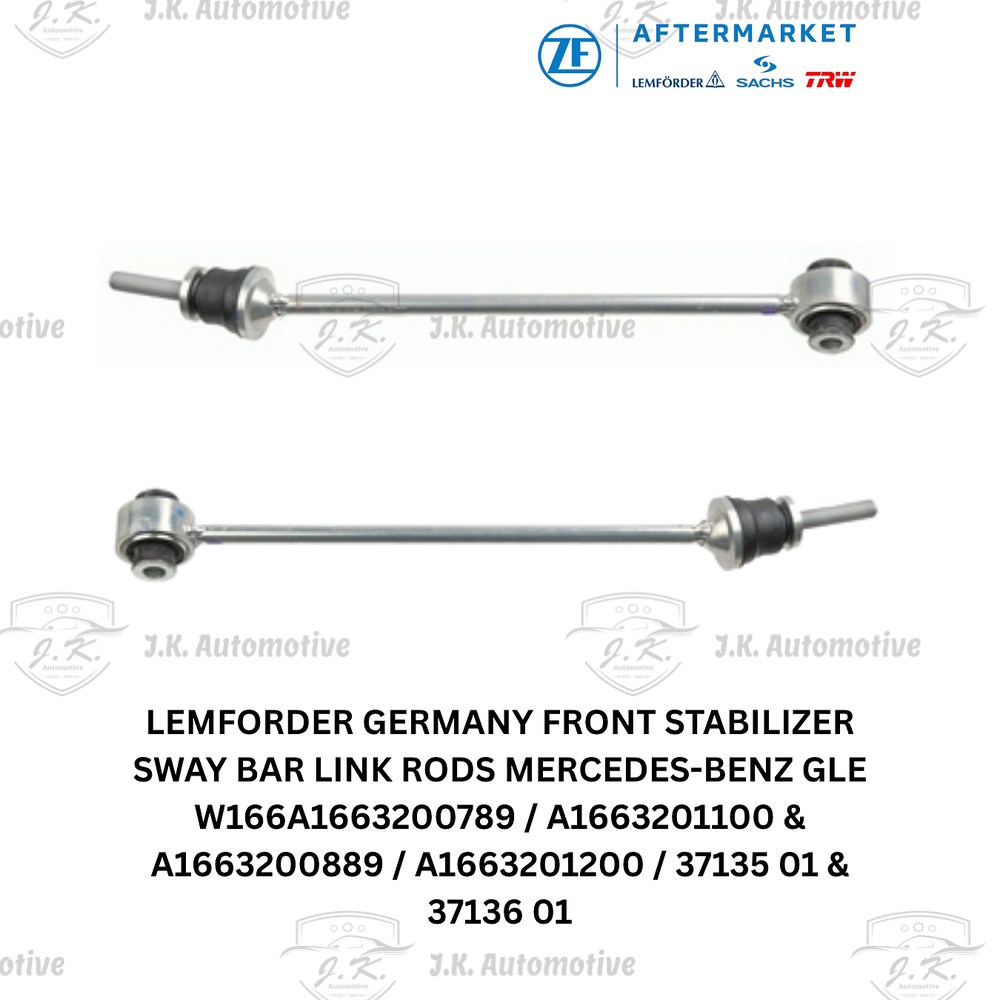
Lemförder Germany Front Stabilizer Sway Bar Link Rods for Mercedes-Benz GLE W166 are important suspension components designed to maintain the correct mechanical connection between the front stabilizer bar and the vehicle's suspension system, helping the Mercedes-Benz GLE W166 maintain controlled handling, stability, and comfortable driving characteristics under different road conditions. The front stabilizer sway bar link rods play an essential role in supporting the anti-roll bar system, which helps manage excessive body roll when the vehicle turns, changes direction, or travels through uneven road surfaces. The Mercedes-Benz GLE W166 is a premium luxury SUV with a substantial body structure, sophisticated suspension engineering, and handling characteristics designed to balance comfort with road stability. Because of these characteristics, maintaining properly functioning stabilizer link rods is particularly important for preserving predictable suspension behaviour. Lemförder 37135 01 and Lemförder 37136 01 are designated front stabilizer link rod references for the applicable left and right suspension applications. The corresponding Mercedes-Benz OEM references include A1663200789, A1663201100, A1663200889, and A1663201200, which should be checked against the vehicle's original parts specification before installation. These components operate by transferring forces between the stabilizer bar and suspension through articulated connections that accommodate normal wheel movement. When the vehicle enters a corner, the suspension experiences changes in loading between the inner and outer wheels, and the anti-roll bar helps resist differences in suspension movement between the two sides. The stabilizer link rods are essential to this process because they provide the mechanical connection through which these forces are transmitted. Properly functioning stabilizer links help the anti-roll bar operate as intended and support the overall handling balance engineered into the vehicle. During normal driving, the front suspension continuously responds to bumps, potholes, speed breakers, changes in road level, and other surface irregularities. The ball joints incorporated into the stabilizer link assemblies allow controlled articulation as the suspension moves through its designed range. When these joints remain in good condition, the links can transmit forces without excessive unwanted movement. However, repeated suspension operation, exposure to water, dirt, road contamination, and general wear can gradually affect the condition of the joints. As wear increases, the components may develop looseness that results in knocking, rattling, or clicking sounds from the front suspension. Excessive joint play can also interfere with the effectiveness of the stabilizer bar connection and may contribute to changes in suspension response. Replacing defective links with appropriately specified Lemförder components helps restore the intended mechanical connection and eliminate noise directly associated with worn link joints. Lemförder is a well-established suspension and steering component brand associated with ZF, a major automotive technology supplier. The brand offers replacement suspension components developed for numerous European vehicle applications, making it a recognised option for Mercedes-Benz suspension maintenance. Correct component selection is particularly important because stabilizer links can differ according to mounting position and vehicle application despite having similar appearances. The correct left and right references should therefore be identified before purchasing or installation. Technicians should also inspect nearby components, including control arm bushes, anti-roll bar bushes, steering joints, and suspension mounting hardware, because defects in these components can produce similar symptoms. Installing correctly specified components using appropriate repair procedures helps maintain the designed operating range of the stabilizer bar system. Although stabilizer links are only one part of the complete suspension assembly, their condition contributes directly to the proper mechanical operation of the front anti-roll bar. For Mercedes-Benz GLE W166 owners seeking reliable suspension maintenance, Lemförder Germany front stabilizer sway bar link rods provide a suitable replacement option when their part numbers and OEM applications are confirmed for the vehicle, helping maintain suspension refinement, predictable cornering behaviour, and the intended driving characteristics of this luxury SUV.
What are the common symptoms of worn or damaged front stabilizer sway bar link rods in Mercedes-Benz GLE W166?
Worn or damaged front stabilizer sway bar link rods in the Mercedes-Benz GLE W166 can cause several symptoms that affect suspension refinement, handling consistency, and the overall driving experience, making early identification important for maintaining the vehicle's mechanical condition. One of the most frequently reported symptoms is a knocking or clunking sound from the front suspension when the vehicle passes over potholes, uneven roads, speed breakers, or rough surfaces. This noise commonly develops when the ball joints inside the stabilizer link rods experience excessive wear and allow movement beyond their intended clearance. Under normal conditions, these joints accommodate suspension articulation while maintaining a controlled mechanical connection to the stabilizer bar. When internal wear increases, unwanted movement can occur between the joint components, producing audible sounds as the suspension responds to road irregularities. Another common symptom is a rattling or tapping sound that becomes more noticeable during low-speed driving over uneven surfaces. Some drivers may hear these noises when entering parking areas, moving across driveway ramps, or travelling along roads with numerous small bumps. The sound can sometimes appear to originate from the front-left or front-right wheel area, although noise may travel through the chassis and make the actual location difficult to determine without physical inspection. Worn stabilizer links may also contribute to changes in the vehicle's handling response because an excessively loose connection can reduce the effectiveness of the anti-roll bar system. The Mercedes-Benz GLE W166 has a relatively high centre of gravity compared with a conventional passenger car, making controlled body movement an important part of its suspension design. If a stabilizer link becomes severely worn or disconnected, the anti-roll bar may not transmit forces as intended, potentially affecting body roll characteristics during cornering. However, it is important to recognise that excessive body roll can also result from other suspension defects and is not conclusive evidence of a damaged link rod. Another indication of possible stabilizer link deterioration is visible damage to the protective rubber boots surrounding the ball joints. These boots help retain the joint's internal lubricant and restrict the entry of moisture, dirt, and road contamination. When a boot develops cracks, tears, or becomes displaced, contaminants can enter the joint and accelerate wear. Corrosion around the joint or mounting area may indicate prolonged exposure to moisture or damaged protective components. During suspension inspection, a qualified technician may check for excessive movement at the link rod joints and examine the mounting hardware for looseness or damage. The stabilizer link should not exhibit abnormal play that indicates deterioration beyond the manufacturer's acceptable condition. In some cases, the technician may reproduce the reported noise by applying an appropriate inspection method to the stabilizer connection while the suspension is positioned safely. However, the presence of front suspension knocking does not automatically mean that the stabilizer links are defective. Similar symptoms can be produced by worn control arm bushes, ball joints, anti-roll bar mounting bushes, strut mounts, steering components, or other suspension parts. Therefore, an accurate diagnosis should be completed before replacement parts are ordered. For the applicable Mercedes-Benz GLE W166 fitments, Lemförder 37135 01 and Lemförder 37136 01 identify the relevant front-left and front-right stabilizer link applications. The listed Mercedes-Benz OEM references include A1663200789, A1663201100, A1663200889, and A1663201200. These references should be matched with the vehicle's original equipment specification through an appropriate catalogue or VIN check. When the links are confirmed to be defective, replacement with correctly specified components can help resolve noises directly caused by worn link joints and restore the intended stabilizer connection. Technicians should also examine both sides because the links operate in the same front suspension environment and may experience similar wear conditions. A road test after installation can help determine whether the original noise has been eliminated and whether further suspension investigation is necessary. Addressing confirmed stabilizer link problems in a timely manner is a sensible maintenance measure for Mercedes-Benz GLE W166 owners who want to preserve quiet suspension operation, predictable handling, and the comfort expected from a premium luxury SUV.
What is the difference between Lemförder 37135 01 and Lemförder 37136 01 front stabilizer link rods for Mercedes-Benz GLE W166?
The primary difference between Lemförder 37135 01 and Lemförder 37136 01 front stabilizer sway bar link rods for the Mercedes-Benz GLE W166 is their designated mounting position within the front suspension system, with each component identified by a separate manufacturer part number for its specific application. Lemförder 37135 01 is identified as the front-left stabilizer link rod, while Lemförder 37136 01 is identified as the corresponding front-right stabilizer link rod for the relevant vehicle specification. Although both components serve the same mechanical purpose, they should not automatically be treated as interchangeable because suspension components can have side-specific mounting arrangements, joint orientations, or application requirements. Lemförder 37135 01 is associated with Mercedes-Benz OEM references A1663200789 and A1663201100, while Lemförder 37136 01 is associated with Mercedes-Benz OEM references A1663200889 and A1663201200. These original equipment reference numbers are particularly important when confirming which component is required for the vehicle. The Mercedes-Benz GLE W166 uses an engineered front suspension arrangement in which the anti-roll bar works with the suspension system to control differences in movement between the front wheels. The stabilizer links provide the connection through which the anti-roll bar transmits its forces during suspension articulation and cornering. When the vehicle turns, the anti-roll bar resists relative suspension movement between the left and right sides, helping manage the vehicle's body roll characteristics. Both stabilizer links therefore work together as part of the same overall system, although each is installed at its respective suspension mounting position. The left-side link must be selected according to the designated left-side part reference, and the right-side link must be selected according to the corresponding right-side reference. Purchasing the wrong link rod can lead to incorrect fitment, mounting difficulties, or incompatibility with the vehicle's intended suspension arrangement. Even when two replacement parts look similar in product photographs, their actual installation requirements may differ. Customers should therefore verify manufacturer part numbers rather than selecting components solely according to their visual appearance. Another important consideration is the possibility of different original equipment references across vehicle variants or production specifications. A Mercedes-Benz model designation alone may not provide enough information to confirm compatibility in every situation. Using the vehicle identification number helps parts specialists determine which OEM reference is applicable to the exact vehicle. If a customer intends to replace only one stabilizer link, the damaged side must first be identified through proper inspection. A defective front-left link should be replaced using the correct left-side component, while a defective front-right link should be replaced using the correct right-side component. When both sides show signs of wear, purchasing the matching left and right components together may be a convenient maintenance choice. However, both links do not necessarily require replacement simply because one has failed, and the final decision should depend on their physical condition and the technician's findings. During installation, the correct mounting locations and fastening instructions must be followed to avoid damaging the new components. Stabilizer link ball joints should be secured using appropriate techniques, and their protective boots should remain undamaged throughout the procedure. Technicians should also inspect the anti-roll bar mounting points and adjacent suspension components for signs of abnormal wear. Following replacement, the stabilizer links should move through their intended articulation range without interference or binding. Correctly installed links help maintain the mechanical relationship between the suspension and front anti-roll bar. For buyers comparing Lemförder 37135 01 and 37136 01, the most important purchasing consideration is not simply which part is available but which reference corresponds to the required side and original Mercedes-Benz application. Confirming the appropriate Lemförder number, matching OEM reference, installation side, and vehicle VIN helps prevent costly ordering errors and supports accurate front suspension maintenance for the Mercedes-Benz GLE W166.
How do Lemförder Germany front stabilizer sway bar link rods improve handling, cornering stability, and ride comfort in Mercedes-Benz GLE W166?
Lemförder Germany front stabilizer sway bar link rods help maintain the intended handling characteristics, cornering stability, and suspension refinement of the Mercedes-Benz GLE W166 by supporting the correct operation of the front anti-roll bar system, which is an important part of the vehicle's suspension design. The Mercedes-Benz GLE W166 is a premium SUV engineered to combine comfortable road travel with controlled body movement and predictable responses when navigating curves, bends, and changing road conditions. Because the vehicle has a substantial body weight and a relatively high centre of gravity, the suspension system must manage body movement effectively to preserve balanced road behaviour. During cornering, lateral acceleration causes the vehicle body to roll toward the outside of the turn, creating different suspension loading conditions between the inner and outer wheels. The front anti-roll bar helps oppose the difference in suspension movement between the two sides and therefore contributes to controlling body roll. The stabilizer sway bar link rods connect this anti-roll bar to the relevant suspension mounting points, allowing forces to be transmitted through articulated joints as the suspension moves. Lemförder 37135 01 and Lemförder 37136 01 are the corresponding front-left and front-right link rod references for their applicable Mercedes-Benz GLE W166 configurations. When installed correctly and matched to the vehicle's original specifications, these components help maintain the mechanical connection required for proper anti-roll bar operation. The articulated joints within the links allow normal suspension movement while maintaining a connection capable of transferring stabilizer forces. This is particularly important when the vehicle passes over uneven road surfaces where the left and right front wheels may experience different vertical movements. A properly functioning stabilizer link should accommodate these movements without developing excessive unwanted clearance or mechanical noise. As stabilizer link joints wear, internal looseness may begin to affect the consistency of the connection between the suspension and anti-roll bar. This can produce knocking or rattling noises and, when wear becomes severe, may interfere with the intended operation of the stabilizer system. Replacing worn components with correctly specified Lemförder links helps restore the designed mechanical connection and may eliminate noises caused specifically by defective link joints. The resulting improvement can be noticeable when driving over small bumps, potholes, uneven road surfaces, and driveway ramps that previously produced unwanted suspension sounds. Maintaining the anti-roll bar connection also helps support predictable suspension behaviour during steering inputs and direction changes. However, stabilizer links should not be confused with shock absorbers, springs, or suspension control arms because each component has a different mechanical function. Shock absorbers primarily control suspension oscillation, while springs support vehicle load and contribute to ride characteristics. Control arms and their joints guide wheel movement, and the anti-roll bar system helps resist differences in suspension movement between the two sides. The stabilizer links support the functioning of this anti-roll bar system rather than independently determining the vehicle's complete handling characteristics. Therefore, replacing stabilizer links cannot resolve every complaint involving body movement, poor ride comfort, or steering instability. Similar symptoms may result from deteriorated dampers, worn bushes, damaged suspension joints, tyre problems, or other mechanical issues. Proper fault diagnosis is essential before concluding that link replacement will improve the vehicle's driving behaviour. Lemförder is a recognised brand within the ZF aftermarket portfolio and supplies suspension and steering components for various European vehicle applications. Selecting the correct front stabilizer links is important because fitment requirements can vary according to vehicle specification. The relevant Mercedes-Benz OEM references A1663200789, A1663201100, A1663200889, and A1663201200 should be checked against the original vehicle specification before purchasing. Following installation, a technician should verify proper fastening, component clearance, and freedom of movement throughout the applicable suspension range. A suitable road test can then be carried out to assess the outcome of the repair. For owners seeking to preserve the sophisticated driving characteristics of their Mercedes-Benz GLE W166, replacing genuinely worn stabilizer links with correctly specified Lemförder components is an important step toward maintaining reliable anti-roll bar operation, reducing unwanted suspension noise, and supporting the comfort and road stability expected from a well-maintained luxury SUV.
How can I confirm that Lemförder 37135 01 and 37136 01 are compatible with my Mercedes-Benz GLE W166 before purchasing?
Confirming the compatibility of Lemförder 37135 01 and Lemförder 37136 01 with a Mercedes-Benz GLE W166 before purchasing is essential because front stabilizer sway bar link rods must match the exact suspension application and original equipment specifications of the vehicle to ensure proper fitment and correct mechanical operation. The Mercedes-Benz GLE W166 model designation provides an important starting point for identifying the vehicle, but it should not be treated as the only factor when selecting suspension replacement parts. Different production specifications, suspension configurations, and original equipment references may influence which components are suitable for a particular vehicle. The most dependable method of confirming compatibility is to obtain the vehicle identification number, commonly known as the VIN, and use it to identify the original Mercedes-Benz suspension parts through a suitable manufacturer or professional aftermarket catalogue. The VIN helps establish the vehicle's relevant production information and original parts specification, allowing the correct references to be selected with greater confidence. For the front-left stabilizer link application, Lemförder 37135 01 is associated with Mercedes-Benz OEM numbers A1663200789 and A1663201100. For the front-right stabilizer link application, Lemförder 37136 01 is associated with Mercedes-Benz OEM numbers A1663200889 and A1663201200. Customers should compare these references with the OEM numbers listed for their specific vehicle rather than assuming that every GLE W166 uses identical components. It is also important to establish whether the required replacement is for the front-left side, front-right side, or both sides of the suspension system. If the original component remains installed, a workshop can inspect the part and check for available markings or identification numbers. However, the number printed on the removed component may represent an earlier original equipment reference, and any claimed supersession should be verified through reliable catalogue information. Customers should not assume that visually similar components are compatible because differences in mounting dimensions, joint orientation, or suspension application may not be obvious from photographs. Another important consideration is the exact product quantity being ordered. If a listing contains both Lemförder 37135 01 and Lemförder 37136 01, customers should confirm that the package includes one corresponding link for each side. If the parts are sold individually, the correct side and quantity must be selected separately. The installation position is particularly important because left-side and right-side stabilizer links should not be treated as interchangeable unless the component manufacturer expressly specifies this. Before completing the purchase, buyers can compare the Lemförder manufacturer references, Mercedes-Benz OEM references, vehicle model designation, and confirmed suspension application. When uncertainty remains, professional parts identification assistance should be obtained rather than relying on assumptions about compatibility. Customers purchasing through JK Automotive can provide their vehicle details and original equipment references so that the relevant part application can be reviewed before an order is placed. This can help reduce the risk of incorrect ordering, delayed workshop repairs, and unnecessary replacement-related expenses. The correct replacement should also be installed using suitable procedures and any manufacturer-specified mounting hardware. Technicians should inspect the surrounding suspension connections before installation because damaged anti-roll bar mounts or other defective components may need attention during the same repair. Once the links have been installed, the mounting positions and joint clearances should be checked to ensure the components operate within their intended range of movement. A visual inspection and appropriate road test may help confirm that the repair has addressed the reported symptoms. Although Lemförder offers replacement parts for numerous European vehicles, compatibility must always be established on the basis of the actual vehicle specification rather than brand reputation alone. Accurate identification is particularly important when purchasing online because returning an incorrectly selected suspension component can delay maintenance and increase overall repair costs. By carefully checking Lemförder 37135 01, Lemförder 37136 01, OEM A1663200789, OEM A1663201100, OEM A1663200889, and OEM A1663201200 against the vehicle's VIN and original part requirements, Mercedes-Benz GLE W166 owners can make a more informed purchasing decision and select the appropriate front stabilizer sway bar link rods for their vehicle.
Should I replace both front stabilizer sway bar link rods together in my Mercedes-Benz GLE W166, and what maintenance precautions should I follow?
Replacing both front stabilizer sway bar link rods together in a Mercedes-Benz GLE W166 can be a practical maintenance decision when both components exhibit wear or when their condition suggests that replacement of the complete pair would be beneficial, although it is important to understand that replacing both sides is not automatically required whenever one link becomes defective. The front stabilizer link rods connect the anti-roll bar to the appropriate suspension mounting points and work together to transmit forces through the front anti-roll bar system during vehicle movement. Since the left and right links operate under broadly similar environmental conditions, including exposure to road dust, moisture, potholes, speed breakers, and repeated suspension articulation, both may experience progressive wear over time. However, the actual wear condition of each component can vary depending on driving conditions, road impacts, corrosion, and previous maintenance history. One stabilizer link may develop excessive joint clearance while the opposite side remains in acceptable operating condition. For this reason, a qualified technician should inspect both front stabilizer links before deciding whether one component or the complete pair requires replacement. The inspection should include checking the articulated ball joints for excessive movement, examining the protective rubber boots for tears or displacement, assessing the mounting hardware, and identifying any signs of corrosion or physical damage. A damaged protective boot can allow dirt, water, and other contaminants to reach the internal joint surfaces, potentially accelerating wear and causing mechanical looseness. If both links are confirmed to be worn, replacing the left and right components during the same repair can reduce repeated workshop visits and restore both stabilizer connections at once. For the applicable Mercedes-Benz GLE W166 configuration, Lemförder 37135 01 is identified as the front-left stabilizer link, while Lemförder 37136 01 is identified as the front-right stabilizer link. The relevant Mercedes-Benz OEM references include A1663200789 and A1663201100 for the left side, along with A1663200889 and A1663201200 for the right side. These original equipment numbers should be verified against the vehicle's exact specification before the parts are ordered. If a replacement pair is purchased, the buyer should ensure that the listing includes the correct left and right components rather than two identical links intended for the same side. During the replacement procedure, the vehicle must be supported using appropriate lifting equipment and workshop safety practices. The technician should inspect the front anti-roll bar assembly, mounting bushes, suspension control arms, and nearby hardware to identify any additional defects that may be contributing to the reported symptoms. The original stabilizer links should be removed using appropriate tools and techniques that avoid damaging the surrounding suspension components. Particular care is necessary when loosening or tightening the link rod fasteners because uncontrolled rotation of a ball-joint stud can complicate removal or installation. The correct counterholding method should be used wherever required by the component design. Any manufacturer-specified replacement nuts or bolts should be installed according to the applicable repair instructions. Fasteners must be tightened using the correct torque values and procedures rather than relying on excessive force. The protective boots of the new ball joints should remain intact, and the installed links must have the necessary freedom of articulation throughout their normal operating range. Once replacement is complete, the technician should check the connections for proper mounting and ensure that there is no interference with other suspension components. A suitable road test may then be performed to assess whether the original knocking or rattling noises have been resolved. If suspension noise continues after installation, the vehicle should undergo further inspection because additional worn components may be responsible. Front stabilizer link replacement by itself does not normally alter wheel alignment settings, but an alignment check may be appropriate if other suspension parts have been disturbed or if the vehicle shows abnormal tyre wear or directional instability. Drivers should also avoid assuming that new stabilizer links will correct problems caused by worn shock absorbers, defective control arm bushes, steering joints, or damaged anti-roll bar mounting bushes. There is no universal replacement mileage applicable to all stabilizer links because their working life depends on numerous operating and environmental factors. Routine suspension inspections, especially after repeated travel on damaged or uneven roads, can help identify deterioration before it becomes more severe. For Mercedes-Benz GLE W166 owners, fitting correctly specified Lemförder front stabilizer sway bar link rods when replacement is justified by inspection helps maintain proper anti-roll bar function, reduce noise associated with worn joints, and preserve the predictable suspension behaviour expected from a premium luxury SUV.
How do Lemförder Germany Front Stabilizer Sway Bar Link Rods help maintain the original suspension quality and driving comfort of Mercedes-Benz GLE W166?
Lemförder Germany Front Stabilizer Sway Bar Link Rods play an important role in maintaining the original suspension characteristics, driving comfort, handling stability, and road performance of the Mercedes-Benz GLE W166 by ensuring that the front anti-roll bar remains properly connected to the suspension system during normal driving conditions. The Mercedes-Benz GLE W166 is a premium luxury SUV designed to provide a balance between comfortable highway cruising, stable cornering, and controlled suspension movement on different road surfaces. Its front suspension incorporates several interconnected mechanical components that work together to manage vehicle weight, wheel movement, steering response, and body control. Among these components, front stabilizer sway bar link rods are responsible for transmitting forces between the anti-roll bar and the suspension mounting points. When the vehicle enters a corner, the suspension experiences different loads on the inner and outer wheels, causing a natural tendency for the vehicle body to roll toward the outside of the turn. The stabilizer bar helps resist differences in suspension movement between the left and right sides, while the link rods provide the mechanical connection required to transfer these forces effectively. Lemförder 37135 01 and Lemförder 37136 01 are the corresponding front-left and front-right stabilizer link references for their specified Mercedes-Benz GLE W166 applications. These replacement components are associated with Mercedes-Benz OEM references A1663200789, A1663201100, A1663200889, and A1663201200, which should be verified against the original vehicle specification before purchasing. The ball-joint connections within the stabilizer links allow controlled articulation as the suspension moves upward and downward over road irregularities. Proper joint articulation is particularly important because the stabilizer bar must accommodate suspension movement without introducing excessive resistance, unwanted looseness, or mechanical interference. Over time, repeated suspension movement, exposure to water, road dust, temperature variation, and ordinary mechanical wear can reduce the condition of stabilizer link joints. As internal clearance develops, worn joints may begin producing knocking, rattling, or clicking noises when the vehicle travels across potholes, rough roads, or speed breakers. These noises can reduce the refined driving experience expected from a luxury Mercedes-Benz SUV, even when other suspension components remain in satisfactory condition. Replacing defective links with correctly specified Lemförder components can restore the intended stabilizer connection and help eliminate noises directly associated with worn link joints. Properly functioning link rods also allow the front anti-roll bar to contribute to consistent suspension behaviour during direction changes, roundabouts, highway bends, and uneven road conditions. However, these components should not be considered a replacement for properly functioning shock absorbers, control arms, suspension bushes, or other essential chassis components. The overall driving comfort of the Mercedes-Benz GLE W166 depends on the combined condition of its complete suspension system, tyres, steering components, and vehicle-specific suspension equipment. Installing new stabilizer links will provide the expected benefit only when the original components are worn or damaged and responsible for the reported symptoms. Lemförder is an established supplier of suspension and steering components within the ZF automotive group, making it a recognised replacement brand for many European vehicle applications. Nevertheless, correct fitment must always be established using the vehicle identification number and relevant OEM references. Professional installation is equally important because incorrect fastening, damaged joint boots, or unsuitable mounting positions may compromise component operation. Once the replacement links have been fitted, the suspension should be inspected to ensure proper articulation and secure mounting. A road test can help confirm that previously identified noises have been resolved. Maintaining the front stabilizer link rods in serviceable condition supports the intended operation of the anti-roll bar and helps preserve the quiet, controlled, and predictable driving experience expected from the Mercedes-Benz GLE W166.
What are the benefits of choosing genuine Lemförder Germany front stabilizer sway bar link rods instead of low-cost aftermarket alternatives for Mercedes-Benz GLE W166?
Choosing genuine Lemförder Germany Front Stabilizer Sway Bar Link Rods for Mercedes-Benz GLE W166 offers several important considerations for vehicle owners who prioritise correct suspension fitment, established manufacturer quality standards, reliable mechanical operation, and consistent vehicle handling rather than selecting replacement components solely according to their purchase price. The front stabilizer links are mechanically important parts of the suspension system because they connect the anti-roll bar to the suspension assembly and transmit forces during cornering and uneven wheel movement. Although these components may appear relatively simple when compared with shock absorbers or control arms, their ball-joint construction, dimensional accuracy, mounting suitability, and resistance to service-related wear can influence their performance over time. Lemförder is a recognised suspension and steering brand associated with ZF, an international automotive technology supplier involved in original equipment and aftermarket component development. This established engineering background is one reason the brand is frequently considered for European luxury vehicle suspension maintenance. Lemförder 37135 01 and Lemförder 37136 01 are designated front stabilizer link references for the relevant Mercedes-Benz GLE W166 applications and are associated with Mercedes-Benz OEM references A1663200789, A1663201100, A1663200889, and A1663201200. These references provide an important starting point when identifying the correct replacement components for a specific vehicle. One potential advantage of choosing an established branded component is the availability of manufacturer documentation and defined application information, which can help parts specialists and technicians identify suitable products. A correctly specified stabilizer link should fit the intended mounting arrangement, permit appropriate joint articulation, and maintain a secure mechanical connection to the anti-roll bar system. Proper component dimensions are essential because incorrect length, mounting geometry, or joint orientation may create difficulties during installation or interfere with suspension operation. Another important consideration is the quality and condition of the ball-joint assemblies. These joints must accommodate repeated movement while transmitting the forces generated by the stabilizer bar. Their protective boots also play an important role by helping retain internal lubricant and restrict entry of dust, water, and road contamination. If a low-quality component has inadequate joint protection or inconsistent manufacturing tolerances, it may be more vulnerable to premature wear, although actual durability depends on the individual product and its operating conditions. It would not be accurate to assume that every lower-priced aftermarket link is inferior, since some alternative manufacturers also supply well-engineered replacement components. However, customers should carefully evaluate product authenticity, correct OEM cross-references, supplier reliability, and available warranty terms rather than choosing exclusively on price. A cheaper component that requires another repair shortly after installation can increase overall maintenance expenditure because suspension work involves both parts costs and workshop labour. In addition, repeated suspension disassembly may create unnecessary inconvenience for the vehicle owner. Correctly specified Lemförder components can be a practical choice for customers seeking parts from a recognised suspension specialist. Genuine product identification is also important because counterfeit automotive components may be offered using established brand names without meeting the manufacturer's intended specifications. Customers should purchase from a reliable supplier and inspect packaging, part markings, and other applicable authenticity details. Professional installation should follow the relevant vehicle repair instructions, including required fastening procedures and inspection of surrounding suspension components. The front anti-roll bar mounting bushes, control arm joints, and adjacent hardware should be checked because replacing stabilizer links cannot correct unrelated suspension defects. For Mercedes-Benz GLE W166 owners, genuine Lemförder front stabilizer sway bar link rods provide a recognised branded replacement option that supports proper suspension maintenance when the application has been correctly verified. The strongest purchasing decision combines authentic product sourcing, accurate OEM compatibility, professional diagnosis, correct installation, and consideration of long-term maintenance requirements rather than relying on either the lowest advertised price or unsupported claims of superior durability.
How long do Lemförder Germany front stabilizer sway bar link rods last in Mercedes-Benz GLE W166, and what factors affect their service life?
The service life of Lemförder Germany Front Stabilizer Sway Bar Link Rods in a Mercedes-Benz GLE W166 depends on several mechanical, environmental, and vehicle maintenance factors, and there is no universal mileage or replacement interval that can accurately predict when every stabilizer link will require replacement. These suspension components operate continuously whenever the vehicle's front wheels move relative to the body and anti-roll bar, exposing their ball-joint connections to repeated articulation and changing mechanical loads. The Mercedes-Benz GLE W166 is a relatively heavy premium SUV, and its suspension system is engineered to manage the vehicle's weight while providing comfortable road behaviour and controlled handling. During normal driving, the front stabilizer links transmit forces between the anti-roll bar and suspension assembly as the vehicle travels through corners, over potholes, across speed breakers, and along uneven road surfaces. The frequency and severity of these movements influence the mechanical demands placed on the components. Vehicles regularly driven on smooth highways may experience different stabilizer link loading conditions from vehicles frequently operated on damaged urban roads, rough rural routes, or surfaces containing deep potholes. Sudden suspension impacts can place substantial loads on the joints and mounting points, potentially accelerating wear or causing damage. Another important factor affecting service life is the condition of the protective rubber boots surrounding the link rod ball joints. These boots help prevent moisture, dust, and other contaminants from entering the articulated joint assemblies. If a protective boot becomes cracked, torn, or displaced, external contamination may reach the internal joint surfaces and contribute to increased friction, corrosion, or premature deterioration. Exposure to standing water, road debris, and other environmental contaminants can further influence component condition, especially when protective sealing has already been compromised. The integrity of the mounting hardware is also important because incorrectly tightened fasteners or damaged mounting points may create unwanted movement and affect the operation of the link assembly. Installation practices therefore influence the reliability of replacement components. Lemförder 37135 01 and Lemförder 37136 01 are the relevant front-left and front-right stabilizer link references for their specified Mercedes-Benz GLE W166 applications. Their associated OEM numbers include A1663200789, A1663201100, A1663200889, and A1663201200, which should be checked against the vehicle's actual original equipment requirements. Correct fitment is essential because installing a component with unsuitable dimensions or mounting geometry may subject it to operating conditions outside its intended design. Another consideration is the condition of the surrounding suspension assembly. Worn anti-roll bar bushes, damaged mounting points, altered suspension geometry, or other suspension defects can affect how the stabilizer system behaves. Although these conditions do not automatically cause stabilizer link failure, they may contribute to abnormal loading or symptoms that should be investigated. Drivers should watch for knocking sounds over bumps, rattling from the front suspension, torn joint boots, and excessive joint play identified during servicing. It is important not to replace stabilizer links solely because a vehicle has reached a particular mileage without first considering their condition. Some components may remain serviceable for an extended period, while others may require earlier attention because of severe road conditions, contamination, impact damage, or installation-related problems. Routine inspections during scheduled servicing can help identify deterioration before unwanted movement becomes significant. A technician should examine both stabilizer links and surrounding components when investigating suspension noise, particularly because control arms, steering joints, strut mounts, and anti-roll bar bushes can produce similar symptoms. Once excessive joint play or other defects are confirmed, replacing the affected links with correctly specified components is an appropriate repair. Genuine Lemförder parts obtained through reliable supply channels provide an established branded option, but their actual working life cannot be guaranteed without considering the vehicle's operating conditions. Owners can support suspension longevity through appropriate driving habits, avoiding unnecessary impacts where safely possible, maintaining the vehicle's general mechanical condition, and addressing damaged protective components promptly. For Mercedes-Benz GLE W166 owners, condition-based suspension inspection and timely replacement remain more dependable maintenance strategies than assuming a fixed service life for every front stabilizer sway bar link rod.
What precautions should be taken when installing Lemförder Germany front stabilizer sway bar link rods in Mercedes-Benz GLE W166?
Installing Lemförder Germany Front Stabilizer Sway Bar Link Rods in a Mercedes-Benz GLE W166 requires careful attention to component identification, workshop safety, correct mounting procedures, appropriate fastening methods, and inspection of the surrounding suspension system to ensure that the replacement parts operate as intended. Before beginning installation, the technician should verify that the supplied stabilizer links correspond to the exact vehicle application and required installation positions. Lemförder 37135 01 and Lemförder 37136 01 are identified as the relevant front-left and front-right stabilizer link references for their specified Mercedes-Benz GLE W166 fitments. The associated Mercedes-Benz OEM references include A1663200789 and A1663201100 for the left-side application and A1663200889 and A1663201200 for the right-side application. These part references should be checked against the vehicle identification number and original Mercedes-Benz parts specification because compatibility cannot be established reliably from the vehicle model name alone. Once the correct parts have been confirmed, the vehicle should be positioned on suitable lifting equipment and supported according to the applicable workshop safety instructions. If the vehicle is equipped with a suspension system requiring a particular service or lifting procedure, those vehicle-specific instructions should be followed before work begins. Suspension components can experience loading even when the vehicle is stationary, so the mechanic should ensure that the working conditions are appropriate for safe removal of the stabilizer links. Before removing the existing components, the technician should inspect both sides of the front suspension and identify any signs of damage or wear that may affect the repair. Common inspection points include stabilizer bar mounting bushes, control arm joints, protective rubber boots, strut mounting areas, and the stabilizer link fastening points. The original link rods should be examined for excessive joint play, corrosion, damaged boots, looseness, or evidence of physical impact. If the ball-joint studs rotate while the mounting nuts are being loosened, the appropriate counterholding method should be used to avoid damage or unnecessary force. Corroded fasteners should be handled carefully using suitable tools and established workshop procedures. Excessive or uncontrolled force can damage surrounding components or complicate the removal process. Once the original link has been removed, the mounting points should be inspected to confirm that they are free from damage or conditions that could prevent correct installation. The new Lemförder component should be compared with the removed part and checked for the correct mounting arrangement, joint orientation, and application identification. The stabilizer link must be installed in its intended position without forcing the joints into an unsuitable angle or applying unnecessary stress. Particular attention should be given to the protective rubber boots because puncturing or twisting these seals can expose the joints to contamination and reduce their serviceability. New nuts or bolts should be used wherever the applicable repair instructions or supplied component hardware require them. The specified tightening torque should be obtained from the relevant Mercedes-Benz service information or authoritative component installation documentation rather than estimated. Any manufacturer-defined suspension loading conditions for tightening should also be respected. Following installation, the technician should examine both mounting points to ensure that the fasteners are secured correctly and the link rods have the required range of articulation. The components should not contact surrounding suspension parts during normal movement. If both front links have been replaced, the left and right installations should be checked separately to ensure that the correct components have been fitted. Once the work is complete, the technician should carry out the appropriate final checks before returning the vehicle to service. A controlled road test can help establish whether the previously reported knocking or rattling noises have been eliminated. If the original suspension symptoms remain, further diagnosis may be necessary because other components could be responsible. Replacing stabilizer links alone does not normally change the vehicle's wheel alignment settings, but alignment inspection may be appropriate when additional suspension components have been disturbed or when uneven tyre wear or directional instability is present. Customers should also retain their purchase and installation records for future maintenance reference. Professional installation is recommended because suspension components directly influence vehicle handling and require appropriate technical knowledge. Following correct fitment identification, safe workshop procedures, and manufacturer-specified installation practices helps ensure that Lemförder front stabilizer sway bar link rods function correctly within the Mercedes-Benz GLE W166 suspension system and support the intended reliability, handling behaviour, and refinement of the vehicle.
Why is Lemförder considered one of the best suspension brands for Mercedes-Benz GLE W166 compared with Meyle, FEBI Bilstein, Bilstein and FAG?
Lemförder is widely recognised as a leading suspension and steering component brand for European vehicles, including many Mercedes-Benz applications, because of its established automotive engineering background, original equipment involvement within the wider ZF group, and specialised focus on chassis components such as suspension control arms, ball joints, tie rod ends, bushes, and stabilizer sway bar link rods. When comparing Lemförder with Meyle, FEBI Bilstein, Bilstein, and FAG for Mercedes-Benz GLE W166 suspension maintenance, it is important to understand that these manufacturers have different product specialisations and that the most suitable brand depends on the specific component, verified vehicle application, and intended repair requirements. Lemförder is particularly well known for suspension and steering parts, making it a natural consideration when customers are searching for front stabilizer link rods designed for European luxury vehicles. Its aftermarket range includes components identified through specific manufacturer part numbers and corresponding original equipment references, which helps technicians and parts specialists select suitable replacement parts. For the Mercedes-Benz GLE W166 applications covered by this product listing, Lemförder 37135 01 and Lemförder 37136 01 are the designated front stabilizer sway bar link rod references, associated with Mercedes-Benz OEM A1663200789, A1663201100, A1663200889, and A1663201200. These reference numbers should always be verified against the vehicle's original parts specification before installation. One reason customers often favour Lemförder is its longstanding concentration on suspension geometry, steering articulation, joint engineering, and the mechanical requirements of chassis systems. This specialisation is relevant because stabilizer links must operate through repeated suspension movement while maintaining a controlled connection between the anti-roll bar and suspension assembly. The quality of the joint design, protective sealing, mounting dimensions, and correct application identification can influence the component's performance and serviceability. Meyle is another established aftermarket manufacturer offering replacement steering and suspension parts for numerous European vehicles. Its product portfolio includes both conventional replacement components and selected Meyle HD products, which are marketed with application-specific design or durability improvements. A comparison between Lemförder and Meyle should therefore take account of the exact part numbers and product ranges rather than assuming that every component from one manufacturer is superior to every component from the other. Lemförder can be attractive to customers seeking a recognised suspension specialist, while Meyle may be considered where its corresponding product offers suitable fitment, documented features, and an appropriate warranty. FEBI Bilstein is a separate aftermarket brand offering an extensive portfolio of replacement automotive components, including suspension and steering products for many vehicle applications. Although the FEBI Bilstein name contains the word Bilstein, it should not be confused with the shock absorber specialist Bilstein, as the brands have different product identities and market positions. FEBI Bilstein provides a broad range of replacement parts, making it a familiar choice for workshops servicing European vehicles. When comparing a FEBI stabilizer link with a Lemförder equivalent, customers should evaluate exact OEM compatibility, construction, supplier authenticity, warranty support, and available product documentation. Lemförder's specialised suspension heritage is an important reason some Mercedes-Benz owners prefer it, but an accurate comparison of durability requires evidence from the particular components rather than general assumptions. Bilstein, the suspension brand associated with high-performance damping technology, is particularly recognised for shock absorbers, dampers, and certain suspension systems. Bilstein products are often considered when customers want to maintain or modify damping performance, depending on the applicable product range. However, shock absorbers and stabilizer sway bar link rods perform different mechanical functions within the suspension system. A shock absorber controls suspension oscillation, whereas a stabilizer link connects the anti-roll bar to the suspension and transfers stabilizer forces. Therefore, Bilstein's reputation for damping products does not automatically establish that it is a better or worse option for a specific stabilizer link application. FAG, part of the Schaeffler brand portfolio, is particularly recognised for bearing technology and related automotive components, including wheel bearing and chassis-related applications. FAG's engineering reputation is relevant when evaluating its specialised products, but wheel bearings and stabilizer link rods are not directly interchangeable product categories. A customer comparing FAG with Lemförder should first determine whether both manufacturers actually offer equivalent parts for the same Mercedes-Benz application. The strongest technical comparison should be based on components designed for the same function and matched against the same original equipment reference. For a Mercedes-Benz GLE W166 requiring front stabilizer links, Lemförder 37135 01 and Lemförder 37136 01 provide identifiable replacement options for their specified left and right applications. Customers choosing Lemförder may value its suspension-specific product experience, established aftermarket presence, and readily identifiable component references. However, no brand can guarantee that installing its stabilizer links will eliminate every suspension noise or improve handling when other chassis components are defective. Correct diagnosis remains essential because worn anti-roll bar bushes, control arms, steering joints, and suspension mounts can create similar symptoms. Product authenticity is another important consideration because counterfeit or incorrectly labelled replacement parts may undermine the expected benefits of selecting an established brand. Purchasing through a reliable automotive parts supplier and verifying packaging and manufacturer references can help reduce this risk. Correct installation, appropriate fastener tightening, and inspection of associated components also influence the repair outcome. Ultimately, Lemförder is a strong choice for Mercedes-Benz GLE W166 front stabilizer sway bar link rod replacement because of its recognised suspension and steering specialisation and established European automotive aftermarket presence, while Meyle, FEBI Bilstein, Bilstein, and FAG should be assessed according to their respective product categories and exact vehicle applications. For Mercedes-Benz owners who prioritise correct fitment, authentic branded components, dependable parts identification, and professional suspension maintenance, selecting the appropriate Lemförder link rods can help restore the intended anti-roll bar connection and preserve the handling refinement expected from a properly maintained premium SUV.

Reviews
There are no reviews yet.