What are the Lemförder Germany Front Stabilizer Sway Bar Link Rods for Mercedes-Benz M-Class W166?
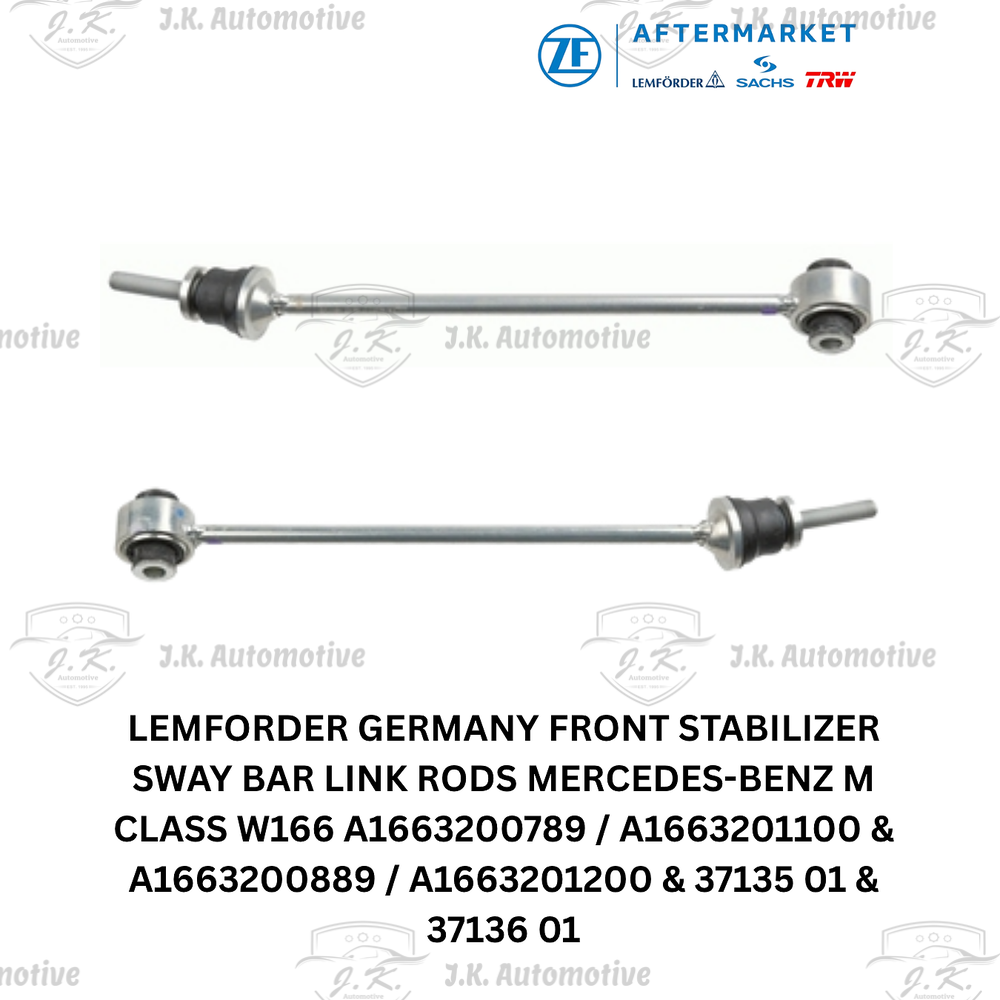
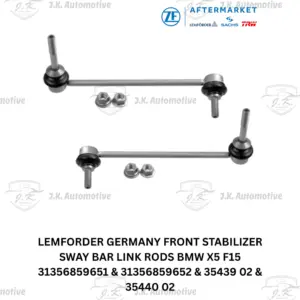
The Lemförder Germany Front Stabilizer Sway Bar Link Rods for Mercedes-Benz M-Class W166 – Lemförder 37135 01 / 37136 01 – OEM A1663200789 / A1663201100 / A1663200889 / A1663201200 are premium front suspension linkage components designed for compatible Mercedes-Benz M-Class W166 applications where these references match the exact vehicle. These stabilizer link rods connect the front stabilizer bar, also known as the anti-roll bar or sway bar, to the front suspension and help transfer stabilizer forces between the left and right sides of the axle. Their main purpose is to support controlled body movement during cornering while still allowing the suspension to move naturally over potholes, speed breakers, road joints and uneven surfaces. On the Mercedes-Benz M-Class W166, which is a larger and heavier SUV platform, effective stabilizer operation is particularly important because the suspension must manage body movement while preserving comfort, stability and predictable handling. Lemförder 37135 01 / 37136 01 correspond with Mercedes-Benz OEM references A1663200789 / A1663201100 / A1663200889 / A1663201200 for compatible applications and provide an OE-oriented replacement option where these references match the exact vehicle. When the original stabilizer links become worn, their internal ball joints can develop free play and may produce knocking, rattling or clicking noises from the front suspension, particularly when driving over small bumps, rough roads or speed breakers. A worn link can also reduce how directly the stabilizer bar responds because some suspension movement is absorbed by looseness inside the joint before anti-roll force is transferred. This can make the front end feel less composed during bends, lane changes or quick steering inputs even when straight-line driving still feels reasonably normal. Lemförder is widely recognized for premium steering and suspension components used across European vehicles and has strong specialization in control arms, ball joints, tie rods, bushes and stabilizer links. The articulated joints inside the link rods need to move smoothly through suspension travel while remaining sufficiently tight to prevent unwanted movement. Protective boots around the joints are equally important because they help retain lubrication and prevent dirt, moisture and road contaminants from reaching the internal joint surfaces. If a protective boot becomes cracked or torn, contamination can accelerate joint wear before severe looseness becomes obvious. Correct component dimensions also matter because stabilizer link length, ball-joint position and mounting geometry influence the working position of the anti-roll bar. Exact compatibility should therefore be confirmed using Mercedes-Benz OEM A1663200789 / A1663201100 / A1663200889 / A1663201200 and preferably the vehicle VIN before ordering. Visual similarity alone should not be used as the final fitment check because different W166 suspension configurations can use parts that look similar while having different specifications. Because this product uses two different Lemförder references, 37135 01 and 37136 01, the correct left-right application should be confirmed during installation rather than assuming both components are interchangeable. Both front links should be inspected because they generally experience similar mileage and road conditions. Stabilizer bar bushes should also be checked because worn bushes can create noises very similar to worn sway links. Control arms, ball joints, tie rod ends and shock absorber mountings should also be inspected if front suspension noise remains. Correct installation is important because the joint studs should be properly seated and the protective boots should not be twisted or damaged during tightening. Wheel alignment is not normally required solely because stabilizer links are replaced, since these components do not directly determine toe or camber settings. When correctly matched and professionally installed, Lemförder 37135 01 / 37136 01 can help restore quieter suspension operation, consistent stabilizer response and stable front-end behavior on the Mercedes-Benz M-Class W166.
Which Mercedes-Benz M-Class W166 models are compatible with Lemförder 37135 01 / 37136 01?
Lemförder 37135 01 / 37136 01 front stabilizer sway bar link rods are intended for compatible Mercedes-Benz M-Class W166 applications where the corresponding OEM references are A1663200789 / A1663201100 / A1663200889 / A1663201200, but exact fitment should always be confirmed using the vehicle VIN before purchase or installation. The Mercedes-Benz M-Class W166 platform was produced with different engines, drivetrains, suspension arrangements and chassis specifications, and these variations can affect which front stabilizer links are required. Simply identifying the vehicle as an M-Class W166 is therefore not sufficient as the only compatibility check. The most reliable method is to perform a VIN-based Mercedes-Benz parts lookup and confirm whether one or more of the supplied OEM references A1663200789 / A1663201100 / A1663200889 / A1663201200 apply to the relevant front stabilizer link positions on the exact vehicle. If these OEM references are confirmed, Lemförder 37135 01 / 37136 01 can then be evaluated as the corresponding replacement components. Existing markings on the removed parts can provide additional guidance, but those markings should support rather than replace VIN verification because the vehicle may have previously received aftermarket suspension components or updated replacement parts. Mercedes-Benz may also revise, replace or supersede OEM references during the service life of a model, which is one reason multiple OEM numbers can appear against a pair of replacement stabilizer links. Stabilizer links that look similar externally may still differ in overall length, joint orientation, stud dimensions, thread specifications or mounting geometry. Even a relatively small difference can affect the operating position of the anti-roll bar and how stabilizer forces are transferred through the front suspension. For this reason, visual comparison alone should not be treated as definitive proof of fitment. The removed links should still be compared physically with Lemförder 37135 01 / 37136 01 before final installation as an additional practical check. Because this product uses two different Lemförder references, the intended left-right position of each component should be confirmed carefully. If the vehicle has modified suspension, altered ride height or other non-standard chassis components, additional fitment checks may be required because changes in suspension geometry can influence link requirements. Both front links should also be inspected together because they normally operate under similar mileage, road conditions and suspension loads. If one side has developed excessive free play, a torn boot or grease leakage, the opposite side may also be showing early signs of deterioration. Stabilizer bar bushes should be inspected at the same time because worn bushes can produce knocking noises very similar to worn links. Control arm bushes, ball joints, tie rod ends and shock absorber mountings should also be checked if the vehicle continues to produce front suspension noise. During installation, the joint studs should be held correctly where required so the protective boots are not twisted or damaged. Mounting hardware should be tightened using the proper workshop method. Replacing stabilizer links alone does not normally require wheel alignment because these components do not directly alter wheel geometry. However, alignment should be considered if other steering or suspension components are replaced at the same time or if the vehicle already shows steering pull or uneven tyre wear. Once Mercedes-Benz OEM A1663200789 / A1663201100 / A1663200889 / A1663201200 are confirmed for the exact vehicle, Lemförder 37135 01 / 37136 01 provide a premium OE-oriented front stabilizer link solution for compatible Mercedes-Benz M-Class W166 applications.
Which Mercedes-Benz OEM numbers cross-reference with Lemförder 37135 01 / 37136 01?
Lemförder 37135 01 / 37136 01 correspond with Mercedes-Benz OEM references A1663200789 / A1663201100 / A1663200889 / A1663201200 for compatible Mercedes-Benz M-Class W166 front stabilizer sway bar link applications. These OEM references are important because they provide a more reliable basis for identifying the correct components than selecting only by model name. Different Mercedes-Benz M-Class W166 variants can use different suspension components depending on engine, drivetrain, chassis configuration and production specification, so the supplied OEM references should be checked against the exact vehicle before purchase or installation. Lemförder uses 37135 01 and 37136 01 as the product references for the corresponding stabilizer link components, while Mercedes-Benz OEM A1663200789 / A1663201100 / A1663200889 / A1663201200 help establish whether the replacement parts match the vehicle’s original suspension specification. If a VIN-based Mercedes-Benz parts lookup identifies these OEM references for the relevant front stabilizer link positions, the Lemförder components can then be considered as the corresponding OE-oriented replacements. Multiple OEM references can sometimes appear because manufacturers revise or supersede part numbers during production or servicing, but these references should still be verified rather than assumed to apply universally to every W166. OEM numbers may also be found on original parts, workshop invoices, previous service records or packaging, but VIN confirmation remains preferable because the vehicle may have undergone previous repairs using substitute or aftermarket components. Stabilizer links can look extremely similar while differing in link length, thread dimensions, mounting stud position or ball-joint orientation. Those differences can affect the stabilizer bar operating geometry and may lead to incorrect fitment if the component is selected only by appearance. The removed components should therefore be compared with the new Lemförder 37135 01 / 37136 01 before installation. Because two separate Lemförder references are used, correct side-specific positioning should also be confirmed before fitting. During inspection, the existing stabilizer link boots should be checked for cracks, tears and grease leakage because damaged sealing allows moisture and contamination to enter the joint. Excessive free play in the ball joints is one of the most common causes of front suspension knocking or rattling. Stabilizer bar bushes should also be inspected because they can create similar noises when worn. Other nearby suspension and steering components, including control arms, ball joints, tie rod ends and shock absorber mountings, should be checked if the exact source of front-end noise is uncertain. The replacement links should be mounted correctly and their protective boots should not be twisted or pinched during tightening. Mounting hardware should be secured according to the correct workshop procedure. After installation, suspension movement and clearance should be checked before returning the vehicle to normal use. Wheel alignment is generally not required after replacing stabilizer links alone because they do not directly adjust wheel alignment angles. However, alignment may be appropriate if other geometry-related suspension components are replaced during the same repair. Using Mercedes-Benz OEM A1663200789 / A1663201100 / A1663200889 / A1663201200 together with VIN verification provides the most reliable basis for selecting Lemförder 37135 01 / 37136 01 for compatible Mercedes-Benz M-Class W166 front suspension applications.
Why should Mercedes-Benz M-Class W166 owners choose Lemförder 37135 01 / 37136 01 front stabilizer sway bar link rods?
Mercedes-Benz M-Class W166 owners should consider Lemförder 37135 01 / 37136 01 front stabilizer sway bar link rods when they want a premium suspension replacement focused on accurate fitment, reliable joint articulation and consistent anti-roll bar operation. Although stabilizer links are comparatively small suspension components, they perform an important role because they provide the mechanical connection through which the stabilizer bar interacts with the suspension. During cornering, lane changes and directional movements, the stabilizer system helps manage body roll by transferring forces between the left and right sides of the axle. On the Mercedes-Benz M-Class W166, this function is especially important because the vehicle’s SUV body and suspension must balance comfort, road stability and controlled body movement. Lemförder 37135 01 / 37136 01 correspond with Mercedes-Benz OEM A1663200789 / A1663201100 / A1663200889 / A1663201200 for compatible applications and provide an OE-oriented replacement approach where these references match the exact vehicle. When original sway links wear, internal ball-joint clearance can increase and create knocking or rattling noises over bumps and broken road surfaces. The stabilizer bar may also react less directly because looseness inside the joint allows movement before stabilizer force is transferred. Lemförder is widely recognized for premium European steering and suspension components and has strong specialization in control arms, tie rods, ball joints, bushes and stabilizer links. This specialization is relevant because a sway link must do more than simply fit between two mounting points. Joint articulation must remain smooth through the suspension’s working range, while the joint itself must remain sufficiently tight to prevent unwanted movement and noise. Protective boots need to seal effectively so that grease stays inside and contamination remains outside the joint. If dirt or moisture penetrates the boot, internal wear can accelerate rapidly. Correct link length and geometry are also important because the stabilizer bar must sit and operate in the intended position. An incorrectly specified component may fit physically but still create undesirable suspension loading or incorrect articulation. Because this application uses two separate Lemförder references, 37135 01 and 37136 01, the correct side-specific application should be verified before installation. Lemförder’s OE-oriented approach makes these components a strong choice when the objective is to restore the vehicle’s intended suspension behavior rather than significantly alter it. However, stabilizer links should not be treated as the automatic cause of every knocking noise from the front suspension. Stabilizer bar bushes, control arm joints, tie rod ends, ball joints and shock absorber mountings can create similar symptoms, so proper diagnosis remains important. If one link has failed through normal wear, the opposite side should also be inspected because both components generally experience similar road conditions and mileage. Replacing both can be practical if both show comparable wear. Installation should be completed professionally to ensure the studs are properly secured and the protective boots remain undamaged. Wheel alignment is normally unnecessary if only stabilizer links are replaced because these parts do not directly alter toe or camber. When Mercedes-Benz OEM A1663200789 / A1663201100 / A1663200889 / A1663201200 have been confirmed for the exact vehicle, Lemförder 37135 01 / 37136 01 provide a premium OE-oriented option for restoring quiet, stable and consistent front stabilizer operation on the Mercedes-Benz M-Class W166.
What components are included with Lemförder 37135 01 / 37136 01 front stabilizer sway bar link rods?
The Lemförder Germany Front Stabilizer Sway Bar Link Rods for Mercedes-Benz M-Class W166 – Lemförder 37135 01 / 37136 01 – OEM A1663200789 / A1663201100 / A1663200889 / A1663201200 product is centered around the corresponding front stabilizer link rod components intended for compatible Mercedes-Benz M-Class W166 applications. Based on the supplied product title, the product uses Lemförder references 37135 01 and 37136 01, representing the corresponding front stabilizer link components, while the exact supplied quantity and any additional nuts, washers or mounting hardware should still be confirmed from the actual product packaging or listing before installation. Additional mounting hardware should not automatically be assumed to be included unless it is specifically supplied with the parts. The stabilizer link components generally consist of rigid link sections with articulated ball joints at the mounting ends so they can transfer stabilizer forces while still accommodating normal suspension movement. These ball joints typically have protective boots that retain lubrication and protect the internal surfaces against dirt, water and road contamination. The links connect the anti-roll bar to the relevant suspension mounting points and help transfer forces during cornering, lane changes and other movements where the left and right sides of the suspension are loaded differently. Lemförder 37135 01 / 37136 01 correspond with Mercedes-Benz OEM A1663200789 / A1663201100 / A1663200889 / A1663201200 for compatible applications. Because two different Lemförder references are supplied together with multiple Mercedes-Benz OEM references, the correct position and reference for each side should be confirmed before installation rather than assuming the components are identical or interchangeable. Before fitting, each new link should be compared with the removed part to check overall length, joint orientation, thread dimensions and mounting configuration. The old links should also be inspected for loose joints, damaged protective boots, grease leakage, corrosion or physical bending because these conditions can help confirm the cause of the original suspension complaint. The stabilizer bar itself should be inspected, and its mounting bushes should be checked for wear, cracking or excessive movement because worn stabilizer bushes can generate noises similar to those caused by deteriorated links. Control arms, ball joints, tie rod ends and shock absorber mountings should also be examined if front suspension noise persists after link inspection. If one side is heavily worn, the opposite side should also be checked because both components usually operate under similar loads and mileage. Where both sides show comparable deterioration, replacing the corresponding pair can provide more consistent stabilizer operation across the front axle. During installation, technicians should avoid twisting or damaging the protective joint boots. The studs may need to be held with the correct tool while the mounting nuts are tightened so the joint is not rotated unnecessarily. All hardware should be tightened according to the appropriate workshop procedure. Once installation is completed, the suspension should be checked for normal movement and adequate clearance. Wheel alignment is not normally required solely because front stabilizer links are replaced because these components do not directly determine toe or camber settings. Alignment should still be considered if other steering or geometry-related suspension components are changed during the same repair. When the OEM references are confirmed for the vehicle, Lemförder 37135 01 / 37136 01 provide the principal front stabilizer linkage components required for a premium suspension repair on compatible Mercedes-Benz M-Class W166 applications.
When should the front stabilizer sway bar link rods on a Mercedes-Benz M-Class W166 be replaced?
The front stabilizer sway bar link rods on a Mercedes-Benz M-Class W166 should be replaced when inspection reveals excessive ball-joint play, damaged protective boots, grease leakage, corrosion, physical bending or wear that prevents the stabilizer system from operating quietly and effectively. Stabilizer links generally do not have one fixed replacement interval because their service life depends heavily on mileage, road conditions, driving style and the condition of the surrounding suspension system. Vehicles frequently driven over potholes, broken roads, speed breakers and rough surfaces can place repeated impact loads on the ball joints and may experience faster stabilizer link wear. One of the most common symptoms is a knocking, tapping or rattling noise from the front suspension when the vehicle travels over small bumps or uneven road surfaces. The sound can be particularly noticeable at lower speeds because the left and right wheels are moving differently and the worn link joints repeatedly change direction under load. As joint clearance increases, the anti-roll bar may also respond less immediately because some suspension movement is taken up by free play before force is transferred. On a larger SUV such as the Mercedes-Benz M-Class W166, deterioration in the stabilizer linkage may therefore contribute to a less composed feeling during cornering or lane changes when the joints are significantly worn. Lemförder 37135 01 / 37136 01 can be considered as replacement components where Mercedes-Benz OEM A1663200789 / A1663201100 / A1663200889 / A1663201200 are confirmed for the exact vehicle. During inspection, technicians should carefully examine the protective joint boots for splits, cracking or grease leakage because damaged sealing allows moisture and dirt to enter the internal ball-joint surfaces and accelerate wear. Joint free play should also be checked using the appropriate workshop inspection technique. It is important to distinguish stabilizer link wear from worn stabilizer bar bushes because both faults can produce very similar front-end noises. Control arm joints, ball joints, tie rod ends, suspension bushes and shock absorber mountings can also create knocking symptoms, so the front suspension should be diagnosed systematically rather than replacing components solely by assumption. If one stabilizer link is confirmed worn, the opposite side should also be inspected because both generally experience similar road loads and mileage. It is not mandatory to replace both sides if one has suffered isolated damage and the opposite link remains in excellent condition, but paired replacement can be sensible where both have comparable age and wear. Because this application uses Lemförder 37135 01 and 37136 01, the correct position of each reference should be confirmed during installation. Protective boots must not be twisted or damaged while the hardware is tightened. After replacement, the vehicle should be road-tested over the same types of surfaces that previously produced the noise to confirm that the repair has addressed the original symptom. Wheel alignment is not normally required solely after replacing sway bar links because these components do not directly adjust wheel geometry. Alignment should nevertheless be checked if other steering or suspension components are replaced at the same time or if uneven tyre wear or steering pull is already present. Timely replacement of worn stabilizer links can help restore quieter suspension operation, more consistent stabilizer response and stable front-end behavior on the Mercedes-Benz M-Class W166.
Are Lemförder 37135 01 / 37136 01 front stabilizer sway bar link rods suitable for daily driving and highway use on Mercedes-Benz M-Class W166?
Yes, Lemförder 37135 01 / 37136 01 front stabilizer sway bar link rods are well suited for compatible Mercedes-Benz M-Class W166 models used for daily city driving, highway travel and long-distance touring because they help the front anti-roll bar operate correctly while allowing the suspension to move naturally over changing road surfaces. The Mercedes-Benz M-Class W166 is a larger SUV platform, so effective control of body movement is important for maintaining stable handling, predictable steering response and a comfortable ride. These link rods connect the front stabilizer bar to the suspension and help transfer forces when the left and right sides of the front suspension move differently. Lemförder 37135 01 / 37136 01 correspond with Mercedes-Benz OEM A1663200789 / A1663201100 / A1663200889 / A1663201200 for compatible applications and provide an OE-oriented replacement option where these references match the exact vehicle. During daily driving, the links are repeatedly exposed to potholes, speed breakers, road joints, rough surfaces and constant suspension movement. During highway use, they help the stabilizer system respond consistently during lane changes, sweeping bends and higher-speed directional inputs. When the original links become worn, their internal ball joints can develop free play and may create knocking, rattling or clicking noises from the front suspension. A worn link can also reduce how directly the anti-roll bar responds because part of the suspension movement is absorbed by looseness inside the joint before stabilizer force is transferred. This can make the front end feel less composed during cornering even though the vehicle may still drive normally in a straight line. Lemförder is widely recognized for premium steering and suspension components used across European vehicles and is especially associated with control arms, ball joints, tie rods, bushes and stabilizer links. The articulated joints inside the link rods need to move smoothly throughout suspension travel while remaining sufficiently tight to prevent unwanted movement. Protective boots around the joints are equally important because they help retain lubrication and prevent dirt, moisture and road contamination from reaching the internal surfaces. If a boot becomes damaged, joint wear can accelerate before severe looseness becomes obvious. Because this application uses two separate references, 37135 01 and 37136 01, correct left-right installation should be confirmed during fitting. Both front links should be inspected because they normally experience similar mileage and road conditions. Stabilizer bar bushes should also be checked because worn bushes can create noises very similar to worn sway links. Control arm bushes, ball joints, tie rod ends and shock absorber mountings should also be inspected if front-end noise persists. Correct installation is important because the joint studs should be seated properly and the protective boots should not be twisted or damaged during tightening. Wheel alignment is not normally required solely after replacing stabilizer links because these components do not directly determine toe or camber settings, but alignment should be checked if other steering or suspension components are disturbed during the same repair. Exact fitment should always be verified using Mercedes-Benz OEM A1663200789 / A1663201100 / A1663200889 / A1663201200 and preferably the VIN. When correctly matched and professionally installed, Lemförder 37135 01 / 37136 01 can support quiet daily use, stable highway behavior and consistent front suspension control on the Mercedes-Benz M-Class W166.
Do Lemförder 37135 01 / 37136 01 front stabilizer sway bar link rods improve handling and body-roll control on Mercedes-Benz M-Class W166?
Yes, Lemförder 37135 01 / 37136 01 front stabilizer sway bar link rods can help restore handling consistency and body-roll control on a Mercedes-Benz M-Class W166 when the original links have developed wear, looseness or damaged joints. The front stabilizer bar is designed to reduce excessive difference in suspension movement between the left and right sides of the vehicle during cornering, and the link rods are the mechanical connection through which those forces are transmitted. On the Mercedes-Benz M-Class W166, effective stabilizer operation is particularly important because the vehicle has a higher body and greater mass than a conventional sedan, so controlling body movement contributes to confidence and stability during cornering and lane changes. If a sway bar link develops free play, the anti-roll bar may not react as immediately because the loose joint has to take up movement before force is transferred. This can make the front end feel slightly softer, less precise or less composed during bends and rapid directional changes. Lemförder 37135 01 / 37136 01 correspond with Mercedes-Benz OEM A1663200789 / A1663201100 / A1663200889 / A1663201200 for compatible applications and provide an OE-oriented replacement where these references match the exact vehicle. Properly functioning links allow the stabilizer bar to respond more consistently while still permitting the suspension to move freely over bumps and normal road irregularities. This helps maintain the intended balance between comfort and chassis control. The link rods themselves do not increase spring stiffness or convert the vehicle into a more aggressive performance setup, but replacing worn components can restore the suspension behavior the Mercedes-Benz was originally designed to provide. This distinction is important because the purpose of replacing stabilizer links is to recover lost suspension function rather than artificially increase chassis stiffness. Lemförder’s specialization in chassis components is relevant because accurate link length, ball-joint geometry and articulation all influence stabilizer performance. Protective boots also need to seal effectively so lubrication remains inside the joints and contamination remains outside. Because 37135 01 and 37136 01 are separate references, correct left-right installation should be confirmed rather than assuming the two components are interchangeable. However, body-roll control depends on the complete suspension system rather than the stabilizer links alone. Worn stabilizer bar bushes, weak dampers, deteriorated control arm bushes, worn ball joints or other damaged suspension components can also reduce chassis control. These components should therefore be inspected before assuming the sway links are the only cause of poor handling. If one link is worn, the opposite side should also be examined because both operate under similar loads and road conditions. Replacing both can be sensible when wear is comparable across the axle. Correct installation is equally important because the links should not be fitted under abnormal tension or with twisted protective boots. Wheel alignment is normally unnecessary when only the stabilizer links are replaced because they do not directly set wheel geometry. When worn links are the underlying cause, Lemförder 37135 01 / 37136 01 can help restore more consistent anti-roll bar response, cleaner directional changes and more predictable front-end handling on the Mercedes-Benz M-Class W166.
Can Lemförder 37135 01 / 37136 01 front stabilizer links help reduce knocking and rattling noises on Mercedes-Benz M-Class W166?
Yes, Lemförder 37135 01 / 37136 01 front stabilizer links can help reduce knocking, tapping and rattling noises on a Mercedes-Benz M-Class W166 when those noises are caused by worn stabilizer link ball joints. One of the most common symptoms of a deteriorated sway bar link is a light knocking sound from the front suspension when the vehicle travels over small bumps, rough roads, potholes or speed breakers. This occurs because wear inside the joint creates free play, allowing the link to move slightly before the stabilizer bar load is transferred. Lemförder 37135 01 / 37136 01 correspond with Mercedes-Benz OEM A1663200789 / A1663201100 / A1663200889 / A1663201200 for compatible applications and provide an OE-oriented replacement solution where these references match the exact vehicle. Replacing worn links can remove excess joint movement and restore a firmer mechanical connection between the stabilizer bar and suspension. This can make the front suspension noticeably quieter on uneven roads and may also restore a more solid and refined front-end feel. However, front suspension noises should always be diagnosed properly because stabilizer links are not the only possible source. Stabilizer bar bushes can create almost identical knocking sounds, while control arm ball joints, suspension bushes, tie rod ends, shock absorber mountings and other chassis components can also produce similar noises. A complete inspection should therefore be carried out rather than replacing components based only on sound. The protective boots on the stabilizer links should be checked for tears, cracking or grease leakage because damaged sealing allows dirt and moisture to enter the joint and accelerate wear. Each ball joint should also be checked for excessive free play using the correct workshop method. If a link rod is bent, corroded or physically damaged, replacement may be required even if the joint itself has not yet developed severe looseness. Because this application uses separate Lemförder references 37135 01 and 37136 01, each component should be installed in the correct side-specific position. Both front links should be inspected because they generally experience similar mileage and road conditions. If both show comparable wear, replacing them together can reduce the likelihood of another similar repair shortly afterwards. During installation, the joint studs should be held correctly where required and the protective boots should not be twisted or damaged. Mounting hardware should be tightened using the correct workshop procedure. After replacement, the vehicle should be road-tested over the same type of surface that originally produced the noise. If the knocking remains, other suspension components should be investigated instead of assuming the replacement links are defective. Wheel alignment is not normally required after stabilizer link replacement alone because these components do not directly alter alignment angles. When worn stabilizer links are the true cause of the noise, Lemförder 37135 01 / 37136 01 can help restore quieter and more refined front suspension operation on the Mercedes-Benz M-Class W166.
Should both Lemförder 37135 01 / 37136 01 front stabilizer sway bar link rods be replaced together on Mercedes-Benz M-Class W166?
It is not always mandatory to replace both front stabilizer sway bar link rods together on a Mercedes-Benz M-Class W166, but replacing both can be a sensible and practical approach when the original links have similar mileage, age and wear. The left and right stabilizer links operate as part of the same anti-roll system and are exposed to similar road conditions, suspension movement and contamination. If one side has developed excessive ball-joint play or a damaged protective boot due to normal service wear, the opposite side may also be approaching the end of its useful life. Lemförder 37135 01 / 37136 01 correspond with Mercedes-Benz OEM A1663200789 / A1663201100 / A1663200889 / A1663201200 for compatible applications and provide the corresponding front stabilizer link solution where these references match the exact vehicle. Because two different Lemförder references and multiple OEM references are used, the left and right positions should be confirmed carefully during installation. Replacing both sides together can help restore a more consistent mechanical connection between the stabilizer bar and suspension across the front axle. This may also reduce the chance of repeating similar workshop labor shortly afterwards if the remaining original link fails. However, if one link has suffered isolated impact damage while the opposite component is relatively new and remains in excellent condition, replacing only the damaged side may be acceptable after proper inspection. The decision should therefore be based on actual component condition rather than automatically replacing parts without evidence of wear. Each sway link should be checked for ball-joint looseness, torn protective boots, grease leakage, corrosion and bending. The stabilizer bar bushes should also be inspected because worn bushes can create similar symptoms and may require separate replacement. Control arms, tie rod ends, ball joints and shock absorber mountings should also be checked if front-end noise continues after the links are inspected. When both links are being replaced, correct installation is important because each component should be fitted on its intended side and each joint should be seated properly. The protective boots must remain undamaged and the links should not be forced into abnormal angles. Mounting hardware should be tightened using the correct workshop method. Unlike tie rod ends, stabilizer links do not normally alter wheel alignment settings, so alignment is usually not required if only these components are replaced. However, if other geometry-related suspension parts are changed during the same repair or if the vehicle already shows uneven tyre wear or steering pull, alignment should be checked. Exact fitment should always be verified using Mercedes-Benz OEM A1663200789 / A1663201100 / A1663200889 / A1663201200 and preferably the VIN. When both original links show comparable deterioration, replacing them together with Lemförder 37135 01 / 37136 01 can provide a more balanced, quiet and complete front stabilizer system repair for the Mercedes-Benz M-Class W166.
Why is Lemförder considered one of the best stabilizer link brands for Mercedes-Benz compared with Meyle, FEBI, Bilstein and FAG?
Lemförder is widely regarded as one of the strongest choices for Mercedes-Benz stabilizer link replacement because the brand has deep specialization in steering and suspension components such as control arms, ball joints, tie rods, bushes and stabilizer links, making Lemförder 37135 01 / 37136 01 particularly relevant for a Mercedes-Benz M-Class W166 front suspension application. The quality of a stabilizer link depends on much more than whether the component physically fits because joint precision, sealing quality, articulation, stud dimensions and overall geometry all influence how effectively the anti-roll bar can transfer force. Lemförder 37135 01 / 37136 01 correspond with Mercedes-Benz OEM A1663200789 / A1663201100 / A1663200889 / A1663201200 for compatible applications and provide an OE-oriented replacement approach where these references match the vehicle. Meyle is also a respected German aftermarket brand and is particularly well known for its Meyle HD range, where selected components may be redesigned with durability as an important objective. FEBI offers a broad European aftermarket catalogue covering suspension, steering, drivetrain and maintenance components and is widely used across many vehicle platforms. Bilstein is one of the most recognized names in shock absorbers, dampers and performance suspension systems, so its core specialization is generally more focused on damping technology than stabilizer link rods. FAG is particularly well known for wheel bearings, hubs and related rotating chassis components. None of these brands should be considered poor overall because each has product categories where it performs especially strongly. Lemförder is often preferred for stabilizer links because of its strong focus on chassis joints and suspension geometry. On the Mercedes-Benz M-Class W166, the links need to articulate smoothly throughout suspension travel while remaining sufficiently tight to transfer anti-roll bar forces without delay or unwanted noise. This requirement is especially relevant on a larger SUV where the stabilizer system works continuously to manage body movement during directional changes. A lower-quality joint may develop play prematurely or allow contamination to enter through inadequate sealing. Correct link length and joint orientation are also important because they influence the stabilizer bar operating geometry and position. Because this application uses separate Lemförder references 37135 01 and 37136 01, correct side-specific fitment is also important. Lemförder’s OE-oriented design philosophy makes these components a strong choice where the objective is to restore original-style Mercedes-Benz suspension behavior rather than significantly alter the chassis characteristics. However, correct fitment remains more important than brand name alone, so Mercedes-Benz OEM A1663200789 / A1663201100 / A1663200889 / A1663201200 should be verified against the VIN before ordering. Stabilizer bar bushes and surrounding suspension components should also be inspected because even premium new links cannot correct wear elsewhere in the front suspension. Professional installation is important to avoid damaging the joint boots or threads. When correctly matched and properly installed, Lemförder 37135 01 / 37136 01 provide a premium OE-oriented solution for Mercedes-Benz M-Class W166 owners seeking quieter suspension operation, consistent stabilizer response and refined handling.

Reviews
There are no reviews yet.