What are SACHS Front Shock Absorbers 318292 and 318293 for BMW X1 F48?
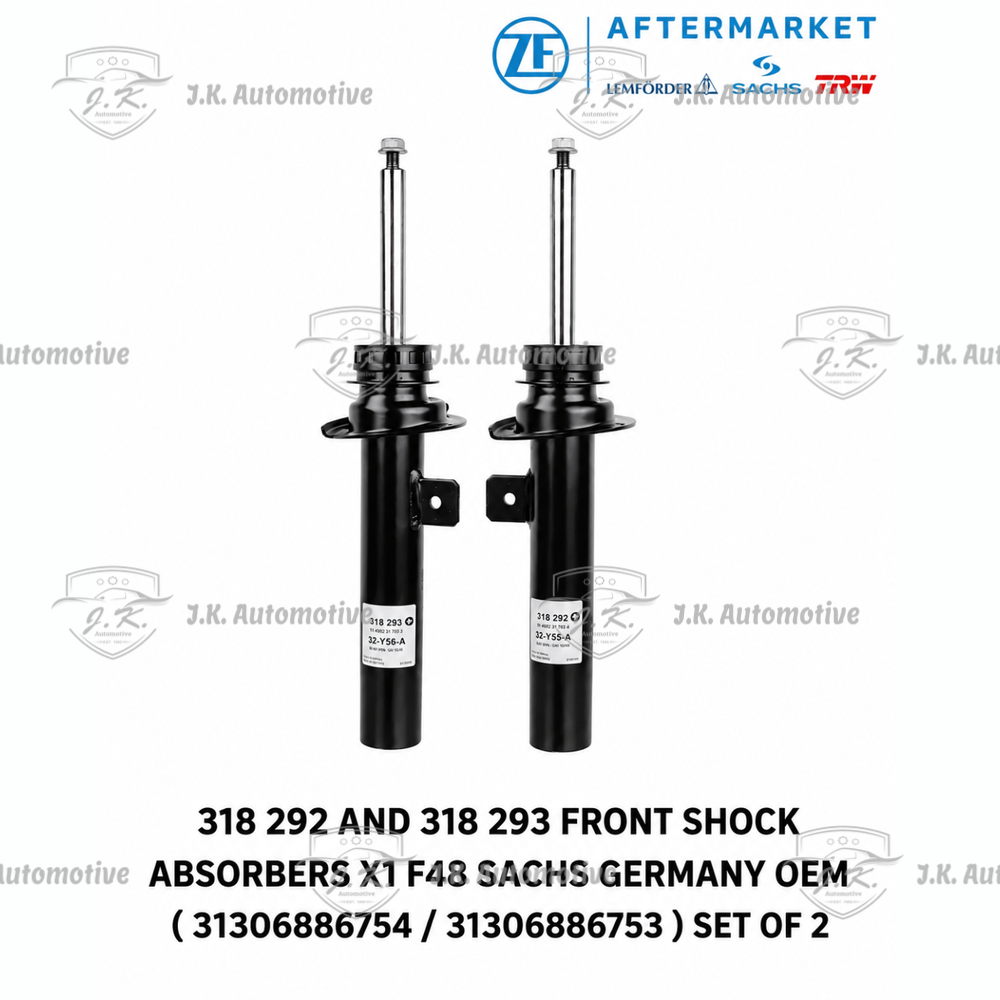
SACHS Front Shock Absorbers 318292 and 318293 are premium front suspension dampers designed for compatible BMW X1 F48 models and supplied as a set of two for the front axle, with OEM references 31306886754 and 31306886753 used for accurate identification and compatibility checking. These shock absorbers perform one of the most important functions within the BMW X1 F48 suspension system because they control the compression and rebound movement created by the coil springs whenever the vehicle travels over bumps, potholes, speed breakers, uneven surfaces, highway joints or changing road levels. A suspension spring supports the weight of the vehicle and allows the wheel to move vertically, but the spring cannot effectively control its own repeated movement after compression. The shock absorber provides the damping resistance necessary to reduce this repeated oscillation and allows the suspension to return to a stable position in a controlled manner. SACHS 318292 and 318293 are therefore not simply components intended to improve comfort; they also contribute to wheel control, steering stability, predictable braking behaviour and consistent tyre contact with the road. When the original front shock absorbers on a BMW X1 F48 become worn, the deterioration can occur gradually, making the vehicle feel progressively softer, less stable or less controlled without the driver immediately realizing how much suspension performance has been lost. Typical effects can include repeated bouncing after road disturbances, excessive front-end movement, increased nose dive under braking, reduced confidence during cornering, instability on uneven roads and abnormal tyre wear. Replacing worn units with correctly specified SACHS front shock absorbers can help restore controlled suspension movement and bring the front axle closer to its intended operating characteristics. SACHS is associated with ZF and has extensive experience in original-equipment damping technology, making the brand particularly relevant for European vehicles where precise suspension characteristics are important. For BMW owners who want to retain an OE-oriented combination of ride comfort and chassis control, SACHS is a widely recognized replacement option. The two individual references 318292 and 318293 correspond to the respective front suspension positions and should always be installed according to the correct application rather than interchanged arbitrarily. OEM references 31306886754 and 31306886753 should be checked against the existing components, parts catalogue or VIN-based vehicle information before purchase because suspension specifications can vary even within the BMW X1 F48 range. Engine configuration, drivetrain, production specification and factory suspension equipment can influence the correct shock absorber selection. Both front dampers are generally replaced together because installing one new unit alongside a substantially worn unit can result in unequal damping characteristics across the same axle. During replacement, the technician should also inspect the springs, top mounts, bearings, dust covers, bump stops, control arms, bushings, ball joints and stabilizer components so that worn surrounding parts do not compromise the operation of the new shock absorbers. Correctly matched and professionally installed SACHS 318292 and 318293 front shock absorbers can help the BMW X1 F48 maintain stable wheel movement, controlled body motion, comfortable ride quality and predictable front suspension behaviour during everyday city driving, highway driving, braking and cornering.
What OEM numbers are compatible with SACHS 318292 and 318293 Front Shock Absorbers for BMW X1 F48?
The SACHS Front Shock Absorbers 318292 and 318293 for BMW X1 F48 are associated with OEM references 31306886754 and 31306886753, and these OEM numbers are among the most important pieces of information that should be checked when identifying the correct replacement front dampers for a particular vehicle. Customers may encounter these references written in several search formats, including BMW 31306886754, BMW 31306886753, 31 30 6 886 754, 31 30 6 886 753, SACHS 318292, SACHS 318293, SACHS 318 292 and SACHS 318 293, depending on the catalogue, supplier or search platform being used. The presence or absence of spaces in an OEM number normally reflects formatting rather than a different basic reference, but the complete sequence of digits must still be checked carefully. OEM cross-reference verification is particularly important for suspension parts because two shock absorbers can look very similar while having different mounting arrangements, dimensions, damping characteristics or intended applications. A BMW X1 F48 can also exist with different equipment and suspension configurations, so identifying a vehicle only by its model name is not always sufficient for guaranteed compatibility. Before ordering SACHS 318292 and 318293, the OEM number on the existing component should therefore be compared with the replacement reference whenever possible. VIN verification provides an additional level of accuracy because it allows the vehicle's exact production specification to be considered when identifying suspension parts. The OEM reference also helps customers searching online for a replacement because the same product may be described using the SACHS number, BMW OEM number or a combination of both. Including all relevant references when checking compatibility reduces the possibility of ordering a component intended for a different suspension specification. Correct reference matching matters because a shock absorber is calibrated to operate as part of a complete chassis system rather than as an isolated component. Its damping characteristics need to work with the spring rate, axle load, wheel and tyre configuration, suspension geometry and overall vehicle setup. Installing an incorrect damper merely because its physical dimensions appear similar can therefore result in inappropriate suspension behaviour or installation difficulties. SACHS 318292 and 318293 should consequently be treated as application-specific suspension components and not as universal BMW X1 shock absorbers. During installation, the technician should confirm that each unit is fitted to its correct position and that all mounting components are assembled according to the appropriate procedure. The surrounding suspension should also be inspected because an accurate shock absorber reference will not correct problems caused by worn mounts, damaged springs, defective bushings, loose ball joints or other suspension faults. When OEM numbers 31306886754 and 31306886753 correspond with the vehicle's required specification and SACHS references 318292 and 318293 are confirmed for the application, the pair provides a premium replacement solution intended to restore effective front suspension damping on the compatible BMW X1 F48.
What are the common symptoms of worn front shock absorbers on a BMW X1 F48?
Worn front shock absorbers on a BMW X1 F48 can produce a wide range of symptoms because the dampers influence suspension movement, tyre contact, steering response, braking stability and overall chassis control, and the deterioration often develops gradually enough that the driver becomes accustomed to the change before realizing that suspension performance has declined. One of the most recognizable symptoms is excessive bouncing after the vehicle crosses a speed breaker, pothole, road joint or uneven surface, particularly when the front end continues moving vertically instead of settling quickly after the initial impact. Another common symptom is increased nose dive during braking, where the front of the BMW appears to compress excessively when the brakes are applied because the dampers are no longer controlling weight transfer as effectively as they should. The vehicle may also feel less stable when changing lanes, entering corners or travelling at higher speeds, with the front suspension taking longer to settle after steering inputs or road disturbances. Drivers can sometimes describe this as a floating, loose or unsettled sensation from the front of the vehicle. Uneven or cupped tyre wear can also occur because weak damping allows the tyre to experience less consistent loading against the road as the wheel repeatedly moves vertically. Increased steering correction on rough roads may be another warning sign, as the front wheels are not being controlled as effectively through changing road surfaces. Fluid leakage around a shock absorber body can indicate deterioration of the damper's sealing system, although the complete component should be inspected before determining whether replacement is necessary. Knocking, rattling or clunking noises can sometimes accompany front suspension problems, but these noises should not automatically be blamed on the shock absorber because worn top mounts, bearings, stabilizer links, control-arm bushings and ball joints can produce similar sounds. Excessive front-end movement during acceleration and braking may also indicate reduced damping efficiency. Another symptom can be a noticeable reduction in ride quality, where the vehicle reacts harshly to some impacts while simultaneously feeling uncontrolled over larger undulations. Because suspension components work together as a system, accurate diagnosis is important before replacing parts. A professional technician should inspect the front shock absorbers along with springs, mounts, bump stops, dust covers, control arms, bushings, ball joints, stabilizer components, tyres and wheel alignment. If the existing front shock absorbers are confirmed to be worn and the vehicle specification corresponds with SACHS references 318292 and 318293 and OEM references 31306886754 and 31306886753, replacement with the correct SACHS pair can help restore effective damping. Both front shock absorbers should normally be considered together because significant differences in damping between the left and right sides can affect the balance of the front axle. Once correctly installed, new SACHS front shock absorbers can help the suspension settle more quickly after road disturbances, control unwanted spring movement, reduce excessive body motion and provide a more stable and predictable driving experience on the BMW X1 F48.
Why should SACHS 318292 and 318293 front shock absorbers be replaced as a set of two on BMW X1 F48?
SACHS 318292 and 318293 front shock absorbers should generally be replaced together as a set of two on a compatible BMW X1 F48 because the left and right dampers operate as a coordinated pair across the same front axle, and maintaining reasonably consistent damping characteristics on both sides is important for balanced suspension response during braking, cornering, steering and travel over uneven roads. Shock absorbers gradually lose effectiveness through repeated compression and rebound cycles, heat, mileage, road impacts and normal mechanical wear, so if one front damper has deteriorated significantly, the opposite unit may also have experienced substantial ageing even when it has not yet developed an obvious leak or severe symptom. Installing one new shock absorber while retaining an old and substantially worn unit on the opposite side can create a difference in damping force across the axle. This difference can cause each side of the front suspension to respond differently when the vehicle encounters bumps or transfers weight during braking and cornering. A matched replacement pair helps provide more consistent behaviour because both sides begin their service life under similar operating conditions. SACHS 318292 and 318293 are the relevant paired references for this product and are associated with BMW OEM numbers 31306886754 and 31306886753. Each reference should be fitted to its intended suspension position after confirming the exact vehicle application. Replacing both units during the same repair also makes practical sense because much of the inspection and workshop preparation is already being performed, allowing both sides of the front suspension to be evaluated at the same time. The technician can inspect the corresponding springs, top mounts, bearings, bump stops, dust covers and mounting hardware on both sides and identify differences that might otherwise be missed. Control arms, bushings, ball joints and stabilizer links should also be examined because worn surrounding components can create symptoms that resemble defective shock absorbers or prevent the newly installed dampers from delivering the expected improvement. Tyres should be checked for irregular wear, particularly if the old dampers had been weak for an extended period. Correct installation is equally important because even premium shock absorbers cannot perform properly if mounting hardware is incorrectly tightened, springs are improperly seated or damaged associated components are reused. After replacement, suspension geometry and wheel alignment should be inspected when required by the repair procedure or when abnormal tyre wear and steering behaviour are present. Replacing SACHS 318292 and 318293 together therefore provides more than simple convenience; it supports balanced damping performance across the BMW X1 F48 front axle. When both sides have comparable damping capability, the suspension can respond more consistently during straight-line driving, braking, cornering and sudden road disturbances. This helps the vehicle maintain controlled body movement and predictable steering characteristics while allowing the tyres to remain more consistently connected to the road surface.
Are SACHS 318292 and 318293 premium-quality shock absorbers for BMW X1 F48?
SACHS 318292 and 318293 are premium replacement shock absorber references intended for compatible BMW X1 F48 applications, and SACHS has a long-established position in automotive damping technology through its association with ZF and its extensive involvement in original-equipment and aftermarket suspension systems. A premium shock absorber should not be judged only by exterior appearance because the critical engineering is contained within the damping system, including the internal hydraulic operation, valves, seals, piston movement and the calibration used to regulate compression and rebound forces. These characteristics determine how effectively the damper controls spring movement and how consistently it responds as the vehicle encounters different road conditions. SACHS shock absorbers are developed with substantial OE engineering experience behind the brand, which is particularly relevant for BMW owners who want replacement components focused on maintaining an OE-oriented balance of ride comfort, road holding and chassis control. On the BMW X1 F48, the front shock absorbers are continuously working whenever the vehicle is moving, even on roads that appear relatively smooth. Small surface variations repeatedly move the wheel and suspension, while larger potholes, speed breakers and undulations create significantly greater suspension travel. Braking, acceleration and cornering additionally transfer vehicle load and require the dampers to control body movement. A correctly functioning SACHS front shock absorber manages these movements by resisting uncontrolled compression and rebound rather than allowing the suspension springs to oscillate freely. SACHS 318292 and 318293 should be matched against OEM references 31306886754 and 31306886753 and the exact BMW X1 F48 specification before installation because premium manufacturing quality does not eliminate the need for correct application selection. An incorrectly specified high-quality shock absorber is still the wrong component for the vehicle. VIN-based confirmation is therefore advisable when there is uncertainty regarding suspension configuration. Another important consideration is the condition of related suspension components. If the shock absorber mount is worn, the spring is damaged, the control-arm bushings have excessive movement or a ball joint is loose, installing new dampers alone may not completely restore the suspension. A complete inspection allows the new SACHS units to operate within a mechanically sound suspension system. Professional installation is also essential because damage to the piston rod, incorrect assembly, improper fastener torque or unsuitable mounting procedures can reduce component life and performance. For customers specifically looking for SACHS Germany BMW X1 F48 front shock absorbers, references 318292 and 318293 represent an OE-oriented premium replacement option when confirmed for the vehicle. Their purpose is not to transform the BMW into a radically different suspension setup but to provide controlled damping characteristics suitable for the intended application. When correctly selected, installed as a pair and combined with suspension components in good condition, SACHS front shock absorbers can help restore stable road behaviour, controlled suspension travel, comfortable ride quality and predictable steering response.
How can SACHS 318292 and 318293 improve ride comfort, handling and stability on BMW X1 F48?
SACHS Front Shock Absorbers 318292 and 318293 can help improve the ride comfort, handling and stability of a compatible BMW X1 F48 when replacing worn or ineffective front dampers because shock absorbers directly control the speed and extent of suspension movement generated by road inputs and vehicle weight transfer. When a front wheel encounters a bump, the spring compresses so that the wheel can move upward instead of transmitting the entire impact directly into the vehicle body, but once compressed the spring naturally wants to expand and can continue oscillating unless that movement is controlled. The shock absorber regulates this process by providing damping resistance during compression and rebound, allowing the wheel and body to return toward their normal positions in a controlled manner. As shock absorbers wear, their ability to regulate this movement can decrease, resulting in excessive bouncing, additional pitching, delayed settling and reduced front-end composure. Installing new correctly specified SACHS 318292 and 318293 units can help restore this damping function and reduce unnecessary suspension movement. Improved damping can make the BMW X1 F48 feel more settled when passing over speed breakers, bridge joints, potholes and undulating roads because the body should require fewer oscillations to stabilize after the initial suspension movement. During braking, effective front damping helps manage the forward transfer of vehicle weight and controls the rate at which the front suspension compresses, contributing to more composed chassis behaviour. During cornering and sudden directional changes, properly functioning dampers help control transient body movement so that steering inputs produce a more predictable vehicle response. Maintaining consistent tyre contact with the road is another important function because the suspension needs to allow wheel movement without permitting uncontrolled bouncing. Effective wheel control supports steering, braking and stability by providing the tyres with more consistent operating conditions. Ride comfort can also improve because controlled damping prevents repeated body movement after individual road impacts. However, the improvement achieved by replacing the shock absorbers depends on the condition of the complete suspension system. Worn top mounts, springs, bushings, control arms, ball joints, stabilizer links, damaged tyres or incorrect wheel alignment can continue producing poor ride or handling symptoms even after new dampers are installed. These components should therefore be inspected when SACHS 318292 and 318293 are fitted. OEM references 31306886754 and 31306886753 should also be verified before purchase to ensure that the dampers correspond to the exact vehicle specification. Correct installation of both front units as a pair helps maintain balanced damping across the axle and prevents a large performance difference between the left and right sides. The objective is not to make the suspension artificially stiff or excessively soft, but to restore controlled movement appropriate for the BMW X1 F48 application. When the existing dampers are genuinely worn, the correct SACHS replacement pair can help provide quicker suspension settling, reduced excessive bouncing, better-controlled braking pitch, more composed cornering behaviour, improved road contact and a more stable and comfortable driving experience.
How do SACHS Front Shock Absorbers 318292 and 318293 help restore the original suspension performance of BMW X1 F48?
SACHS Front Shock Absorbers 318292 and 318293 are designed to help restore controlled front suspension performance on compatible BMW X1 F48 vehicles by providing the damping force required to manage compression and rebound movement of the suspension springs while the vehicle is travelling over different road surfaces. The shock absorber is one of the most important components in the BMW X1 F48 front suspension because the spring alone cannot adequately control the repeated vertical movement generated when the wheel passes over potholes, speed breakers, expansion joints, rough roads, undulations and sudden changes in road level. When the original front shock absorbers become worn after extended mileage and repeated suspension cycles, the vehicle can gradually lose the tightly controlled ride characteristics that were present when the suspension components were in good condition. The driver may experience additional bouncing after bumps, excessive front-end movement, increased pitching under acceleration and braking, reduced confidence during fast directional changes, less precise steering response and a general feeling that the front of the vehicle is no longer as composed as before. SACHS 318292 and 318293 are intended for the corresponding front suspension positions on compatible BMW X1 F48 applications and should be checked against OEM references 31306886754 and 31306886753 before installation. When correctly matched to the vehicle, these SACHS front shock absorbers work by controlling the speed at which the suspension compresses and rebounds instead of allowing uncontrolled spring oscillation. This damping action helps the front wheels maintain more consistent contact with the road and contributes to predictable steering response, braking stability, cornering behaviour and passenger comfort. Proper damping is particularly important on a premium compact SUV such as the BMW X1 F48 because the suspension must simultaneously manage vehicle weight, passenger comfort, steering precision and stability across different speeds and road conditions. New shock absorbers cannot compensate for defective control arms, worn top mounts, damaged springs, deteriorated bushings, loose ball joints or worn stabilizer components, which is why these related parts should be inspected when the dampers are replaced. When the rest of the suspension system is in good condition, installation of correctly specified SACHS 318292 and 318293 shock absorbers can help bring the suspension response closer to its intended operating characteristics. The result can be reduced unwanted vertical movement, quicker settling after bumps, more controlled weight transfer during braking, improved front-end composure and more predictable behaviour on uneven surfaces. Because ZF applies its OE damping expertise to SACHS aftermarket shock absorbers, SACHS is particularly relevant for owners looking for a replacement focused on maintaining OE-oriented ride and damping characteristics rather than deliberately changing the suspension toward a substantially different setup.
Why is correct damping important for the BMW X1 F48 when installing SACHS 318292 and 318293?
Correct damping is extremely important for the BMW X1 F48 because a vehicle suspension must do considerably more than simply absorb the initial impact produced by an uneven road surface; it must control the movement of the body and wheels immediately after that impact so that the tyres continue following the road in a stable and predictable manner. SACHS Front Shock Absorbers 318292 and 318293 perform this damping function on compatible BMW X1 F48 applications by controlling the energy generated as the front suspension springs compress and extend. A suspension spring supports the vehicle and allows wheel movement, but without an effective shock absorber the spring can continue oscillating after being compressed, causing the vehicle to bounce repeatedly rather than settling quickly. This can negatively affect comfort, steering response, braking behaviour and tyre contact with the road. The shock absorber converts suspension movement into controlled hydraulic resistance, limiting the rate of compression and rebound according to its internal damping characteristics. When front shock absorbers become worn, the reduction in damping force may initially be subtle because deterioration normally occurs gradually over thousands of kilometres. The driver may slowly become accustomed to increased body movement, additional steering corrections, greater nose dive during braking or a softer and less controlled front-end response without realizing how much the damping performance has changed. Installing correctly specified SACHS 318292 and 318293 units can help restore the damping function required by the compatible BMW X1 F48 suspension configuration. The relationship between the shock absorber and spring is particularly important because damping that is inappropriate for the application can alter how quickly the suspension reacts and settles. Too little damping allows excessive movement, while an unsuitable damping characteristic can also compromise the intended balance between comfort and control. ZF explains that damping involves a fundamental balance between driving comfort, dynamics and safety, with the shock absorber helping calm body movement while keeping the wheels in contact with the road. This principle is directly relevant when servicing a BMW X1 F48 because maintaining stable tyre contact helps the steering, braking and stability systems operate under more consistent mechanical conditions. Correct damping can also help control vehicle weight transfer when braking, accelerating or changing direction. During hard braking, for example, vehicle load moves toward the front axle and compresses the front suspension. Properly functioning dampers regulate this movement so that it occurs in a controlled manner rather than allowing excessive pitching. Similarly, during cornering and rapid lane changes, effective damping helps control transient body movement and supports predictable chassis behaviour. SACHS 318292 and 318293 should therefore be considered functional suspension components rather than simply replacement tubes fitted when an old shock begins leaking. Correct selection, professional installation and inspection of related suspension components are essential for obtaining the intended performance from the replacement.
ZF Group
Can SACHS 318292 and 318293 help reduce bouncing, nose diving and unstable handling on BMW X1 F48?
SACHS Front Shock Absorbers 318292 and 318293 can help reduce excessive bouncing, uncontrolled suspension movement, excessive nose diving and unstable handling on a compatible BMW X1 F48 when those symptoms are actually being caused by worn or deteriorated front shock absorbers. A healthy shock absorber regulates the movement of the suspension spring and prevents it from continuing to oscillate excessively after the wheel has passed over a road disturbance. When a BMW X1 F48 travels across a pothole, speed breaker or uneven section of road, the suspension spring compresses to accommodate the wheel movement and subsequently expands as the suspension returns toward its normal position. If the damper is functioning correctly, this movement is progressively controlled and the vehicle body settles quickly. If damping performance has deteriorated, the spring can move through additional compression and rebound cycles, which the occupants experience as repeated bouncing or floating. Similar principles apply during braking. When the driver applies the brakes, weight transfers toward the front axle and compresses the front suspension. Effective shock absorbers help control the speed and magnitude of this movement, whereas worn dampers can allow the front of the vehicle to pitch more noticeably. During cornering or sudden directional changes, weakened damping can also make the vehicle feel less settled because the body takes longer to stabilize after the initial steering input. SACHS 318292 and 318293 are designed to provide controlled damping for their specified applications, and fitting new correctly matched units can therefore address these symptoms when the existing shock absorbers have lost effectiveness. However, suspension diagnosis should not be based on symptoms alone because similar behaviour can result from worn control-arm bushings, damaged springs, defective top mounts, ball joints, tyre problems, incorrect tyre pressures, wheel alignment issues or other chassis components. A professional inspection should determine whether the dampers are actually responsible before parts are replaced. When worn shock absorbers are confirmed as the cause, replacing both front units as a matched pair can help provide consistent damping across the axle. SACHS describes its passenger-car dampers as applying the company's OE expertise to aftermarket production, with the objective of maintaining safety, driving comfort and appropriate vehicle dynamics. The practical benefit on a BMW X1 F48 is not that the replacement shock absorber creates an entirely new suspension system, but rather that it helps return the existing suspension to properly controlled operation. This can translate into quicker settling after bumps, less unnecessary vertical movement, more controlled braking pitch, improved stability on undulating roads and a more composed front-end feel.
What should be checked while installing SACHS Front Shock Absorbers 318292 and 318293 on BMW X1 F48?
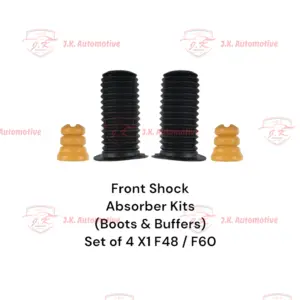
When installing SACHS Front Shock Absorbers 318292 and 318293 on a BMW X1 F48, the complete front suspension assembly should be inspected rather than treating the job as a simple removal and replacement of two shock absorbers because the performance and service life of the new dampers depend partly on the condition and correct installation of the surrounding components. The first step should be confirming that SACHS references 318292 and 318293 and OEM references 31306886754 and 31306886753 correspond to the exact vehicle specification because BMW X1 F48 variants can differ according to engine, drivetrain, production specification and suspension equipment. VIN verification is recommended whenever there is uncertainty. Once fitment has been confirmed, the technician should inspect the front coil springs for cracks, corrosion, deformation, incorrect seating or evidence of sagging. The upper shock absorber mounts and bearings should also be examined because worn mounts can cause knocking noises, steering roughness or unwanted movement that may incorrectly be blamed on the new dampers. Dust covers and bump stops should be checked carefully because the dust cover protects the piston rod from contaminants while the bump stop helps prevent damaging metal-to-metal suspension compression under severe travel. Any torn, deteriorated or missing protective components should be addressed during installation. Control-arm bushings, ball joints, stabilizer link rods and related front suspension joints should also be checked for looseness, cracking or excessive movement because these components have a direct influence on steering and chassis behaviour. Tyres should be inspected for irregular wear patterns that may indicate previous damping or alignment problems. Mounting surfaces and fasteners should be cleaned and examined before assembly, and all fasteners should be tightened according to the appropriate BMW repair specifications rather than using arbitrary torque values. Where BMW specifies replacement of single-use hardware or self-locking nuts, the correct replacement hardware should be used. Care should also be taken not to damage the new shock absorber piston rod during installation because scratches or inappropriate gripping of the polished rod surface can damage the sealing system and lead to premature leakage. Suspension components that require tightening at normal ride height should be handled according to the correct service procedure to prevent unwanted preload in rubber bushings. After both SACHS front shock absorbers have been installed, the suspension should be checked for correct assembly and clearance throughout the steering range. A wheel-alignment inspection is advisable when suspension geometry has been disturbed or when abnormal tyre wear was present before the repair. A road test should then confirm that the vehicle settles normally after bumps, tracks correctly, steers consistently and does not produce unusual noises. Installing SACHS 318292 and 318293 correctly is therefore not merely a parts replacement procedure; it should form part of a complete front suspension inspection designed to ensure that the new dampers can operate under the conditions for which they were engineered.
Why is SACHS considered one of the best shock absorber brands for BMW compared with Bilstein?
SACHS is widely regarded as a premium shock absorber choice for BMW applications because the brand combines extensive original-equipment experience, large-scale automotive manufacturing, sophisticated damping technology and an aftermarket product philosophy closely connected with OE suspension requirements, while Bilstein is also a highly respected German suspension manufacturer with significant OE, replacement and performance expertise; therefore, the most useful comparison is not to claim that one brand is universally superior, but to understand how their product philosophies and specific applications can differ. SACHS is part of ZF, one of the major global automotive technology suppliers, and ZF states that SACHS shock absorbers are installed as standard equipment by numerous well-known vehicle manufacturers, with more than 10 million new vehicles per year leaving production fitted with SACHS dampers and shock absorbers.
Aftermarket ZF This extensive OE involvement is particularly relevant for BMW owners looking for replacement dampers because suspension tuning is not simply about producing a firm or soft shock absorber; the damping characteristics must work correctly with the vehicle's springs, suspension geometry, axle loads, tyre characteristics, electronic systems and overall chassis calibration. SACHS aftermarket shock absorbers benefit from the company's OE engineering experience, and ZF specifically states that its OE expertise is applied to spare-parts production.
Aftermarket ZF This makes SACHS particularly attractive where the objective is to replace worn original dampers while maintaining an OE-oriented balance between comfort, road holding and chassis control rather than deliberately modifying the character of the suspension. SACHS also has substantial experience with advanced damping systems; ZF's Continuous Damping Control technology continuously adjusts damping force according to variables such as road conditions, vehicle load and handling conditions, demonstrating the engineering depth behind the SACHS/ZF damping portfolio.
ZF Press Center Bilstein, however, should not be treated as a lower-grade alternative because it is itself a major suspension specialist with original-equipment expertise and extensive experience in monotube, twin-tube, electronic and performance-oriented damping technologies. Bilstein states that its technologies include high-performance monotube and twin-tube shock absorbers, air springs and electronic suspension systems, while its DampTronic technologies demonstrate significant expertise in balancing ride comfort with driving dynamics.
Bilstein Bilstein also has a particularly strong reputation in performance suspension, sport suspension and applications where drivers intentionally want a different chassis response, although Bilstein also produces OE-style replacement dampers and should not automatically be characterized as a harsher or purely performance-focused brand. The actual ride characteristics depend on the specific Bilstein or SACHS product reference selected for a particular BMW. For an owner of a BMW X1 F48 whose priority is replacing worn original-style front shock absorbers and preserving the intended everyday balance of ride comfort, stability and damping control, correctly specified SACHS units such as 318292 and 318293 can therefore be a highly relevant choice when their references match the vehicle. For another BMW owner seeking a particular Bilstein suspension specification, upgraded performance characteristics or a complete matched suspension package, an appropriate Bilstein product may be equally relevant. Both manufacturers possess substantial German suspension engineering heritage, both participate in OE-level technology development, and both offer technically sophisticated damping products. The key advantage of SACHS in an OE-oriented BMW replacement context is the depth of ZF's original-equipment damping expertise and SACHS's direct focus on translating that expertise into aftermarket replacement products. ZF states that SACHS products are manufactured using high-quality materials, reflect current technology and are designed for performance and reliability, while its shock absorber portfolio emphasizes safety and driving comfort.
Aftermarket ZF Bilstein likewise emphasizes rigorous suspension development, road testing, OE know-how and precise coordination of dampers for specific applications.
Bilstein Consequently, choosing between SACHS and Bilstein for a BMW should ultimately be based on the exact vehicle, OEM reference, suspension specification and desired chassis characteristics rather than the brand name alone. For the BMW X1 F48 application discussed here, SACHS 318292 and 318293 with OEM references 31306886754 and 31306886753 should be selected only after confirming exact compatibility, and when correctly matched they provide an OE-oriented premium replacement solution backed by SACHS and ZF's extensive damping engineering experience.



Reviews
There are no reviews yet.