What is the Pierburg Rheinmetall Germany EGR Valve for BMW 5 Series (F10) B47 Diesel Engines – 7.04493.17.0?
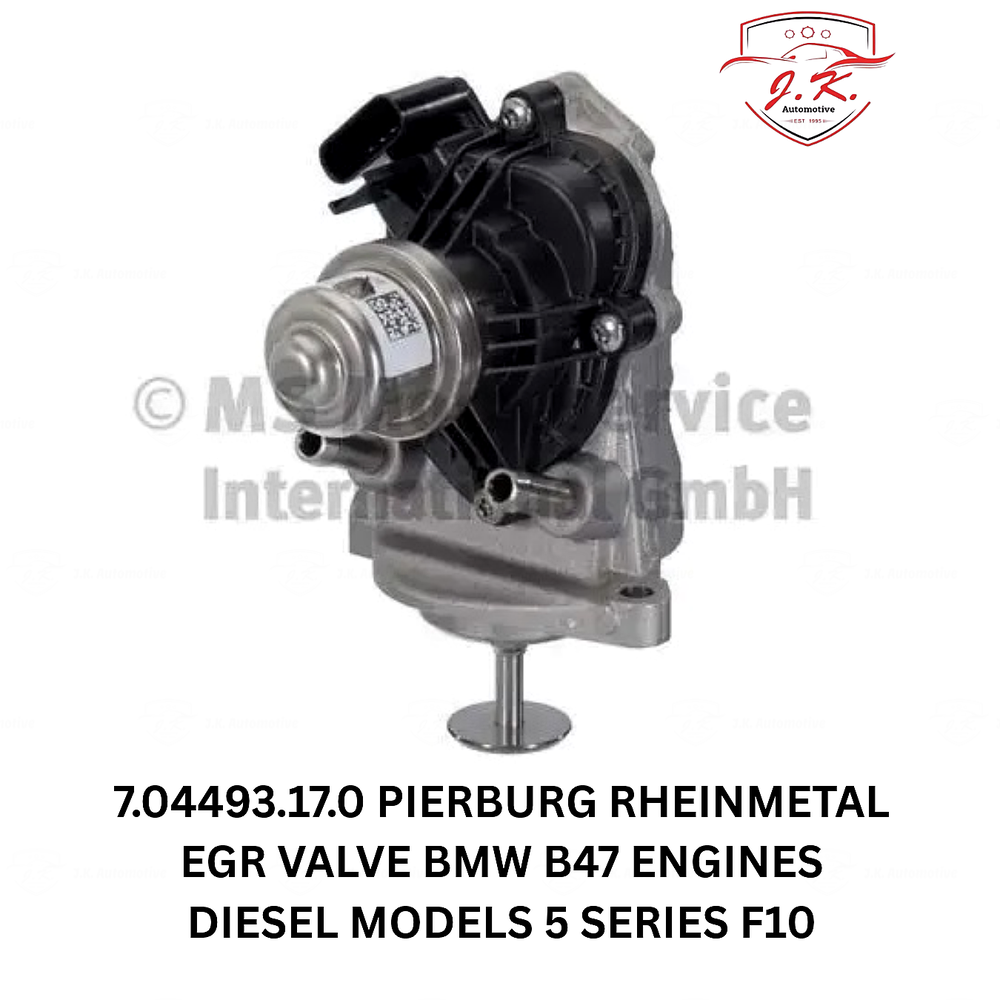
The Pierburg Rheinmetall Germany EGR Valve for BMW 5 Series (F10) B47 Diesel Engines – 7.04493.17.0 is an electrically operated exhaust-gas recirculation replacement component designed for compatible BMW diesel engine applications. Its complete manufacturer part number is 7.04493.17.0. EGR stands for Exhaust Gas Recirculation. The EGR system forms part of the vehicle's original emissions-control equipment. Its main purpose is to regulate how much exhaust gas returns to the engine's intake system. The BMW 5 Series F10 is an executive sedan available with several petrol and diesel engine configurations. Selected F10 diesel variants use BMW's B47 four-cylinder diesel engine family. The B47 engine must be distinguished from the earlier N47 engine because their emissions-control components can differ. Pierburg's application information identifies selected B47-equipped 518d, 520d and 520d xDrive versions for this reference. Diesel engines generate mechanical power through compression ignition. This process also produces heat and exhaust gases. Nitrogen oxides are among the pollutants generated under certain combustion conditions. Nitrogen oxide formation is influenced by combustion temperature and the availability of oxygen. The EGR system helps control these conditions during appropriate engine operation. It redirects a measured quantity of exhaust gas toward the engine intake. Recirculated gas replaces part of the incoming fresh-air charge. This changes the composition of gases entering the combustion chambers. Under suitable conditions, the process can reduce peak combustion temperatures. Lower peak temperatures help reduce nitrogen oxide formation. The engine-management system calculates the amount of exhaust-gas recirculation required. The EGR valve controls the flow according to electronic commands. Pierburg 7.04493.17.0 uses an electrically operated valve mechanism. Its actuator must operate correctly with the original BMW engine-management system. The required valve position changes according to engine operating conditions. Engine load, engine speed and operating temperature can affect the control strategy. Diesel exhaust contains soot and other combustion by-products. These materials can gradually accumulate in the recirculation passages. Heavy deposits may interfere with valve movement. Electrical actuator faults can also prevent normal operation. A defective EGR valve may contribute to an illuminated engine warning light. Drivers may also experience rough idling, hesitation or reduced acceleration response. However, these symptoms do not automatically establish EGR valve failure. Faulty sensors, restricted intake passages and turbocharger-control problems may produce similar complaints. Professional diagnosis is therefore recommended before replacing components. Pierburg also identifies a special installation requirement for this valve. It must be electrically energized using the appropriate diagnostic service function before being mounted into the EGR cooler module. Forcing an unpowered valve into position may damage its internal gearing. The original BMW OE reference must be compared with the proposed replacement. The complete vehicle VIN and exact B47 engine configuration must also be verified. Correct identification and professional installation help restore the intended emissions-control function. Customers should confirm compatibility before purchasing from JK Automotive Online India.
What is the part number and OEM reference of the Pierburg EGR valve for BMW 5 Series (F10) B47 diesel engines?
The Pierburg Rheinmetall Germany EGR valve manufacturer reference for this BMW 5 Series (F10) B47 diesel listing is 7.04493.17.0. This complete number must remain unchanged during product searches and purchase enquiries. Every digit and punctuation mark is important for accurate component identification. The number belongs to Pierburg's manufacturer numbering system. It is different from the original BMW equipment reference. Pierburg's technical service information identifies BMW reference 11 71 8 513 132 as a comparison number for this valve. This reference can also appear without spaces as 11718513132. Independent aftermarket catalogues list additional BMW OE comparisons. These include 11 71 8 580 442 and 11 71 9 886 715. Their continuous formats are 11718580442 and 11719886715. These references are useful when identifying the intended replacement component. However, they do not establish universal interchangeability for every BMW F10 diesel vehicle. The original factory equipment specification must still be checked. The F10 generation was produced with different diesel engine families. Some earlier vehicles use N47 engines. Selected later vehicles use the B47 diesel engine. Both engine families appear under similar model badges. Consequently, the 520d designation alone cannot confirm the correct EGR valve. Pierburg's catalogue lists selected 518d, 520d and 520d xDrive vehicles with B47 D20 A engines for this part. However, individual production and market specifications may differ. The first step is to obtain the complete vehicle identification number. A suitable BMW parts catalogue should be used to identify the original valve. The factory engine designation should also be confirmed. The existing EGR valve should be inspected for identifying markings. These markings may include a manufacturer label or stamped component reference. The original BMW OE number should be recorded. That number should be compared with current Pierburg application information. The replacement mounting points must correspond with the original assembly. Exhaust-gas passages and connecting fittings must also match. Relevant sealing surfaces should be compatible. Electrical connector compatibility is especially important. Pierburg 7.04493.17.0 is an electrically operated control valve. Its actuator must communicate correctly with the vehicle's original engine-management system. Similar-looking valves may contain different internal mechanisms. Visual resemblance alone cannot establish interchangeability. Pierburg identifies 7.04493.11.0 as a previous manufacturer reference replaced by 7.04493.17.0. However, this replacement relationship should not be used to bypass VIN and OE verification. The workshop must also understand the manufacturer's energized installation requirement. Incorrect fitting may damage the internal transmission gearing. Customers should provide the VIN and original component number when requesting assistance. Accurate verification helps avoid unsuitable purchases and unnecessary repair expenses. JK Automotive customers should confirm their exact BMW F10 B47 specification before ordering.
How does the Pierburg Rheinmetall Germany EGR Valve 7.04493.17.0 work in BMW 5 Series (F10) B47 diesel engines?
Pierburg Rheinmetall Germany EGR Valve 7.04493.17.0 regulates exhaust-gas recirculation in compatible BMW B47 diesel engines. The EGR system forms part of the vehicle's original emissions-control arrangement. BMW's B47 diesel engine generates power through compression ignition. This combustion process also produces heat and exhaust gases. Certain operating conditions encourage the formation of nitrogen oxides. Nitrogen oxide production is influenced by combustion temperature and available oxygen. The EGR system helps manage these factors during suitable engine operation. It redirects a controlled quantity of exhaust gas toward the intake circuit. Recirculated exhaust gas replaces part of the incoming fresh-air charge. This changes the composition of gases entering the engine cylinders. Under appropriate conditions, the process reduces peak combustion temperatures. Lower combustion temperatures can help limit nitrogen oxide formation. The EGR valve controls the quantity of exhaust gas passing through the recirculation circuit. The engine control unit calculates the required valve position. It sends electronic commands according to the programmed operating strategy. Pierburg 7.04493.17.0 is an electrically actuated EGR control valve. Its internal mechanism uses motor-driven gearing to move the valve head. The actuator must respond accurately to the original BMW engine-management system. Engine speed influences the required recirculation rate. Engine load is another important factor. Temperature and relevant sensor readings also affect the control strategy. The valve does not necessarily remain in one position throughout a journey. When the engine requests recirculation, the valve allows exhaust gas to flow through the relevant circuit. When reduced recirculation is needed, it restricts that flow. A valve stuck open can introduce excessive exhaust gas into the intake. This may interfere with combustion stability. Rough idling or hesitation may result. A valve stuck closed can prevent the intended quantity of recirculated exhaust gas. This may affect the engine's emissions-control operation. The engine-management system may detect abnormal behaviour and record a diagnostic fault code. Diesel exhaust contains soot and other combustion by-products. These deposits can accumulate around the EGR system. Excessive buildup may interfere with valve movement. Electrical actuator faults can also prevent correct operation. Damaged wiring or connectors may interrupt control signals. Related intake sensors and the EGR cooler may also influence system behaviour. A qualified technician should therefore evaluate the complete EGR circuit. Diagnostic equipment can help identify whether the valve responds correctly to commands. The installation procedure is especially important for this Pierburg reference. The manufacturer requires the actuator to be energized before mounting the valve into the EGR cooler module. This allows the valve head to retract slightly into the valve chamber. The valve should not be forced into position while unpowered. Correct component identification, installation and diagnostic procedures help restore the intended EGR function. Customers should verify their BMW F10 engine specification before purchasing from JK Automotive.
What are the common symptoms of a faulty Pierburg EGR valve in BMW 5 Series (F10) B47 diesel engines?
A faulty EGR valve may produce several symptoms affecting a BMW 5 Series (F10) B47 diesel engine. The symptoms depend on the type of failure and the vehicle's engine-management strategy. One possible indication is an illuminated engine warning light. The engine control unit may detect exhaust-gas recirculation outside its expected operating range. It may then record a diagnostic trouble code. However, an engine warning light does not automatically prove that the EGR valve itself has failed. Other emissions-system components may produce similar warnings. Rough engine idling is another possible symptom. A valve that remains open when it should close may permit excessive exhaust gas into the intake. This can interfere with stable combustion. The engine may then run unevenly. Drivers may experience hesitation during acceleration. Reduced engine response may also occur. Significant engine-management faults may sometimes activate a protective operating mode. This can limit available engine power. However, reduced power can have several different causes. Turbocharger-control problems may produce similar symptoms. Restricted intake passages can interfere with normal airflow. Fuel-injection faults may also cause irregular running. Increased exhaust smoke may justify further investigation. However, visible smoke alone cannot establish EGR valve failure. Fuel consumption may change when the engine operates abnormally. Nevertheless, fuel consumption is not a reliable standalone EGR diagnostic test. Diesel exhaust contains soot that can accumulate around the EGR mechanism. Heavy deposits may restrict valve movement. Electrical actuator faults may also prevent correct operation. Damaged wiring or poor connector contact can interrupt electronic commands. Defective engine sensors may produce related diagnostic faults. Problems involving the EGR cooler may also require investigation. A qualified technician should retrieve stored diagnostic fault codes. Live engine data can help identify abnormal recirculation behaviour. Commanded EGR operation may be checked with BMW-compatible diagnostic equipment. Relevant intake and exhaust passages should also be examined. Cleaning may help certain deposit-related problems when permitted by BMW. However, cleaning cannot repair every mechanical or electrical defect. The original cause should be established before replacing components. The existing BMW OE number must be matched with Pierburg 7.04493.17.0. The complete VIN and B47 engine designation should also be checked. Any relevant BMW EGR cooler service campaign should be verified separately by VIN. A cooler-related campaign does not automatically establish that the EGR valve needs replacement. Correct diagnosis helps prevent unnecessary repairs and unresolved problems. JK Automotive customers should confirm their original component before ordering.
How often should the Pierburg Rheinmetall Germany EGR Valve be replaced on a BMW 5 Series (F10) B47 diesel engine?
There is no universal replacement mileage that applies to every EGR valve fitted to BMW 5 Series (F10) B47 diesel engines. Component service life depends on original design, driving conditions and maintenance history. The supplied Pierburg manufacturer reference is 7.04493.17.0. This is an electrically operated exhaust-gas recirculation control valve. Its mechanism operates in an environment exposed to diesel exhaust gases. Diesel exhaust contains soot and other combustion by-products. These materials can gradually accumulate around the valve and connected passages. Heavy deposits may interfere with normal movement. Electrical components can also deteriorate over time. Wiring and connector problems may develop independently of the EGR valve itself. Therefore, a suspected failure should be diagnosed before replacement. Previous service records may help identify recurring emissions-system problems. Short city journeys and longer highway driving create different operating conditions. However, driving patterns alone cannot predict exactly when the component will fail. Any manufacturer-prescribed maintenance requirement should be confirmed through BMW service information. An EGR valve does not necessarily require replacement at a fixed mileage. Replacement is generally appropriate when a confirmed defect cannot be corrected through an approved repair. An engine warning light may justify inspection. However, the warning alone does not prove replacement is necessary. Rough idling or reduced acceleration may also require diagnosis. These symptoms can arise from other engine-management problems. Restricted intake passages may affect combustion. Turbocharger-control faults can reduce acceleration response. Defective sensors may send inaccurate information to the control unit. Fuel-injection problems may create similar complaints. Heavy soot deposits may justify inspection of the complete EGR circuit. Cleaning may sometimes be suitable when approved by BMW. However, cleaning cannot restore a failed electrical actuator. It may also be ineffective when the valve is mechanically damaged. Related EGR cooler components may require examination. Any relevant BMW service campaign should be checked by VIN. A qualified technician should follow the applicable diagnostic procedure. Stored fault codes should be interpreted alongside functional testing. The original BMW EGR reference must be identified before ordering. The vehicle VIN helps establish the factory engine and equipment specification. The replacement must match the mounting arrangement and electrical connections. Exhaust passages and sealing surfaces must also correspond with the original installation. Pierburg specifically requires this valve to be electrically energized during installation. A suitable diagnostic service function must be used before mounting. This helps prevent internal gearing damage. After fitting, required diagnostic adaptations should be completed. The engine should then be tested for normal operation. Customers should confirm exact compatibility before purchasing from JK Automotive Online India.
Can a faulty Pierburg EGR valve affect engine performance, fuel efficiency, emissions and reliability in BMW 5 Series (F10) B47 diesel engines?
A faulty EGR valve can affect the engine performance and emissions-control operation of a BMW 5 Series (F10) B47 diesel vehicle. The supplied manufacturer reference is Pierburg 7.04493.17.0. Exact compatibility must first be confirmed for the individual vehicle. The EGR system regulates the amount of exhaust gas returned to the engine intake. This process helps manage nitrogen oxide emissions during suitable operating conditions. The engine control unit calculates the required recirculation rate. The EGR valve responds by regulating the exhaust-gas flow. If the valve remains open when it should close, excessive recirculated gas may enter the intake. This can reduce the proportion of fresh air available for combustion. The engine may then experience unstable combustion. Rough idling may become noticeable. Drivers may also experience hesitation during acceleration. Reduced engine response is another possible symptom. If the valve remains closed when recirculation is required, the intended emissions-control function may be affected. The engine-management system may detect abnormal EGR behaviour. A diagnostic trouble code may then be stored. The vehicle may display an engine warning light. Significant faults can sometimes trigger a protective operating mode. Available engine power may then be limited. However, reduced power does not automatically prove EGR valve failure. Turbocharger-control problems may cause similar complaints. Restricted intake passages can interfere with normal airflow. Defective engine sensors may provide inaccurate information to the control unit. Fuel-injection faults may contribute to irregular running or exhaust smoke. These possibilities should be investigated before ordering a replacement. Fuel consumption may change when the engine operates abnormally. However, installing a new EGR valve does not guarantee better fuel efficiency. The main purpose of replacement is to restore the original exhaust-gas recirculation function. Heavy soot deposits may prevent correct valve movement. Electrical actuator faults may also affect operation. Damaged wiring or connectors can interrupt control signals. A qualified technician should inspect the wider EGR circuit. Diagnostic testing may include retrieving stored fault codes and reviewing live engine data. Commanded valve operation can be checked using suitable BMW-compatible equipment. The EGR cooler and related passages may require examination. Persistent engine warning lights should not be ignored. However, the consequences depend on the actual diagnosed fault. The original BMW OE reference must be checked before purchasing. Pierburg 7.04493.17.0 must match the VIN and factory B47 specification. Professional fitting is particularly important because this component requires an energized installation procedure. Correct replacement and diagnostic checks help restore the intended emissions-control operation. JK Automotive customers should verify their exact F10 diesel application before ordering.
How can I confirm that Pierburg Rheinmetall Germany EGR Valve 7.04493.17.0 fits my BMW 5 Series (F10) B47 diesel engine?
Confirming compatibility is essential before purchasing Pierburg Rheinmetall Germany EGR Valve 7.04493.17.0 for a BMW 5 Series (F10) B47 diesel engine. The complete manufacturer reference should remain unchanged during product searches and purchase enquiries. The product title identifies the BMW F10 chassis and B47 diesel engine family. However, the F10 was produced with different diesel engines. Earlier vehicles may use the N47 engine family. Some later vehicles use B47 engines. These engine families may require different EGR components. Pierburg's application catalogue identifies selected 518d, 520d and 520d xDrive vehicles with B47 D20 A engines for this reference. However, these listings do not establish universal fitment. The vehicle's exact original equipment specification must be verified. The first step is to obtain the complete vehicle identification number. The VIN should be checked against a suitable BMW parts catalogue. This can identify the factory engine and relevant emissions equipment. The original EGR valve should also be inspected for identification markings. These may include stamped numbers or manufacturer labels. The original BMW OE reference should be recorded. Pierburg's service information identifies 11 71 8 513 132 as an important comparison number. Other aftermarket catalogue comparisons include 11 71 8 580 442 and 11 71 9 886 715. These numbers must be checked against the individual vehicle. A catalogue cross-reference does not guarantee universal interchangeability. The replacement mounting arrangement must match the original assembly. Exhaust-gas passages and connecting fittings must correspond with the engine. Relevant sealing surfaces must also be compatible. The electrical connector requires particular attention. Pierburg 7.04493.17.0 is an electrically actuated EGR control valve. Its actuator and operating characteristics must match the factory system. Similar-looking valves may use different internal mechanisms. Visual resemblance alone cannot confirm compatibility. Pierburg also identifies 7.04493.11.0 as a previous manufacturer reference. However, this replacement relationship should not override the individual BMW OE requirement. The reported engine fault should be diagnosed before ordering. An engine warning light may result from defective wiring or sensors. Restricted intake passages may cause reduced acceleration. Turbocharger-control problems can produce similar complaints. The EGR cooler may also require inspection. The workshop must understand the special installation procedure. Pierburg states that 7.04493.17.0 must be energized before being mounted into the cooler module. Installing it without power may damage the internal gearing. Customers should provide their VIN, engine code and original EGR reference when requesting assistance. Accurate fitment verification helps prevent unsuitable orders and repeat repairs. JK Automotive customers should confirm the correct BMW F10 B47 application before purchasing.
What special installation precautions must be followed for Pierburg Rheinmetall Germany EGR Valve 7.04493.17.0 on BMW 5 Series (F10) B47 diesel engines?
Pierburg Rheinmetall Germany EGR Valve 7.04493.17.0 has a manufacturer-specific installation requirement that must be followed on compatible BMW 5 Series (F10) B47 diesel engines. Pierburg technical service information SI 1597 specifically identifies the F10 among the affected vehicle series. The manufacturer states that this electromotive EGR valve must be installed in an electrically energized condition. Installing it while unpowered can damage its internal transmission gearing. The component contains an electric actuator that controls movement of the valve head. When the valve is not energized, its gearing is positioned at a mechanical end stop. The valve head may then obstruct correct insertion into the cooler module. Attempting to force the valve into position can apply excessive load to the mechanism. That force can damage internal gearing before the engine is started. Therefore, this component should not be treated as an ordinary bolt-on replacement. Before installation, the vehicle VIN should be checked. The original BMW OE reference must also be verified. The correct B47 engine specification should be identified. The replacement's mounting points and electrical connections must match the original assembly. The underlying engine fault should be diagnosed before components are removed. The engine and exhaust system must be allowed to cool. Appropriate tools and protective equipment should be used. The relevant BMW workshop instructions should guide disassembly. Nearby wiring, hoses and connected components should be protected. The original electrical connector should be inspected for corrosion or damage. Connected EGR passages should be examined for contamination. Mounting surfaces should be checked for damage and soot buildup. Appropriate seals and designated single-use hardware must be used. The actual package contents should be checked before installation. Pierburg specifies that the electrical plug connection must be connected to the valve before mounting. A suitable diagnostic engine tester must then be connected to the vehicle. The technician should select the service function for replacing the EGR valve. This function supplies electrical power to the actuator. The valve head should then retract slightly into the valve chamber. This movement indicates that the component has reached the required installation condition. Only after this step should the valve be mounted into the EGR cooler module. The technician should not attempt to retract the valve head manually by applying force. The manufacturer warns that doing so may damage the internal transmission mechanism. Once the valve is correctly positioned, the mounting procedure should be completed according to BMW instructions. Fasteners should be tightened to the applicable specifications. Exhaust connections and seals must be checked carefully. The electrical connector should be secured correctly. Disturbed components should be reinstalled according to the workshop procedure. The appropriate diagnostic adaptation or initialization should be completed. Stored fault codes should then be reviewed. The engine should be tested for normal operation. Exhaust connections should be checked for leakage. Relevant live engine data may help verify EGR response. Professional installation using the correct diagnostic function helps prevent avoidable damage and repeat repairs. Customers should ensure that the workshop understands the specific Pierburg energized installation requirement before fitting this component.
Why should BMW 5 Series (F10) B47 diesel owners consider Pierburg Rheinmetall Germany EGR Valve 7.04493.17.0 for replacement?
Pierburg Rheinmetall Germany is an established manufacturer of automotive engine-management and emissions-control components. Its product range includes exhaust-gas recirculation valves for several diesel engine applications. BMW 5 Series (F10) B47 diesel owners may consider a compatible Pierburg replacement when their original EGR valve requires attention. The supplied manufacturer reference is 7.04493.17.0. Its exact compatibility must be confirmed before purchasing. Pierburg's experience manufacturing emissions-control components is one factor customers may consider. A correctly functioning EGR valve regulates the return of exhaust gases into the intake system. This helps manage nitrogen oxide formation during appropriate engine operation. The BMW B47 diesel engine uses several electronic and mechanical systems to manage combustion and emissions. The EGR valve forms part of this arrangement. Its actuator must respond accurately to engine-management commands. Pierburg 7.04493.17.0 is identified as an electrically operated control valve. Published catalogue information also lists the product with a gasket or seal. Pierburg provides technical service information for the component. This documentation identifies an important energized installation requirement. Such technical instructions are useful to qualified workshops. A correctly matched valve may restore intended EGR operation when the original component is defective. However, replacing the valve cannot resolve every engine-management problem. Faulty intake sensors may continue to produce warning lights. Restricted intake passages can affect acceleration. Turbocharger-control problems may reduce engine response. Fuel-system faults may contribute to irregular running. Damaged wiring can prevent correct actuator operation. Heavy soot deposits may also affect the wider EGR circuit. Accurate diagnosis helps identify the actual repair requirement. Product authenticity is another important consideration. Customers should inspect manufacturer packaging and identification markings. The reference printed on the component should match the ordered product. Warranty conditions and supplier support should also be reviewed. The replacement mounting arrangement must match the original assembly. Exhaust passages and sealing surfaces must be compatible. The electrical connector should correspond with the factory system. The original BMW OE reference provides important identification information. The complete VIN helps establish the correct engine application. Professional installation is especially important for this specific valve. An unpowered installation attempt may damage the internal gearing. A suitable BMW-compatible diagnostic tester is needed to perform the manufacturer-prescribed service function. Connected EGR passages and cooler components should be examined when contamination is suspected. Any required adaptation should be completed according to BMW instructions. Customers should not expect guaranteed increases in horsepower or fuel economy simply from replacing the EGR valve. Its main purpose is to restore the original exhaust-gas recirculation function. Pierburg 7.04493.17.0 should be matched with current application information. JK Automotive customers should verify their original BMW component before purchasing.
Why is Pierburg Rheinmetall Germany considered a suitable EGR valve brand for BMW 5 Series (F10) B47 diesel engines compared with BorgWarner, Delphi, HELLA and other aftermarket manufacturers?
Pierburg Rheinmetall Germany is an established manufacturer of automotive engine-management and emissions-control components. Other manufacturers, including BorgWarner, Delphi and HELLA, also supply replacement EGR components for different diesel engine applications. Selecting a suitable EGR valve requires comparing exact technical specifications rather than relying solely on manufacturer reputation. The supplied Pierburg reference for this BMW 5 Series (F10) B47 diesel application is 7.04493.17.0. Exact compatibility must first be established for the individual vehicle. This component is an electrically operated EGR control valve. Its actuator and electrical operating characteristics must correspond with the original BMW engine-management system. Any competing replacement must meet the same factory equipment requirements. Mounting points should match the existing installation. Exhaust-gas passages and connecting fittings must be compatible. Relevant sealing surfaces must correspond with the original assembly. Electrical connectors and control characteristics must also match. Similar-looking EGR valves may use different internal mechanisms. Their actuators may require different installation procedures. Visual resemblance alone cannot establish interchangeability. Current manufacturer catalogue data should guide comparisons. Pierburg has experience producing automotive emissions-control equipment. However, that does not establish that every Pierburg valve is superior to every BorgWarner, Delphi or HELLA component. Other reputable manufacturers may provide suitable replacements for specific BMW applications. A meaningful comparison requires identifying each manufacturer's exact component reference. Independent aftermarket catalogues list Delphi EG10560-12B1 among comparison candidates for this Pierburg valve family. Other catalogues may include BorgWarner or HELLA components for related applications. However, such listings are not universal fitment guarantees for every F10 B47 vehicle. The original BMW OE number must still be checked. The VIN and exact engine configuration should also be verified. Reliability depends on component design and manufacturing quality. Operating conditions and maintenance influence service life. Heavy soot buildup can affect EGR valves from different manufacturers. Wiring defects may prevent electrical operation regardless of brand. Professional diagnosis is therefore important before replacement. Correct installation is another major consideration. Pierburg specifically requires its 7.04493.17.0 valve to be electrically energized during mounting. Attempting to force an unpowered valve into position can damage the internal gearing. Competing products may have their own installation requirements. Those instructions should also be followed. Damaged seals may allow exhaust leakage. Incorrect mounting may damage components. Poor electrical connections can create engine-management faults. Required diagnostic adaptations should not be omitted. These problems do not automatically establish inferior component quality. Product authenticity should be checked before purchasing. Manufacturer markings and packaging should be inspected. Warranty conditions and technical support should also be compared. Price and availability can influence the final purchase decision once compatibility is confirmed. A lower price does not automatically guarantee better value. A higher price does not independently prove longer service life. Reliable durability comparisons require suitable application-specific evidence. Without that evidence, universal manufacturer superiority claims cannot be justified. Pierburg may be a suitable replacement when the BMW original equipment specification matches this component. Competing manufacturers may also offer suitable products when their compatibility has been confirmed. The final selection should prioritize exact fitment, authentic manufacturing, technical quality, professional installation and warranty support.

Reviews
There are no reviews yet.