What are Mercedes-Benz GLA X156 Front Lower Arms and what is their function?
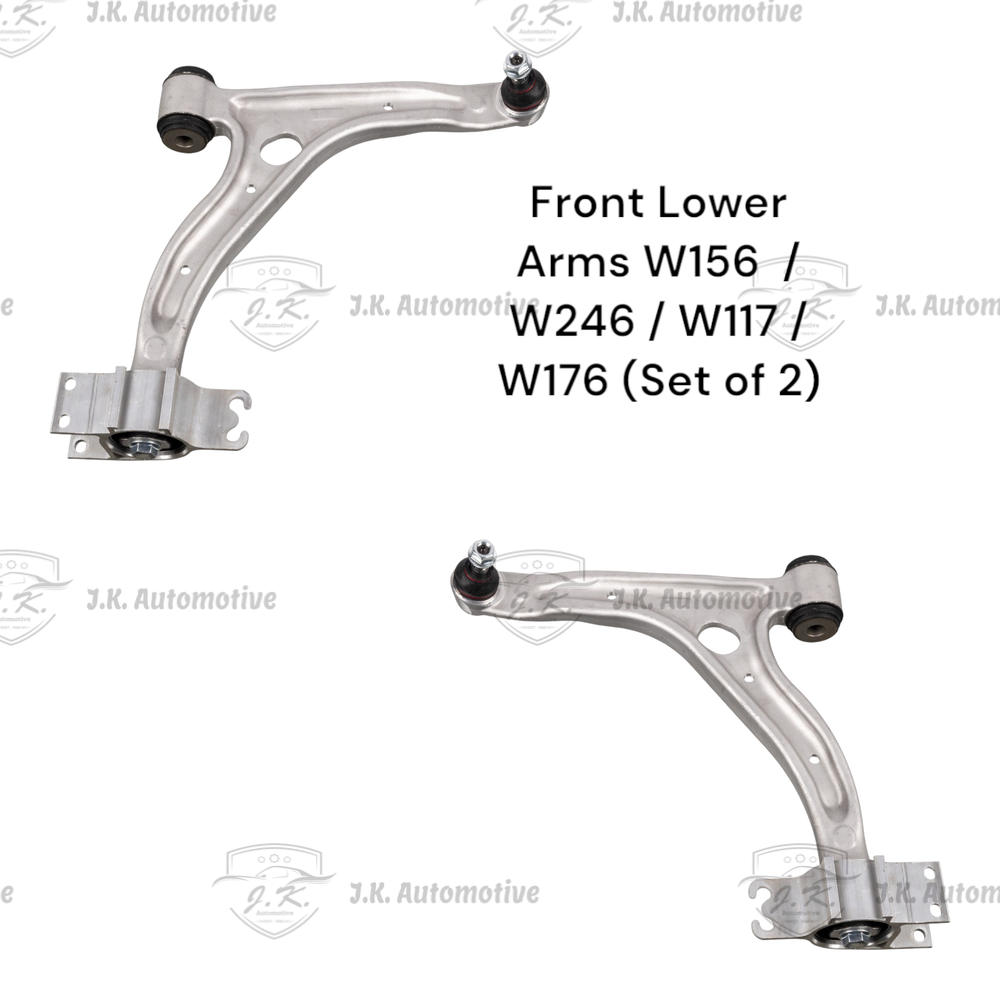
Mercedes-Benz GLA X156 Front Lower Arms are important wheel-locating components of the front suspension system, and this Set of 2 is intended for Mercedes-Benz GLA X156 Models from 2013–2020. The supplied OEM reference groups are A2463304700 / A2463301707 / A2423300700 & A2463304800 / A2463301807 / A2423300800, covering the corresponding components on both sides of the front axle. The primary purpose of these suspension arms is to connect and locate the wheel assemblies relative to the vehicle structure while allowing controlled vertical movement as the suspension compresses and rebounds. During braking, acceleration, cornering and driving over uneven roads, the components help keep each wheel positioned according to the intended suspension geometry. This is important because steering accuracy depends not only on the steering system but also on the suspension maintaining controlled wheel location. The bushes incorporated into the assemblies help isolate vibration while accommodating the limited movement necessary for suspension operation, while the joint arrangement permits articulation as the wheel travels and steers. Over time, repeated road loads, potholes, mileage, heat and ageing can deteriorate bushes or joints. When excessive movement develops, the vehicle may begin to show knocking or clunking noises, vague steering, reduced directional stability or abnormal tyre wear. Changes may be particularly noticeable during braking or when driving over broken surfaces because suspension loads change rapidly in these situations. However, these symptoms do not automatically prove that the arms require replacement. Tie rod ends, ball joints, wheel bearings, shock absorbers, strut mounts and stabilizer-system components can produce similar symptoms. Sway bar links, sway links, anti roll link rods and stabiliser sway links should therefore be inspected during diagnosis. Tyres should also be examined for inner-edge wear, outer-edge wear, feathering and differences in tread depth between sides. When the suspension arms are professionally diagnosed as worn, replacing the required components can restore controlled wheel positioning and provide a sound mechanical foundation for accurate alignment. Correctly functioning components support steering precision, braking stability, predictable cornering, consistent tyre contact and refined ride quality. The exact OEM references should always be verified before ordering, and professional installation followed by a wheel-alignment check is recommended.
Which Mercedes-Benz GLA X156 models are compatible with A2463304700 / A2463301707 / A2423300700 & A2463304800 / A2463301807 / A2423300800?
This Front Lower Arms Set of 2 is specified for the Mercedes-Benz GLA X156 from 2013–2020 and uses OEM references A2463304700 / A2463301707 / A2423300700 & A2463304800 / A2463301807 / A2423300800. These multiple references are important because manufacturers may introduce revised or superseding component numbers during a vehicle's production and service life. The first group identifies one side of the suspension application, while the second group covers the corresponding opposite side, providing a matching pair for the front axle. Compatibility should nevertheless be established using more than the vehicle name alone. The chassis designation should be confirmed as X156, the supplied 2013–2020 year range should be checked, and the relevant OEM numbers should ideally be compared with the original components or a vehicle-specific parts catalogue. VIN-based verification is particularly useful where different engine, drivetrain, production-date or suspension configurations may exist. This approach reduces the risk of ordering a visually similar component with different dimensions, mounting points or geometry. Correct fitment is especially important for suspension components because the arm influences the physical location of the wheel assembly. An incorrect component could therefore affect installation as well as suspension behaviour. Once compatibility has been established, the Set of 2 provides the corresponding components required for both sides. If both original assemblies have developed age-related bush or joint deterioration, replacing the pair can provide more consistent suspension response across the axle. Replacement should still be based on inspection rather than mileage alone because actual component life varies according to road conditions, driving environment and vehicle usage. Workshops should inspect the bushes, joints, mounting points and surrounding hardware before installation. Tie rod ends, wheel bearings, shock absorbers, strut mounts and other suspension bushes should be checked at the same time. The stabilizer system should also be inspected, including sway bar links, sway links, anti roll link rods and stabiliser sway links. Tyres can provide additional evidence of suspension problems and should be checked across the complete tread surface. After installation, a professional wheel-alignment check is recommended to verify geometry and help maintain balanced tyre wear, predictable steering and stable handling.
What do OEM references A2463304700 / A2463301707 / A2423300700 and A2463304800 / A2463301807 / A2423300800 mean?
The numbers A2463304700 / A2463301707 / A2423300700 and A2463304800 / A2463301807 / A2423300800 are the OEM reference groups associated with this Front Lower Arms Set of 2 for the Mercedes-Benz GLA X156 from 2013–2020. OEM references are one of the most useful methods of identifying the intended automotive component because several suspension arms can look similar while differing in dimensions, mounting arrangements or application. Multiple numbers grouped for each side commonly indicate references associated with the same component family, including revisions or superseded numbers introduced during production and subsequent parts servicing. For this product, the complete reference sequence should be preserved and checked when determining compatibility: A2463304700 / A2463301707 / A2423300700 & A2463304800 / A2463301807 / A2423300800. Customers should ideally compare these references with the original parts, a reliable vehicle catalogue or VIN-specific information before ordering. This is more precise than purchasing solely on the basis of a product photograph or a broad description such as “Mercedes GLA lower arm.” Correct identification matters because the suspension arm establishes an important connection between the wheel assembly and chassis. Its mounting locations and geometry must correspond with the intended vehicle application for the suspension to operate correctly. Once fitted, the components permit suspension travel while restricting unwanted wheel movement during braking, acceleration and cornering. Their bushes help absorb road vibration and accommodate controlled movement, while the joints allow articulation as the suspension travels. Deterioration of these areas can create excessive movement that affects steering response and road behaviour. Possible symptoms include knocking, vibration, reduced steering precision and unusual tyre wear. However, correct diagnosis remains important because tie rods, wheel bearings, shock absorbers, strut mounts and stabilizer links can produce similar symptoms. The condition of surrounding parts should therefore be assessed before installation. Matching the OEM numbers correctly, installing the components professionally and checking wheel alignment afterwards provides a more complete approach to repairing the GLA X156 suspension and protecting tyre life.
What are the symptoms of worn Front Lower Arms on a Mercedes-Benz GLA X156?
Worn front suspension arms on a Mercedes-Benz GLA X156 can produce several symptoms involving noise, steering response, wheel control, braking behaviour and tyre wear. One commonly reported indication of suspension wear is knocking or clunking when travelling over potholes, speed breakers, rough roads or uneven surfaces. As bushes or joints deteriorate, additional movement can develop within the suspension, allowing components to move beyond their intended operating range as loads change. Steering can also begin to feel less precise because the front wheels depend on the suspension arms to maintain consistent positioning. A driver may notice increased steering correction, reduced confidence during lane changes or a less settled feeling while cornering. Braking can expose suspension wear because substantial forces pass through the wheel-locating components when vehicle weight transfers forward. Excessive movement may make the vehicle feel less stable or consistent during braking. Tyre wear is another useful diagnostic clue. Inner-shoulder wear, outer-shoulder wear, feathering or rapid deterioration of one tyre should prompt inspection of both suspension condition and wheel geometry. These symptoms do not necessarily mean that A2463304700 / A2463301707 / A2423300700 & A2463304800 / A2463301807 / A2423300800 require replacement, because other components can cause similar behaviour. Tie rod ends, ball joints, wheel bearings, shock absorbers and strut mounts should be inspected as part of a systematic diagnosis. Sway bar links, sway links, anti roll link rods and stabiliser sway links are particularly relevant when the main complaint is knocking over uneven roads because worn stabilizer joints can generate similar sounds. Technicians should inspect bushes for deterioration, cracking or separation and check joints for excessive movement according to the appropriate service procedure. The mounting points should also be examined for impact damage, particularly if symptoms began after hitting a severe pothole. If the relevant components are confirmed worn, replacement can help restore controlled wheel positioning. A subsequent alignment check helps establish correct geometry and can reduce the risk of continuing abnormal tyre wear. Maintaining the complete suspension system in serviceable condition supports predictable steering, stable braking, consistent cornering and refined Mercedes-Benz GLA X156 ride quality.
Why should both Mercedes-Benz GLA X156 Front Lower Arms be replaced as a Set of 2 when both are worn?
Replacing the corresponding suspension arms as a Set of 2 can be beneficial when inspection confirms significant wear on both sides of the Mercedes-Benz GLA X156 front axle. The left and right components operate under broadly similar mileage, road conditions, braking forces, cornering loads and environmental exposure, so age-related deterioration may occur on both sides over time. This product combines OEM reference groups A2463304700 / A2463301707 / A2423300700 & A2463304800 / A2463301807 / A2423300800 into one Set of 2 for the supplied 2013–2020 application. When both original components are worn, installing a corresponding pair can help provide more consistent bush and joint behaviour from side to side. This matters because the suspension is responsible for maintaining predictable wheel location as vehicle loads change. If one side has a serviceable replacement while the opposite side has severe bush deterioration or excessive joint movement, suspension response can potentially differ across the axle. However, pair replacement should not be treated as an absolute requirement in every repair situation. If one arm suffers isolated impact damage while the opposite component is professionally inspected and found to be serviceable, the correct repair should follow the vehicle's condition and applicable service procedure. When both sides display comparable age-related wear, a Set of 2 offers a comprehensive repair solution. Before fitting the replacement pair, the technician should inspect the mounting points, fasteners and nearby suspension hardware. Steering components, tie rod ends, wheel bearings, shock absorbers and strut mounts should also be checked because replacing the arms will not resolve a separate fault elsewhere. Sway bar links, sway links, anti roll link rods and stabiliser sway links should be inspected for play or damaged boots. Tyres should be checked for pressure, damage and irregular tread wear. If severe inner or outer shoulder wear is already present, correcting the suspension fault cannot restore the lost tread, so tyre replacement may also be necessary. After installation, wheel geometry should be checked. A properly repaired and aligned suspension can help restore balanced wheel control, steering precision, braking stability and consistent tyre contact while maintaining the comfortable driving characteristics of the Mercedes-Benz GLA X156.
Is wheel alignment necessary after replacing Mercedes-Benz GLA X156 Front Lower Arms?
A professional wheel-alignment check is strongly recommended after replacing Mercedes-Benz GLA X156 Front Lower Arms because these suspension components help establish the physical position and movement of the front wheel assemblies. The Set of 2 uses OEM reference groups A2463304700 / A2463301707 / A2423300700 & A2463304800 / A2463301807 / A2423300800 for the supplied 2013–2020 application. When the original bushes or joints become worn, excessive movement may allow wheel geometry to vary under braking, acceleration or cornering loads. Replacing worn components removes this unwanted play, but alignment should subsequently be measured to verify that the complete suspension is operating with appropriate geometry. This is particularly important if the vehicle previously displayed steering pull, an off-centre steering wheel, uneven tyre wear or instability. Before performing alignment, the technician should confirm that the suspension and steering system is mechanically sound. Attempting to align a vehicle while tie rod ends, wheel bearings, suspension bushes or other joints have excessive play can produce unreliable measurements and will not correct the underlying mechanical problem. Shock absorbers, strut mounts and mounting hardware should therefore be inspected before final adjustment. Sway bar links and related anti-roll components should also be checked where suspension noise is present. Tyre pressures and tread condition should be examined because tyre problems can influence vehicle behaviour even after suspension repairs are completed. Once the mechanical system is confirmed serviceable, alignment equipment can be used to measure the relevant geometry and identify whether further adjustment or investigation is required. Correct geometry supports consistent tyre contact and helps reduce unnecessary inner-edge or outer-edge wear. It also contributes to predictable steering response, straight-line stability and controlled cornering. Alignment cannot compensate for bent, damaged or incorrectly fitted components, so abnormal readings should be properly investigated rather than simply adjusted wherever possible. Professional installation of the replacement pair followed by suspension inspection and wheel alignment provides a comprehensive repair approach. This helps the Mercedes-Benz GLA X156 maintain balanced tyre wear, stable braking, precise steering and refined road behaviour.
How do worn Mercedes-Benz GLA X156 Front Lower Arms affect steering, handling and driving stability?
Worn Mercedes-Benz GLA X156 Front Lower Arms can affect steering precision, wheel control, braking stability, tyre contact and the overall driving behaviour of the vehicle because these components form an important part of the front suspension geometry. This Set of 2 uses OEM references A2463304700 / A2463301707 / A2423300700 & A2463304800 / A2463301807 / A2423300800, with A2463304700 corresponding to the left-hand arm and A2463304800 to the right-hand arm. Parts catalogues also associate A2463301707 with the left side and A2463301807 with the right side. When the bushes and joints are in good condition, they allow the suspension to move while keeping the wheel assembly properly located relative to the chassis. As wear develops, excessive movement may occur under acceleration, braking and cornering loads. The driver may notice that steering feels less direct, the vehicle requires more correction on uneven roads, or the front end feels less planted during quick directional changes. Braking can also expose worn suspension components because weight transfers towards the front axle and places additional loads through the wheel-locating arms. If the bushes have excessive movement, the wheel position can change slightly under load, reducing the stable and controlled feeling expected from the GLA. Cornering performance can similarly deteriorate because accurate suspension geometry helps maintain consistent tyre contact with the road. Knocking or clunking over potholes, speed breakers and broken surfaces may also occur when bushes, joints or mounting areas have excessive movement. Tyre condition should be monitored because abnormal inner-edge wear, outer-edge wear or feathering may accompany suspension or alignment problems. However, these symptoms are not unique to the control arms. Tie rod ends, wheel bearings, shock absorbers, strut mounts and other suspension bushes can produce similar behaviour. Sway bar links, sway links, anti roll link rods and stabiliser sway links should also be checked when knocking is present. A technician should therefore diagnose the complete suspension rather than replacing components based only on one symptom. When worn parts are correctly identified and renewed, controlled wheel location can be restored, providing a better mechanical foundation for accurate alignment. This can help recover steering confidence, braking stability, predictable cornering, balanced tyre wear and refined ride quality.
Can worn Mercedes-Benz GLA X156 Front Lower Arms cause uneven tyre wear and wheel alignment problems?
Yes, deterioration within the front suspension can contribute to abnormal tyre wear and unstable wheel geometry because the lower control arms help maintain the position of the wheel assemblies relative to the chassis. For this application, the Set of 2 carries OEM references A2463304700 / A2463301707 / A2423300700 & A2463304800 / A2463301807 / A2423300800. A2463304700 is catalogued as a front axle left lower control arm supplied with a ball joint and bushing, while A2463304800 is the corresponding right-side component. These bushes and joints must allow normal suspension articulation while restricting movement outside the intended range. As rubber bushes deteriorate or joints develop excessive play, the wheel assembly can potentially move under acceleration, braking or cornering forces. This is particularly important because wheel geometry is not simply a static measurement; the suspension must also maintain controlled geometry while the vehicle is moving and experiencing changing loads. Excessive movement can contribute to irregular tyre contact and may result in inner-shoulder wear, outer-shoulder wear, feathering or other unusual tread patterns. A driver might also notice steering pull, an off-centre steering wheel or reduced directional stability, although these symptoms can originate from several different faults. Incorrect tyre pressure, damaged tyres, bent wheels, worn tie rod ends, wheel-bearing play and incorrect alignment can all contribute to abnormal tyre wear. For that reason, tyres should be inspected across their entire tread surface and suspension components should be checked before an alignment is attempted. Simply adjusting alignment without repairing excessive mechanical play may not provide a lasting solution because the wheel can continue changing position when road forces act on the suspension. If the arms are confirmed worn, replacing the necessary components can remove unwanted movement and provide a more stable foundation for geometry adjustment. Related parts such as ball joints, steering joints, shock absorbers and strut mounts should be inspected simultaneously. Stabilizer components, including sway bar links, sway links, anti roll link rods and stabiliser sway links, should also be checked for wear. After mechanical repairs are completed, professional wheel alignment is recommended. Correct suspension condition, suitable tyre pressure and accurate geometry work together to support even tyre wear, stable road contact, predictable steering and controlled handling.
What other suspension and steering components should be inspected when replacing the Mercedes-Benz GLA X156 Front Lower Arms?
When replacing the Mercedes-Benz GLA X156 Front Lower Arms, it is advisable to inspect the complete front suspension and steering system because the control arms operate as part of an interconnected assembly rather than as isolated components. The supplied Set of 2 uses OEM references A2463304700 / A2463301707 / A2423300700 & A2463304800 / A2463301807 / A2423300800 and is listed by JK Automotive for the GLA X156 2013–2020 application. The first inspection points should include the bushes, ball joints, mounting points and fasteners associated with the arm assemblies. Tie rod ends should also be examined because steering-joint play can produce symptoms such as vague steering, knocking and abnormal tyre wear that can easily be confused with control-arm deterioration. Wheel bearings should be checked for excessive movement, noise or roughness because bearing wear can affect wheel stability. Shock absorbers should be inspected for leakage, physical damage and poor damping, while strut mounts and bearings should be checked for deterioration or unusual noises. The anti-roll-bar system is another important area. Sway bar links, sway links, anti roll link rods and stabiliser sway links can develop joint play and produce knocking over potholes or rough surfaces, while worn stabilizer bushes can create additional movement or noise. Steering components should be examined for looseness, damaged protective boots or other visible deterioration. The tyres can also provide valuable diagnostic information. Inner-edge wear, outer-edge wear, feathering, cupping or substantial differences between the two front tyres may indicate suspension, steering or alignment issues. Tyre pressures should be checked because incorrect inflation can independently create abnormal tread wear and poor handling. Wheels should be inspected for impact damage, particularly when suspension problems began after a severe pothole strike. Mounting areas should similarly be checked for deformation or other evidence of impact. A comprehensive inspection prevents a situation where new suspension arms are installed while another badly worn component remains in service and continues producing noise or poor handling. Once all diagnosed faults have been corrected, the suspension should be checked for secure installation and unrestricted movement. A professional wheel-alignment check should then be performed to confirm geometry and help protect the tyres. This complete repair approach can help maintain precise steering, stable braking, predictable cornering and refined road behaviour.
Why is professional installation and wheel alignment recommended after fitting this Set of 2?
Professional installation is recommended because these wheel-locating suspension components directly influence how the front wheel assemblies move and remain positioned under driving loads. The product uses OEM references A2463304700 / A2463301707 / A2423300700 & A2463304800 / A2463301807 / A2423300800, and independent catalogue information identifies A2463304700 as the left-side control arm and A2463304800 as the corresponding right-side unit. Correct installation involves more than simply removing the original components and bolting replacement parts into place. The vehicle must be safely supported, fasteners must be removed and installed using the appropriate procedure, and mounting points must be inspected for damage. The technician should ensure that surrounding brake, steering and suspension components are not damaged during removal or installation. Bushings must operate within their intended movement range, so correct fitting and tightening procedures are important for service life and suspension performance. Before completing the repair, the technician should inspect tie rod ends, ball joints, wheel bearings, shock absorbers, strut mounts and related bushes. Sway bar links and other anti-roll components should also be checked because worn joints can continue producing knocking even after the new arms are fitted. Tyres should be examined for uneven wear, damage and correct inflation. Once the mechanical repair is complete, a professional wheel-alignment check becomes important because the suspension now has serviceable wheel-locating components instead of the worn assemblies that were previously allowing unwanted movement. Alignment measurements can establish whether the vehicle's geometry is appropriate and can also reveal whether another problem remains. If a measurement cannot be brought into the required range, technicians can investigate for bent, worn or incorrectly fitted components instead of attempting to compensate for a mechanical fault through adjustment. Accurate geometry helps maintain predictable steering response, straight-line stability and consistent tyre contact. It can also help prevent unnecessary inner or outer tyre wear. Professional installation combined with a post-repair alignment therefore provides a more complete solution than simply replacing the components and returning the vehicle to service.
Why is Stokes Germany a European-quality alternative to Lemförder, FEBI, Meyle and other established brands for Mercedes-Benz GLA X156?
Stokes Germany provides an aftermarket replacement option for customers seeking a complete Set of 2 for the Mercedes-Benz GLA X156 using OEM references A2463304700 / A2463301707 / A2423300700 & A2463304800 / A2463301807 / A2423300800. The JK Automotive listing identifies this exact product as Stokes Germany and specifies compatibility with the Mercedes-Benz GLA X156 for the supplied 2013–2020 range. These OEM reference families are established front suspension applications, with A2463304700 catalogued for the left side and A2463304800 for the right side; aftermarket catalogues also list equivalent control-arm products against these references. When comparing Stokes Germany with established suspension brands such as Lemförder, FEBI and Meyle, customers should evaluate the exact OEM cross-reference, vehicle compatibility, component specification, warranty terms, price and availability rather than choosing solely on the brand printed on the box. Correct fitment remains the most important starting point because even a premium-quality suspension component will not perform correctly if it is intended for a different application. The vehicle should therefore be confirmed as GLA X156 within the supplied year range, and the OEM references should be compared with the original components or checked using vehicle-specific information. A Set of 2 can be particularly useful when inspection confirms age-related deterioration on both sides because matching replacement components can provide consistent suspension behaviour across the axle. These arms play an important role in maintaining wheel location during acceleration, braking and cornering, while their bushes and joints permit controlled suspension articulation. Serviceable components therefore support steering precision, stable braking, consistent tyre contact and refined ride behaviour. Professional installation is equally important regardless of the replacement brand selected. The technician should inspect mounting hardware and surrounding components and ensure the assemblies are installed using the correct repair procedure. Tie rod ends, wheel bearings, shocks, strut mounts and suspension bushes should be checked during the same service. Sway bar links, sway links, anti roll link rods and stabiliser sway links should also be examined for wear. Finally, the tyres and wheel geometry should be inspected after installation. When correctly selected, professionally installed and combined with proper alignment, the Stokes Germany Set of 2 provides a practical premium aftermarket suspension repair option for the Mercedes-Benz GLA X156.





Reviews
There are no reviews yet.