What are the Front Lower Arms for Mercedes-Benz GL Class X166 and what is their function?
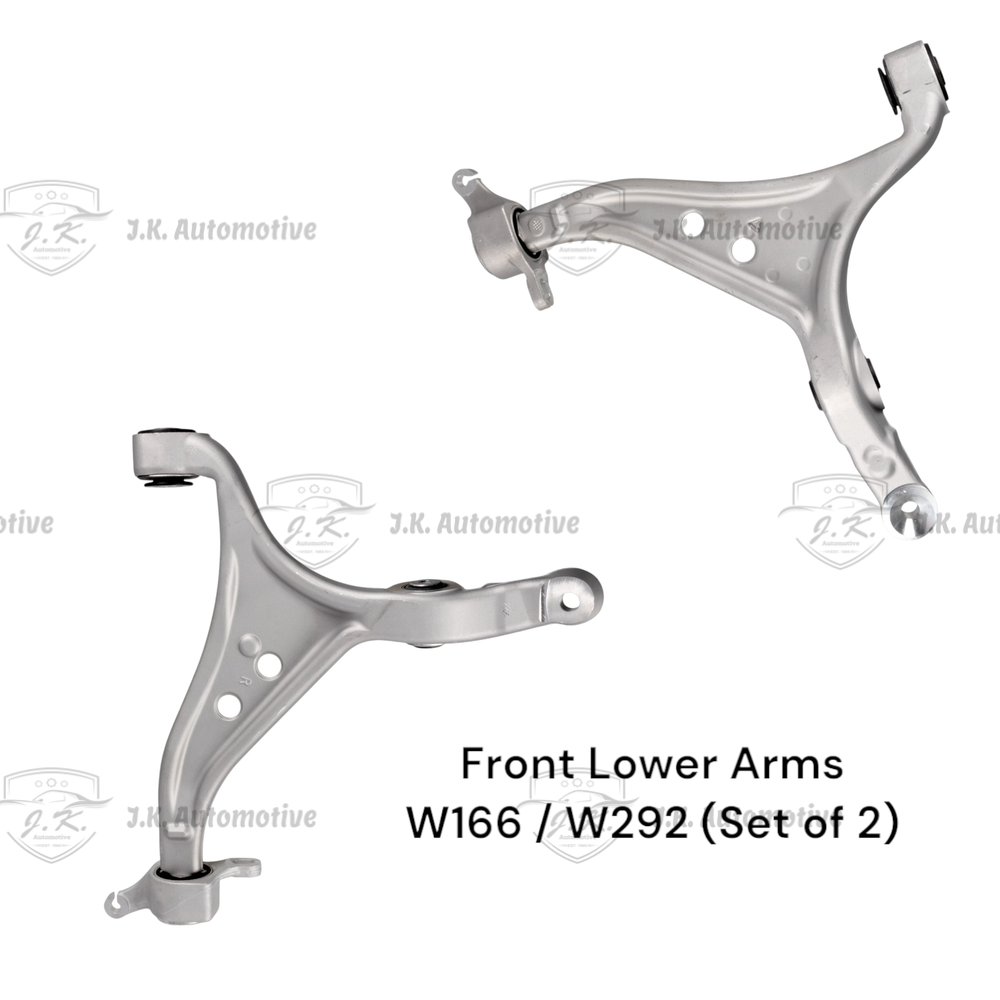
The Front Lower Arms for Mercedes-Benz GL Class X166 are major suspension components that connect the front wheel assemblies to the vehicle chassis and help control wheel position, suspension movement, steering stability and front-end geometry during everyday driving. This product is supplied as a set of 2 for compatible Mercedes-Benz GL Class X166 models produced from 2012 to 2019 and corresponds with OEM reference numbers A1663300107 and A1663300207, subject to VIN and original part-number verification. The lower arms allow the front suspension to move in a controlled way when the vehicle travels over potholes, speed breakers, uneven roads and changing surfaces while helping keep the front wheels correctly positioned relative to the body. They are important because the front wheels must remain stable during braking, acceleration and cornering, especially on a large luxury SUV such as the GL Class X166 where suspension components handle significant vehicle weight and road forces. When the driver turns the steering wheel, the lower arms help the wheel assemblies respond predictably instead of shifting excessively under load. Their bushes and mounting points help absorb and manage road forces while permitting the controlled flexibility required for suspension travel and ride comfort. When the bushes begin to crack, soften, split or separate, the arm can move more than intended, which can affect steering response, tyre wear, braking stability and wheel alignment. The Front Lower Arms also help transfer forces between the wheels and chassis during hard braking, acceleration and directional changes. A bent or damaged lower arm can alter wheel position and may cause the vehicle to pull, wear tyres unevenly or become difficult to align correctly. On the Mercedes-Benz GL Class X166, properly functioning lower arms contribute to a stable and controlled driving experience by helping the suspension operate within its intended geometry. Replacing worn arms can help restore steering precision, reduce unwanted front-end movement and improve alignment consistency. Because this product is supplied as a pair, both front sides can be renewed together when both original arms show similar wear. Replacing both sides can help provide more balanced bush stiffness and suspension response across the front axle. The lower arms form part of a larger steering and suspension system that also includes shock absorbers, ball joints, tie rod ends, wheel bearings, sway bar links, sway links, anti roll link rods and stabiliser sway links. If any of these surrounding components are worn, they can create similar symptoms, which is why a complete suspension inspection is recommended before replacement. Correct OEM-number matching is essential because Mercedes-Benz may use revised or superseded part numbers during the production life of the GL Class X166. The listed references A1663300107 and A1663300207 help identify compatibility, but the chassis code X166, production year and VIN should also be checked carefully. Once correctly installed, the Front Lower Arms can help support improved wheel control, better steering confidence and more predictable handling. After installation, a professional wheel alignment should normally be carried out to confirm that the suspension geometry is within the required range. These components are therefore a fundamental part of the Mercedes-Benz GL Class X166 front suspension and should be replaced when wear, excessive play or physical damage is confirmed during inspection.
Which Mercedes-Benz GL Class X166 models are compatible with Front Lower Arms A1663300107 and A1663300207?
These Front Lower Arms are intended for compatible Mercedes-Benz GL Class X166 models produced from 2012 to 2019 and are supplied as a set of 2, with one side corresponding to OEM reference A1663300107 and the opposite side corresponding to A1663300207, subject to final verification through the vehicle VIN and original fitted part numbers. The Mercedes-Benz GL Class X166 was offered with different engines, trims, driveline configurations and suspension specifications, so fitment should never be confirmed only from the model name or production year. The safest method is to check the vehicle chassis code X166, compare the OEM number from the original lower arm and confirm the VIN using a compatible Mercedes-Benz parts catalogue. The GL Class X166 shares parts architecture with other Mercedes-Benz SUV platforms, but this does not mean every visually similar arm is interchangeable. Suspension parts can look alike while having different arm lengths, bush positions, ball joint geometry or mounting points, so visual comparison alone is not sufficient. The lower arm must match the exact suspension geometry used by the specific vehicle. These arms are intended for the X166 GL Class within the stated 2012–2019 production range and should not automatically be assumed to fit every related Mercedes-Benz SUV unless separately confirmed. Compatibility is especially important because an incorrect suspension arm can create installation problems, poor handling or alignment issues. The set is useful for vehicles where both front lower arms are worn, cracked, bent or showing excessive bush movement. Workshops may choose to replace both sides when wear is similar across the axle because both components normally experience the same mileage, road conditions and vehicle loads. The GL Class X166 is a relatively heavy SUV, and that weight places substantial stress on front suspension components, particularly on rough roads, potholes and frequent speed breakers. If the vehicle has developed front suspension knocking, steering instability, uneven tyre wear or repeated alignment problems, the lower arms should be inspected carefully. Related components such as tie rod ends, ball joints, shock absorbers, sway bar links, sway links, anti roll link rods, stabiliser sway links and wheel bearings should also be checked because they can create similar symptoms. Before ordering, providing the vehicle VIN to the supplier or workshop can help confirm the correct application and reduce the risk of incorrect fitment. The original OEM number on the fitted arm is also an important reference where it can be identified clearly. Once compatibility is confirmed, professional installation is recommended because suspension fasteners must be tightened correctly and some bush bolts may require final tightening with the suspension positioned at normal ride height. After replacement, wheel alignment should be checked because the new arms can change the resting position of the front wheels compared with worn components. Using the correct set for the Mercedes-Benz GL Class X166 helps restore intended suspension geometry and can contribute to improved steering stability, more even tyre wear and better front-end control. Fitment should therefore always be confirmed using the OEM references, chassis code, VIN and actual vehicle specification together.
What are the common symptoms of worn Front Lower Arms on a Mercedes-Benz GL Class X166?
The common symptoms of worn Front Lower Arms on a Mercedes-Benz GL Class X166 can include knocking or clunking noises from the front suspension, loose or vague steering, uneven tyre wear, steering-wheel vibration, pulling under braking, repeated wheel-alignment problems and a general reduction in front-end stability. One of the most common early signs is a dull knocking sound when driving over potholes, rough roads, road joints or speed breakers. This can happen when the rubber bushes inside the lower arms become cracked, soft, torn or separated and allow the arm to move more than intended. The bushes are designed to provide controlled flexibility, but once they deteriorate, the wheel assembly can shift under load and create noise or instability. Because the Mercedes-Benz GL Class X166 is a large and heavy SUV, worn lower-arm bushes can become particularly noticeable during braking and directional changes because the suspension has to control significant forces. Another symptom is steering that feels less precise than normal, especially during highway driving, lane changes or cornering. The driver may notice that the vehicle requires small steering corrections to remain straight or that the steering response feels delayed because the worn arm is moving before the wheel reacts fully. Uneven tyre wear can also develop because worn lower arms can alter the position of the wheel during braking, acceleration and cornering. The tyres may wear excessively on the inner or outer edges depending on how the suspension geometry changes under load. Some drivers may also feel vibration through the steering wheel, particularly during braking or at certain road speeds, if the lower arm bushes allow excessive movement. During stronger braking, a worn lower arm can allow the wheel to move backward slightly, which can temporarily affect steering geometry and make the vehicle pull to one side. In more severe cases, the driver may hear a clunk when braking or accelerating as the suspension load changes direction. A bent lower arm caused by a pothole impact, accident or kerb strike can also produce persistent steering or alignment issues. The vehicle may pull continuously, the steering wheel may sit off-centre or the alignment machine may show values that cannot be corrected within the desired range. Repeatedly performing wheel alignment without repairing worn suspension components will not solve the underlying mechanical problem because the wheel position continues to move under road forces. A professional workshop can inspect the lower arms by checking for excessive movement, torn rubber, cracked bushes, damaged mounting points or visible deformation. It is important to remember that similar noises or handling symptoms can also come from tie rod ends, ball joints, shock absorbers, wheel bearings, top mounts, sway bar links, sway links, anti roll link rods and stabiliser sway links. For that reason, diagnosis should be based on a complete front suspension inspection rather than a single symptom. If the lower arms are confirmed to be worn, replacing the correct set for the Mercedes-Benz GL Class X166 can help restore more stable wheel control. The relevant OEM references for compatible applications are A1663300107 and A1663300207. After replacement, professional wheel alignment should be performed because the new arms can restore the front wheels to a different position compared with the old worn components. Correctly functioning lower arms can help improve steering response, tyre wear, braking stability and overall driving confidence. Ignoring heavily worn arms can place additional stress on tyres and surrounding suspension components, so timely inspection and replacement are recommended when these symptoms appear.
Why is it recommended to replace both Front Lower Arms together on a Mercedes-Benz GL Class X166?
Replacing both Front Lower Arms together on a Mercedes-Benz GL Class X166 is often recommended because the left and right lower arms work together on the same front axle and generally experience similar mileage, road conditions, braking loads, suspension movement and age-related deterioration. If one lower arm has developed significant bush wear or excessive movement, the arm on the opposite side may also be worn even if its symptoms are less noticeable. This product is supplied as a set of 2 and corresponds with OEM references A1663300107 and A1663300207 for compatible applications, subject to VIN verification. Replacing the pair can help ensure that both sides of the front suspension have similar bush stiffness and movement characteristics. If one side is fitted with a new arm while the opposite side retains an old and softened bush, the suspension may respond differently from left to right. This difference can influence steering feel, braking stability, wheel alignment consistency and overall front-end behaviour. Pair replacement can also reduce the chance of the customer needing another similar suspension repair shortly afterward when the older opposite-side arm begins to fail. From a workshop perspective, replacing both arms during one repair can also be more efficient because the vehicle can undergo a single wheel-alignment procedure instead of repeating the process after a second repair later. This approach can be especially useful on older or higher-mileage Mercedes-Benz GL Class X166 vehicles where both sides have been exposed to years of road use. Because the GL Class X166 is a heavy luxury SUV, its front suspension components are subjected to substantial forces during braking, cornering and travel over uneven roads. Rough roads, potholes, speed breakers and frequent urban driving can accelerate lower-arm bush wear, so vehicles used regularly under these conditions may show similar ageing on both sides. Balanced suspension components can help the front axle behave more consistently when the vehicle turns, brakes or travels over uneven surfaces. However, replacing both arms is not an absolute rule in every situation. If one lower arm is physically damaged because of an isolated pothole strike or accident while the opposite side remains in excellent condition, a workshop may decide that only one arm needs replacement. The decision should therefore be based on inspection rather than assumption. Both sides should be checked for cracked rubber, bush separation, excessive play, visible bending or mounting damage. The technician should also inspect related suspension and steering components such as tie rod ends, ball joints, shock absorbers, sway bar links, sway links, anti roll link rods, stabiliser sway links and wheel bearings. If these parts are worn, replacing only the lower arms may not eliminate all front-end noise or instability. Wheel alignment should be performed after the repair because new arms can alter the wheel position compared with worn parts. Proper alignment helps protect the tyres and ensures that the suspension operates within the intended geometry. Using a matched left-and-right set can therefore provide a more complete and balanced repair when both original arms show wear. For owners looking to restore the front suspension of a Mercedes-Benz GL Class X166, replacing both sides together can be a practical way to improve steering consistency, suspension control and long-term reliability, especially when the vehicle has accumulated significant mileage or has been driven frequently on rough roads.
Can worn Front Lower Arms cause uneven tyre wear and wheel-alignment problems on Mercedes-Benz GL Class X166?
Yes, worn Front Lower Arms can cause uneven tyre wear and repeated wheel-alignment problems on a Mercedes-Benz GL Class X166 because these components help hold the front wheels in the correct position while the suspension moves and road forces act on the vehicle. Wheel alignment depends on the suspension mounting points remaining within the intended tolerances, and worn lower arm bushes can allow the wheel to move outside those limits during actual driving conditions. When the bushes become soft, cracked, torn or separated, the arm can shift under braking, acceleration and cornering. This movement may cause the wheel to sit differently under load than it does when the vehicle is stationary on an alignment machine. As a result, an alignment report may sometimes appear acceptable while the tyres continue to wear irregularly during normal driving. Common tyre-wear patterns may include excessive wear along the inner or outer edges, feathering across the tread or uneven wear between the left and right front tyres. The vehicle may also pull to one side, require constant steering correction or have an off-centre steering wheel. Because the Mercedes-Benz GL Class X166 is a heavy SUV, its tyres and suspension components experience considerable loads, which can make the effects of worn lower arms more noticeable. During braking, worn bushes may allow the wheel to move backward or forward slightly, which can temporarily alter toe or caster behaviour and create instability. A bent lower arm can cause even more severe alignment problems because the physical geometry of the suspension is changed. In that situation, a workshop may be unable to bring the wheel alignment within the correct range until the damaged arm is replaced. Repeated wheel alignment without repairing the worn suspension component will not provide a permanent solution because the mechanical play remains present. This is why the lower arms should be inspected whenever a Mercedes-Benz GL Class X166 has persistent tyre wear or repeated alignment complaints. The correct replacement set for compatible models may correspond with OEM references A1663300107 and A1663300207, subject to VIN and original part-number confirmation. After worn lower arms are replaced, a professional wheel alignment should be completed so the suspension can be adjusted around the new, tighter components. The tyres should also be examined carefully because tyres that have already developed severe irregular wear may continue causing vibration or pulling even after the suspension repair is completed. In some cases, tyre replacement may be necessary to fully restore smooth road behaviour. Other suspension and steering components should also be inspected because tie rod ends, ball joints, wheel bearings, shock absorbers, sway bar links, sway links, anti roll link rods and stabiliser sway links can also influence wheel movement and tyre wear. Tyre pressures should also be checked because incorrect or uneven pressure can create pulling and abnormal tread wear. The best approach is therefore to correct any mechanical suspension wear first and then perform alignment rather than repeatedly adjusting the wheels while worn parts remain fitted. When the Front Lower Arms are in good condition and the alignment is correctly set, the Mercedes-Benz GL Class X166 can maintain more stable tyre contact, predictable steering and more even tyre wear. Timely replacement of worn arms can help protect tyre life and prevent repeated alignment-related problems.
Is professional installation recommended for Mercedes-Benz GL Class X166 Front Lower Arms and what should be checked after replacement?
What is the difference between replacing only the bushes and replacing the complete Front Lower Arms on Mercedes-Benz GL Class X166?
The difference between replacing only the bushes and replacing the complete Front Lower Arms on a Mercedes-Benz GL Class X166 depends on the condition of the original arms, the amount of bush wear, structural integrity, labour cost, availability of correct replacement bushes and the long-term reliability expected from the repair. If the metal arm itself is straight, structurally sound and free from distortion or serious corrosion, some workshops may consider pressing out the worn bushes and fitting new ones. However, bush replacement requires the correct bush specification, professional pressing equipment and accurate orientation because suspension bushes are often designed to operate in a particular position. If a bush is installed at the wrong angle, damaged during pressing or fitted into a worn housing, it may fail prematurely or affect suspension behaviour. Complete Front Lower Arm replacement is generally the more comprehensive solution because the entire arm assembly is renewed instead of retaining an older metal component and replacing only selected wear parts. For compatible Mercedes-Benz GL Class X166 models produced from 2012 to 2019, this set corresponds with OEM references A1663300107 and A1663300207, subject to VIN and original part-number confirmation. Complete arm replacement is especially useful when the original arm has become bent because of a pothole impact, accident or kerb strike because new bushes cannot correct a distorted metal component. It can also be preferable when the bush housing, mounting points or arm structure show signs of age or damage. Replacing the complete arms may reduce workshop labour because the technician does not need to remove and press individual bushes separately. In some cases, the labour cost involved in bush-only replacement can narrow the overall difference compared with fitting full arms. Replacing both left and right arms together can also help provide more consistent bush stiffness and suspension response across the front axle. If only one side receives a fresh bush while the opposite side remains old and softened, the suspension may respond differently from left to right. A matched set can therefore provide a more balanced repair when both sides show similar wear. However, complete arm replacement is not automatically necessary in every situation, and the correct repair should be based on inspection. The technician should inspect the arm structure, bush housings, mounting points and related suspension components before deciding whether bush replacement or complete arm replacement is the better option. Tie rod ends, ball joints, shock absorbers, sway bar links, sway links, anti roll link rods, stabiliser sway links, wheel bearings and other suspension bushes should also be checked because they can create similar symptoms. After either type of repair, wheel alignment should be performed because suspension geometry can change when the lower arms are removed and refitted. Tyres should also be inspected for existing irregular wear because previous suspension movement may already have affected the tread. In practical terms, bush-only replacement can be suitable when the original arms are in excellent structural condition and the correct bushes are available, while complete Front Lower Arm replacement is usually the more thorough option when there is any doubt about the old assemblies. For a Mercedes-Benz GL Class X166, the final decision should consider component condition, labour, cost, expected service life and the goal of restoring the front suspension as reliably as possible.
How long do Front Lower Arms normally last on a Mercedes-Benz GL Class X166?
The service life of Front Lower Arms on a Mercedes-Benz GL Class X166 can vary considerably because their durability depends on road conditions, driving habits, vehicle mileage, age, suspension condition, tyre condition, installation quality and the environment in which the SUV is used. There is no fixed mileage at which every lower arm must be replaced because some vehicles may retain serviceable original arms for many years while others can experience bush wear much earlier due to rough roads, potholes or frequent heavy urban use. The Mercedes-Benz GL Class X166 was produced from 2012 to 2019, so many vehicles are now old enough for age-related deterioration of rubber suspension bushes to become an important factor even if their total mileage is moderate. Rubber bushes are constantly exposed to heat, water, road contamination, temperature changes and repeated compression and twisting, which can cause them to harden, crack, soften or separate from their housings over time. Because the GL Class X166 is a large and relatively heavy luxury SUV, its front suspension components are subjected to substantial loads during braking, cornering and travel over uneven roads. Vehicles driven frequently over broken surfaces, large speed breakers and potholes generally place greater stress on the lower-arm bushes than vehicles used mainly on smooth highways. Aggressive driving can also shorten component life because hard braking, rapid acceleration and fast cornering transfer greater forces through the suspension arms. Heavy vehicle loading can add further stress to the bushes and mounting points. Worn shock absorbers can also contribute to faster lower-arm wear because excessive suspension movement can place extra loads on surrounding components. Incorrect wheel alignment may create additional strain by making the front wheels operate outside the intended geometry. Installation quality is another important factor because incorrectly tightened suspension bush bolts can leave the rubber permanently twisted at normal ride height. If the bolts are fully tightened while the suspension is hanging instead of in the correct loaded position, the bushes can remain preloaded and fail earlier than expected. This is why professional installation is strongly recommended. The Front Lower Arms corresponding with OEM references A1663300107 and A1663300207 should therefore be inspected based on actual condition rather than replaced according to a strict mileage schedule. Symptoms such as knocking noises, steering looseness, vibration, uneven tyre wear, pulling under braking or repeated wheel-alignment problems can indicate that inspection is required. A workshop can check for cracked rubber, bush separation, excessive movement, visible bending or damage around the mounting points. Related components should also be inspected because worn tie rod ends, ball joints, shock absorbers, wheel bearings, sway bar links, sway links, anti roll link rods and stabiliser sway links can create similar symptoms or place additional stress on the lower arms. Regular maintenance, correct tyre pressures, proper wheel alignment and timely replacement of worn shock absorbers can all help extend lower-arm service life. If both arms show similar deterioration, replacing them as a pair can provide more balanced suspension behaviour. After replacement, professional wheel alignment should be completed to protect the new components and tyres. In practical terms, the Front Lower Arms on a Mercedes-Benz GL Class X166 should be replaced when inspection confirms excessive wear, damage or bush deterioration rather than according to one universal kilometre figure.
Can damaged Front Lower Arms affect steering stability and braking performance on Mercedes-Benz GL Class X166?
Yes, damaged or excessively worn Front Lower Arms can affect both steering stability and braking behaviour on a Mercedes-Benz GL Class X166 because these suspension components help control the exact position of the front wheels relative to the chassis during acceleration, cornering and braking. When the lower arm bushes are in good condition, they allow a controlled amount of movement while preventing the wheel assemblies from shifting excessively under load. Once the bushes become worn, cracked, soft or separated, the wheel can move more than intended and this can change the way the vehicle responds to steering input. The driver may notice vague steering, delayed steering response, frequent corrections while driving straight or a less stable feeling during lane changes and cornering. Because the Mercedes-Benz GL Class X166 is a large and heavy SUV, the forces passing through the front suspension during braking can be considerable. If the lower arm bushes have excessive play, the wheel may move backward slightly under braking, which can temporarily change toe or caster behaviour. If one side is more worn than the other, the vehicle may pull toward one side during braking or the steering wheel may feel unstable. In some cases, the driver may hear or feel a clunk when the suspension load changes direction between acceleration and braking. It is important to understand that the lower arms do not directly create brake pressure or friction, so they do not replace proper brake-system maintenance. However, they influence how securely the front wheels are held in position while the brakes are operating. This means that even with good brake pads and discs, worn lower arms can still make the vehicle feel less controlled during braking. A bent lower arm can create even more serious problems because it changes the basic suspension geometry even when the vehicle is stationary. This may result in continuous pulling, an off-centre steering wheel or alignment values that cannot be corrected within the required range. The correct replacement set for compatible Mercedes-Benz GL Class X166 models may correspond with OEM references A1663300107 and A1663300207, subject to final VIN verification. If steering or braking instability is present, the entire front suspension and braking system should be inspected because similar symptoms can also result from worn tie rod ends, ball joints, wheel bearings, shock absorbers, top mounts, tyres, brake discs or uneven tyre pressures. Sway bar links, sway links, anti roll link rods and stabiliser sway links should also be checked because front-end noise and movement can have several possible causes. Once worn lower arms are replaced, professional wheel alignment is important because the new components can restore the wheels to a more accurate position compared with worn parts. The vehicle should then be road-tested to confirm improved straight-line stability, steering response and braking behaviour. When the Front Lower Arms and related suspension components are in good condition, the Mercedes-Benz GL Class X166 can maintain more predictable wheel geometry and provide a more controlled driving experience. Excessive lower-arm wear should therefore not be ignored, particularly when it is accompanied by steering looseness, braking pull or repeated alignment problems.
Why is wheel alignment important after replacing Front Lower Arms on Mercedes-Benz GL Class X166?
Wheel alignment is important after replacing the Front Lower Arms on a Mercedes-Benz GL Class X166 because the lower arms directly influence the position of the front wheel assemblies, and replacing worn components can change the resting geometry of the suspension. Old lower-arm bushes may have softened, distorted or developed excessive play over time, allowing the wheels to sit slightly outside their intended position. If the vehicle was previously aligned while those worn bushes were still fitted, the alignment settings may have been adjusted around a suspension condition that no longer exists once the new arms are installed. After replacement, the wheels can return to a more accurate position, which means the previous alignment values may no longer be correct. A professional wheel alignment should therefore be considered an essential part of the repair rather than an optional extra. The purpose of alignment is to ensure that the wheels are positioned correctly relative to one another and to the vehicle chassis so that the GL Class X166 tracks straight, the steering wheel remains centred and the tyres wear as evenly as possible. Toe is especially important because even a small incorrect setting can cause rapid tyre wear over time, particularly on a heavy SUV with large tyres. Camber and caster characteristics also influence steering and tyre contact, although the amount of adjustment available depends on the specific suspension design. The replacement Front Lower Arms corresponding with OEM references A1663300107 and A1663300207 can remove unwanted movement that existed in the old components, so the alignment should be checked after installation. If this step is skipped, the customer may notice pulling to one side, an off-centre steering wheel, uneven tyre wear or unstable straight-line tracking even though the new suspension arms are correctly fitted. Before alignment is performed, the workshop should confirm that all suspension fasteners are properly tightened and that no other components have excessive play. Aligning a vehicle with worn tie rod ends, ball joints, wheel bearings or other loose suspension parts can produce inaccurate or temporary results because the wheel position may change again after adjustment. Tyre pressures should also be set correctly because unequal pressure can influence handling and alignment readings. The condition of the tyres should also be considered because heavily worn or irregular tyres can continue causing pulling or vibration even after the mechanical problem has been corrected. A professional alignment machine allows the technician to compare each wheel with the required geometry and make the available adjustments accurately. After the settings are completed, the steering wheel should be centred and the vehicle should be road-tested to confirm straight-line stability. The technician should also check whether previous knocking, vibration or pulling has been reduced. Wheel alignment helps protect both the tyres and the new suspension components by ensuring that the wheels are working in the correct geometric relationship. Skipping alignment may reduce tyre life and prevent the customer from receiving the full benefit of the new lower arms. For these reasons, professional wheel alignment should be considered an important final step after replacing the Front Lower Arms on a Mercedes-Benz GL Class X166.
Why is Stokes Germany a European-quality alternative to Lemförder, FEBI, Meyle and other established brands for Mercedes-Benz GL Class X166?


Reviews
There are no reviews yet.