What is the Stokes Germany Front Lower Control Arm Set of 4 for Mercedes-Benz EQS V297?
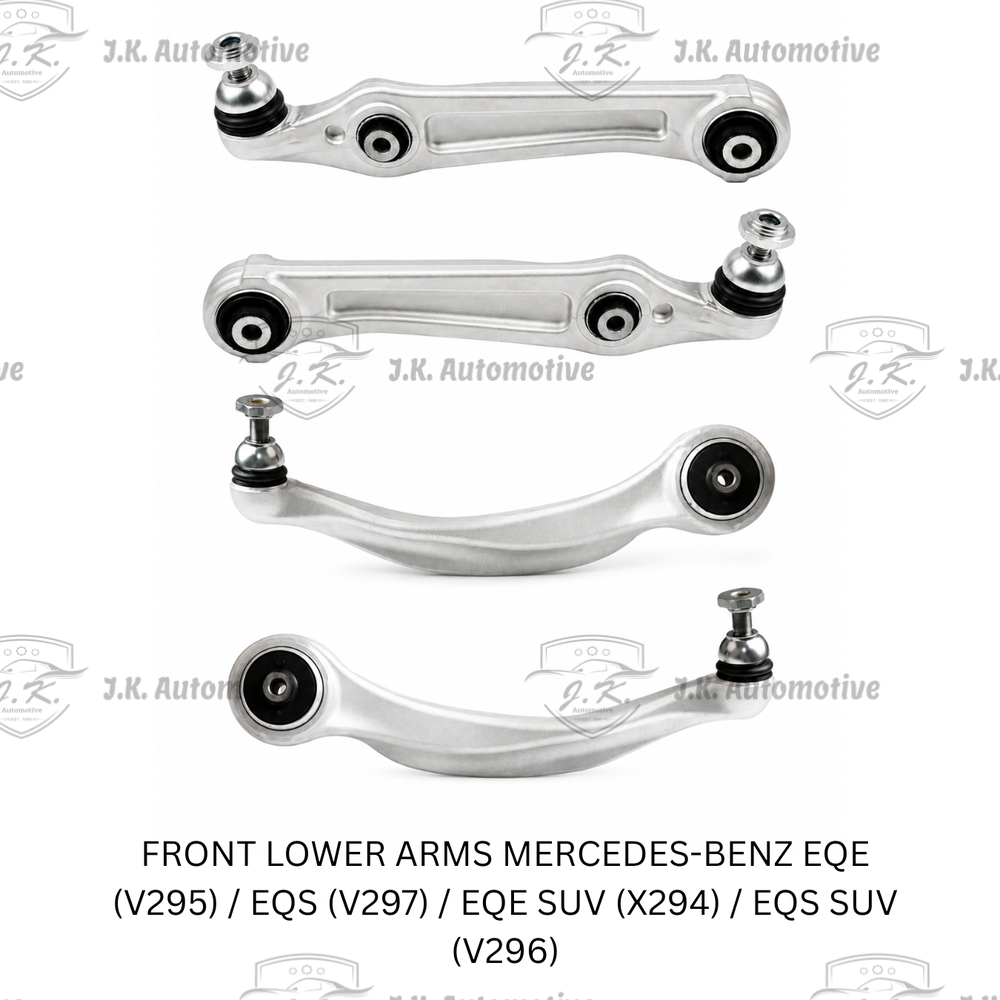
The Stokes Germany Front Lower Control Arm Set of 4 for Mercedes-Benz EQS V297 is a complete premium front suspension repair set containing four lower control arm components with OEM references A2973303301 & A2973303401 & A2973305800 & A2973305700. These front lower suspension arms form important wheel-locating components within the sophisticated suspension system of the Mercedes-Benz EQS V297 and help maintain controlled wheel movement, steering precision, suspension geometry and refined ride quality. Lower control arms are also commonly described as lower suspension arms or lower wishbone arms, depending on their specific suspension position and design. Each arm works as part of the complete front axle system rather than functioning independently. During normal driving, the suspension must continuously respond to braking, acceleration, cornering, road undulations, potholes and speed breakers while keeping the front wheels appropriately positioned relative to the chassis. The front lower control arms help manage these movements and transfer forces between the wheel-side suspension assemblies and the vehicle structure. This function is particularly important for the Mercedes-Benz EQS V297 because it is a premium electric luxury vehicle with substantial vehicle mass, high levels of refinement and precise steering and handling requirements. As original control arms, bushes or joints wear, additional movement can develop within the suspension. Drivers may notice knocking or clunking over uneven roads, reduced steering precision, instability during braking or cornering, vibration, or a less controlled feeling from the front axle. Suspension wear can also contribute to irregular tyre wear when excessive movement changes wheel positioning dynamically while driving. The Set of 4 provides the OEM reference combination A2973303301 & A2973303401 & A2973305800 & A2973305700, allowing the corresponding front lower suspension positions to be renewed when professional diagnosis determines replacement is required. Exact OEM verification remains essential because Mercedes-Benz suspension arms can be position-specific, and visually similar components should not automatically be treated as interchangeable. The complete front suspension should also be inspected during replacement. Front upper control arms, including the relevant upper suspension components, should be checked for bush or joint wear. Steering tie rod ends, wheel bearings, suspension bushes and damping components should also be inspected. Sway bar links, sway links, anti roll link rods and stabiliser sway links should be examined because worn stabiliser components can produce knocking noises that may resemble control-arm wear. Tyres should be inspected for inner-edge wear, outer-edge wear, feathering or other irregular tread patterns. Professional installation of the Stokes Germany Front Lower Control Arm Set of 4 is recommended to ensure correct component positioning and mounting. After all required suspension repairs have been completed, professional wheel alignment should be performed. Correctly functioning front lower control arms can help support accurate steering, stable braking, predictable cornering, controlled tyre contact and the quiet, refined premium driving characteristics expected from the Mercedes-Benz EQS V297.
Which OEM references are included in the Mercedes-Benz EQS V297 Front Lower Control Arm Set of 4?
The Stokes Germany Mercedes-Benz EQS V297 Front Lower Control Arm Set of 4 includes the exact OEM reference combination A2973303301 & A2973303401 & A2973305800 & A2973305700. These four references should be preserved exactly when identifying, ordering or verifying the suspension set because each control arm is intended for a specific position within the front suspension system. A complete multi-link suspension arrangement can use several separate arms to control wheel movement rather than relying on a single lower wishbone, which is why a Set of 4 can be required to renew the corresponding lower control-arm positions. Each suspension arm helps control wheel movement along a particular path while the vehicle accelerates, brakes, corners and travels over changing road surfaces. The geometry, bushes, joints and mounting positions of the arms work together to keep the front wheels appropriately located relative to the chassis. Because these components are position-specific, an arm should never be selected simply because it has a similar physical appearance to another suspension component. OEM references A2973303301 & A2973303401 & A2973305800 & A2973305700 should therefore be checked against the required vehicle application before installation. Vehicle-specific or VIN-based parts verification is advisable whenever there is uncertainty. Maintaining correct suspension geometry is particularly important on the Mercedes-Benz EQS V297 because the vehicle combines luxury ride expectations with substantial electric-vehicle weight and sophisticated steering and chassis systems. The lower control arms experience repeated forces during everyday driving. Hard braking transfers significant load toward the front axle, while cornering generates lateral forces through the tyres and wheel assemblies. Acceleration, road impacts and changing road surfaces also create repeated loads through the suspension. Over time, bushes or joints associated with the original control arms may deteriorate and allow unwanted movement. This can contribute to knocking, clunking, steering looseness, reduced directional stability or irregular tyre wear. Replacing professionally diagnosed worn components with the complete Set of 4 can help renew the corresponding lower suspension positions and provide a more consistent mechanical condition across the front axle. However, the repair should not stop at the four lower control arms. The front upper control arms should be inspected because upper and lower suspension arms work together to maintain wheel positioning. Steering tie rod ends should be checked for excessive play, wheel bearings should be inspected for looseness or noise and damping components should be evaluated for correct operation. Sway bar links, sway links, anti roll link rods and stabiliser sway links should also be checked, particularly if the original complaint includes knocking over smaller road irregularities. Tyres can provide useful evidence of suspension condition and should be inspected for abnormal wear. After installation of A2973303301 & A2973303401 & A2973305800 & A2973305700 and completion of any additional repairs, professional wheel alignment is recommended. This helps ensure the renewed suspension operates with appropriate wheel geometry and supports precise steering, even tyre contact, stable handling and refined Mercedes-Benz EQS ride quality.
What function do the Front Lower Control Arms perform in the Mercedes-Benz EQS V297 suspension?
The Front Lower Control Arms in the Mercedes-Benz EQS V297 perform the critical function of helping locate, guide and control the front wheel assemblies throughout suspension movement, and the Stokes Germany Set of 4 uses OEM references A2973303301 & A2973303401 & A2973305800 & A2973305700 for the corresponding lower suspension positions. Unlike a simple suspension layout that may rely primarily on one large lower wishbone per side, sophisticated premium vehicle suspension systems can use multiple separate links or arms to control wheel movement with greater precision. Each arm contributes to the intended suspension geometry by restricting unwanted movement in particular directions while still allowing the wheel to move through the suspension's designed range of travel. When the Mercedes-Benz EQS V297 encounters a bump, the wheel must move upward without losing controlled alignment relative to the chassis. When the road surface drops away, the suspension must extend while continuing to guide the wheel. During braking, substantial longitudinal and vertical forces pass through the front suspension as vehicle weight transfers forward. During cornering, lateral forces generated at the tyre contact patches must be managed by the suspension links while maintaining predictable steering behaviour. During acceleration, changing loads also act through the wheel assemblies and suspension. The lower control arms therefore work continuously whenever the vehicle is moving. This role is particularly significant on the Mercedes-Benz EQS V297 because it is a premium electric luxury vehicle designed to provide a combination of quietness, refined ride comfort and precise road behaviour. Electric vehicles can also carry substantial mass because of their battery systems, placing significant demands on wheel-locating suspension components. When control-arm bushes or joints remain in good condition, they help maintain consistent wheel positioning and provide a mechanically stable foundation for steering and alignment. When wear develops, however, the wheel may gain additional movement beyond the suspension's intended operating geometry. This can contribute to vague steering, knocking noises, instability during braking or cornering and abnormal tyre wear. A vehicle may also develop recurring alignment concerns if worn mechanical components continue allowing the wheels to move after alignment adjustments have been made. The Stokes Germany Set of 4 is intended to provide the corresponding A2973303301 & A2973303401 & A2973305800 & A2973305700 lower control-arm components for a comprehensive front suspension repair when replacement is professionally diagnosed. During the repair, technicians should inspect the upper control arms, steering tie rod ends, wheel bearings, suspension bushes and damping system. Sway bar links, sway links, anti roll link rods and stabiliser sway links should also be checked for excessive play or damaged joints. Tyres should be examined for abnormal tread wear and wheels inspected where impact damage is suspected. Correct installation followed by professional wheel alignment can help the renewed control arms perform their intended function effectively. A mechanically sound front suspension supports accurate steering, stable braking, controlled cornering, consistent tyre contact and the refined luxury driving dynamics expected from the Mercedes-Benz EQS V297.
What are the common symptoms of worn Mercedes-Benz EQS V297 Front Lower Control Arms?
Common symptoms of worn Mercedes-Benz EQS V297 Front Lower Control Arms can include knocking or clunking from the front suspension, vague steering, reduced straight-line stability, excessive movement during braking, inconsistent cornering behaviour, vibration, irregular tyre wear and recurring wheel-alignment concerns. The Stokes Germany Front Lower Control Arm Set of 4 includes OEM references A2973303301 & A2973303401 & A2973305800 & A2973305700 for the corresponding lower front suspension positions. Because these arms help locate the front wheel assemblies, deterioration in their bushes, joints or mounting areas can influence both ride and handling. A knocking or clunking noise is one of the most commonly noticed suspension symptoms. It may occur when driving over potholes, speed breakers, broken roads or sharp surface changes because worn suspension components can move beyond their intended operating range as loads change. The driver may also notice that the steering feels less precise around the straight-ahead position or that the vehicle requires more correction on uneven roads. During braking, the front end may feel less settled because the front suspension experiences increased loading as vehicle weight transfers forward. During cornering, excessive movement in wheel-locating components may contribute to a less controlled or less predictable response. Tyre wear is another important indicator. If worn lower control arms allow the wheel position to change dynamically, the tyres may develop inner-edge wear, outer-edge wear, feathering or other irregular tread patterns. A repeated wheel alignment may provide limited benefit if mechanical play remains in the suspension because alignment measurements cannot permanently compensate for loose or deteriorated components. Nevertheless, none of these symptoms proves by itself that A2973303301 & A2973303401 & A2973305800 & A2973305700 require replacement. Professional diagnosis is essential because similar symptoms can originate elsewhere. Upper control arms can develop bush or joint wear, steering tie rod ends can create looseness, wheel bearings can cause vibration or play and damping components can influence tyre contact and ride control. Sway bar links, sway links, anti roll link rods and stabiliser sway links can produce knocking or rattling that may initially be mistaken for lower control-arm problems. Tyres themselves can create vibration or handling concerns if they are incorrectly inflated, unevenly worn or damaged. Wheels can also be bent by severe pothole impacts. The correct diagnostic approach is therefore to inspect the entire front steering and suspension system before deciding which parts require replacement. If wear is confirmed in the lower control arms, replacing the appropriate Stokes Germany Set of 4 can help renew the corresponding front suspension positions. Professional installation should be followed by inspection of all remaining components and final wheel alignment. Correctly functioning lower control arms can help restore controlled wheel positioning, precise steering, stable braking, predictable handling and refined premium electric vehicle ride quality.
Can worn Mercedes-Benz EQS V297 Front Lower Control Arms cause uneven tyre wear and steering problems?
Yes, worn Mercedes-Benz EQS V297 Front Lower Control Arms can contribute to uneven tyre wear and steering problems because these suspension arms help maintain controlled wheel positioning while the vehicle is moving. The Stokes Germany Set of 4 contains OEM references A2973303301 & A2973303401 & A2973305800 & A2973305700 for the corresponding front lower control-arm positions. Wheel alignment depends on a mechanically stable suspension. If a control-arm bush or joint has excessive play, the wheel may move beyond its intended position as forces change during acceleration, braking and cornering. This is important because a wheel-alignment machine measures geometry while the vehicle is stationary, whereas worn suspension components may allow geometry to change dynamically once the vehicle is driven. Consequently, a vehicle can sometimes be repeatedly aligned but continue developing tyre wear if the underlying mechanical play has not been repaired. Inner-edge tyre wear can be one possible symptom, while outer-edge wear, feathering or accelerated wear across portions of the tread may also occur depending on the mechanical condition and wheel geometry. Steering behaviour may change at the same time. The vehicle may feel vague around the straight-ahead position, require more steering correction or feel less stable when travelling over uneven roads. During braking, excessive suspension movement can influence how consistently the front wheels remain located. During cornering, lateral forces can make worn bushes or joints more noticeable because the wheel assemblies are being loaded sideways relative to the chassis. Maintaining precise wheel control is especially important for the Mercedes-Benz EQS V297 because this premium electric luxury vehicle is engineered for refined steering response, quiet ride quality and stable road behaviour. However, tyre wear and steering concerns should not automatically be blamed on the lower control arms. Incorrect tyre pressure, wheel imbalance, damaged wheels, worn tie rod ends, upper control-arm wear, wheel-bearing problems or damping issues can produce similar symptoms. The complete steering and suspension system should therefore be professionally inspected. Sway bar links, sway links, anti roll link rods and stabiliser sway links should also be checked when steering or tyre concerns are accompanied by suspension noise. If professional inspection confirms wear in the A2973303301 & A2973303401 & A2973305800 & A2973305700 control-arm positions, replacing the corresponding Set of 4 can help restore a stable mechanical foundation for the front suspension. Existing tyre damage cannot be reversed by installing new suspension parts, so significantly worn tyres may require replacement. After the new control arms and any other necessary components have been fitted, professional wheel alignment should be completed. This combination of mechanically sound suspension components, suitable tyres and accurate wheel geometry can help restore precise steering, even tyre contact, stable handling and the refined driving characteristics expected from the Mercedes-Benz EQS V297.
Is wheel alignment necessary after installing the Mercedes-Benz EQS V297 Front Lower Control Arm Set of 4?
Professional wheel alignment is strongly recommended after installing the Mercedes-Benz EQS V297 Front Lower Control Arm Set of 4 because A2973303301 & A2973303401 & A2973305800 & A2973305700 are wheel-locating suspension components whose condition and installation can influence front suspension geometry. Before replacement, worn bushes or joints may have allowed excessive wheel movement during driving, meaning the previous alignment condition may have been established around deteriorated components. Once new lower control arms are fitted, important suspension locating points are renewed, and the wheel geometry should therefore be measured on the repaired suspension. This is especially important when the vehicle previously showed steering pull, an off-centre steering wheel, irregular tyre wear, instability or repeated alignment concerns. However, wheel alignment should always be treated as the final stage of a complete mechanical suspension repair rather than a substitute for repairing worn components. An alignment machine cannot correct excessive play in a control-arm bush, loose steering joint, worn wheel bearing or another defective suspension component. Before alignment is performed, the technician should inspect the upper control arms and their bushes or joints. Steering tie rod ends should be checked for play because they directly influence wheel direction. Wheel bearings should be examined for looseness, roughness or abnormal noise. Suspension damping components should be inspected to ensure that tyre contact and body movement remain properly controlled. Sway bar links, sway links, anti roll link rods and stabiliser sway links should also be checked because they form part of the wider front suspension system and may require attention if knocking noises remain. Tyres should be inspected for irregular wear, damage and correct pressure. Wheels should also be checked where severe road impacts or vibration are reported. Professional installation of the Stokes Germany Front Lower Control Arm Set of 4 is particularly important because each OEM reference must be fitted to its correct suspension position. Mounting hardware should be installed and tightened according to the appropriate repair procedure so the control arms and their bushes can operate correctly throughout suspension travel. Once A2973303301 & A2973303401 & A2973305800 & A2973305700 have been installed and all other required repairs completed, wheel alignment can establish the appropriate geometry on a mechanically stable suspension. Accurate alignment can help support consistent steering response, straight-line stability and even tyre contact. This is especially valuable for a premium electric vehicle such as the Mercedes-Benz EQS V297, where refined ride quality and precise handling depend on the complete chassis system operating correctly. Combining professionally installed front lower control arms with serviceable surrounding suspension components and accurate wheel alignment provides a comprehensive repair approach that can help maintain stable braking, controlled cornering, precise steering, balanced tyre wear and premium Mercedes-Benz EQS driving comfort.
How does the Stokes Germany Front Lower Control Arm Set of 4 improve suspension stability and handling on the Mercedes-Benz EQS V297?
The Stokes Germany Front Lower Control Arm Set of 4 for Mercedes-Benz EQS V297 is designed to renew four important wheel-locating components within the front suspension using OEM references A2973303301 & A2973303401 & A2973305800 & A2973305700. These control arms work together to help guide the front wheel assemblies through their intended suspension movement while supporting stable wheel positioning during acceleration, braking, cornering and travel over uneven road surfaces. This function is especially important on the Mercedes-Benz EQS V297 because it is a premium electric luxury vehicle where substantial vehicle mass, quiet operation, precise steering and refined ride quality place significant demands on the suspension system. When the original lower control arms, bushes or joints are in good mechanical condition, they restrict unwanted movement while allowing the suspension to articulate through its designed range. As these components deteriorate, additional movement can develop between the wheel assemblies and chassis. The driver may begin to experience vague steering, knocking or clunking from the front suspension, reduced straight-line stability or a less controlled feeling during braking and cornering. Replacing professionally diagnosed worn lower control arms can help restore a more stable mechanical relationship between the wheels and chassis. A2973303301 and A2973303401 form corresponding left and right lower control-arm positions, while A2973305700 and A2973305800 form another corresponding left and right lower pair within the front suspension. Renewing these four positions as a complete Set of 4 can therefore provide a comprehensive lower front suspension repair when all four original components are worn. Improved mechanical control can help the front wheels follow their intended suspension path more consistently, which supports steering precision and predictable vehicle response. During braking, serviceable lower arms help manage the forces transferred through the front axle as vehicle load shifts forward. During cornering, they help maintain controlled wheel positioning as lateral forces act through the tyres. On rough roads, they allow suspension movement while helping prevent excessive uncontrolled displacement. However, replacing the lower control arms should form part of a complete suspension inspection. The front upper control arms should also be checked for wear because they work together with the lower arms to control wheel geometry. Steering tie rod ends, suspension bushes, wheel bearings and damping components should also be examined. Sway bar links, sway links, anti roll link rods and stabiliser sway links should be inspected because worn stabiliser components can create knocking noises and influence suspension behaviour. Tyres should be checked for irregular wear that may have developed while the old suspension components were worn. Professional installation is recommended to ensure each of the four position-specific components is fitted correctly. Once the complete suspension is mechanically sound, professional wheel alignment should be performed. Correctly installed Stokes Germany Front Lower Control Arms can help support precise steering, stable braking, controlled cornering, consistent tyre contact and the refined premium driving characteristics expected from the Mercedes-Benz EQS V297.
Can worn Mercedes-Benz EQS V297 Front Lower Control Arms cause knocking noises, vibration and uneven tyre wear?
Yes, worn Mercedes-Benz EQS V297 Front Lower Control Arms can contribute to knocking noises, vibration, unstable steering and uneven tyre wear because these components help locate and control the front wheel assemblies under continuously changing road and driving loads. The Stokes Germany Set of 4 includes OEM references A2973303301 & A2973303401 & A2973305800 & A2973305700 and renews corresponding left and right lower suspension positions. Knocking or clunking is one of the symptoms commonly associated with deterioration in control-arm bushes, joints or mounting points. When the vehicle passes over potholes, speed breakers, expansion joints or broken road surfaces, the suspension moves rapidly through compression and rebound. If excessive play exists within a control arm or its associated joint, the resulting unwanted movement can become audible as a knock or clunk. Vibration can also occur, although vibration should never automatically be attributed to the control arms because tyres, wheels, wheel bearings and other steering or suspension components can produce similar symptoms. Steering behaviour may gradually become less precise if worn lower control arms allow the wheel assemblies to move beyond their intended path. The Mercedes-Benz EQS V297 may require more steering correction on uneven roads, or the front end may feel less settled during braking and cornering. Tyre wear is another important consideration because suspension geometry depends on mechanically stable wheel-locating components. If a worn control-arm bush or joint allows wheel position to change dynamically, the tyre can contact the road differently as driving forces change. Inner-edge wear, outer-edge wear, feathering or accelerated tread deterioration may develop. This explains why repeatedly performing wheel alignment without repairing worn suspension components may fail to solve the underlying problem. An alignment machine measures wheel geometry under controlled stationary conditions, whereas excessive mechanical play can allow the geometry to change once the vehicle is being driven. The correct approach is therefore to inspect the suspension mechanically before alignment. A2973303301, A2973303401, A2973305800 & A2973305700 should be examined along with the corresponding bushes and joints. The upper control arms should also be checked because wear in the upper suspension can produce similar symptoms. Steering tie rod ends should be inspected for excessive play, and wheel bearings should be checked for looseness or abnormal noise. Sway bar links, sway links, anti roll link rods and stabiliser sway links should receive particular attention when the primary complaint is knocking over smaller road irregularities. Tyre pressures, tread condition and wheel balance should also be evaluated. If professional diagnosis confirms that the lower control arms are worn, replacing the Stokes Germany Set of 4 can help restore controlled front-wheel movement. Any other worn components should be replaced during the repair. Professional wheel alignment should then be completed to establish correct geometry on a mechanically stable suspension. This comprehensive approach can help restore steering precision, stable handling, even tyre contact and the refined ride quality required from the Mercedes-Benz EQS V297.
What other suspension parts should be inspected when replacing A2973303301, A2973303401, A2973305800 & A2973305700 on the Mercedes-Benz EQS V297?
When replacing A2973303301 & A2973303401 & A2973305800 & A2973305700 on the Mercedes-Benz EQS V297, the complete front steering and suspension system should be inspected because the four lower control arms operate as part of an interconnected suspension assembly rather than as isolated components. The front upper control arms are among the first related components that should be checked because upper and lower suspension links work together to guide the wheel assemblies and maintain suspension geometry. Any excessive play, damaged bushes or worn joints in the upper arms can continue affecting steering and wheel control even after the lower control arms have been replaced. Steering tie rod ends and related steering linkage components should also be inspected because they directly influence wheel direction and steering precision. Excessive play in a steering joint can cause vague steering, instability and abnormal tyre wear that may resemble symptoms associated with worn control arms. Wheel bearings should be checked for looseness, roughness or abnormal noise because a worn bearing can allow unwanted wheel movement and produce vibration or humming. The damping system should also be inspected because correct damping is important for controlling wheel and body movement. The Mercedes-Benz EQS V297 is a premium electric luxury vehicle, making the overall condition of its suspension particularly important for maintaining refined ride quality and predictable road behaviour. Suspension bushes and mounting points should be checked for deterioration, cracking, separation or damage. Sway bar links, sway links, anti roll link rods and stabiliser sway links should also be inspected because these components connect the anti-roll system to the suspension and frequently operate under rapidly changing loads. Worn stabiliser links can create knocking or rattling over uneven roads and may be incorrectly diagnosed as control-arm wear. The tyres should be examined carefully because their wear pattern can provide useful evidence of previous suspension or alignment problems. Inner-edge wear, outer-edge wear, feathering or cupping should be recorded and investigated. Tyre pressure should be checked because incorrect inflation can independently contribute to abnormal wear and handling concerns. Wheels should also be inspected for bends or impact damage, particularly if the vehicle has encountered severe potholes. The four replacement control arms themselves are position-specific. A2973303301 corresponds to a left lower suspension position and A2973303401 to its corresponding right lower position, while A2973305700 and A2973305800 form another left and right lower control-arm pair. Each component should therefore be installed in its intended position rather than treated as an interchangeable suspension arm. Once the Stokes Germany Front Lower Control Arm Set of 4 and any other required components have been installed, the technician should confirm that no excessive mechanical play remains anywhere in the steering and suspension system. Professional wheel alignment should then be performed. Completing the repair in this sequence provides a mechanically stable foundation for accurate wheel geometry and can help restore steering precision, controlled braking, predictable cornering, balanced tyre contact and the refined ride expected from the Mercedes-Benz EQS V297.
Why is professional installation recommended for the Mercedes-Benz EQS V297 Front Lower Control Arm Set of 4?
Professional installation is strongly recommended for the Mercedes-Benz EQS V297 Front Lower Control Arm Set of 4 because A2973303301 & A2973303401 & A2973305800 & A2973305700 are position-specific structural suspension components that influence wheel location, suspension geometry, steering behaviour and tyre contact. Installing control arms correctly involves considerably more than removing the old components and attaching replacements. The technician should first confirm that the original lower control arms are actually worn and responsible for the diagnosed suspension concern. This avoids unnecessary component replacement when knocking, vibration or steering instability originates from another part of the vehicle. Once replacement is confirmed, each OEM reference must be matched to its correct suspension position. A2973303301 and A2973303401 form corresponding left and right lower positions, while A2973305700 and A2973305800 form another left and right lower pair. Correct positioning matters because suspension arms can differ in geometry, mounting orientation and joint configuration even when they appear visually similar. During installation, the mounting points should be inspected for damage, corrosion or deformation. Associated hardware should be checked and replaced where the appropriate workshop procedure requires it. Suspension bushes must also operate within their designed range of movement, so correct installation and tightening procedures are important to avoid unintended bush preload or premature deterioration. The Mercedes-Benz EQS V297 is also a technologically advanced electric vehicle, meaning workshop safety, lifting procedures and manufacturer-appropriate service practices are especially important. A qualified workshop familiar with premium Mercedes-Benz electric vehicles is better positioned to handle the suspension repair safely and correctly. While the lower arms are being replaced, surrounding components should be inspected. Upper control arms, steering tie rod ends, wheel bearings, suspension bushes and damping components should be checked for wear. Sway bar links, sway links, anti roll link rods and stabiliser sway links should also be examined because worn joints can cause knocking and reduced suspension refinement. Tyres should be inspected for abnormal wear and wheels checked if there is evidence of impact damage. Once the Stokes Germany Set of 4 has been installed, the technician should confirm that the suspension moves correctly and that no additional mechanical play remains. Wheel alignment should then be performed because renewing wheel-locating components can change the mechanical condition on which previous alignment measurements were based. Accurate alignment on a mechanically sound suspension helps support straight-line stability, steering response and even tyre contact. Professional installation therefore protects more than the new control arms themselves; it helps ensure the entire front suspension operates as a coordinated system. Correct installation of A2973303301 & A2973303401 & A2973305800 & A2973305700, combined with inspection of related components and professional wheel alignment, can help restore the precise steering, stable handling, controlled suspension movement and premium ride comfort expected from the Mercedes-Benz EQS V297.
Why is Stokes Germany a European-quality alternative to Lemförder, FEBI, Meyle and other established brands for Mercedes-Benz EQS V297?
Stokes Germany offers a premium aftermarket suspension replacement option for Mercedes-Benz EQS V297 owners and workshops requiring a complete Front Lower Control Arm Set of 4 with OEM references A2973303301 & A2973303401 & A2973305800 & A2973305700, while Lemförder, FEBI, Meyle and other established European aftermarket brands may also provide suspension components for Mercedes-Benz and other premium European vehicles. When comparing suspension brands, the most important considerations should include correct OEM reference matching, exact vehicle compatibility, appropriate suspension position, component construction and professional installation rather than relying only on a brand name. For the Mercedes-Benz EQS V297 application, the Stokes Germany package brings four corresponding lower suspension arms together as one complete set, which can simplify a comprehensive front suspension repair when professional diagnosis confirms wear in all four positions. The set contains two corresponding left/right lower control-arm pairs, allowing the associated lower suspension positions to be renewed together. This is particularly useful on a sophisticated premium electric vehicle such as the Mercedes-Benz EQS V297, where multiple suspension links work together to maintain controlled wheel movement and precise geometry. A healthy suspension system is important for maintaining steering precision, stable braking, predictable cornering and refined ride comfort. When comparing Stokes Germany with Lemförder, FEBI, Meyle or another aftermarket manufacturer, customers should first verify that the selected components correspond with the required A2973303301, A2973303401, A2973305800 and A2973305700 OEM references. Vehicle configuration and VIN-based verification should be used whenever exact fitment is uncertain. Component selection is only one part of a successful suspension repair. Even a correctly matched replacement control arm cannot provide the intended result if surrounding components have excessive wear or the installation procedure is incorrect. The upper control arms, steering tie rod ends, suspension bushes, wheel bearings and damping components should therefore be inspected at the same time. Sway bar links, sway links, anti roll link rods and stabiliser sway links should also be examined for play because these components can produce front suspension noises and influence overall suspension behaviour. Tyres should be inspected for abnormal wear, and wheels should be checked for impact damage when necessary. The Stokes Germany Set of 4 can therefore be considered a practical premium aftermarket option for customers seeking a complete Mercedes-Benz EQS V297 lower control-arm repair solution with the specified OEM reference combination. This comparison should not be interpreted as a claim that Stokes Germany automatically outperforms every suspension component produced by Lemförder, FEBI, Meyle or another manufacturer, because individual product specifications and applications can differ. Correct compatibility, installation quality and complete suspension condition ultimately influence the success of the repair. Professional installation followed by wheel alignment is recommended after replacement. When accurately matched and correctly fitted, the Stokes Germany Mercedes-Benz EQS V297 Front Lower Control Arm Set of 4 can help restore controlled wheel movement, steering precision, stable handling, even tyre contact and the refined premium electric luxury vehicle driving characteristics expected from the Mercedes-Benz EQS.

Reviews
There are no reviews yet.