What are Stokes Germany Front Lower Control Arms for Mercedes-Benz EQE V295 and what do they do?
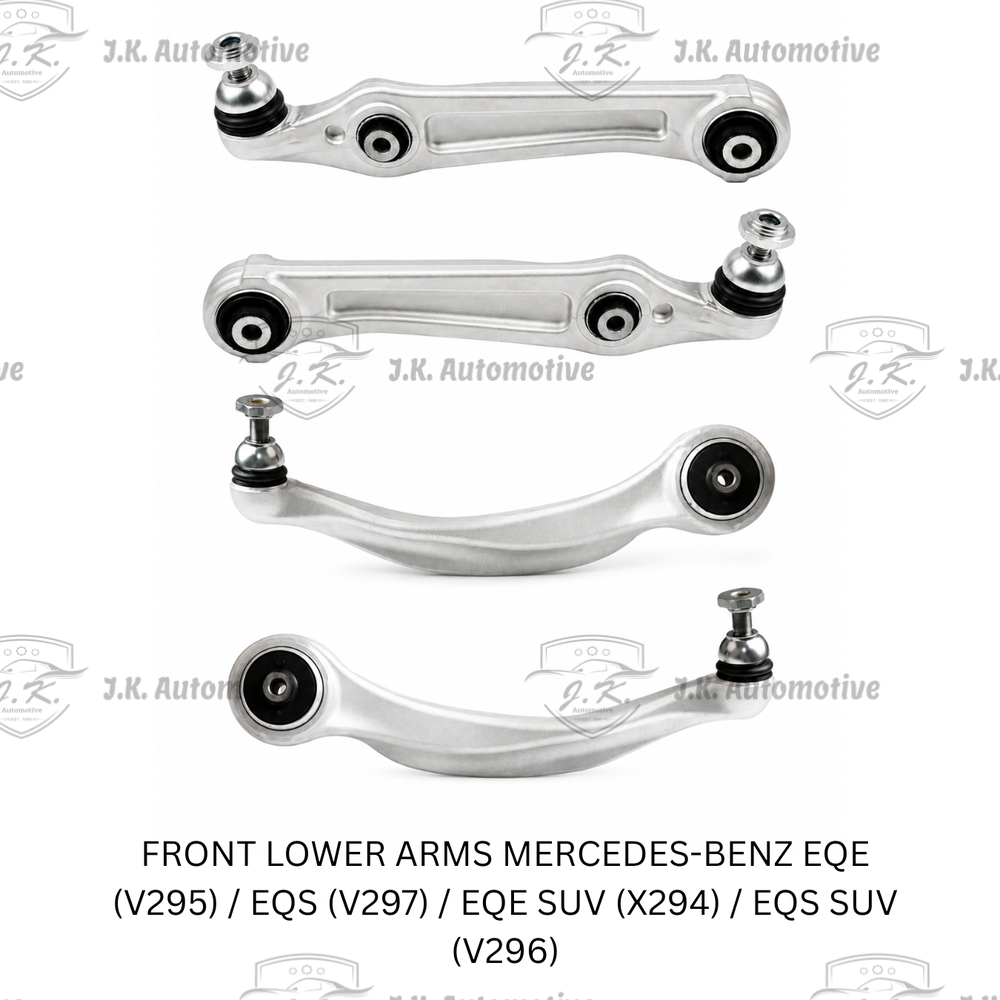
Mercedes-Benz EQE V295 Front Lower Control Arms are important components of the front suspension system that help guide the front wheel assemblies, maintain controlled suspension movement and support the correct relationship between the wheels, steering system and vehicle chassis during normal driving. This Stokes Germany Front Lower Control Arm Set of 4 for Mercedes-Benz EQE V295 is supplied with A2973303301 & A2973303401 & A2973305800 & A2973305700, providing four corresponding front lower suspension components in one package for the applicable vehicle configuration. The product listing specifies Mercedes-Benz EQE V295 2022–2025 compatibility and identifies all four references as its OEM cross-reference set. The EQE V295 uses a sophisticated front suspension arrangement in which multiple suspension links work together rather than relying on a single control arm on each side. The lower control arms help control how the wheel moves relative to the chassis as the suspension compresses and extends. When the vehicle travels over potholes, speed breakers, broken roads or uneven surfaces, the front wheels move vertically and the suspension components guide this movement through their designed path. During braking, considerable forces pass from the tyres and wheels through the suspension links and into the chassis. During acceleration and cornering, the direction and magnitude of these forces change continuously. Mechanically sound lower control arms, bushes and joints therefore help keep wheel movement controlled under different driving conditions. A2973303301 is independently catalogued as a Front Left Lower suspension control arm for Mercedes EQE V295, while A2973305800 is independently catalogued as a Front Right Lower arm and ball-joint assembly for V295 applications. With increasing mileage, age and repeated road impacts, the bushes, joints and related mounting areas of the lower suspension arms can gradually develop wear. Excessive wear may permit more movement than intended within the front suspension. Depending on which component is worn, the driver may notice knocking or clunking over rough surfaces, reduced steering precision, unwanted suspension movement or irregular tyre wear. These symptoms do not automatically prove that the lower control arms are defective because other suspension and steering components can create similar problems. Front upper control arms should also be inspected, together with steering tie rod ends, shock absorbers, wheel bearings and tyres. Sway bar links, Sway links, Anti roll link rods and Stabiliser sway links should also be checked when knocking or rattling is present because worn stabilizer components can create similar front suspension noises. When professional diagnosis confirms deterioration in the applicable Mercedes-Benz EQE V295 Front Lower Control Arms, replacing the correctly identified components can address the excessive mechanical movement caused by those worn parts. Before ordering, all four references should be checked against the vehicle configuration and VIN. Professional installation followed by a wheel alignment check is recommended.
Are A2973303301 & A2973303401 & A2973305800 & A2973305700 suitable for Mercedes-Benz EQE V295?
A2973303301 & A2973303401 & A2973305800 & A2973305700 are supplied together in this Stokes Germany Front Lower Control Arm Set of 4 for Mercedes-Benz EQE V295, and the current product listing specifies these four numbers as the OEM cross references for Mercedes-Benz EQE V295 2022–2025. Independent suspension catalogue information also supports the EQE V295 application of these lower suspension-arm families. For example, A2973303301 is listed as a Front Left Lower control arm with one required per vehicle and Mercedes EQE V295 from 2022 onward among its compatible applications. A2973305800 is listed separately as a Front Right Lower suspension control arm and ball-joint assembly with Mercedes EQE V295 from 2022 onward among its compatible vehicles. Mercedes-Benz's own parts catalogue identifies A2973303301 as a front-axle tension strut and lists multiple V295 configurations, including EQE 500 4MATIC, EQE 300, EQE 350 4MATIC, EQE 280, EQE 350, AMG EQE variants and EQE 350+ configurations. Mercedes-Benz also recommends checking compatibility using the vehicle's 17-digit VIN. This VIN check is particularly important because the EQE range includes different drivetrain and suspension configurations, and not every lower control-arm reference necessarily applies to every EQE V295 variant. A2973305800, for example, is identified by Mercedes-Benz as a right-side front spring link for selected EQE and EQS configurations, and Mercedes-Benz lists specific EQE V295 variants among its applications. Therefore, customers should not assume that all four references fit every V295 simply because the vehicle is an EQE. The exact model variant, drivetrain, suspension specification, original part numbers and VIN should be checked before ordering. This is particularly important for 4MATIC and rear-wheel-drive configurations because suspension components can differ. The original arms should be inspected for visible reference numbers whenever practical. Customers should also avoid selecting suspension parts based only on photographs because visually similar control arms can differ in length, mounting points, bush design, ball-joint configuration or suspension position. The mechanical problem should also be diagnosed before buying the complete set. Knocking, vibration or uneven tyre wear can originate from several suspension components. Front upper control arms, steering joints, shock absorbers, wheel bearings, tyres, Sway bar links, Sway links, Anti roll link rods and Stabiliser sway links should therefore be inspected where relevant. If the four supplied references match the vehicle specification and the relevant lower suspension arms require replacement, this Stokes Germany set provides the corresponding four-component package. Professional installation and a wheel alignment check are recommended.
What are the common symptoms of worn Mercedes-Benz EQE V295 Front Lower Control Arms?
Common symptoms that may be associated with worn Mercedes-Benz EQE V295 Front Lower Control Arms include knocking or clunking noises from the front suspension, unwanted wheel or suspension movement, less precise steering response, vibration, changes in handling or irregular tyre wear, although none of these symptoms should be treated as automatic proof of control-arm failure because several other steering, suspension, tyre and wheel components can create similar problems. The front lower control arms operate continuously whenever the EQE V295 is moving because they help guide the front wheel assemblies while the suspension responds to the road. Every pothole, speed breaker, damaged section of road and uneven surface creates changing loads through the tyres, wheels and suspension components. Braking places additional longitudinal forces through the suspension, while cornering creates lateral loads that must also be controlled by the suspension links, bushes and joints. Over time, repeated movement, normal component ageing and road impacts can contribute to wear in bushes, joints and mounting areas. If a lower control-arm bush or joint develops excessive play, the wheel assembly may move beyond its intended range when the suspension is loaded and unloaded. One possible symptom is a knocking or clunking noise from the front suspension when driving over potholes, speed breakers or broken roads. A recent technical guide for A2973305800 also identifies clunking or knocking over bumps as a common symptom associated with control-arm deterioration. Another possible symptom is less precise steering because unwanted suspension movement can influence wheel positioning. The vehicle may require more steering correction or may simply feel less controlled than expected. Vibration requires careful diagnosis because wheel imbalance, damaged tyres, bent wheels and wheel-bearing problems can produce similar symptoms. Irregular tyre wear can indicate that suspension condition or wheel geometry needs attention, but incorrect tyre pressure and alignment can also contribute to abnormal tread wear. For this reason, replacing Mercedes-Benz EQE V295 Front Lower Control Arms solely because one symptom is present is not recommended. The complete front suspension should first be inspected. Front upper control arms and their bushes should be checked for excessive movement. Steering tie rod ends and related steering joints should be examined for play. Shock absorbers should be checked for leakage, damage and damping condition. Wheel bearings should be inspected when humming, vibration or excessive wheel movement is present. Sway bar links, Sway links, Anti roll link rods and Stabiliser sway links should also be checked because worn stabilizer joints can create knocking noises that may be mistaken for control-arm wear. Tyres and wheels should also be inspected. When professional diagnosis confirms that one or more lower suspension components corresponding to A2973303301 & A2973303401 & A2973305800 & A2973305700 are worn, replacement can address the excessive mechanical movement associated with those components. Correct fitment verification, professional installation and a wheel alignment check are recommended.
Why is the Mercedes-Benz EQE V295 Front Lower Control Arm package supplied as a set of 4?
The Mercedes-Benz EQE V295 Front Lower Control Arm package is supplied as a set of 4 because the vehicle's front suspension uses multiple lower suspension links to control the movement and position of the front wheel assemblies, and this Stokes Germany package combines A2973303301 & A2973303401 & A2973305800 & A2973305700 into one replacement set. The current product listing specifically identifies the product as a Front Lower Control Arm Set of 4 for Mercedes-Benz EQE V295 and lists all four references together for 2022–2025 models. This is different from simpler suspension layouts where customers may think of a single lower wishbone on each side. Modern multi-link suspension systems can use multiple individual links, each contributing to control of wheel movement and suspension geometry. Independent catalogue data confirms that A2973303301 is a Front Left Lower control-arm assembly for EQE V295, while A2973305800 is a Front Right Lower control-arm and ball-joint assembly for the platform. Providing the relevant suspension components together in one set can make parts selection more convenient when a workshop is carrying out a broader front suspension repair and inspection. It also allows the technician to inspect corresponding suspension links on both sides of the vehicle rather than focusing only on the component producing the most obvious symptom. However, a set of four does not mean that all four suspension arms necessarily wear at exactly the same rate or must automatically be replaced solely because one arm has developed wear. One side of the vehicle may experience more pothole impacts, kerb impacts or damaged road surfaces than the other side. Different bushes and joints can also experience different loads according to their location and function within the suspension geometry. Replacement decisions should therefore be based on professional inspection and the actual mechanical condition of each component. When one lower suspension arm is found to have excessive play, the other lower links should be inspected carefully. The front upper control arms should also be checked because upper and lower suspension links work together to guide the wheel assembly. Steering tie rod ends and other steering joints should be examined for excessive movement. Shock absorbers should be inspected for leakage and damping condition. Wheel bearings should be checked when vibration or humming is present. Sway bar links, Sway links, Anti roll link rods and Stabiliser sway links should be inspected when knocking or rattling is part of the original complaint. Tyres should be examined for irregular wear and correct pressure, while wheels should be checked for damage and balancing issues. Before purchasing the complete set, all four supplied references should be verified against the exact vehicle configuration and VIN because EQE V295 suspension specification can vary between versions. Once fitment and the need for replacement are confirmed, the four-arm package provides a convenient solution for the applicable front lower suspension repair.
What are the benefits of replacing worn Front Lower Control Arms on Mercedes-Benz EQE V295?
Replacing worn Mercedes-Benz EQE V295 Front Lower Control Arms can help restore controlled suspension movement and remove excessive mechanical play associated with deteriorated bushes, joints or control-arm assemblies when professional diagnosis confirms that these components are actually responsible for the problem. The lower suspension links are important because they help control how the front wheel assemblies move relative to the chassis during normal driving, braking, acceleration and cornering. If a bush or joint within one of these components develops excessive play, the wheel can gain unwanted movement under changing loads. If that movement is responsible for a knocking or clunking noise, replacing the worn component can address the mechanical source of that particular noise. If excessive suspension play is contributing to less precise steering response, replacing the confirmed worn components can help restore more controlled wheel movement. If suspension wear is influencing wheel positioning, correcting the worn mechanical components before performing wheel alignment is also important. The Stokes Germany Front Lower Control Arm Set of 4 for Mercedes-Benz EQE V295 combines A2973303301 & A2973303401 & A2973305800 & A2973305700, with the product listing specifying 2022–2025 compatibility. Independent catalogues confirm that these part-number families are associated with front lower suspension positions on the EQE V295, including A2973303301 on the front-left lower position and A2973305800 on the front-right lower position. Customers should nevertheless understand that replacing lower control arms cannot repair unrelated mechanical faults. If a knocking noise originates from a worn stabilizer link, the stabilizer component must be repaired separately. If vibration is caused by wheel imbalance or a damaged tyre, replacing suspension arms will not correct that problem. If a wheel bearing is responsible for humming or vibration, that bearing requires separate repair. Front upper control arms should therefore be inspected at the same time. Steering tie rod ends and related steering components should be checked for play. Shock absorbers should be inspected for leakage, physical damage and damping condition. Sway bar links, Sway links, Anti roll link rods and Stabiliser sway links should be inspected when front suspension knocking or rattling is present. Tyres should be checked for pressure, tread condition and irregular wear. Wheels should also be checked for physical damage and balancing issues. Once the actual worn components have been identified and correct replacement parts selected, the suspension repair can address the mechanical faults responsible for excessive movement. Professional installation is recommended because suspension components are safety-relevant parts of the vehicle's running gear. After replacement, a professional wheel alignment check should be carried out so that wheel geometry can be assessed with the suspension in its repaired mechanical condition.
What should be checked before buying Stokes Germany Mercedes-Benz EQE V295 Front Lower Control Arms?
Why are Mercedes-Benz EQE V295 Front Lower Control Arms important for suspension, steering and road handling?
Mercedes-Benz EQE V295 Front Lower Control Arms are important components of the front suspension because they help guide the front wheel assemblies, control suspension movement and maintain the intended relationship between the wheels and chassis while the vehicle is accelerating, braking, cornering or travelling over uneven roads. This Stokes Germany Front Lower Control Arm Set of 4 for Mercedes-Benz EQE V295 combines A2973303301 & A2973303401 & A2973305800 & A2973305700, providing two corresponding left-and-right lower suspension arm pairs for the applicable front suspension configuration. Independent suspension catalogue information identifies A2973303301 as Front Left Lower and A2973303401 as Front Right Lower, while A2973305700 is another Front Left Lower suspension arm and A2973305800 is its corresponding Front Right Lower component. All four are listed for Mercedes-Benz EQE V295 applications. The Mercedes-Benz EQE V295 uses multiple suspension links to control wheel movement rather than depending on only one lower arm on each side. Each lower suspension component performs part of the job of locating and guiding the wheel assembly as suspension load changes. When the vehicle travels over potholes, speed breakers, rough roads or uneven surfaces, the wheels move vertically as the suspension compresses and extends. The lower control arms help guide this movement through the intended suspension path. During braking, substantial longitudinal forces are transferred through the tyres, wheels and suspension links. Cornering creates lateral forces, while acceleration can introduce additional load changes through the suspension system. The lower control arms, their bushes and their joints therefore need to remain mechanically sound so that unwanted movement is limited. If a bush or joint develops excessive play, the wheel assembly may move beyond its intended range. Depending on the affected component, this may contribute to knocking or clunking, reduced steering precision, unwanted suspension movement or irregular tyre wear. The lower control arms also work together with the upper control arms and steering system, so a problem elsewhere in the front suspension can sometimes produce similar symptoms. Front upper control arms should therefore be inspected whenever significant lower-arm wear is diagnosed. Steering tie rod ends and related steering joints should be checked for excessive play. Shock absorbers should be inspected for leakage, physical damage and damping condition. Wheel bearings should be checked if humming, vibration or wheel movement is present. Sway bar links, Sway links, Anti roll link rods and Stabiliser sway links should also be inspected because worn stabilizer components can produce knocking noises that may be mistaken for lower control-arm problems. Tyres and wheels should be checked for pressure, physical damage, balancing problems and irregular tread wear. When professional inspection confirms deterioration in the Mercedes-Benz EQE V295 Front Lower Control Arms, replacing the correctly identified worn components can address the excessive mechanical movement associated with those parts. All four supplied OEM references should be verified against the exact vehicle specification and VIN before ordering, followed by professional installation and a wheel alignment check.
Is wheel alignment necessary after replacing Mercedes-Benz EQE V295 Front Lower Control Arms?
A professional wheel alignment check is strongly recommended after replacing Mercedes-Benz EQE V295 Front Lower Control Arms because the lower suspension links directly influence the mechanical positioning and controlled movement of the front wheel assemblies, and replacing worn control arms changes the mechanical condition from which wheel geometry is measured. This Stokes Germany Front Lower Control Arm Set of 4 contains A2973303301 & A2973303401 & A2973305800 & A2973305700, representing corresponding lower suspension components on the left and right sides of the front suspension. A2973303301 and A2973303401 form one handed lower-arm pair, while A2973305700 and A2973305800 form another left-and-right lower pair according to current suspension catalogue data. If the original control-arm bushes or joints have developed excessive play, the wheel assembly may have been moving beyond its intended position before the repair. Replacing those worn components can remove the unwanted mechanical movement, but wheel geometry should still be measured afterward. Correct alignment helps ensure that the wheels operate within the required geometry after the suspension repair and supports predictable steering behaviour, straight-line stability and consistent tyre contact with the road. Incorrect wheel geometry can contribute to inner-edge or outer-edge tyre wear, steering pull or unnecessary steering correction. However, customers should understand that wheel alignment and suspension repair are not the same procedure. An alignment machine cannot repair a worn control-arm bush, ball joint, steering joint or wheel bearing. All excessive mechanical play should therefore be corrected before the final alignment is performed. The technician should inspect the upper control arms because they work together with the lower suspension links to guide the front wheels. Remaining bushes and joints should be checked for cracking, deterioration or excessive movement. Steering tie rod ends should be inspected because steering-joint wear can affect wheel positioning and steering response. Shock absorbers should be checked for leakage, physical damage and damping condition. Wheel bearings should be inspected when noise, vibration or wheel movement is present. Sway bar links, Sway links, Anti roll link rods and Stabiliser sway links should also be checked if the original complaint includes knocking or rattling over uneven roads. Tyres should be inspected for existing irregular wear because an alignment cannot restore tread that has already worn abnormally. Wheels should also be checked for physical damage and balancing problems. Once the Mercedes-Benz EQE V295 Front Lower Control Arms have been installed and all other mechanical suspension problems have been addressed, a professional wheel alignment check provides an important final stage of the repair. This allows the technician to assess wheel geometry with the suspension in its repaired mechanical condition and helps reduce the possibility of continued abnormal tyre wear or undesirable steering behaviour.
Can worn Mercedes-Benz EQE V295 Front Lower Control Arms cause knocking, vibration, loose steering or uneven tyre wear?
Worn Mercedes-Benz EQE V295 Front Lower Control Arms can contribute to knocking or clunking noises, excessive suspension movement, less precise or loose steering behaviour, vibration and irregular tyre wear when deterioration in their bushes, ball joints or related mounting areas allows the front wheel assemblies to move more than intended, although these symptoms should always be professionally diagnosed because several other suspension, steering, wheel and tyre problems can create similar complaints. The front lower suspension links operate continuously whenever the vehicle is moving. Every pothole, speed breaker, damaged section of road and uneven surface causes the suspension to compress and extend while the control arms guide the wheel assemblies through their designed movement. Braking creates substantial longitudinal loads through the tyres, wheels and suspension links. Cornering creates lateral forces, while acceleration changes the load distribution across the suspension. Over time, normal mileage, component ageing and repeated road impacts can contribute to wear in the control-arm bushes and joints. If excessive play develops, one possible symptom is a knocking or clunking sound when the suspension is loaded and unloaded, particularly over rough roads, potholes or speed breakers. Technical guidance for the A2973305800 lower control-arm family similarly identifies clunking or knocking over bumps as a symptom associated with control-arm deterioration. Another possible symptom is reduced steering precision because excessive movement within the suspension can influence the position of the front wheel. The steering may feel less controlled or require more correction than expected. Vibration should be diagnosed carefully because wheel imbalance, tyre damage, bent wheels, wheel bearings and other suspension components can create similar vibration. Uneven tyre wear can indicate that suspension condition or wheel geometry requires attention, but incorrect tyre pressure and wheel alignment can also produce abnormal tread wear. Customers should therefore avoid replacing the complete control-arm set based only on one symptom. A professional workshop should inspect each lower arm and its bushes or joints for excessive movement. The upper control arms should also be inspected because they work together with the lower links. Steering tie rod ends and other steering joints should be checked for play. Shock absorbers should be examined for leakage and damping condition. Wheel bearings should be inspected if humming, vibration or wheel movement is present. Sway bar links, Sway links, Anti roll link rods and Stabiliser sway links should also be checked because worn stabilizer joints frequently produce front suspension knocking or rattling. Tyres and wheels should be inspected for pressure, tread condition, physical damage and balance. If professional diagnosis confirms wear in components corresponding to A2973303301 & A2973303401 & A2973305800 & A2973305700, replacement can address the excessive mechanical movement caused by those worn components. Professional installation and a wheel alignment check are recommended after the suspension repair.
What other suspension parts should be checked when replacing Mercedes-Benz EQE V295 Front Lower Control Arms?
When replacing Mercedes-Benz EQE V295 Front Lower Control Arms, the complete front suspension and steering system should be inspected because A2973303301 & A2973303401 & A2973305800 & A2973305700 operate as part of a multi-component suspension arrangement rather than functioning independently. Current suspension catalogues identify A2973303301 and A2973303401 as a corresponding Front Left Lower and Front Right Lower pair and A2973305700 and A2973305800 as another Front Left Lower and Front Right Lower pair for Mercedes-Benz EQE V295 applications. Because multiple lower suspension links work together to guide each front wheel, the condition of one arm should not be assessed in isolation from the surrounding components. The front upper control arms should be inspected for bush or joint wear because the upper and lower suspension links work together to control wheel movement. Every applicable suspension bush should be checked for cracking, tearing, separation, deformation or excessive movement. Ball joints and other suspension joints should be inspected for excessive play and damaged protective boots. Steering tie rod ends should be checked carefully because steering-joint wear can produce vague steering, knocking and irregular tyre wear similar to suspension-arm problems. Axial steering joints and related steering components should also be inspected where applicable. Shock absorbers should be examined for fluid leakage, physical damage and reduced damping performance because the damping system controls suspension oscillation as the vehicle travels over changing road surfaces. Wheel bearings should be checked when humming, vibration or excessive wheel movement is present. Stabilizer components should receive particular attention when the customer's original complaint is knocking or rattling over rough roads. Sway bar links, Sway links, Anti roll link rods and Stabiliser sway links perform a different suspension function from lower control arms, but worn joints in these components can produce very similar noises. Tyres should be inspected for correct pressure, tread condition, physical damage and irregular wear patterns. Wheels should also be checked for damage and balancing problems, especially when vibration is present. During replacement, the technician should inspect the control-arm mounting areas and applicable fasteners. The exact part numbers should also be verified because Mercedes-Benz identifies A2973303401 as a front-axle tension strut used across specific EQE and EQS configurations and notes that this reference has been superseded by A2973305201. Mercedes-Benz separately identifies A2973305700 and A2973305800 as front spring-link components for specified EQE/EQS applications, with A2973305800 explicitly designated for the right side. This makes VIN-based verification important before installing the complete set. Once all worn suspension and steering components have been identified and repaired, a professional wheel alignment check should be performed. This complete inspection approach helps prevent a situation where the Mercedes-Benz EQE V295 Front Lower Control Arms are replaced but another worn component continues to cause noise, steering problems or irregular tyre wear.
Why is Stokes Germany a European-quality alternative to Lemförder, FEBI, Meyle and other established brands for Mercedes-Benz EQE V295?
Stokes Germany can be considered as a replacement option when customers are comparing Mercedes-Benz EQE V295 Front Lower Control Arms with suspension components available from established aftermarket brands such as Lemförder, FEBI, Meyle and other manufacturers, provided that the exact OEM references, vehicle configuration, suspension positions, product specification and warranty conditions have been properly verified before purchase. This Stokes Germany Front Lower Control Arm Set of 4 for Mercedes-Benz EQE V295 combines A2973303301 & A2973303401 & A2973305800 & A2973305700 in one package, and the product listing specifies Mercedes-Benz EQE V295 2022–2025 compatibility together with a six-month warranty against manufacturing defects. Independent suspension catalogues support the four reference families as lower suspension components for EQE V295 applications. A2973303301 is identified as Front Left Lower and A2973303401 as Front Right Lower, while A2973305700 is identified as Front Left Lower and A2973305800 as Front Right Lower. When comparing Stokes Germany with Lemförder, FEBI, Meyle or another replacement suspension brand, customers should begin with correct fitment rather than choosing solely according to brand name. The replacement arms should correspond to the required suspension positions and correct part-number references for the exact vehicle. Package contents should also be considered because some manufacturers or sellers may supply individual control arms, while this Stokes Germany product is presented as a four-component set. Material construction, bush specification, ball-joint design, manufacturing processes, quality-control procedures, warranty conditions, availability, seller support and pricing can differ between manufacturers. Products from different brands should therefore not automatically be described as identical simply because they cross-reference the same Mercedes-Benz part number. An OEM cross-reference indicates the intended reference/application relationship, but it does not by itself establish identical manufacturing origin, identical materials or identical expected service life between different aftermarket brands. A more useful comparison therefore considers verified compatibility, component specification, package contents, warranty, availability, after-sales support and overall value. The Stokes Germany set can be particularly convenient for customers carrying out a broader Mercedes-Benz EQE V295 front suspension repair because it provides four corresponding lower suspension components together. Before ordering, the workshop or customer should verify A2973303301 & A2973303401 & A2973305800 & A2973305700 against the original parts and vehicle VIN. The upper control arms, steering joints, shock absorbers and wheel bearings should also be inspected according to their condition. Sway bar links, Sway links, Anti roll link rods and Stabiliser sway links should be checked if knocking or rattling is present. When the four supplied references match the vehicle and professional inspection confirms that replacement is required, correct installation followed by a wheel alignment check provides a more complete approach to Mercedes-Benz EQE V295 front suspension repair.

Reviews
There are no reviews yet.