What are Stokes Germany Front Lower Control Arms for BMW 6 Series GT G32 and what do they do?
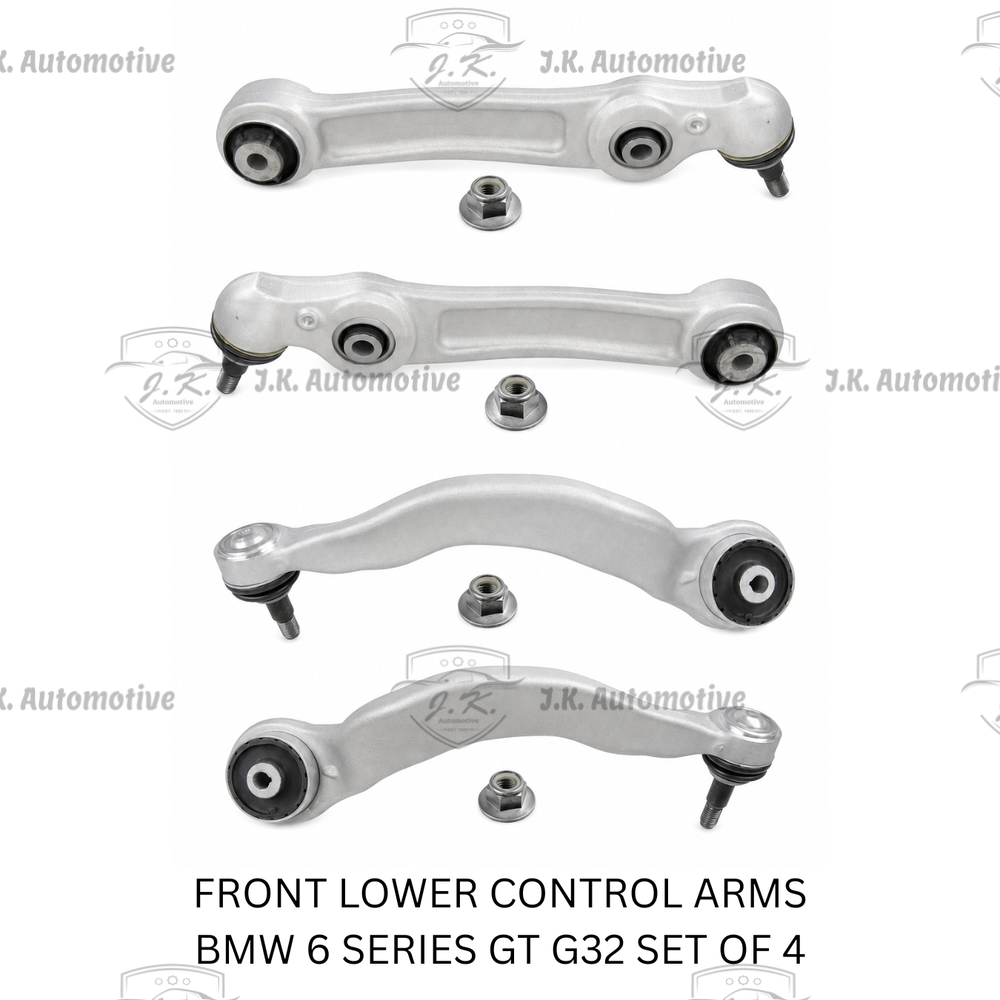
BMW 6 Series GT G32 Front Lower Control Arms are important components of the front suspension system that help locate, support and guide the front wheel assemblies while allowing controlled suspension movement during acceleration, braking, cornering and travel over uneven road surfaces. This Stokes Germany Front Lower Control Arm Set of 4 for BMW 6 Series GT G32 31106861151 & 31106861152 & 31106861169 & 31106861170 combines four position-specific lower suspension arms for the front axle rather than four identical interchangeable arms. JK Automotive currently lists this exact Stokes Germany product for the BMW 6 Series Gran Turismo G32 with a 2018–2024 application range. The four OEM references identify different left, right, forward and rearward positions within the front suspension arrangement. Technical catalog data identifies 31106861151 as the front left lower forward control arm and 31106861152 as the corresponding front right lower forward control arm, while 31106861169 is identified as the front left lower rearward control arm and 31106861170 as the corresponding front right lower rearward control arm. This arrangement means the Set of 4 provides a comprehensive left-and-right lower control-arm package covering both corresponding lower suspension positions on each side of the vehicle. The control arms create important mechanical connections between the wheel-side suspension assembly and the vehicle chassis, allowing the wheels to move through their intended suspension path while limiting unwanted movement. When the BMW 6 Series GT G32 travels over potholes, speed breakers, road joints or broken road surfaces, the front wheels move vertically as the suspension absorbs the changing road profile. The lower control arms help guide this movement while their bushes and applicable joints allow controlled articulation at the mounting points. During braking, substantial longitudinal forces are transferred through the tyres and front suspension, while cornering generates lateral forces and acceleration changes the loading acting through the suspension system. The control arms must therefore manage continuously changing forces while maintaining controlled wheel location. BMW's own parts information describes 31106861151 as a left tension strut with hydraulic mount for G32 Gran Turismo applications, while other technical listings describe the component as a lower control arm incorporating its relevant bushing and ball-joint assembly. As mileage and suspension cycles accumulate, bushes, hydraulic mounting elements and applicable joints can gradually deteriorate, particularly where the vehicle is regularly driven over potholes or rough roads. Excessive wear may contribute to knocking, clunking, vibration, changes in steering response, unwanted wheel movement or irregular tyre wear. These symptoms are not exclusive to control-arm deterioration, so steering tie rod ends, shock absorbers, wheel bearings, tyres, wheels, Sway bar links, Sway links, Anti roll link rods and Stabiliser sway links should also be inspected during diagnosis. When professional inspection confirms excessive wear in the original BMW 6 Series GT G32 Front Lower Control Arms, replacing the affected components can remove unwanted mechanical play from those suspension positions. Correct OEM-number verification, professional installation and a wheel alignment check after completing the necessary suspension repairs are recommended.
Are 31106861151, 31106861152, 31106861169 & 31106861170 suitable for BMW 6 Series GT G32?
The OEM references 31106861151, 31106861152, 31106861169 & 31106861170 are associated with front lower suspension applications for the BMW 6 Series Gran Turismo G32, and JK Automotive currently lists this exact four-number combination as a Stokes Germany Front Lower Control Arm Set of 4 for BMW 6 Series GT G32 2018–2024. Independent technical catalog information also supports the G32 application and provides useful position-specific information for each component. Teknorot identifies 31106861151 as a suspension control-arm and ball-joint assembly positioned at the Front Left Lower Forward location and specifically lists BMW 6 Series G32 compatibility. Corresponding suspension data identifies 31106861152 as the Front Right Lower Forward control arm, creating the left/right pair for the forward lower suspension position. Another technical listing identifies 31106861169 as the Front Left Lower Rearward arm and 31106861170 as the Front Right Lower Rearward arm for the BMW G32/G11/G12 suspension family. This means the four OEM numbers should not be interpreted as alternative numbers for one single arm. They represent four physical position-specific suspension components within the Set of 4. The 31106861151 and 31106861152 pair covers the corresponding left and right forward lower positions, while 31106861169 and 31106861170 cover the corresponding left and right rearward lower positions. This distinction is particularly important when customers compare different BMW G32 suspension listings online because one listing may contain only 31106861151, another may contain only the 31106861151 and 31106861152 pair, while the complete product supplied here covers all four listed positions. Independent catalog information also shows these references within the BMW 6 Series Gran Turismo G32 and BMW 7 Series G11/G12 suspension family, meaning customers should verify their exact vehicle rather than assuming that the presence of a shared part number makes every suspension configuration identical. BMW's official UK parts store specifically lists 31106861151 for 6 Series G32 GT Gran Turismo applications, including examples such as the 620d and 630d. Nevertheless, exact compatibility can vary with vehicle configuration, drivetrain, engine or production specification, so VIN-based verification remains the safest approach before ordering. Customers should compare the OEM references with the existing components or a reliable BMW parts catalog and should not choose control arms solely from photographs. Visually similar suspension arms can differ in mounting geometry, dimensions, ball-joint location, bush specification or vehicle application. Therefore, for a BMW 6 Series GT G32 requiring these exact OEM references, the Stokes Germany Set of 4 provides the corresponding front lower suspension components together, but the VIN and OEM references should still be confirmed before purchase.
What are the common symptoms of worn BMW 6 Series GT G32 Front Lower Control Arms?
Common symptoms that may be associated with worn BMW 6 Series GT G32 Front Lower Control Arms include knocking or clunking from the front suspension, vibration or shaking, unwanted movement during braking, less precise steering response, changes in front-end stability and irregular tyre wear, although none of these symptoms should automatically be treated as proof that the lower control arms require replacement without a proper suspension inspection. The BMW G32 front lower suspension arrangement covered by this Stokes Germany Set of 4 includes 31106861151 and 31106861152 for corresponding forward lower positions together with 31106861169 and 31106861170 for corresponding rearward lower positions. These components operate continuously whenever the vehicle is moving because braking, acceleration, steering inputs and road impacts constantly change the forces passing through the front suspension. If a rubber bush, hydraulic mount or ball joint develops excessive wear, the affected control arm may move farther than intended under load. BMW's parts listing describes 31106861151 as a tension strut with hydraulic mount, and aftermarket technical information describes the same reference as a front lower control arm incorporating a bushing and ball-joint assembly. When deterioration develops at these mounting or articulation points, a knocking or clunking noise can sometimes become noticeable over potholes, speed breakers, rough roads or sharp road joints because the suspension is repeatedly loaded and unloaded. A worn hydraulic or rubber mounting element may also permit additional longitudinal movement when braking, which can sometimes be felt as unwanted front-end movement or reduced precision. Vibration or shaking may also accompany a badly worn control arm or bush in some circumstances; technical parts guidance for 31106861151 specifically notes vibration and shaking as possible symptoms associated with failed control arms. However, vibration should be diagnosed carefully because wheel imbalance, tyre deformation, damaged alloy wheels and worn wheel bearings can create similar symptoms. Steering may sometimes feel less precise if excessive control-arm movement allows wheel location to change more than intended when braking or cornering forces are applied. Uneven tyre wear may also develop if suspension deterioration contributes to inconsistent wheel geometry, although incorrect alignment, tyre pressure and damaged tyres can independently cause abnormal wear. Steering tie rod ends and related steering joints should be inspected whenever the vehicle feels loose or inconsistent through the steering. Shock absorbers should be checked for leakage, physical damage and damping condition because they work alongside the lower arms to manage wheel movement. Sway bar links, Sway links, Anti roll link rods and Stabiliser sway links should be inspected when the complaint includes knocking or rattling over smaller road irregularities because worn stabilizer joints can create noises that resemble control-arm wear. Wheel bearings should be checked if humming, roughness or speed-related vibration is present, and the wheels themselves should be inspected for pothole damage. A complete professional diagnosis is therefore necessary to determine whether the BMW 6 Series GT G32 Front Lower Control Arms are responsible for the reported symptoms or whether another suspension, steering, wheel or tyre component requires attention.
Why is the BMW 6 Series GT G32 Front Lower Control Arm kit supplied as a Set of 4?
The BMW 6 Series GT G32 Front Lower Control Arm kit is supplied as a Set of 4 because the front suspension arrangement uses four corresponding position-specific lower control arms across the left and right sides, rather than four identical arms that can be installed in any position. This Stokes Germany Front Lower Control Arm Set of 4 for BMW 6 Series GT G32 contains OEM references 31106861151 & 31106861152 & 31106861169 & 31106861170, and JK Automotive currently lists the complete package for BMW 6 Series Gran Turismo G32 2018–2024. The first pair, 31106861151 and 31106861152, covers the corresponding front lower forward positions. Technical catalog information identifies 31106861151 as Front Left Lower Forward and 31106861152 as the corresponding Front Right Lower Forward arm. The second pair, 31106861169 and 31106861170, covers the corresponding rearward lower positions, with 31106861169 identified as the left rearward lower arm and 31106861170 as the right rearward lower arm. The complete package therefore consists of a left forward arm, right forward arm, left rearward arm and right rearward arm. This is an important distinction for customers comparing BMW G32 suspension products because an individual 31106861151 control arm is only one component of the complete four-position lower suspension arrangement. A listing containing 31106861151 and 31106861152 supplies the forward left/right pair but does not necessarily contain the 31106861169 and 31106861170 rearward pair. Similarly, a listing containing only 31106861169 and 31106861170 covers the corresponding rearward positions rather than the entire four-arm package. Supplying all four together can be useful when professional inspection identifies substantial deterioration across several lower suspension positions and a more comprehensive front axle repair is required. Since the corresponding components operate on the same vehicle and generally accumulate similar mileage, discovering substantial wear on one side is also a sensible reason to inspect the matching arm on the opposite side. However, being sold as a Set of 4 does not mean all four arms necessarily fail at exactly the same mileage. One side may experience more pothole impacts, road-edge damage or kerb strikes, and previous repairs may mean individual components have different service histories. Therefore, the complete Set of 4 provides a convenient package when all corresponding components require replacement, but the repair scope should still be based on actual mechanical inspection. Steering tie rod ends, shock absorbers, wheel bearings, tyres, wheels, Sway bar links, Sway links, Anti roll link rods and Stabiliser sway links should also be inspected while the front suspension is being repaired. After all confirmed worn components are replaced, a professional wheel alignment check is recommended.
What are the benefits of replacing worn Front Lower Control Arms on BMW 6 Series GT G32?
Replacing worn BMW 6 Series GT G32 Front Lower Control Arms can help restore controlled mechanical movement at the affected front suspension positions when professional inspection confirms deterioration in the original control-arm bushes, hydraulic mounting elements, ball joints or related suspension connections. The Stokes Germany Front Lower Control Arm Set of 4 combines 31106861151 & 31106861152 & 31106861169 & 31106861170, covering corresponding forward and rearward lower suspension positions on both sides of the BMW G32 front axle. The primary function of these arms is to guide and locate the front wheel assemblies while allowing the suspension to move through its intended range. When the original bushes or joints are in good mechanical condition, they permit controlled articulation while limiting unwanted movement under braking, acceleration and cornering forces. As these components deteriorate, additional movement can develop at the mounting or joint positions. Replacing confirmed worn arms removes that excessive mechanical play from the affected locations and restores a tighter mechanical connection within the suspension system. If excessive control-arm movement was responsible for knocking or clunking over potholes, correcting the worn component can address that particular source of noise. If deteriorated bushes were allowing unwanted wheel movement during braking, replacing them can restore better control at those suspension positions. BMW's official parts information identifies 31106861151 as a tension strut with hydraulic mount for G32 applications, demonstrating that the mounting system is an integral part of how the component operates. If excessive bush or hydraulic-mount movement contributes to vibration or shaking, replacing the worn component may also address that mechanical source, although wheel and tyre problems must be ruled out separately. Technical guidance for 31106861151 specifically associates failed control arms with vibration and shaking transmitted through the steering wheel. Renewing worn lower suspension components also provides a mechanically sounder basis for wheel alignment because alignment equipment cannot compensate for uncontrolled movement in a worn bush, ball joint or steering component. If the vehicle has irregular tyre wear, correcting the suspension fault and verifying alignment may help prevent an alignment-related wear pattern from continuing, although existing tyre damage cannot be reversed. A complete four-arm package can be especially useful when multiple forward and rearward lower positions show deterioration because all corresponding components are available together. However, new control arms cannot repair unrelated faults. Worn steering tie rod ends, defective shock absorbers, damaged wheel bearings, bent wheels, worn Sway bar links, Sway links, Anti roll link rods or Stabiliser sway links will continue to produce their own symptoms until repaired. For this reason, replacing worn BMW 6 Series GT G32 Front Lower Control Arms should form part of a complete suspension diagnosis and repair process, followed by professional wheel alignment after all significant mechanical wear has been addressed.
What should be checked before buying Stokes Germany BMW 6 Series GT G32 Front Lower Control Arms?
Before buying Stokes Germany BMW 6 Series GT G32 Front Lower Control Arms, customers should verify the exact vehicle chassis, year range, drivetrain or suspension configuration where applicable, OEM references, required suspension positions and the actual mechanical condition of the vehicle. JK Automotive currently lists this exact Stokes Germany Front Lower Control Arm Set of 4 with 31106861151 & 31106861152 & 31106861169 & 31106861170 for BMW 6 Series Gran Turismo G32 2018–2024. The four OEM numbers should be checked carefully because they represent four different suspension positions rather than interchangeable alternatives. Technical catalog data identifies 31106861151 as the Front Left Lower Forward control arm and 31106861152 as the corresponding Front Right Lower Forward component. The 31106861169 and 31106861170 references correspond to the Front Left Lower Rearward and Front Right Lower Rearward positions respectively. BMW's official UK parts information also specifically lists 31106861151 for BMW 6 Series G32 GT Gran Turismo applications, providing further support for the G32 fitment family. Customers should nevertheless verify the VIN before ordering because compatibility can depend on the exact production specification and vehicle configuration. This is especially important because technical catalogs can distinguish applications by drivetrain; for example, one catalog notes the 31106861151 application for G32 Gran Turismo rear-wheel-drive configurations. The OEM numbers on the original suspension components should therefore be compared wherever accessible, or the vehicle VIN should be checked against an appropriate BMW parts catalog. Customers should not purchase suspension arms solely because the product photographs resemble the original components. Visually similar control arms can differ in dimensions, mounting geometry, ball-joint position, bush construction and vehicle application. The actual suspension problem should also be professionally diagnosed before ordering a complete Set of 4. If the complaint is knocking, the lower arms should be inspected for excessive bush or joint movement, but Sway bar links, Sway links, Anti roll link rods and Stabiliser sway links should also be checked because they can create similar noises. If the complaint is loose or inconsistent steering, tie rod ends and other steering joints should be inspected. If vibration or shaking is present, wheels, tyres, wheel balancing and wheel bearings should also be examined. Shock absorbers should be inspected for leakage, physical damage and damping condition, while tyres should be checked for abnormal tread wear that may indicate an existing suspension or alignment problem. Once the BMW 6 Series GT G32 chassis, OEM numbers and required suspension positions have been confirmed, professional installation is recommended. All related mounting hardware should be handled according to the applicable BMW repair procedure, and a professional wheel alignment check should be completed after the necessary front suspension and steering repairs.
Can worn BMW 6 Series GT G32 Front Lower Control Arms cause knocking, vibration, loose steering or uneven tyre wear?
Worn BMW 6 Series GT G32 Front Lower Control Arms can contribute to a wide range of front suspension symptoms, including knocking or clunking noises, vibration or shaking, unwanted movement during braking, less precise steering response, changes in front-end stability and uneven tyre wear, although none of these symptoms should be treated as automatic proof that the control arms are faulty without a proper inspection of the entire front suspension and steering system. This Stokes Germany Front Lower Control Arm Set of 4 for BMW 6 Series GT G32 31106861151 & 31106861152 & 31106861169 & 31106861170 covers four different lower suspension positions across the front axle, with corresponding forward and rearward arms on the left and right sides. The front lower control arms continuously experience changing loads while the BMW G32 is driven because braking transfers significant longitudinal forces through the tyres and suspension, cornering creates lateral forces, acceleration changes the way the front axle is loaded and uneven roads repeatedly compress and release the suspension. Over time, bushes, hydraulic mounting elements and applicable ball joints can wear or develop excessive movement, and this can allow the wheel assembly to move more than intended under load. One of the most common symptoms is a dull knocking or clunking sound from the front suspension when driving over potholes, speed breakers, rough roads or sharp road joints, because worn bushes or joints can move abruptly as suspension loads change. The noise may also be noticeable during braking or when changing direction if excessive control-arm movement is present. Vibration or shaking can sometimes occur when a badly worn bush or suspension joint allows additional movement, but vibration must be diagnosed carefully because wheel imbalance, damaged tyres, bent alloy wheels and worn wheel bearings are also common causes. If the steering feels loose, delayed or less precise, excessive movement within the lower control-arm system can be one possible reason because the front wheel may not remain as consistently located under braking or cornering forces. However, steering tie rod ends, inner steering joints and other steering components can create very similar symptoms, so they must also be checked. Uneven tyre wear can develop when worn suspension components contribute to inconsistent wheel geometry, but incorrect tyre pressure, pre-existing wheel alignment issues and damaged tyres can produce similar wear patterns. If one tyre shows heavy inner-edge or outer-edge wear, the suspension and alignment should be inspected rather than assuming the control arm alone is responsible. Shock absorbers should also be examined for leakage, physical damage and reduced damping because poor damping can contribute to unstable wheel movement and may make suspension symptoms feel more severe. Sway bar links, Sway links, Anti roll link rods and Stabiliser sway links should be checked whenever knocking or rattling occurs over smaller road irregularities because worn stabilizer-link joints are another common source of front suspension noise. Wheel bearings should be inspected if humming, roughness or road-speed-related vibration is present, while the wheels themselves should be checked for pothole damage or bending. The tyres should also be inspected for pressure, tread condition and sidewall damage. A complete professional inspection is therefore the correct way to determine whether the BMW 6 Series GT G32 Front Lower Control Arms are actually worn. If excessive movement is confirmed in 31106861151, 31106861152, 31106861169 or 31106861170 or their associated bushes and joints, replacing the affected components can remove unwanted play from those suspension positions. After all necessary front suspension and steering repairs are completed, a professional wheel alignment check is recommended to verify the final wheel geometry and help support consistent steering response and tyre wear.
Should all four BMW 6 Series GT G32 Front Lower Control Arms be replaced together?
All four BMW 6 Series GT G32 Front Lower Control Arms do not automatically have to be replaced together simply because one component has developed wear, but discovering significant deterioration in one arm is a strong reason to inspect all four corresponding positions because they operate on the same front suspension system and usually accumulate similar mileage and road-use cycles. This Stokes Germany Front Lower Control Arm Set of 4 includes 31106861151, 31106861152, 31106861169 and 31106861170, covering left and right lower forward and left and right lower rearward suspension positions. Because all four arms are exposed to braking forces, steering loads, cornering forces, road impacts and changing suspension movement throughout the life of the vehicle, wear can develop across more than one position over time. However, the amount of wear on each component may still differ. One side of the vehicle may regularly encounter deeper potholes, broken road edges or kerb impacts, while the opposite side may experience fewer severe impacts. One control arm may also have been replaced during an earlier repair, meaning its mileage and age may be different from the other components. For this reason, the repair decision should be based on actual mechanical inspection rather than a rule that every arm must always be replaced at the same time. If only one control arm has been physically damaged by an isolated road impact and the other three remain mechanically sound, a technician may determine that individual replacement is appropriate. If several arms show cracked bushes, hydraulic mount deterioration, excessive ball-joint movement or unwanted play, installing the complete Set of 4 can provide a more comprehensive repair and can simplify parts selection by supplying all corresponding lower suspension positions together. Replacing multiple worn components together may also help avoid a situation where one severely worn part is changed and another related component fails soon afterwards due to similar age and mileage. At the same time, customers should not replace mechanically sound suspension parts unnecessarily. The correct approach is to inspect each of the four arms, their bushes, applicable ball joints, mounting points and related hardware. Steering tie rod ends should also be checked because steering play can remain even after the lower control arms are renewed. Shock absorbers should be inspected for leakage and damping condition, while wheel bearings should be checked for roughness or play if vibration or humming is present. Sway bar links, Sway links, Anti roll link rods and Stabiliser sway links should be inspected for joint wear because they can produce knocking that may initially be blamed on the control arms. Tyres should be checked for abnormal wear, while the wheels should be inspected for impact damage or bending. If the suspension has experienced a severe pothole strike, the mounting points and alignment should also be evaluated. When all four lower arms show substantial wear or when a more complete front axle suspension refresh is appropriate, using the Stokes Germany Set of 4 can be practical because 31106861151, 31106861152, 31106861169 and 31106861170 are supplied together as matching position-specific components. After replacing the required arms and correcting any other steering or suspension faults, a professional wheel alignment check is recommended. This ensures that the decision to replace all four BMW 6 Series GT G32 Front Lower Control Arms is based on real mechanical condition and provides a complete repair approach rather than replacing parts solely because they are supplied together in one package.
What other suspension parts should be inspected when replacing BMW 6 Series GT G32 Front Lower Control Arms?
When replacing BMW 6 Series GT G32 Front Lower Control Arms, the complete front suspension, steering system, wheels and tyres should be inspected because the lower control arms are only one part of a larger system that controls wheel position, steering response, ride movement and tyre contact with the road. This Stokes Germany Front Lower Control Arm Set of 4 includes 31106861151, 31106861152, 31106861169 and 31106861170, covering corresponding forward and rearward lower suspension positions on both sides of the front axle, and when these components are being replaced it is an ideal opportunity to inspect other parts that may be contributing to the same symptoms. The applicable control-arm ball joints should be checked for excessive play, stiffness, damaged protective boots or loss of lubrication because worn joints can cause knocking, loose steering or unwanted wheel movement. All remaining suspension bushes should be examined for cracking, separation, tearing or excessive deformation because replacing four lower arms will not eliminate movement caused by another deteriorated bush. Steering tie rod ends should be inspected carefully because they directly control wheel direction and can create vague steering, uneven tyre wear or knocking when worn. Inner steering joints and related steering components should also be checked if the steering has free play or if the vehicle does not respond consistently to steering input. Shock absorbers should be examined for oil leakage, damaged bodies, damaged mounts and reduced damping performance because poor damping can allow excessive wheel movement and make the front end feel unstable. Upper shock absorber mounts and bearings should also be inspected where applicable, since wear at the upper mount can cause noise that may be mistaken for lower suspension problems. Coil springs should be checked for cracks, breakage, corrosion or incorrect seating, especially if the vehicle sits lower on one side or produces unusual noises over bumps. Sway bar links, Sway links, Anti roll link rods and Stabiliser sway links should be inspected because worn stabilizer-link joints often produce rattling or knocking over smaller road irregularities and can easily be confused with worn control-arm bushes. Stabilizer bar mounting bushes should also be checked for excessive movement or deterioration. Wheel bearings deserve attention if there is humming, roughness, vibration or excessive wheel movement, because bearing wear can create symptoms that remain even after the control arms are replaced. The wheels should be checked for bending, cracks or pothole damage, especially if the control-arm problem began after a severe road impact. Tyres should be inspected for correct pressure, sidewall damage, tread separation and abnormal wear patterns because tyre condition can reveal previous suspension or alignment problems. Brake components should also be visually inspected while the wheel is removed because loose brake hardware or other brake-related issues can sometimes create noises that are mistaken for suspension knocking. The front suspension mounting points should be examined for deformation or accident damage, especially if the vehicle has experienced a strong impact. All nuts, bolts and hardware removed during the repair should be inspected, and any hardware specified as non-reusable under the applicable BMW repair procedure should be replaced rather than automatically reused. The new control arms should be compared with the removed components before installation to confirm correct left, right, forward and rearward orientation and to ensure that the mounting geometry and bush arrangement match. After the BMW 6 Series GT G32 Front Lower Control Arms are installed, any remaining steering or suspension faults should be corrected before final wheel alignment. Alignment equipment cannot compensate for play in a worn tie rod end, wheel bearing, bush or other joint, so completing all necessary mechanical repairs first provides the best basis for accurate wheel-geometry measurement. A comprehensive inspection helps ensure that the Stokes Germany Set of 4 is installed into a mechanically sound front suspension and that the original complaint is properly addressed rather than simply replacing one group of components.
Is wheel alignment required after replacing BMW 6 Series GT G32 Front Lower Control Arms?
A professional wheel alignment check is strongly recommended after replacing BMW 6 Series GT G32 Front Lower Control Arms because these components directly influence how the front wheel assemblies are located relative to the chassis, and changing worn suspension arms or bushes alters the mechanical condition of the system compared with the condition in which the vehicle was previously being driven. This Stokes Germany Front Lower Control Arm Set of 4 includes 31106861151, 31106861152, 31106861169 and 31106861170, covering left and right lower forward and rearward suspension positions, and all four arms contribute to controlled wheel movement and front suspension geometry. When the original bushes or ball joints become worn, the control arms can move more than intended as braking, steering and cornering forces are applied. This additional movement can allow the wheel position to change dynamically under load, which means the geometry measured in a static condition may not accurately reflect the way the suspension behaves while driving if significant wear is still present. Replacing the worn arms removes this excessive mechanical movement and gives the suspension a more stable foundation, making post-repair alignment verification important. Alignment should ideally be carried out only after all significant steering and suspension faults have been repaired. If a tie rod end, wheel bearing, another bush or another joint still has excessive play, alignment equipment cannot mechanically eliminate that movement. Tyre pressures should be corrected before alignment because incorrect pressure can affect handling and tyre wear even when wheel geometry is within specification. Tyres should also be inspected for severe inner-edge or outer-edge wear, physical damage or significant differences in tread depth. Installing new BMW 6 Series GT G32 Front Lower Control Arms cannot restore tread that has already worn away, so a badly damaged or excessively worn tyre may need separate replacement. Wheels should be inspected for bending or impact damage because a bent wheel can create vibration or handling problems that remain after suspension repair. Steering tie rod ends and inner steering components should be checked before alignment because they are directly involved in controlling and adjusting wheel direction. Shock absorbers, springs, Sway bar links, Sway links, Anti roll link rods and Stabiliser sway links should also be inspected as part of the overall front suspension assessment. During installation of the new control arms, the correct vehicle-specific tightening procedure should be followed because rubber and hydraulic mounting elements can be sensitive to how the arm is positioned when fasteners are tightened. The manufacturer's workshop procedure should therefore be used rather than relying on generic suspension-tightening methods. Once the suspension is mechanically sound and the new 31106861151, 31106861152, 31106861169 and 31106861170 components are installed correctly, professional alignment equipment can measure the relevant wheel geometry and identify whether adjustment is required. Correct wheel geometry helps support predictable steering behaviour, consistent tyre contact with the road and more even tyre wear. It can also help the vehicle benefit properly from the renewed suspension components by ensuring the wheels are operating within the intended geometric range. Therefore, wheel alignment should be considered an important final stage of BMW G32 lower control-arm replacement rather than an unrelated optional service. The preferred sequence is to diagnose the complete suspension, replace all confirmed worn components, verify installation, inspect tyres and wheels and then perform a professional wheel alignment check.
Why is Stokes Germany a European-quality alternative to Lemförder, FEBI, Meyle and other established brands for BMW 6 Series GT G32?


Reviews
There are no reviews yet.