What are Stokes Germany Front Lower Control Arms for BMW 2 Series Active Tourer F44 and what do they do?
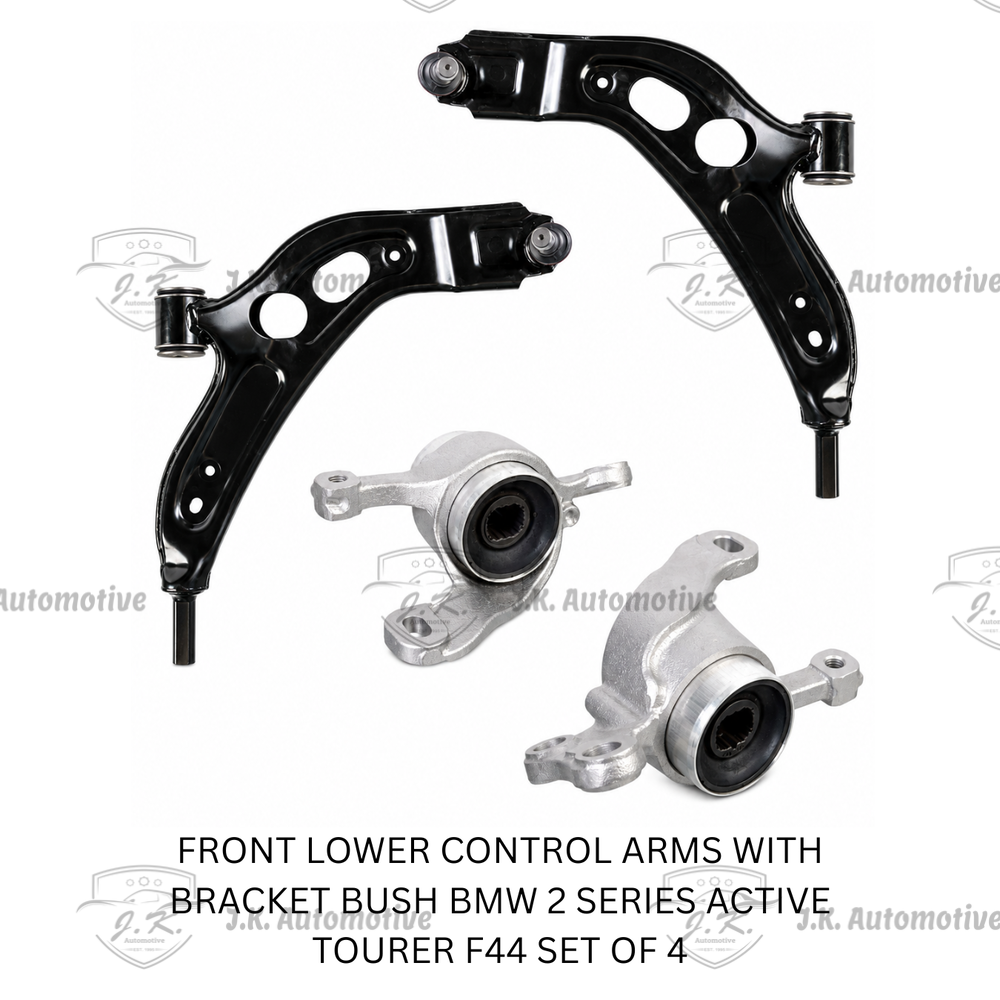
BMW 2 Series Active Tourer F44 Front Lower Control Arms are important front suspension components designed to help locate, guide and control the movement of the front wheel assemblies while the vehicle is accelerating, braking, cornering or travelling over uneven roads. This Stokes Germany Front Lower Control Arm Set of 4 for BMW 2 Series Active Tourer F44 31126879844 / 31126871302 & 31126871301 / 31126879843 & 31126882844 & 31126882843 combines corresponding left and right lower suspension components into one replacement package. Technical suspension catalog data identifies 31126879844 / 31126871302 as the front lower right control-arm reference family and 31126871301 / 31126879843 as the front lower left reference family. The additional 31126882844 and 31126882843 references are associated with the corresponding lower control-arm bush/bracket positions, meaning the Set of 4 should not be understood as four identical control arms. The lower control arms form an important mechanical connection within the front suspension and help maintain controlled wheel positioning as road and driving forces pass through the tyres and suspension into the vehicle chassis. When the vehicle travels over potholes, speed breakers, road joints or rough surfaces, the front wheels move vertically while the lower arms help guide this movement through the suspension's designed path. During braking, the suspension experiences longitudinal forces, while cornering introduces lateral loads and changes in vehicle direction. The control-arm bushes help isolate and control movement at the mounting points while still permitting the suspension movement required by the design. As mileage accumulates, bushes, ball joints and related mounting components can gradually deteriorate. Excessive wear may contribute to knocking or clunking, additional suspension movement, changes in steering response or irregular tyre wear. However, these symptoms should not automatically be blamed on the lower arms because other components can produce similar behaviour. Steering tie rod ends, shock absorbers, wheel bearings, tyres, wheels, Sway bar links, Sway links, Anti roll link rods and Stabiliser sway links should also be inspected during diagnosis. When professional inspection confirms deterioration in the BMW 2 Series Active Tourer F44 Front Lower Control Arms or corresponding mounting bushes, replacing the worn components can remove unwanted mechanical movement from the affected suspension positions. Correct part-number verification, professional installation and a wheel alignment check after replacement are recommended.
Are 31126879844 / 31126871302, 31126871301 / 31126879843, 31126882844 & 31126882843 suitable for BMW 2 Series Active Tourer F44?
The OEM reference group 31126879844 / 31126871302 & 31126871301 / 31126879843 & 31126882844 & 31126882843 is the reference combination supplied in this Stokes Germany Front Lower Control Arm Set of 4 listing, but customers should verify the exact BMW model and chassis before ordering because there is an important naming distinction with the supplied title. JK Automotive currently lists this exact Stokes Germany product under the title BMW 2 Series Active Tourer F44 while its product information identifies the vehicle model as BMW 2 Series Gran Coupe (F44) and the year range as 2020–2025. Independent technical catalog data likewise identifies F44 as the 2 Series Gran Coupé, while the earlier 2 Series Active Tourer is identified as F45. The part-number mapping itself is well supported: 31126879844 / 31126871302 corresponds to the front lower right control-arm family, and 31126871301 / 31126879843 corresponds to the front lower left family. ECS also identifies 31126879844 as a front lower right control arm and lists 31126871302 as a previous revision, while listing F44 applications among compatible vehicles. The 31126882844 and 31126882843 references belong to the corresponding lower suspension bush/bracket family and are included to complete the four-component package. Customers should therefore not interpret every number separated by a slash as a separate physical component. The slash-separated 31126879844 / 31126871302 references represent corresponding or superseding right-side references, while 31126871301 / 31126879843 represents the corresponding left-side reference family. Before purchasing, the OEM references should be compared with the original suspension components or a reliable VIN-based parts catalog. This is especially important for this listing because BMW model names and chassis codes must match correctly. Customers should not rely only on photographs because visually similar lower control arms can differ in dimensions, mounting positions, ball-joint configuration or bush design. Correct vehicle identification and OEM-number verification should therefore be completed before ordering the Set of 4.
What are the common symptoms of worn BMW 2 Series Active Tourer F44 Front Lower Control Arms?
Common symptoms that may be associated with worn BMW 2 Series Active Tourer F44 Front Lower Control Arms include knocking or clunking from the front suspension, unwanted movement during braking, less precise steering, changes in front-end stability and irregular tyre wear, although each of these symptoms can also have causes unrelated to the lower control arms. The left and right control arms continuously experience forces as the vehicle accelerates, brakes, corners and passes over uneven road surfaces, and the associated bushes and joints allow controlled suspension movement while limiting unwanted displacement. As these components age or experience repeated road impacts, deterioration may gradually develop in the bushes, ball joints or mounting points. A worn control-arm bush can permit additional movement when braking or accelerating, while excessive joint wear may contribute to knocking when suspension loads change quickly. Potholes, speed breakers and broken road surfaces can make these noises more noticeable because the front suspension is rapidly compressed and released. Steering may sometimes feel less precise if excessive movement allows the front wheel assembly to change position more than intended under braking or cornering loads. Uneven tyre wear may also develop when suspension deterioration contributes to inconsistent wheel geometry, although incorrect alignment and tyre pressure can produce similar patterns. Vibration should be diagnosed carefully because wheel imbalance, tyre defects, bent wheels and wheel-bearing wear are common alternative causes. If the steering feels loose, steering tie rod ends and related steering joints should be inspected before assuming the lower control arms are responsible. Shock absorbers should be examined for leakage, physical damage and damping condition because they work alongside the control arms to manage wheel movement. Sway bar links, Sway links, Anti roll link rods and Stabiliser sway links should also be inspected when knocking or rattling occurs because stabilizer-link wear can create similar front suspension noises. The tyres and alloy wheels should be examined for impact damage, particularly when symptoms began immediately after hitting a pothole. A complete professional front suspension inspection is therefore the correct way to determine whether the BMW 2 Series Active Tourer F44 Front Lower Control Arms actually require replacement rather than replacing parts solely on the basis of noise or vibration.
Why is the BMW 2 Series Active Tourer F44 Front Lower Control Arm kit supplied as a Set of 4?
The BMW 2 Series Active Tourer F44 Front Lower Control Arm kit is supplied as a Set of 4 because the package combines corresponding left and right lower control arms with their related left and right lower control-arm bush/bracket components rather than providing four identical suspension arms. The right-side lower control-arm family includes 31126879844 / 31126871302, while the corresponding left-side family includes 31126871301 / 31126879843. Independent suspension catalog data specifically identifies these as front lower right and front lower left applications. The 31126882844 and 31126882843 references are associated with the corresponding lower control-arm mounting bush/bracket positions, completing the four-component suspension package. This distinction is important because customers comparing suspension products online may find very different package configurations. One product may contain only the front lower right control arm, another may contain only the front lower left arm, while another may provide a two-piece left/right arm pair without the corresponding bush or bracket assemblies. A Set of 4 containing both arms and their related mounting components should therefore not be compared directly with a single control arm purely on headline price. Providing all four corresponding components in one package can be useful when inspection identifies deterioration in several positions and a more comprehensive front suspension repair is required. Since the left and right components operate on the same vehicle and usually accumulate similar mileage, discovering substantial bush or joint wear on one side is also a sensible reason to inspect the corresponding component on the opposite side. This does not mean that all four components necessarily fail simultaneously. Road conditions, pothole impacts, driving conditions, previous repairs and individual component condition can result in different wear rates between the left and right sides. The complete suspension should therefore be inspected before determining the required repair scope. Steering joints, shock absorbers, wheel bearings, stabilizer links and other related components should also be checked so that additional faults are not overlooked.
What are the benefits of replacing worn Front Lower Control Arms on BMW 2 Series Active Tourer F44?
Replacing worn BMW 2 Series Active Tourer F44 Front Lower Control Arms can help restore controlled mechanical movement at the affected front suspension positions when inspection confirms deterioration in the original control arms, bushes, ball joints or related mounting components. The 31126879844 / 31126871302 right-side family and 31126871301 / 31126879843 left-side family form the principal lower control-arm references within this product, while 31126882844 and 31126882843 cover corresponding lower mounting bush/bracket positions. When a control-arm bush becomes excessively worn, the arm can move farther than intended as braking, acceleration or cornering forces act on the wheel assembly. Replacing a confirmed worn component removes this unwanted mechanical play from that suspension position and restores a firmer mechanical connection. If worn control-arm components are responsible for knocking or clunking, replacing them can address the source of that particular noise. If excessive movement is contributing to inconsistent steering behaviour, correcting the worn suspension positions can help restore more controlled wheel location. A complete Set of 4 can be particularly useful when both lower control arms and their corresponding mounting components have been diagnosed as worn because the required left and right components can be replaced together. Replacing worn suspension components also creates a mechanically sounder foundation for wheel alignment because alignment equipment cannot compensate for uncontrolled movement in a deteriorated bush or joint. However, new lower control arms cannot correct unrelated faults elsewhere in the front suspension or steering system. A worn tie rod end, damaged shock absorber, worn wheel bearing or defective stabilizer link will still require separate repair. Existing irregular tyre wear will also remain visible after suspension replacement and may require tyre replacement depending on severity. Sway bar links, Sway links, Anti roll link rods and Stabiliser sway links should be checked during the same inspection, particularly when the original complaint includes front-end knocking. After all confirmed mechanical wear has been repaired, a professional wheel alignment check is recommended to verify the vehicle's wheel geometry.
What should be checked before buying Stokes Germany BMW 2 Series Active Tourer F44 Front Lower Control Arms?
Before buying Stokes Germany BMW 2 Series Active Tourer F44 Front Lower Control Arms, the first and most important step is to verify the exact BMW model, chassis code and OEM references because the supplied product title contains a model/chassis naming combination that should be checked carefully. JK Automotive currently lists this exact product as “Stokes Germany Front Lower Control Arm Set of 4 for BMW 2 Series Active Tourer F44” with OEM references 31126879844 / 31126871302 & 31126871301 / 31126879843 & 31126882844 & 31126882843, but its own product information identifies the model as “2 Series Gran Coupe (F44)” and gives a 2020–2025 year range. Independent technical catalog information also associates F44 with the BMW 2 Series Gran Coupé, while F45 is used for the earlier 2 Series Active Tourer. For that reason, customers should verify the VIN before purchasing instead of relying solely on the written model name. The OEM mapping should then be checked carefully. Technical catalog data identifies 31126879844 / 31126871302 as the front lower right control-arm family and 31126871301 / 31126879843 as the front lower left family. The 31126882844 and 31126882843 references correspond with the related lower suspension bush/bracket family used within this Set of 4. Customers should understand that slash-separated numbers can represent corresponding or superseded references rather than additional physical parts. The actual condition of the vehicle should also be diagnosed before ordering. If knocking is present, stabilizer components such as Sway bar links, Sway links, Anti roll link rods and Stabiliser sway links should be inspected. Loose steering requires inspection of tie rod ends and other steering joints, while vibration requires checking tyres, wheel balancing, alloy wheels and wheel bearings. Shock absorbers should also be inspected for leakage and damping condition. Once the exact vehicle, OEM references and required components have been confirmed, professional installation should be used and a wheel alignment check should be performed after completing the necessary suspension repairs.
Can worn BMW 2 Series Active Tourer F44 Front Lower Control Arms cause knocking, vibration, loose steering or uneven tyre wear?
Worn BMW 2 Series Active Tourer F44 Front Lower Control Arms can contribute to several noticeable front suspension symptoms, including knocking or clunking noises, unwanted movement during braking, vibration in certain conditions, less precise steering response and uneven tyre wear, although these symptoms should always be professionally diagnosed because they can also originate from other steering, suspension, wheel or tyre components. This Stokes Germany Front Lower Control Arm Set of 4 for BMW 2 Series Active Tourer F44 31126879844 / 31126871302 & 31126871301 / 31126879843 & 31126882844 & 31126882843 covers corresponding left and right lower suspension positions and their related mounting components. The 31126879844 / 31126871302 reference family corresponds to the front lower right control-arm position, while 31126871301 / 31126879843 corresponds to the front lower left control-arm position. The additional 31126882844 and 31126882843 references are associated with the corresponding lower control-arm bush or mounting-bracket positions. These components operate continuously while the vehicle is driven because the front suspension must control wheel movement while simultaneously handling braking, acceleration, cornering and road-impact forces. When a control-arm bush begins to deteriorate, the rubber or mounting structure may allow more movement than intended between the suspension arm and vehicle structure. This excessive movement can sometimes produce a dull knocking or clunking noise when travelling over potholes, speed breakers, broken roads or sharp road joints. The noise may also become noticeable when braking or accelerating because the direction and magnitude of the forces acting on the suspension change rapidly. If the bush or mounting component develops significant movement, the wheel assembly may shift slightly more than intended under braking or cornering loads, which can contribute to a less precise steering sensation or a feeling that the front of the vehicle is not responding as consistently as expected. Uneven tyre wear can sometimes develop when excessive suspension movement contributes to changes in wheel geometry, but tyre wear should never be used as the only diagnosis because incorrect tyre pressure, damaged tyres, wheel alignment problems and worn steering components can create similar patterns. Vibration also requires careful diagnosis because wheel imbalance, tyre deformation, damaged alloy wheels, worn wheel bearings or driveline-related problems can produce vibration independently of the control arms. If vibration is mainly related to road speed, the wheels, tyres and wheel bearings should be checked before assuming that the BMW 2 Series Active Tourer F44 Front Lower Control Arms are responsible. If the vehicle feels loose through the steering wheel, steering tie rod ends and related steering joints should also be checked for excessive play. Shock absorbers should be inspected for leakage, physical damage and reduced damping performance because they control wheel oscillation while the lower control arms guide wheel movement. Sway bar links, Sway links, Anti roll link rods and Stabiliser sway links should also be inspected whenever knocking or rattling occurs over smaller road irregularities because worn stabilizer joints can create noises that are easily confused with control-arm bush wear. Stabilizer mounting bushes should also be inspected where applicable. The tyres should be checked for abnormal inner-edge or outer-edge wear, while the alloy wheels should be inspected for impact damage if the symptoms began after a severe pothole strike. Therefore, knocking, vibration, loose steering or uneven tyre wear can justify inspection of the BMW F44 lower suspension, but they do not automatically prove that every component in this Set of 4 requires replacement. A complete front suspension and steering inspection should identify the actual source of the problem before parts are replaced. When excessive movement is confirmed in the original lower control arms or corresponding mounting bushes, replacement of the worn components can remove unwanted mechanical play from the affected positions. After all necessary suspension and steering repairs have been completed, a professional wheel alignment check is recommended to verify the final wheel geometry.
Should all four BMW 2 Series Active Tourer F44 Front Lower Control Arms be replaced together?
All four components supplied within the BMW 2 Series Active Tourer F44 Front Lower Control Arms Set of 4 do not automatically need replacement simply because one suspension component has developed wear, but discovering significant deterioration in one lower control-arm or bush position is a strong reason to inspect the corresponding components on both sides of the front suspension. This Stokes Germany Front Lower Control Arm Set of 4 combines 31126879844 / 31126871302 & 31126871301 / 31126879843 & 31126882844 & 31126882843, meaning the package is intended to cover corresponding left and right lower suspension positions rather than provide four identical control arms. The 31126879844 / 31126871302 family corresponds to the front lower right control-arm application, while 31126871301 / 31126879843 corresponds to the front lower left application. The additional 31126882844 and 31126882843 references are associated with the corresponding lower control-arm bush or mounting-bracket positions. Because the left and right suspension components operate on the same vehicle and generally accumulate similar overall mileage, wear discovered on one side can indicate that the opposite side deserves careful inspection even if it has not yet produced an obvious noise. Both sides repeatedly experience braking forces, cornering loads, acceleration forces and road impacts throughout the vehicle's life. However, the forces experienced by the two sides are not always identical. One side may regularly encounter deeper potholes, damaged road edges or kerb impacts, while the other side may operate under less severe conditions. Previous suspension repairs can also create different component ages, meaning one control arm may have considerably less mileage than the other. For this reason, suspension components should be replaced according to their actual condition rather than an automatic rule that every component must always be changed together. If only one lower control arm has been physically damaged by an isolated impact and the opposite-side components remain mechanically sound, a technician may determine that individual replacement is appropriate. If both control arms show significant bush or joint deterioration and the corresponding mounting components are also worn, installing the complete Stokes Germany Set of 4 can provide a more comprehensive repair. Replacing corresponding left and right components together may also simplify parts purchasing when the complete lower suspension requires attention. Customers should understand that purchasing a Set of 4 and mechanically needing all four components are related but separate questions. The package gives the required corresponding parts together, while the actual repair scope should still be determined through professional inspection. During this inspection, the technician should examine the lower control-arm bushes for cracking, separation or excessive movement and check applicable ball joints for play or damaged protective boots. The corresponding mounting bushes or bracket assemblies should also be examined carefully. Steering tie rod ends should be checked because steering play can remain even after the lower arms have been renewed. Shock absorbers should be inspected for leakage and damping condition, and wheel bearings should be checked if humming, vibration or wheel movement is present. Sway bar links, Sway links, Anti roll link rods and Stabiliser sway links should also be examined because they can produce knocking that may initially appear to come from the control arms. Tyres should be checked for uneven wear, while wheels should be inspected for pothole damage or bending. If several suspension components have accumulated similar wear, replacing the complete corresponding set may reduce the possibility of performing another closely related repair shortly afterwards, but replacement should still be based on actual mechanical condition. Once all confirmed suspension and steering wear has been repaired, a wheel alignment check is recommended. This approach ensures that the decision to replace the complete BMW 2 Series Active Tourer F44 Front Lower Control Arms Set of 4 is based on proper diagnosis rather than replacing parts unnecessarily.
What other suspension parts should be inspected when replacing BMW 2 Series Active Tourer F44 Front Lower Control Arms?
When replacing BMW 2 Series Active Tourer F44 Front Lower Control Arms, the complete front suspension, steering system, wheels and tyres should be inspected because the lower control arms work as part of an interconnected system and replacing them cannot correct excessive movement or damage originating from another component. This Stokes Germany Front Lower Control Arm Set of 4 contains the 31126879844 / 31126871302 right-side control-arm reference family, the 31126871301 / 31126879843 left-side reference family and the corresponding 31126882844 and 31126882843 lower control-arm mounting components. When these components are being replaced, the applicable ball joints should be checked for excessive play, stiffness, damaged protective boots or loss of lubrication because ball-joint condition directly affects controlled suspension movement. Any remaining suspension bushes should be inspected for cracking, tearing, separation or excessive deformation because one deteriorated bush can continue to create movement even after other lower suspension components have been renewed. Steering tie rod ends are particularly important because they help control wheel direction and can create loose steering, knocking or inconsistent wheel positioning when worn. The inner steering joints and related steering components should also be inspected if the steering has noticeable free play or if the vehicle does not respond consistently to steering input. Shock absorbers should be checked for fluid leakage, damaged bodies, damaged mounting points and reduced damping performance because they control vertical wheel oscillation while the lower control arms guide the wheel assembly through its intended suspension path. Upper shock absorber mounts and related mounting hardware should also be inspected where accessible because deterioration at the upper mounting position can create noise that may be incorrectly attributed to the lower control arms. Coil springs should be checked for cracks, breakage, corrosion or incorrect seating because spring damage can affect vehicle height and suspension operation. Sway bar links, Sway links, Anti roll link rods and Stabiliser sway links should be inspected carefully because worn stabilizer-link joints frequently create knocking or rattling over potholes and smaller road irregularities. Stabilizer bar mounting bushes should also be checked for deterioration or excessive movement. Wheel bearings deserve inspection when the customer reports humming, roughness, vibration or wheel movement because bearing wear can produce symptoms that may initially appear suspension-related. The front wheels should be examined for bending, cracks or impact damage, especially if the original control-arm problem developed after hitting a severe pothole. Tyres should be inspected for sidewall damage, abnormal tread wear, incorrect pressure and differences in wear between the left and right sides. Uneven tyre wear can provide useful information about previous suspension or alignment problems, although the tread pattern alone cannot identify the exact failed component. Brake components should also be visually inspected while the wheel is removed because loose or damaged brake hardware can sometimes create noises that are mistaken for suspension knocking. Suspension mounting points should be examined for impact damage or deformation, particularly when the vehicle has experienced a significant road impact or accident. All nuts, bolts and other mounting hardware removed during the repair should be inspected, and any hardware specified as non-reusable under the appropriate BMW repair procedure should be replaced rather than automatically reused. The technician should also compare the new control arms with the removed components before installation to confirm correct left/right orientation, mounting geometry and bush arrangement. Once the BMW 2 Series Active Tourer F44 Front Lower Control Arms have been installed, all other confirmed steering and suspension faults should be corrected before final wheel alignment. Alignment equipment cannot compensate for mechanical play in a worn tie rod end, wheel bearing, bush or another suspension joint. A comprehensive inspection therefore helps ensure that the new Stokes Germany control-arm components are installed into a mechanically sound suspension system and that the original complaint is properly addressed rather than simply replacing one group of parts.
Is wheel alignment required after replacing BMW 2 Series Active Tourer F44 Front Lower Control Arms?
A professional wheel alignment check is strongly recommended after replacing BMW 2 Series Active Tourer F44 Front Lower Control Arms because these lower suspension components help determine and control the position of the front wheel assemblies relative to the vehicle chassis, and replacing worn control arms or their mounting bushes changes the mechanical condition of the suspension from the condition in which the vehicle was previously operating. This Stokes Germany Front Lower Control Arm Set of 4 covers 31126879844 / 31126871302 & 31126871301 / 31126879843 & 31126882844 & 31126882843, including corresponding left and right lower suspension components. When the original control-arm bushes become worn, the arms can move more than intended as braking, cornering and road forces are applied. This unwanted movement can allow wheel position to vary dynamically while the vehicle is being driven. A wheel alignment measurement performed while significant suspension play is present may therefore not represent the wheel geometry that exists when the vehicle is subjected to real driving forces. Replacing the deteriorated components removes this unwanted mechanical movement and creates a firmer suspension condition, making post-repair wheel geometry verification important. Alignment should ideally be carried out only after all major steering and suspension faults have been repaired. If a tie rod end, steering joint, wheel bearing or another control-arm bush still has excessive play, alignment equipment cannot mechanically eliminate that movement. The technician should therefore inspect the complete front suspension before performing final alignment. Tyre pressures should be set correctly because incorrect pressure can affect handling and tyre wear even when wheel geometry is within specification. Tyres should also be examined for existing irregular wear, physical damage or substantial differences in tread depth. If a tyre already has severe inner-edge or outer-edge wear caused by a previous suspension or alignment problem, fitting new BMW 2 Series Active Tourer F44 Front Lower Control Arms cannot restore the missing tread. The damaged or excessively worn tyre may require separate replacement depending on its condition. Wheels should be inspected for bending or pothole damage because a damaged wheel can create vibration or handling problems that remain after suspension repair and alignment. Steering tie rod ends should be checked before alignment because these components are directly involved in setting and maintaining wheel direction. Shock absorbers, springs, Sway bar links, Sway links, Anti roll link rods and Stabiliser sway links should also be inspected as part of the overall suspension assessment. During installation of the new control arms, the appropriate vehicle-specific tightening procedure should be followed. Suspension bushes can be sensitive to installation position and tightening procedure, so the manufacturer's workshop instructions should be followed rather than relying on generic tightening practices. Correct installation is essential before alignment measurements are taken. Once all suspension components are mechanically sound, professional alignment equipment can measure the relevant wheel geometry and identify whether adjustment is required. Correct wheel geometry helps support predictable steering behaviour, consistent tyre contact with the road and more even tyre wear. It also allows the vehicle to benefit properly from the renewed suspension components. Therefore, wheel alignment should be considered an important final stage of a BMW F44 lower control-arm replacement rather than an unrelated optional service. The correct sequence is to diagnose the suspension, replace all confirmed worn components, verify installation, check wheels and tyres and then perform the professional wheel alignment check.
Why is Stokes Germany a European-quality alternative to Lemförder, FEBI, Meyle and other established brands for BMW 2 Series Active Tourer F44?
Stokes Germany can be considered as an alternative replacement option when customers are comparing BMW 2 Series Active Tourer F44 Front Lower Control Arms with products offered under established suspension brands such as Lemförder, FEBI, Meyle and other aftermarket manufacturers, but a proper comparison should be based on exact OEM cross-reference, vehicle fitment, suspension position, package quantity, warranty, availability, pricing and after-sales support rather than assuming that every product carrying the same application is mechanically identical. This Stokes Germany Front Lower Control Arm Set of 4 is specified with 31126879844 / 31126871302 & 31126871301 / 31126879843 & 31126882844 & 31126882843, covering corresponding left and right lower suspension positions and their related mounting components. When comparing this package with Lemförder, FEBI, Meyle or another replacement brand, customers should first compare the exact OEM references because suspension parts that appear visually similar may have different dimensions, ball-joint positions, bush designs or mounting geometry. The second important comparison is package quantity. A single front lower control arm should not be compared directly with a complete Set of 4 based only on headline price because the quantity and type of components supplied are different. One aftermarket listing may contain only the right control arm, another may contain only the left control arm, another may supply a left/right pair, while this product is intended as a broader four-component lower suspension package. Customers should therefore identify exactly what is included before deciding which option provides appropriate value for their particular repair. Vehicle fitment is equally important, and this particular product requires additional attention because the supplied title combines “2 Series Active Tourer” with the F44 chassis designation. The exact vehicle chassis and VIN should therefore be verified before ordering rather than selecting the suspension kit solely by model name. OEM-number matching should be treated as the primary fitment check where applicable. Warranty terms can also form part of a brand comparison because they affect the support available after purchase, but warranty coverage should always be reviewed according to the seller's current terms rather than assumed from the brand name. Availability can be particularly relevant for imported European vehicles in India because a suspension repair may require several corresponding components and vehicle downtime can increase when parts have to be sourced separately. A complete Stokes Germany Set of 4 may therefore be practical when the required OEM references match and professional inspection confirms that multiple corresponding suspension positions need replacement. Price should be evaluated together with package quantity, correct fitment and seller support rather than being considered in isolation. At the same time, sharing the same OEM cross-reference does not prove that Stokes Germany, Lemförder, FEBI, Meyle or any other manufacturer uses identical aluminium or steel specifications, rubber compounds, ball-joint construction, bush design, manufacturing processes or quality-control procedures. For that reason, it would not be technically appropriate to claim that different aftermarket brands are automatically identical simply because their products fit the same vehicle. It is also better to avoid claiming that one replacement brand is universally superior to another without application-specific testing or technical evidence. The geographic wording within a brand name should likewise not be treated by itself as proof that every individual component is manufactured in that country. For customers choosing BMW 2 Series Active Tourer F44 Front Lower Control Arms, the most important practical considerations are whether the correct suspension problem has been diagnosed, whether the OEM references correspond with the vehicle, whether the package contains the required components and whether professional installation and after-sales support are available. Customers should also consider the condition of related steering and suspension components because replacing even a complete control-arm set cannot correct an unrelated worn wheel bearing, tie rod end, shock absorber, Sway bar link, Sway link, Anti roll link rod or Stabiliser sway link. If the OEM references match the vehicle and the corresponding lower suspension components have been diagnosed as worn, the Stokes Germany Set of 4 can be evaluated as a complete replacement package alongside Lemförder, FEBI, Meyle and other established alternatives based on its fitment, package contents, price, availability, warranty terms and seller support. VIN verification is recommended before ordering this particular F44 application, and professional installation followed by a wheel alignment check is recommended after completing the necessary suspension repairs.

Reviews
There are no reviews yet.