What are tie rod ends for Volkswagen Polo and what is their function?
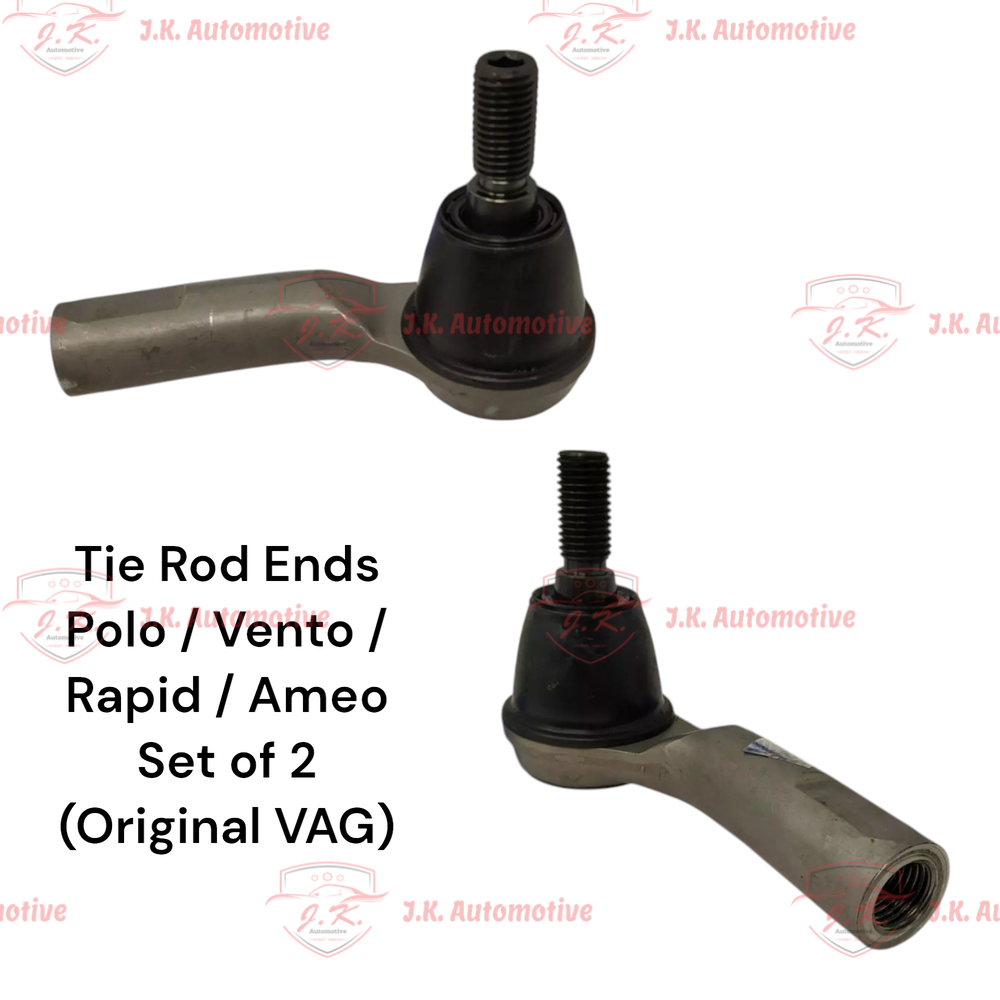
Tie rod ends for Volkswagen Polo are important components of the front steering system that help transfer steering movement toward the road wheels while allowing the articulation required as the wheels change direction and the suspension moves over different road surfaces. This product is supplied as an Original VAG Set of 2 for Volkswagen Polo models from 2010–2022 with OEM references 6RD423811B & 6RD423812B. During everyday driving, these steering joints operate repeatedly during parking manoeuvres, low-speed turns, lane changes, highway corrections and cornering. At the same time, the front suspension moves vertically over potholes, speed breakers, road joints and uneven surfaces, meaning the connected joints must accommodate steering movement while maintaining a controlled mechanical connection. Tie rod ends also form part of the system used to establish front-wheel toe, making their mechanical condition relevant to steering response and wheel geometry. Repeated articulation, vibration, road impacts and accumulated mileage can gradually contribute to internal wear. Protective rubber boots help retain lubrication and restrict water, road dust, dirt and abrasive contamination from reaching the internal moving surfaces. If a boot becomes cracked, torn, punctured or displaced, lubricant may escape while contamination enters, potentially accelerating deterioration. Developing mechanical clearance may result in vague steering, increased free movement, wandering, knocking, changes in steering-wheel centring or abnormal tyre wear. However, these symptoms should be diagnosed professionally because control-arm bushes, other steering joints, suspension components, wheel bearings and steering-rack connections can produce similar behaviour. Sway bar links, Sway links, Anti roll link rods and Stabiliser sway links should also be inspected when front-end knocking is present. Correct replacement should be based on OEM references 6RD423811B & 6RD423812B, vehicle application and VIN verification where necessary, followed by professional installation and wheel alignment.
Are Original VAG OEM 6RD423811B and 6RD423812B compatible with Volkswagen Polo 2010–2022?
This Original VAG Set of 2 is supplied for the Volkswagen Polo 2010–2022 application with OEM references 6RD423811B & 6RD423812B, and these exact references should be used as primary identifiers when confirming the required replacement components. Vehicle model and year range provide useful application information, but steering-component fitment should not be determined from the model name or visual appearance alone. The references associated with the components currently fitted to the vehicle should be compared with 6RD423811B and 6RD423812B using appropriate vehicle-specific parts information. VIN-based verification should be used whenever exact compatibility remains uncertain. Useful searches can include VAG 6RD423811B, VAG 6RD423812B, Volkswagen 6RD423811B, Volkswagen 6RD423812B, Volkswagen Polo 6RD423811B and Volkswagen Polo 6RD423812B. The numbers should be preserved exactly because even a changed letter or digit can identify a different component or revision. If another reference appears on the existing part, interchangeability should be established before ordering rather than automatically assumed. Physical comparison is also recommended before installation. Thread diameter, thread pitch, overall dimensions, mounting taper, ball-stud configuration, articulation geometry and installation position should correspond with the removed components. Visually similar steering joints can contain important dimensional differences, so appearance alone is not sufficient for fitment confirmation. Protective boots should also be inspected before installation for cracks, cuts, deformation or other damage. When the repair is being performed because of steering looseness, knocking or abnormal tyre wear, related front axle components should also be examined. Control-arm bushes, suspension joints, wheel bearings and steering-rack connections can produce overlapping symptoms. Correct OEM-number verification, VIN checking where necessary, physical comparison and professional installation provide the appropriate fitment process.
What do OEM references 6RD423811B and 6RD423812B mean for Volkswagen Polo tie rod ends?
OEM references 6RD423811B and 6RD423812B are the supplied VAG identification numbers associated with this Set of 2 for the Volkswagen Polo 2010–2022 application. Exact part-number identification is particularly useful for steering components because broad searches based only on the vehicle model can return multiple visually similar products with different threads, tapers, dimensions, revisions or intended installation positions. Customers and workshops can therefore search using combinations such as Original VAG 6RD423811B, Original VAG 6RD423812B, Volkswagen 6RD423811B, Volkswagen 6RD423812B, Volkswagen Polo 6RD423811B and Volkswagen Polo 6RD423812B. Both references should remain exactly as supplied because changing a digit, letter or suffix can lead to an unrelated catalogue result. OEM-number identification should still be considered together with the Volkswagen Polo designation, supplied 2010–2022 application and VIN information where required. If the parts currently installed on the vehicle carry different references, their relationship with 6RD423811B and 6RD423812B should be established before assuming interchangeability. The removed and replacement components should also be physically compared before fitting. Thread diameter, thread pitch, mounting taper, ball-stud dimensions, overall length and articulation configuration are particularly important because small differences can affect installation and steering geometry. Protective rubber boots should also be inspected for cracking, tearing, deformation, contamination or lubricant leakage. When steering components are being replaced because of looseness, noise or tyre wear, the technician should inspect the complete front axle. Control-arm bushes, other suspension joints, wheel bearings and steering-rack connections can produce similar symptoms, while Sway bar links, Sway links, Anti roll link rods and Stabiliser sway links may produce knocking over uneven surfaces. Accurate OEM identification combined with VIN checking and physical comparison provides a stronger fitment method than relying solely on vehicle year or appearance.
What are the symptoms of worn tie rod ends on a Volkswagen Polo?
Possible symptoms of worn tie rod ends on a Volkswagen Polo include increased steering free movement, vague directional response, wandering, delayed reaction to steering input, front-end knocking, changes in steering-wheel centring and abnormal tyre wear. Tie rod ends operate continuously as the steering wheel is turned and must maintain controlled movement while accommodating articulation generated by steering and suspension travel. As the internal joint surfaces deteriorate, unwanted mechanical clearance can develop. The driver may initially notice that the vehicle requires more frequent small corrections when travelling straight or that steering response around the centre position feels less precise than previously. Knocking or clunking can become more noticeable over potholes, broken roads and speed breakers as changing loads expose mechanical movement. Protective rubber boots should be inspected because a cracked, torn or displaced boot can permit lubricant loss and allow water, road dust and abrasive contamination to reach internal surfaces. Tyres can also provide useful diagnostic information. Feathering across the tread, accelerated inner-edge wear or excessive outer-edge wear can indicate that steering geometry or front suspension condition requires investigation. However, none of these symptoms independently confirms that OEM 6RD423811B or 6RD423812B requires replacement. Incorrect tyre pressure, unsuitable alignment settings, worn control-arm bushes, suspension joints, wheel bearings, steering-rack connections, damaged wheels or other front axle problems can create similar behaviour. Sway bar links, Sway links, Anti roll link rods and Stabiliser sway links should be examined when knocking or rattling is present. A professional technician should identify the actual source of mechanical clearance before replacing components. If replacement is required, OEM references 6RD423811B & 6RD423812B should be confirmed against the Volkswagen Polo application and VIN where necessary. Professional installation should then be followed by accurate wheel alignment because tie rod adjustment directly relates to front-wheel toe.
Should Volkswagen Polo tie rod ends be replaced as a Set of 2?
Whether Volkswagen Polo tie rod ends should be replaced together depends on their individual mechanical condition, accumulated mileage, protective-boot condition, road exposure and the findings of a professional inspection. This product is supplied as an Original VAG Set of 2 for the Volkswagen Polo 2010–2022 application with OEM references 6RD423811B & 6RD423812B. Components operating across the same front axle experience broadly similar mileage, steering cycles, road vibration and environmental exposure, although this does not mean that both sides necessarily deteriorate at exactly the same rate. If excessive play, protective-boot damage, lubricant leakage or contamination is identified on one side, the corresponding component on the opposite side should also be inspected carefully. When both sides demonstrate deterioration, replacing the required pair during the same repair can provide a coordinated approach to restoring the affected steering components and can avoid repeated workshop dismantling. However, replacement decisions should still be based on actual condition rather than assuming that every component must automatically be changed simply because one side is worn. Before fitting the Set of 2, OEM references 6RD423811B and 6RD423812B should be verified against the vehicle application, and VIN checking should be used where exact fitment remains uncertain. Both replacement components should also be physically compared with the removed parts for thread specifications, mounting taper, dimensions, ball-stud configuration and articulation characteristics. Surrounding front suspension components should be inspected because replacing the tie rod ends will not correct looseness originating from control-arm bushes, suspension joints, wheel bearings or steering-rack connections. Sway bar links, Sway links, Anti roll link rods and Stabiliser sway links should also be examined when front-end noise is present. After installation, professional wheel alignment is particularly important because the tie rod assembly is directly involved in establishing front-wheel toe.
Is wheel alignment necessary after replacing Volkswagen Polo tie rod ends?
How do worn tie rod ends affect the driving and handling of a Volkswagen Polo?
Worn tie rod ends can affect the steering precision, directional stability and front-wheel control of a Volkswagen Polo because these components form an important mechanical connection between the steering system and the road wheels. When the joints are in suitable mechanical condition, steering movement is transferred toward the wheels while the ball-and-socket arrangement allows the articulation required during turning and suspension travel. As internal surfaces gradually wear, unwanted mechanical clearance can develop and the driver may notice increased free movement around the steering-wheel centre position, vague directional response, wandering on straight roads or the need to make frequent small corrections while driving. Steering response may also feel less consistent during lane changes, cornering or braking because changing loads are acting through the front axle. Knocking or clunking can sometimes become noticeable when travelling over potholes, speed breakers, broken surfaces or road joints. Protective rubber boots are important because they help retain lubrication and restrict water, dirt and abrasive road contamination from reaching internal moving surfaces. If a boot becomes cracked, torn or displaced, deterioration may accelerate. Tyre wear can also provide useful diagnostic information because excessive mechanical movement combined with incorrect toe can contribute to feathering or irregular tread wear. However, these symptoms should not automatically be attributed to OEM 6RD423811B or 6RD423812B. Control-arm bushes, suspension joints, wheel bearings, steering-rack connections, shock absorbers, wheels and tyres can produce overlapping symptoms. Sway bar links, Sway links, Anti roll link rods and Stabiliser sway links can also cause front-end knocking over uneven roads. Professional diagnosis should therefore establish the actual source of mechanical play. If replacement is required, OEM references 6RD423811B & 6RD423812B should be verified against the Volkswagen Polo application and VIN where necessary, followed by professional installation and accurate wheel alignment.
How can I confirm the correct Original VAG 6RD423811B and 6RD423812B Set of 2 before ordering for Volkswagen Polo?
The correct Original VAG Set of 2 should be confirmed using the Volkswagen Polo model designation, supplied 2010–2022 application, OEM references 6RD423811B & 6RD423812B and VIN information where necessary rather than relying exclusively on the vehicle model, production year or visual appearance. Exact part-number verification is particularly important with steering components because visually similar joints can differ in thread diameter, thread pitch, mounting taper, overall dimensions, ball-stud configuration or intended installation position. Useful searches include Original VAG 6RD423811B, Original VAG 6RD423812B, Volkswagen 6RD423811B, Volkswagen 6RD423812B, Volkswagen Polo 6RD423811B and Volkswagen Polo 6RD423812B. The letters, digits and suffixes should be preserved exactly when checking the references because even a small difference can identify another component or revision. If the parts currently fitted to the vehicle carry different numbers, their relationship with 6RD423811B and 6RD423812B should be established before assuming interchangeability. VIN-based verification provides an additional method of checking the required application when there is uncertainty. Physical comparison should also be completed before installation. The replacement components should correspond with the removed parts in overall dimensions, threads, mounting taper, ball-stud configuration and articulation characteristics. Threaded connections should engage naturally without forcing or cross-threading, and an incorrect component should never be modified simply to make it fit. Protective rubber boots should also be inspected before fitting for cracking, cuts, deformation or other damage. If the vehicle is undergoing repair because of steering looseness, knocking or abnormal tyre wear, surrounding front axle components should be inspected simultaneously. Control-arm bushes, suspension joints, wheel bearings and steering-rack connections can produce similar symptoms, while Sway bar links, Sway links, Anti roll link rods and Stabiliser sway links can contribute to knocking. OEM verification, VIN confirmation where required, physical comparison and professional installation provide a more reliable fitment process.
Can worn tie rod ends cause uneven tyre wear on a Volkswagen Polo?
Yes, worn tie rod ends can contribute to uneven tyre wear on a Volkswagen Polo because excessive mechanical clearance within the steering linkage can allow unwanted changes in front-wheel positioning while the vehicle is being driven. The tie rod assembly is particularly relevant to wheel geometry because its adjustment is used to establish front-wheel toe. When the joints and associated connections remain mechanically controlled, the front wheels can maintain the intended relationship more consistently as steering and suspension loads change. As internal wear develops, unwanted movement can make wheel positioning less stable during braking, acceleration, cornering and travel over uneven roads. Feathering across the tread, accelerated inner-edge wear, excessive outer-edge wear or noticeably different wear between the two front tyres can indicate that steering geometry or front suspension condition requires investigation. However, tyre wear alone cannot confirm that OEM 6RD423811B or 6RD423812B is defective. Incorrect tyre pressure, unsuitable wheel alignment, deteriorated control-arm bushes, other suspension joints, wheel-bearing play, damaged wheels, steering-rack problems or shock-absorber condition can also contribute to irregular tread wear. A technician should therefore inspect tyre condition, mechanical components and alignment measurements together. Protective rubber boots on the steering joints should be checked for cracking, tearing, contamination or lubricant leakage because boot damage can accelerate internal deterioration. Sway bar links, Sway links, Anti roll link rods and Stabiliser sway links should also be inspected when tyre-wear complaints occur together with front-end knocking, although these components are not normally the primary toe-adjustment mechanism. If replacement is required, the Original VAG Set of 2 with supplied OEM references 6RD423811B & 6RD423812B should be verified against the Volkswagen Polo application and VIN where necessary. After professional installation, accurate wheel alignment should be completed so that front-wheel toe can be measured and adjusted using suitable equipment.
Why is professional installation recommended for Volkswagen Polo Original VAG tie rod ends?
Professional installation is recommended because Volkswagen Polo tie rod ends operate within a safety-relevant steering system and their installation can directly influence steering geometry, front-wheel toe and directional response. Correct replacement involves more than removing the existing components and installing replacements that appear visually similar. Before fitting, the technician should verify the supplied Volkswagen Polo 2010–2022 application together with Original VAG OEM references 6RD423811B & 6RD423812B and use VIN-based confirmation whenever exact compatibility remains uncertain. The replacement components should then be physically compared with the removed parts for overall dimensions, thread diameter, thread pitch, mounting taper, ball-stud configuration, articulation characteristics and intended installation position. Threaded connections should engage correctly without forcing or cross-threading, tapered mounting surfaces should seat properly and applicable locking arrangements should be secured according to the appropriate vehicle repair procedure. An unsuitable steering component should never be drilled, ground, bent or otherwise modified simply to make it fit. Professional installation also allows the surrounding front axle to be inspected while the vehicle is undergoing repair. Control-arm bushes, suspension joints, wheel bearings and steering-rack connections can develop mechanical clearance that produces symptoms similar to worn tie rod ends. Sway bar links, Sway links, Anti roll link rods and Stabiliser sway links should also be checked when knocking or rattling is present over uneven surfaces. Protective boots should be examined for damage, while tyres should be checked for feathering, inner-edge wear, outer-edge wear or other abnormal patterns. Because the tie rod assembly is directly involved in establishing front-wheel toe, professional wheel alignment should be completed after replacement. If the specified geometry cannot be achieved, the technician should investigate for additional worn, bent, damaged or incorrectly installed components rather than attempting to compensate through unsuitable adjustment.
Why is Original VAG a suitable choice compared with Lemförder, FEBI, Meyle and other established brands for Volkswagen Polo tie rod ends?
Reviews
There are no reviews yet.