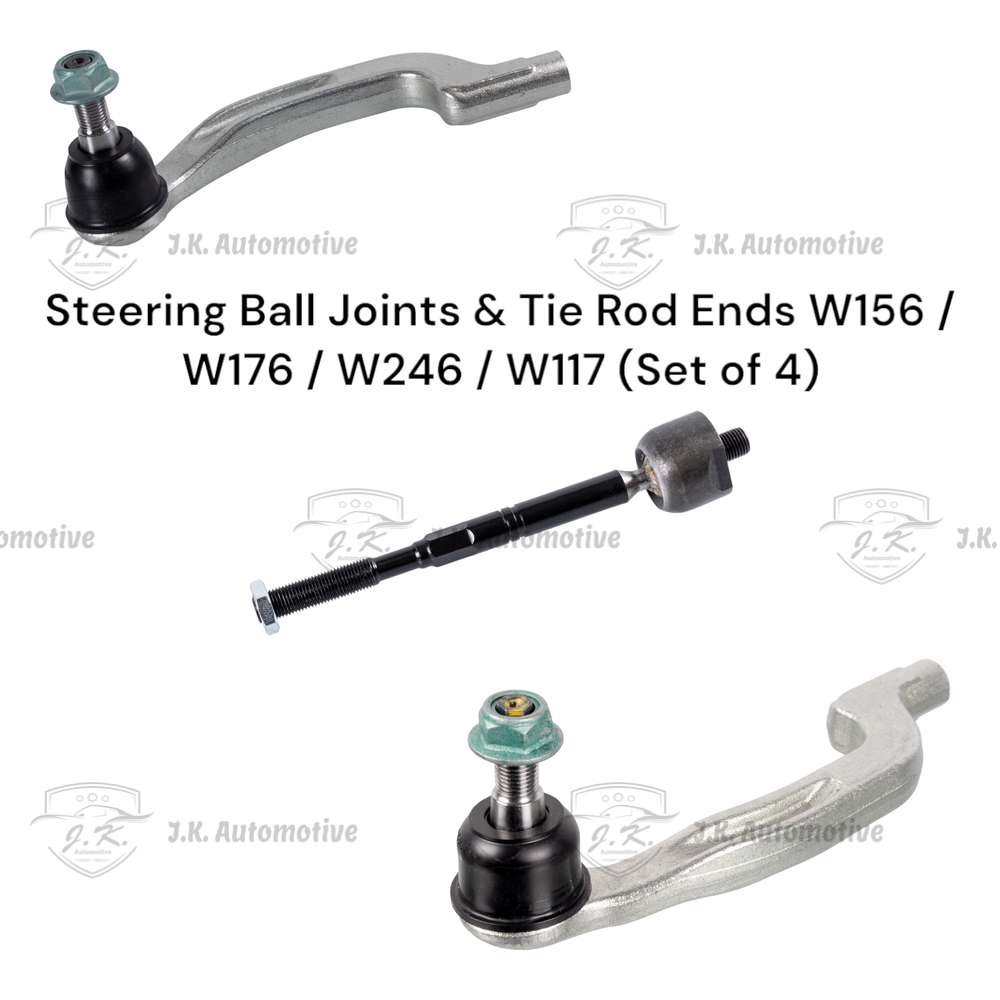
What is the Steering Ball Joints And Tie Rod Ends Set of 4 for Mercedes-Benz B-Class W246?
The Steering Ball Joints And Tie Rod Ends Set of 4 for Mercedes-Benz B-Class W246 is a combined steering and suspension replacement package for the specified 2011–2018 application, supplied with OEM references A2463380000 & A2463301700 & A2463301800, and it contains components that perform important functions in maintaining controlled steering movement, suspension articulation and front wheel positioning during everyday driving. The tie rod ends form part of the steering linkage and help transfer steering movement towards the front wheel assemblies when the driver turns the steering wheel, while the ball joints provide articulated connections within the applicable suspension system so the wheels and suspension can move through their required range while remaining properly located. These components operate continuously whenever the vehicle is driven because every steering input, pothole, speed breaker, road joint, braking event, acceleration movement and cornering force creates movement or load within the steering and suspension system. A healthy joint must allow the articulation required by the suspension while maintaining controlled connection without excessive unwanted clearance. As mileage increases, joint surfaces and protective components can gradually deteriorate because of repeated movement, road impacts, contamination and normal mechanical wear. When excessive clearance develops, possible symptoms can include knocking, clunking, steering looseness, less precise directional response, unwanted wheel movement or irregular tyre wear, although these symptoms should always be properly diagnosed because other steering and suspension components can create similar complaints. The Set of 4 format provides the specified ball-joint and tie-rod-end components together, which can simplify parts sourcing when the corresponding components have been professionally identified for replacement. However, compatibility should never be determined only from the vehicle model or visual appearance of the parts. The OEM references A2463380000 & A2463301700 & A2463301800 should be compared with the original components and appropriate vehicle-specific catalogue information, while the exact VIN should also be checked before installation. This is particularly important because components that appear visually similar can have differences in thread dimensions, taper dimensions, mounting arrangements or intended installation positions. The supplied 2011–2018 application range should also be retained when identifying this product. Professional installation is recommended because ball joints are associated with wheel-locating suspension connections and tie rod ends form part of the steering linkage. During installation, control arms, bushes, stabilizer links, shock absorbers, springs, wheel bearings, steering rack connections, tyres and wheels should also be inspected for related wear. After tie rod end replacement, wheel alignment should be performed or verified because tie rod adjustment directly affects front toe geometry. Correct fitment, professional installation and accurate final alignment allow the Set of 4 to operate as part of a properly maintained Mercedes-Benz B-Class W246 steering and suspension system.
What are the common symptoms of worn ball joints or tie rod ends on the Mercedes-Benz B-Class W246?
Common symptoms of worn ball joints or tie rod ends on the Mercedes-Benz B-Class W246 can include knocking or clunking noises from the front suspension, excessive steering play, less precise steering response, unusual movement when travelling across uneven roads, inconsistent directional behaviour or irregular tyre wear, although the exact symptoms depend on which component is worn and how much deterioration has occurred. Tie rod ends are part of the steering linkage, so excessive clearance in these joints can reduce the precision with which steering movement is transferred towards the front wheels. The driver may notice that the steering feels less direct, requires more correction than before or does not respond with the same consistency during directional changes. Ball joints perform an articulated suspension function and are required to permit necessary movement while maintaining controlled positioning between connected components. When a ball joint develops excessive clearance, unwanted movement can occur as the suspension changes direction under load. This can potentially create knocking or clunking when the vehicle crosses potholes, broken road surfaces, expansion joints or speed breakers. The symptoms can sometimes become more noticeable during braking or cornering because additional forces are acting through the tyres and suspension. However, a knocking sound does not automatically prove that a ball joint is defective, and steering looseness does not automatically prove that a tie rod end has failed. Control-arm bushes, stabilizer links, sway bar links, shock absorber mountings, wheel bearings, steering rack components, damaged wheels and tyre-related problems can create similar symptoms. A professional inspection should therefore be performed before replacement. The technician can check the relevant joints for excessive movement, inspect protective boots for damage or deterioration and examine the mounting points for abnormalities. The tyres should also be inspected for irregular wear because tread patterns can provide useful evidence of an existing geometry or steering problem. If excessive joint clearance is confirmed, the surrounding suspension should be inspected at the same time so another worn component is not left unresolved. For this Set of 4, supplied references A2463380000 & A2463301700 & A2463301800 should be compared with the original parts and exact vehicle VIN before ordering. The specified 2011–2018 application should also be verified. After replacement of the tie rod ends, wheel alignment should be performed or checked because toe geometry can be affected by steering-linkage adjustment. Proper diagnosis is therefore important because it ensures that the actual source of the steering or suspension complaint is repaired instead of replacing components solely on the basis of noise or general steering feel.
How do ball joints and tie rod ends affect steering control and suspension movement on the Mercedes-Benz B-Class W246?
Ball joints and tie rod ends affect steering control and suspension movement on the Mercedes-Benz B-Class W246 by providing articulated mechanical connections at locations where components must move continuously while still maintaining controlled wheel positioning and accurate response to steering input. Tie rod ends form part of the steering linkage and help transfer steering movement towards the front wheels when the driver changes direction, but because the wheels also move vertically as the suspension responds to the road surface, the steering linkage requires articulated joints rather than completely rigid connections. The tie rod ends therefore need to accommodate the necessary movement while maintaining a controlled connection with minimal unwanted clearance. Ball joints perform a related suspension function by providing articulation within applicable wheel-locating connections. As the vehicle crosses potholes, speed breakers, expansion joints and uneven surfaces, the suspension moves through compression and rebound while the wheels must remain appropriately located relative to the chassis. The ball joints allow the required movement to occur while helping maintain the intended mechanical relationship between connected suspension components. Both component types are also exposed to changing loads during braking, acceleration and cornering. During braking, significant forces are transferred through the tyres and front suspension, while cornering introduces lateral loads as the vehicle changes direction. Steering inputs can occur at the same time as suspension movement, meaning these joints may be articulating while simultaneously carrying substantial mechanical loads. When the joints remain in serviceable condition, the required movement occurs with controlled clearance. When wear becomes excessive, however, movement can develop where the system is intended to remain accurately located. A worn tie rod end can potentially contribute to steering play, inconsistent response or less stable toe control, while excessive ball-joint clearance can potentially contribute to knocking or unwanted suspension movement. Nevertheless, the steering and suspension system must be considered as a complete assembly because tyres, wheel alignment, control arms, bushes, stabilizer components, shock absorbers, springs, wheel bearings and the steering rack can all influence vehicle behaviour. For the specified 2011–2018 Mercedes-Benz B-Class W246 application, the replacement Set of 4 carries OEM references A2463380000 & A2463301700 & A2463301800. These references should be compared with the original components and exact VIN before installation. Professional fitting is recommended, and final wheel alignment should be performed or verified after tie rod end replacement to ensure the front toe geometry is correctly set.
Can worn steering ball joints and tie rod ends cause uneven tyre wear on the Mercedes-Benz B-Class W246?
Worn steering ball joints and tie rod ends can contribute to conditions associated with uneven tyre wear on the Mercedes-Benz B-Class W246 because these components are directly connected with steering operation and controlled wheel positioning, although irregular tyre wear can have several causes and should never automatically be blamed on the ball joints or tie rod ends without a complete mechanical inspection and wheel-alignment measurement. Tie rod ends are particularly important in relation to front toe because the effective adjustment of the steering linkage influences the directional relationship between the front wheels. When a tie rod end develops excessive clearance, the wheel may not maintain the intended position as consistently under changing steering, braking and road loads. Incorrect tie rod adjustment can also result in a toe setting that is outside the appropriate specification. When toe is incorrect, the tyres can experience unnecessary scrubbing as they roll along the road, potentially contributing to accelerated or irregular tread wear. Ball joints are also important because they provide articulation within applicable wheel-locating suspension connections. If excessive clearance develops, unwanted wheel movement can occur as suspension loads change during braking, cornering or travel over uneven surfaces. However, tyre wear must be diagnosed carefully because incorrect inflation pressure alone can produce significant wear patterns. Worn control-arm bushes, damaged suspension components, incorrect alignment, wheel-bearing problems, bent wheels, tyre defects and previous pothole or kerb impacts can also contribute to irregular tread wear. The condition of both front tyres should therefore be inspected alongside the steering and suspension system. A technician should check the ball joints and tie rod ends for excessive movement, inspect control arms and bushes, examine stabilizer-related components and assess wheel bearings for looseness or roughness. Shock absorbers and springs should also be inspected because poor suspension control can affect how consistently the tyres respond to changing road surfaces. When replacement is required, the Set of 4 with references A2463380000 & A2463301700 & A2463301800 should be verified against the original components, specified 2011–2018 application and exact VIN. After tie rod end replacement, wheel alignment should be performed or verified because toe adjustment can change during the repair. If tyres have already developed significant irregular wear, correcting the steering and alignment cannot reverse the existing tread damage, so tyre condition should be assessed separately. The most effective repair therefore combines replacement of confirmed worn components with inspection of related suspension parts, correct tyre pressures and accurate final wheel geometry.
How do I confirm this Steering Ball Joints And Tie Rod Ends Set of 4 is suitable for my Mercedes-Benz B-Class W246?
The safest way to confirm whether this Steering Ball Joints And Tie Rod Ends Set of 4 is suitable for your Mercedes-Benz B-Class W246 is to verify the complete application using the supplied OEM references, original components and exact vehicle VIN rather than relying only on the B-Class W246 model designation or the visual appearance of the replacement parts. The supplied product information identifies the application as Mercedes-Benz B-Class W246 2011–2018 and provides OEM references A2463380000 & A2463301700 & A2463301800, so these details should form the starting point for fitment verification. The original steering and suspension components should be inspected for identification numbers wherever available, and those references should be compared with the numbers supplied for the replacement set. A reliable vehicle-specific parts catalogue can also be used to cross-check the application against the VIN. VIN verification is particularly important because vehicles within the same chassis family can sometimes use different steering or suspension components depending on their exact specification, production configuration or engineering revisions. The fact that two vehicles are both identified as W246 does not automatically mean that every steering component used throughout the entire model range is identical. Visual similarity is also not enough to establish compatibility because ball joints and tie rod ends can appear almost identical while differing in thread size, taper dimensions, overall length, mounting geometry or intended installation position. The Set of 4 package quantity should also be confirmed so the technician understands exactly which components are being replaced and their correct positions before installation begins. If the vehicle has undergone previous steering or suspension repairs, extra care is advisable because the currently installed components may already have been substituted at some point in the vehicle's service history. Replacement parts should never be forced, modified or machined simply to make them fit an incompatible application. If the mounting arrangement, thread, taper or another important detail does not correspond with the original component, installation should stop until compatibility has been confirmed. The supplied 2011–2018 year range should also be preserved rather than silently changing it based on another market or catalogue. Once the OEM references A2463380000 & A2463301700 & A2463301800, original components, B-Class W246 application and exact VIN all correspond, fitment confidence is substantially stronger. Professional installation is recommended, and wheel alignment should be performed or verified after tie rod end replacement because steering-linkage adjustment directly influences front toe geometry.
What other steering and suspension components should be checked when replacing this Set of 4 on the Mercedes-Benz B-Class W246?
When replacing the Steering Ball Joints And Tie Rod Ends Set of 4 on the Mercedes-Benz B-Class W246, the complete front steering and suspension system should be inspected because these joints operate within an interconnected chassis assembly and replacing them cannot correct problems caused by other worn, loose or damaged components. The front control arms should be inspected carefully, with particular attention to their bushes because deteriorated bushes can allow excessive movement during braking, acceleration and cornering and may create symptoms similar to worn ball joints. Stabilizer links should also be checked for looseness or deterioration, particularly if the vehicle produces knocking noises over potholes or speed breakers; these components may also be described as Sway bar links, Sway links, Anti roll link rods or Stabiliser sway links. Relevant stabilizer bar bushes and mounting points should be examined where applicable. The front shock absorbers should be checked for deterioration or abnormal damping behaviour, while the springs should be inspected for visible damage or unusual condition. Shock absorber mountings should also be examined because worn mounting components can produce knocking or unwanted movement that may initially be mistaken for ball-joint problems. The steering rack and other steering connections should be inspected when excessive steering play or abnormal steering noise is present. Wheel bearings should be checked for excessive movement, roughness or humming because bearing deterioration can affect wheel control and can sometimes resemble steering or suspension looseness. Tyres should be inspected for correct inflation pressure, tread depth, physical damage and irregular wear patterns because the tyre condition can reveal useful information about existing alignment or suspension problems. Wheels should also be checked for bends or impact damage, especially when the vehicle has experienced substantial pothole or kerb impacts. Before installation, the replacement Set of 4 should be compared with the original components, while OEM references A2463380000 & A2463301700 & A2463301800 and the exact VIN should be checked for the specified Mercedes-Benz B-Class W246 2011–2018 application. Any additional worn component discovered during the inspection should be diagnosed and repaired as appropriate rather than expecting the new ball joints and tie rod ends to compensate for it. After installation, all relevant joints and mounting points should be checked for correct assembly and normal articulation without abnormal binding or excessive looseness. Wheel alignment should then be performed or verified because tie rod end replacement can directly change front toe geometry. If control arms, bushes or other geometry-related components are replaced during the same repair, their effect on alignment should also be considered. Correct tyre pressures should be established before final alignment measurement. This complete inspection and repair approach helps ensure that the new Set of 4 operates within a mechanically healthy steering and suspension system and that another worn component does not compromise the improvement expected from the replacement parts.
Why is professional installation recommended for the Steering Ball Joints And Tie Rod Ends Set of 4 on the Mercedes-Benz B-Class W246?
Can worn ball joints and tie rod ends affect other steering and suspension components on the Mercedes-Benz B-Class W246?
Worn ball joints and tie rod ends can influence the way movement and forces are controlled throughout the Mercedes-Benz B-Class W246 steering and suspension system because these joints operate within an interconnected chassis assembly rather than functioning independently, although it is important not to assume that every surrounding suspension problem is directly caused by worn joints. Tie rod ends are responsible for articulated steering linkage connections, while ball joints provide controlled articulation within applicable wheel-locating suspension connections. When these joints are in serviceable condition, they permit the movement required by steering and suspension operation while maintaining controlled positioning with minimal unwanted clearance. As wear develops, additional clearance can appear, allowing movement that was not intended in the original steering or suspension geometry. This can potentially contribute to steering looseness, knocking, inconsistent directional response or changes in wheel positioning under different loads. During braking, significant forces pass through the tyres and front suspension, while cornering introduces lateral forces and steering movement. Potholes and broken road surfaces can generate rapid suspension movement and impact loads. If a joint already has excessive clearance, these changing forces may make the resulting movement or noise more noticeable. However, worn ball joints and tie rod ends frequently exist alongside other deteriorated chassis components because many suspension parts are exposed to the same mileage, road conditions, vibration and impacts. Control-arm bushes may therefore be worn at the same time, and stabilizer links or Sway bar links can also develop joint clearance that produces knocking over rough roads. Shock absorbers may have reduced damping performance, while damaged springs or mountings can influence suspension behaviour. Wheel bearings can develop play or roughness that may initially resemble suspension looseness. Steering rack connections and other steering joints should also be examined when steering play is present. Tyres are another important part of the diagnosis because irregular tyre wear may indicate incorrect wheel geometry, worn steering components or other suspension problems. Wheels should be checked for bending or impact damage, particularly if the vehicle has encountered severe potholes or kerbs. When replacing this Set of 4, OEM references A2463380000 & A2463301700 & A2463301800 should be verified against the original components and exact VIN for the specified 2011–2018 application. The surrounding steering and suspension components should then be inspected before the new joints are installed. Any additional excessive play or deterioration should be diagnosed and addressed as appropriate rather than expecting the new components to compensate for another fault. After replacement, wheel alignment should be performed or verified because tie rod work can alter front toe geometry. Correcting all confirmed faults together helps the new components operate within a mechanically healthy chassis and provides a more complete repair than replacing individual joints without examining the rest of the system.
Is wheel alignment required after replacing the ball joints and tie rod ends on the Mercedes-Benz B-Class W246?
Wheel alignment should be performed or properly verified after replacing the ball joints and tie rod ends on the Mercedes-Benz B-Class W246, particularly because tie rod ends are directly involved in the steering linkage and their adjustment affects front toe geometry. Toe describes the directional relationship of the wheels when viewed from above, and the effective length of the steering linkage influences this setting. During tie rod end replacement, the original component is disconnected and the replacement component must be installed and adjusted, which means the previous toe setting cannot simply be assumed to remain exactly correct after the repair. A technician may count the number of turns used to remove an old tie rod end, measure its position or mark the original adjustment before disassembly, and these methods can be useful for establishing an approximate initial position for the new component. However, none of these methods replaces an actual wheel-alignment measurement because replacement components can have dimensional tolerances and the vehicle’s alignment may already have been incorrect before the repair began. If the old tie rod ends had significant wear or excessive clearance, the previous wheel position may also have varied under load, making it even more important to measure the geometry after new components are installed. Ball joints are also wheel-locating suspension connections, so replacement of worn ball joints provides another reason to verify that the suspension geometry remains within the appropriate specification. Before an alignment is performed, the technician should confirm that the steering and suspension system is mechanically sound because accurate geometry cannot be maintained if another joint, bush or wheel bearing still has excessive movement. Control arms and bushes should therefore be inspected, along with stabilizer-related components, steering connections and wheel bearings. Tyre pressures should be corrected before final measurement, and the tyres themselves should be inspected for irregular wear or physical damage. Wheels should also be checked if there has been a significant pothole or kerb impact. Once the Set of 4 has been installed and the chassis is confirmed to be mechanically suitable, the wheel geometry can be measured and adjusted according to the appropriate vehicle specification. Correct toe helps the tyres roll in their intended direction rather than continuously scrubbing against the road surface because of incorrect wheel orientation. This can help maintain predictable steering response and reduce unnecessary tyre wear associated with incorrect geometry. The steering wheel position and vehicle directional behaviour should also be checked after the alignment as appropriate. Therefore, after replacing components associated with OEM references A2463380000 & A2463301700 & A2463301800 on the specified Mercedes-Benz B-Class W246 2011–2018 application, wheel alignment should be considered an important final stage of the repair rather than assuming that fitting the replacement parts in approximately the same physical positions will automatically preserve the previous geometry.
Why is this Steering Ball Joints And Tie Rod Ends Set of 4 a practical replacement choice for the Mercedes-Benz B-Class W246?
This Steering Ball Joints And Tie Rod Ends Set of 4 is a practical replacement choice for the specified Mercedes-Benz B-Class W246 2011–2018 application when the corresponding steering and suspension joints have been correctly diagnosed as worn because it combines multiple related components required for the intended repair into one convenient package rather than requiring the customer or workshop to source every relevant component separately. Tie rod ends and ball joints perform different functions, but both are important articulated connections within the front chassis. Tie rod ends form part of the steering linkage and help transfer directional movement towards the front wheels, while ball joints allow applicable suspension components to articulate as the wheels travel through suspension movement. These components are repeatedly loaded during steering, braking, acceleration and cornering and are also exposed to impacts and vibration from potholes, speed breakers, expansion joints and broken road surfaces. Over time, excessive joint clearance can potentially develop and may contribute to knocking, steering looseness, reduced directional precision or other steering and suspension symptoms. When several related joints have been professionally confirmed as worn, sourcing them as a Set of 4 can simplify repair planning and help the workshop address the specified components during the same repair operation. The supplied OEM references A2463380000 & A2463301700 & A2463301800 provide important cross-reference information for checking the intended application, but they should still be compared with the original components and exact vehicle VIN before installation. The specified 2011–2018 year range should also be preserved when verifying this product. A complete set should not be installed merely because all four components are available; replacement should still be based on correct fitment and actual repair requirements. Professional installation is recommended because steering and wheel-locating suspension components require secure fastening, correct articulation and appropriate workshop procedures. During the repair, the technician can inspect control arms, bushes, stabilizer links, shock absorbers, springs, wheel bearings, steering rack connections, tyres and wheels so another worn component does not remain unresolved. This is particularly useful because several different chassis faults can produce similar knocking or steering symptoms. Once the new components are installed, wheel alignment should be performed or verified because tie rod adjustment directly affects front toe geometry. Correct alignment ensures that the steering linkage is not merely assembled but also adjusted so the wheels operate within the appropriate geometry specification. When the supplied OEM references, original components and VIN all confirm compatibility, and the repair is completed with professional installation and alignment, this Set of 4 provides a convenient and comprehensive approach to replacing the specified steering ball joints and tie rod ends on the Mercedes-Benz B-Class W246.
Why is Stokes Germany a European-quality alternative to Lemförder, FEBI and Meyle for Mercedes-Benz B-Class W246 steering ball joints and tie rod ends?
Stokes Germany can be considered a European-positioned aftermarket alternative for customers looking for steering ball joints and tie rod ends for the Mercedes-Benz B-Class W246 while also evaluating established brands such as Lemförder, FEBI and Meyle, but the most responsible comparison should focus on verified fitment, OEM cross-reference, package quantity, availability, warranty, seller support and overall repair value rather than claiming that one brand is automatically superior in every application. Lemförder is a highly established name in steering and suspension components and is widely recognised within the European vehicle parts market, while FEBI offers a broad aftermarket range covering steering, suspension and numerous other mechanical categories, and Meyle is also a well-known aftermarket manufacturer with an extensive steering and suspension portfolio. These brands can therefore be strong alternatives whenever their exact components correspond with the required Mercedes-Benz B-Class W246 application. Stokes Germany provides another replacement option, particularly for customers who want a coordinated Set of 4 for the specified steering ball joints and tie rod ends rather than sourcing the relevant components individually. The first factor in any comparison should always be exact fitment. A correctly matched Stokes Germany component is more appropriate for a repair than an incorrectly selected component from a more established brand, just as a correctly matched Lemförder, FEBI or Meyle part can be an excellent option when its application is properly verified. For this product, OEM references A2463380000 & A2463301700 & A2463301800 and the supplied 2011–2018 application should be compared with the original components and exact vehicle VIN before ordering. Package quantity should also be considered when comparing prices because this listing is for a Set of 4, whereas an alternative manufacturer or seller may list individual components, pairs or a differently configured package. A lower advertised price should therefore not automatically be considered better value unless the quantity and exact components being compared are equivalent. Warranty coverage and seller support are also relevant because steering and suspension parts require accurate fitment identification, and access to knowledgeable support can help reduce ordering errors. Availability may matter when the vehicle needs to return to service quickly, while the intended repair budget can also influence the final brand decision. Regardless of whether Stokes Germany, Lemförder, FEBI or Meyle is selected, professional installation remains important because these parts operate within the steering and wheel-locating suspension system. Control arms, bushes, Sway bar links, Sway links, Anti roll link rods, Stabiliser sway links, shock absorbers, wheel bearings, tyres and wheels should also be inspected so another worn component does not compromise the repair. Wheel alignment should be performed or verified after tie rod end replacement because the steering linkage directly influences front toe geometry. Stokes Germany should therefore be evaluated as a practical European-positioned aftermarket alternative alongside Lemförder, FEBI and Meyle, with the final purchasing decision based on exact compatibility, OEM-reference matching, package content, availability, warranty, seller support and overall repair requirements rather than an unsupported claim that any single manufacturer is universally the best for every Mercedes-Benz B-Class W246.


Reviews
There are no reviews yet.