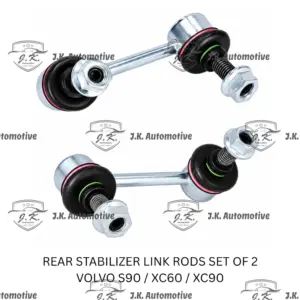
What is the Stokes Germany Rear Stabilizer Link Rod Set of 2 for Volvo XC60?
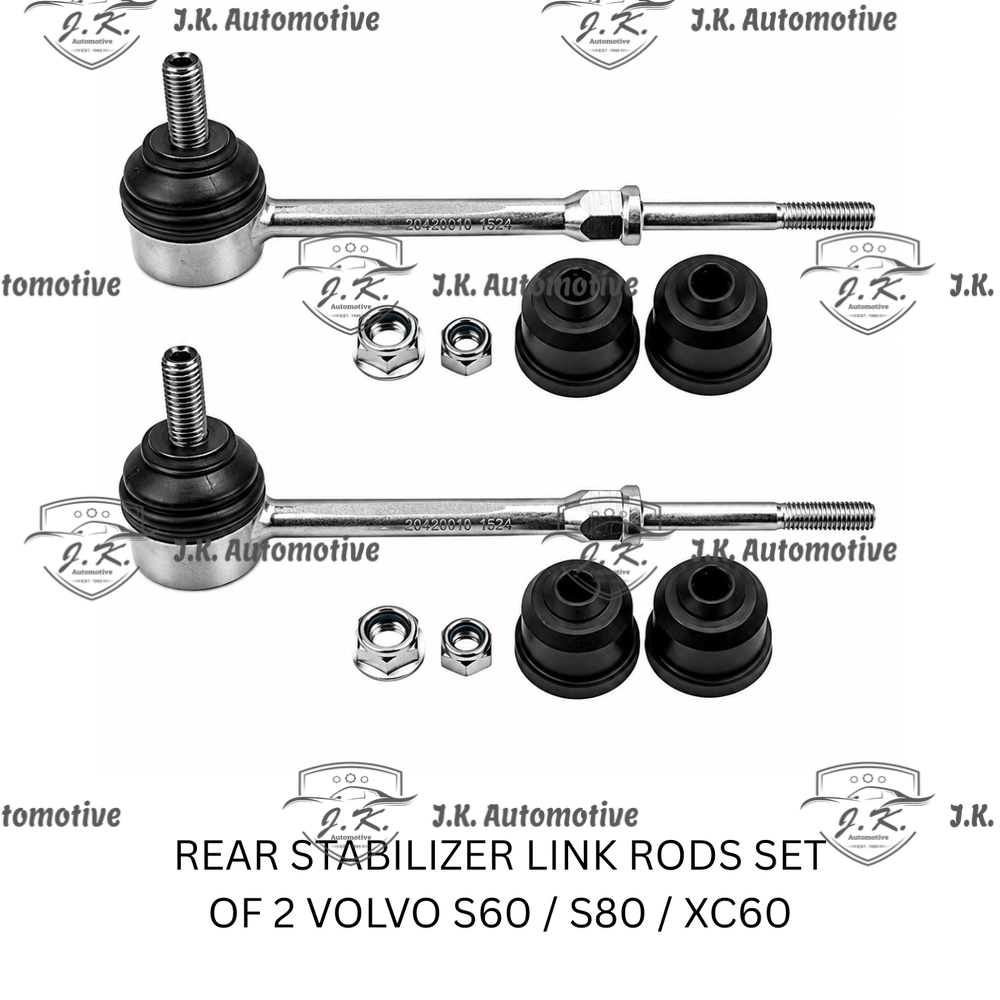
The Stokes Germany Rear Stabilizer Link Rod Set of 2 for Volvo XC60 is a premium aftermarket suspension replacement designed for compatible Volvo XC60 I applications requiring the 31451817 / 30736875 rear stabilizer-link reference family, and it is supplied as a set of 2 to provide the corresponding components for the rear left and rear right stabilizer positions when both links require replacement. These suspension components are commonly known as Sway bar links, Sway links, Anti roll link rods, Stabiliser sway links, rear drop links, anti-roll bar links, coupling rods or stabilizer end links, and although customers, workshops, mechanics and parts catalogues may use different terminology, these terms generally describe the same type of component operating within the vehicle's rear stabilizer or anti-roll-bar arrangement. Independent catalogue information supports this application because Roadrunner groups 31451817, 30736875, 30760678, 31429561, 31476579 and other related references under the LS-FO-979 Suspension Stabilizer Bar Link, identifies its position as Rear, specifies two links per vehicle and explicitly lists the Volvo XC60 2008–2016 first generation among its compatible vehicles. CTR independently identifies 31451817 as a rear stabilizer-link reference for the XC60 (156), providing additional support for the application. The purpose of these Sway bar links is to provide the necessary mechanical connection within the rear stabilizer arrangement while allowing articulation as the suspension responds to normal vehicle movement. Every time the Volvo XC60 travels through a corner, crosses a speed breaker, passes over an expansion joint, enters a pothole or encounters an uneven road surface, the left and right rear wheels can experience different amounts of vertical movement. When one rear wheel moves differently from the opposite wheel, the Sway links articulate as part of the stabilizer arrangement. Consequently, the Anti roll link rods complete a very large number of articulation cycles during their operating life while also experiencing continuous road vibration. Because the Stabiliser sway links are mounted underneath the vehicle, they operate in an environment involving dust, dirt, moisture, road water and changing temperatures. Over extended service, deterioration can gradually develop within the joints, protective components or mounting interfaces. If excessive joint clearance develops, unwanted movement may occur and can contribute to tapping, rattling, knocking or clunking sounds from the rear suspension, especially when travelling over broken or uneven surfaces. However, suspension noise alone does not prove that the stabilizer links are defective because rear suspension arms, bushes, shock absorbers, mounts, stabilizer bushes and mounting hardware can create similar symptoms. Proper diagnosis should therefore identify the actual worn component before replacement. When both corresponding links are confirmed worn, the Stokes Germany set of 2 provides a practical pair for renewing the applicable rear stabilizer connections during the same repair. Your current product catalogue identifies this exact product with OEM cross-reference 31451817 / 30736875, model XC60 I (156), and year range 2008–2017. Final compatibility should always be verified using the VIN, original installed reference and exact suspension specification before ordering.
What do the rear Sway bar links do on the Volvo XC60?
The rear Sway bar links on the Volvo XC60 provide important mechanical connections within the rear stabilizer or anti-roll-bar arrangement and repeatedly articulate as the rear suspension responds to cornering, changes in road surface, potholes, speed breakers, vehicle loading and differences in vertical movement between the left and right rear wheels, making these relatively compact components an important working part of the rear suspension system. They are also commonly described as Sway links, Anti roll link rods, Stabiliser sway links, rear drop links, anti-roll bar links, coupling rods or stabilizer end links. During everyday driving, the left and right rear wheels do not always move through exactly the same vertical distance at exactly the same moment. If the Volvo XC60 passes through a pothole with one rear wheel while the opposite wheel remains on smoother pavement, the two sides of the rear suspension experience different vertical movement. The stabilizer arrangement responds to this difference and the Sway bar links articulate as part of the system. Crossing a speed breaker diagonally creates another common operating situation because one rear wheel reaches the raised surface before the opposite wheel. Broken roads, uneven parking ramps, expansion joints, damaged road edges and other irregular surfaces can create similar suspension movement. Cornering also changes the loading experienced by the left and right sides of the vehicle, meaning the Sway links continue articulating as the suspension responds to changing chassis loads. The Anti roll link rods must accommodate these repeated movements while maintaining the required stabilizer connections without excessive unwanted clearance. Over thousands of kilometres, the Stabiliser sway links can complete an extremely large number of articulation cycles, and their position underneath the vehicle exposes them to road vibration, dust, dirt, moisture and water. If deterioration develops inside the joints or around the mounting interfaces, excessive free movement may become possible. This unwanted movement can contribute to tapping, rattling, knocking or clunking noises from the rear suspension, particularly when travelling slowly over uneven surfaces. However, these symptoms are not exclusive to Sway bar links because rear suspension bushes, arms, shock absorbers, mounts, stabilizer bushes and mounting hardware can create similar noises. A physical inspection is therefore required to determine whether excessive play is actually present within the Sway links before replacement. For the XC60 I, Roadrunner lists 31451817 / 30736875 within the same rear stabilizer-link family, identifies the position as Rear and specifies two links per vehicle. SKANDIX likewise identifies this component family as a rear-axle Sway bar link fitting both left and right, requiring two per vehicle and applicable to the XC60 up to 2017. Therefore, when inspection confirms that both corresponding rear links are worn, the Stokes Germany set of 2 provides the applicable replacement pair, subject to VIN and original-part-number verification.
What are the common symptoms of worn rear stabilizer links on the Volvo XC60?
Common symptoms that may be associated with worn rear stabilizer links on the Volvo XC60 include tapping, rattling, clicking, knocking or clunking noises from the rear suspension, particularly while travelling slowly across potholes, speed breakers, broken roads, expansion joints, uneven parking ramps or repetitive road irregularities, although these symptoms should always be properly diagnosed because several other suspension components can create similar sounds. The rear Sway bar links repeatedly articulate as the XC60 suspension responds to cornering and differences in movement between the left and right rear wheels. When the Sway links remain mechanically serviceable, their joints accommodate the required movement while maintaining the corresponding stabilizer connections without excessive unwanted clearance. As the vehicle accumulates mileage, repeated articulation, road vibration and environmental exposure can gradually contribute to wear within the joints or protective components of the Anti roll link rods. During the early stages of deterioration, the driver may notice only a relatively light tapping or rattling noise when travelling slowly across smaller road irregularities. The same vehicle may appear considerably quieter on a smooth highway because the suspension experiences less abrupt articulation and normal tyre or road noise can mask smaller mechanical sounds. As joint clearance becomes greater, a minor tapping noise may potentially develop into a more noticeable knocking or clunking sound. Unequal movement between the rear wheels can make these symptoms particularly noticeable because the stabilizer arrangement experiences articulation whenever one wheel moves differently from the opposite wheel. If one rear wheel enters a pothole while the other remains on comparatively smooth pavement, the difference in vertical movement causes the Sway bar links to articulate within the rear stabilizer arrangement. Crossing a speed breaker diagonally creates another situation in which the Sway links move because the rear wheels do not reach the raised surface simultaneously. However, a knocking noise should never automatically be diagnosed as worn Stabiliser sway links. Rear control-arm bushes, suspension links, shock absorbers, mounts, stabilizer-bar bushes and loose mounting hardware can all generate sounds that may initially appear similar. A technician should therefore inspect the complete rear suspension and physically check the Anti roll link rods for excessive joint play, looseness, damaged protective components or unwanted movement around the mounting points. When excessive clearance is specifically confirmed within the stabilizer links, replacing those components renews the affected mechanical connections. If one link is worn, the opposite link should also be inspected because both components have accumulated approximately the same overall vehicle mileage, although different road impacts can cause one side to deteriorate more quickly. When both links show significant wear, the Stokes Germany set of 2 provides a convenient replacement pair. The 31451817 / 30736875 reference family is supported for the applicable XC60 I rear stabilizer-link application, with two links specified per vehicle. Final fitment should still be verified using the VIN and original component reference.
Are 31451817 and 30736875 the correct rear stabilizer link references for the Volvo XC60?
Yes, 31451817 and 30736875 are supported rear stabilizer-link references for applicable Volvo XC60 I models, and multiple independent catalogue sources connect these numbers with the same general rear stabilizer-link family, so the reference combination can appropriately remain in your Stokes Germany product title, OEM cross-reference field, descriptions and SEO content. Roadrunner groups 31451817 and 30736875 together with related references such as 30760678, 31429561 and 31476579 under its LS-FO-979 Suspension Stabilizer Bar Link, identifies the installation position as Rear, specifies two components per vehicle and explicitly lists the Volvo XC60 2008–2016 first generation as a compatible application. Teknorot provides essentially the same cross-reference grouping for its FO-979 stabilizer link and also identifies the position as Rear, the quantity as two per vehicle and the Volvo XC60 I among the applications. CTR provides further support by listing 31451817 as a rear stabilizer-link OEM reference for the Volvo XC60 (156), while 31476579 is also shown in that rear-link entry. SKANDIX provides particularly useful cross-reference evidence because its rear-axle link listing includes 30736875 and 31451817 among the OE numbers and lists the XC60 up to 2017 as an applicable model. This cross-reference relationship is valuable for automotive e-commerce because customers and workshops frequently search for the same component using different reference numbers. One buyer may search for 31451817 Volvo XC60, another may search for 30736875 Volvo XC60, while another may simply search for Volvo XC60 rear stabilizer link. Customers may additionally search for rear Sway bar links, Sway links, Anti roll link rods, Stabiliser sway links, rear drop links, anti-roll bar links, coupling rods or stabilizer end links. Including these alternative component terms naturally within the product page gives search engines additional semantic context without forcing excessive repetition of the exact main keyword. Related numbers including 30760678, 31429561 and 31476579 also appear in this component family, but there is no requirement to add every related number to your product title because doing so can make the title unnecessarily long. Your existing 31451817 / 30736875 combination already gives customers two useful and independently supported references. Your JK Automotive catalogue currently lists exactly 31451817 / 30736875 for the Stokes Germany rear stabilizer-link set for Volvo XC60 I (156) 2008–2017. Therefore, the references in your supplied product title are appropriate for the applicable XC60 I application. Final compatibility should still be confirmed against the vehicle VIN, original installed reference and suspension specification before ordering or installation.
Do 31451817 / 30736875 fit both the rear left and rear right sides of the Volvo XC60?
Yes, the 31451817 / 30736875 rear stabilizer-link family is supported for the corresponding rear left and rear right positions on applicable Volvo XC60 I models, meaning this application uses the same general stabilizer-link family across both sides of the rear axle rather than requiring completely different left-hand and right-hand reference families, and this provides good technical support for supplying the Stokes Germany product as a set of 2 when both corresponding rear links require replacement. SKANDIX provides particularly clear positional information because it identifies the associated component as a Sway bar link Rear axle fits left and right, specifies a required quantity of two in the vehicle, includes both 30736875 and 31451817 among the additional OE references and lists the Volvo XC60 up to 2017 among the applicable models. Teknorot and Roadrunner independently group the same core references within their rear stabilizer-link family and specify two components per vehicle for the XC60 I. Therefore, for a compatible vehicle, the Stokes Germany set of 2 can provide the corresponding Sway bar links for the rear left and rear right stabilizer positions. These components may also be described as Sway links, Anti roll link rods, Stabiliser sway links, rear drop links, anti-roll bar links, coupling rods or stabilizer end links. Both links perform the same general mechanical function within the rear stabilizer arrangement and repeatedly articulate as the suspension responds to cornering, potholes, speed breakers, changes in road surface and differences in vertical wheel movement. Because both Sway links are installed on the same vehicle, they accumulate approximately the same overall mileage and operate under broadly similar environmental conditions involving continuous vibration, dirt, dust, moisture and road water. However, the two Anti roll link rods do not necessarily deteriorate at exactly the same rate because the left and right wheels may experience very different road impacts. One rear wheel may repeatedly encounter deeper potholes, broken road edges, drainage covers or uneven surfaces while the opposite wheel experiences less severe impacts. Consequently, one Stabiliser sway link may develop excessive joint clearance before the component on the other side. If one rear link is confirmed worn, the opposite link should therefore be inspected carefully rather than automatically assumed to be defective. When both components show excessive joint play, looseness or deterioration, replacing them as a set of 2 provides a convenient way to renew both corresponding rear stabilizer connections during the same repair. For your product specifications, Position: Rear, Installation Position: Rear Left & Rear Right, Quantity: Set of 2, and Reference Numbers: 31451817 / 30736875 are appropriate for the applicable XC60 I application. One important fitment point is that these references concern the first-generation XC60 application; later XC60 II vehicles use different rear left/right references in the CTR catalogue. Final fitment should therefore be checked using the VIN and original component reference.
Why is it useful to replace the Volvo XC60 rear stabilizer links as a set of 2?
Replacing the Volvo XC60 rear stabilizer links as a set of 2 can be a practical approach when inspection confirms that both corresponding rear links have developed excessive joint play, looseness, deterioration, damaged protective components or another mechanical problem, because the rear left and rear right stabilizer connections can then be renewed during the same suspension repair using a corresponding replacement pair. The 31451817 / 30736875 reference family is particularly suitable for a set-of-2 listing because independent catalogue data identifies this family as a Rear Suspension Stabilizer Bar Link, specifies two components per vehicle and lists the Volvo XC60 I among the compatible applications. SKANDIX provides additional support by identifying the associated Sway bar link as fitting both rear left and rear right positions and requiring two components per vehicle. During everyday driving, both Sway bar links repeatedly articulate as the Volvo XC60 rear suspension responds to cornering, potholes, speed breakers, expansion joints, broken roads and differences in movement between the rear wheels. Because both Sway links are installed on the same vehicle, they accumulate the same overall vehicle mileage and operate under broadly similar environmental conditions involving road vibration, dirt, dust, moisture and water. However, the Anti roll link rods do not necessarily wear at exactly the same rate because road impacts can differ significantly between the left and right sides. One wheel may repeatedly encounter potholes, damaged road edges or drainage covers while the opposite side experiences smoother road surfaces, meaning one Stabiliser sway link can develop excessive joint clearance before the other. Therefore, if only one link is confirmed worn, the opposite component should be inspected rather than replaced automatically without diagnosis. When both links show excessive play or deterioration, however, replacing them as a pair provides a convenient way to renew both rear stabilizer connections during one repair operation. Pair replacement can also avoid completing one repair and then discovering shortly afterwards that the opposite high-mileage component was already approaching a worn condition. During replacement, the workshop should inspect the surrounding suspension components and mounting points rather than focusing exclusively on the Sway bar links because rear suspension arms, bushes, shock absorbers, mounts, stabilizer bushes and mounting hardware can also deteriorate and create similar noises. The replacement Sway links should be installed according to the appropriate workshop procedure and fastening specifications for the vehicle. The 31451817 / 30736875 references have strong catalogue support for the applicable XC60 I rear stabilizer-link family, while 30760678, 31429561 and 31476579 are additional related references appearing within the same cross-reference family. For your Stokes Germany product, however, the supplied 31451817 / 30736875 references can remain the primary references exactly as provided. Your current catalogue identifies the product for Volvo XC60 I (156) 2008–2017. Final fitment should always be confirmed against the vehicle VIN, original component reference and exact suspension specification before ordering or installation.
When should the rear stabilizer link rods be replaced on the Volvo XC60?
The rear stabilizer link rods on the Volvo XC60 should be considered for replacement when a proper suspension inspection confirms excessive joint play, looseness, worn ball-joint movement, damaged protective components, deterioration or abnormal movement within the rear stabilizer-link connections, rather than replacing them automatically at one fixed mileage because the actual service life of these suspension parts depends heavily on road conditions, vehicle usage, driving environment, suspension condition and the frequency of impacts from potholes, speed breakers and uneven roads. These components are commonly known as Sway bar links, Sway links, Anti roll link rods, Stabiliser sway links, rear drop links, anti-roll bar links, coupling rods or stabilizer end links, and they repeatedly articulate whenever the XC60 rear suspension responds to cornering or differences in vertical movement between the rear wheels. If one rear wheel enters a pothole while the opposite wheel remains on comparatively smooth pavement, the two sides of the suspension experience different amounts of vertical travel and the Sway bar links articulate within the rear stabilizer arrangement. A similar condition occurs when the XC60 crosses a speed breaker diagonally because one rear wheel reaches the raised surface before the other. Over thousands of kilometres, the Sway links therefore complete a very large number of articulation cycles while simultaneously experiencing continuous road vibration. Because the Anti roll link rods are positioned underneath the vehicle, they are also exposed to dirt, dust, moisture, road water and changing environmental conditions throughout their operating life. Over extended service, deterioration can gradually develop inside the joints or around the protective and mounting components of the Stabiliser sway links. During the early stages of wear, the driver may notice a relatively light tapping, clicking or rattling noise from the rear suspension when travelling slowly across broken roads. As joint clearance increases, the noise may develop into a more noticeable knocking or clunking sound during stronger suspension articulation. However, these symptoms do not automatically prove that the stabilizer links are defective because rear suspension arms, bushes, shock absorbers, mounts, stabilizer bushes and loose mounting hardware can produce similar noises. A technician should therefore inspect the complete rear suspension and physically check each link for excessive movement before recommending replacement. If one rear Sway bar link is confirmed worn, the opposite component should also be inspected because both links have accumulated approximately the same overall vehicle mileage, although different road impacts can cause one side to deteriorate earlier. When both rear Sway links show excessive joint play or deterioration, replacing them with the Stokes Germany set of 2 provides a convenient way to renew the corresponding rear stabilizer connections during the same repair. For the XC60 I, independent catalogue data groups 31451817 and 30736875 within the same rear stabilizer-link family, identifies the position as Rear and specifies two links per vehicle. Exact compatibility should still be checked using the vehicle VIN, original component reference and suspension specification before ordering.
Can worn rear Sway bar links cause knocking or rattling noises in the Volvo XC60?
Yes, worn rear Sway bar links can be one possible cause of tapping, clicking, rattling, knocking or clunking noises from the Volvo XC60 rear suspension when excessive clearance develops within the stabilizer-link joints or around their mounting interfaces, although the presence of suspension noise alone should never be considered definite proof that the links are defective because several other suspension components can produce very similar symptoms. During normal driving, the Sway links repeatedly articulate as the XC60 rear suspension responds to cornering, potholes, speed breakers, uneven road surfaces and differences in vertical movement between the left and right rear wheels. When the Anti roll link rods remain mechanically serviceable, their joints accommodate the required movement while maintaining the corresponding stabilizer connections without excessive unwanted free play. Over time, however, repeated articulation, continuous vibration and environmental exposure can gradually contribute to deterioration within the joints or protective components of the Stabiliser sway links. During the early stages of wear, the driver may notice only a relatively light tapping or rattling sound while travelling slowly over smaller potholes, broken roads or repetitive surface irregularities. The same vehicle may appear considerably quieter on a smooth highway because suspension articulation is less abrupt and general tyre or road noise can mask smaller mechanical sounds. As joint clearance becomes greater, a minor tapping noise may develop into a clearer knocking or clunking sound. Unequal movement between the rear wheels can make these symptoms particularly noticeable because the stabilizer arrangement experiences articulation whenever one wheel moves differently from the opposite wheel. If one rear wheel enters a pothole while the other remains on smoother pavement, the difference in vertical movement creates articulation through the stabilizer arrangement and its Sway bar links. Crossing a speed breaker diagonally creates another common situation because the rear wheels do not reach the raised surface simultaneously. This helps explain why worn Sway links may become more noticeable on broken city roads than during smooth straight-line highway driving. Nevertheless, rear suspension bushes, control arms, other suspension links, shock absorbers, mounts, stabilizer-bar bushes and loose mounting hardware can all create similar noises. A technician should therefore physically inspect the Anti roll link rods for excessive joint play, looseness, deterioration, damaged protective components or unwanted movement around the mounting points before replacement. When excessive clearance is specifically confirmed inside the links, replacing the affected Stabiliser sway links renews those particular mechanical connections. If one component is worn, the opposite link should also be checked because both have accumulated similar mileage. For the first-generation XC60, 31451817 / 30736875 belong to the applicable rear stabilizer-link family, with two links specified per vehicle. Therefore, when both rear links are confirmed worn, the Stokes Germany set of 2 provides the corresponding replacement pair subject to final VIN verification.
Are 31451817 and 30736875 the correct rear stabilizer link references for the Volvo XC60?
Yes, 31451817 and 30736875 are supported rear stabilizer-link references for applicable first-generation Volvo XC60 models, and there is strong independent catalogue evidence connecting both numbers with the same rear stabilizer-link family, so these references can appropriately remain in your Stokes Germany product title, OEM reference information, short description, long description and SEO content. Teknorot lists both 31451817 and 30736875 among the OEM codes for its FO-979 Suspension Stabilizer Bar Link, identifies the position as Rear, specifies a quantity of two components per vehicle and explicitly lists the Volvo XC60 I 2008–2016 among the compatible applications. SKANDIX independently identifies 30736875 and 31451817 among the OE references associated with its rear-axle Sway bar link application for the Volvo XC60 up to 2017, identifies the fitting position as both left and right and specifies two components as the required quantity in the vehicle. This provides particularly useful confirmation because it supports not only the OEM-number relationship but also the rear position and set-of-2 configuration. Automotive replacement components frequently acquire multiple cross-references or superseding numbers during their service life, which means customers and workshops may search for the same general component using different reference numbers. One customer may search for 31451817 Volvo XC60, another may enter 30736875 Volvo XC60, while another may simply search for Volvo XC60 rear stabilizer link. Customers may additionally search for the component as rear Sway bar links, Sway links, Anti roll link rods, Stabiliser sway links, rear drop links, anti-roll bar links, coupling rods or stabilizer end links. Including these alternative terms naturally within the product content gives the listing broader semantic SEO relevance without excessively repeating one exact keyword. The same catalogue family also contains related references such as 30760678, 31429561 and 31476579, among others. However, you do not need to add all these related references to the product title because 31451817 / 30736875 already provide two strong and relevant search references. There is also an important generation distinction: these references apply to the first-generation XC60 application, whereas later XC60 models use different rear left and rear right stabilizer-link references. SKANDIX lists 31387674 for the rear left and 31387675 for the rear right on XC60 models from 2018 onward. Therefore, your title Stokes Germany Rear Stabilizer Link Rod Set of 2 for Volvo XC60 31451817 / 30736875 is appropriate for the applicable XC60 I application, but it should not be presented as universally fitting every XC60 generation. Final compatibility should always be confirmed using the VIN, original installed component reference and exact suspension specification.
Do 31451817 / 30736875 fit both the rear left and rear right sides of the Volvo XC60?
Yes, the 31451817 / 30736875 rear stabilizer-link family is supported for the corresponding rear left and rear right positions on applicable first-generation Volvo XC60 models, meaning this application can use the same general stabilizer-link family across both sides of the rear axle rather than requiring completely different left-hand and right-hand reference families, and this provides strong support for supplying the Stokes Germany product as a set of 2 when both corresponding rear links require replacement. SKANDIX provides particularly clear positional information because it identifies the associated component as a Sway bar link Rear axle fits left and right, lists both 30736875 and 31451817 among the additional OE references, specifies a required quantity of two in the vehicle and includes the Volvo XC60 up to 2017 among the compatible applications. Teknorot independently groups the same two references within its FO-979 rear stabilizer-link family, identifies the position as Rear, specifies two components per vehicle and explicitly lists the XC60 I application. Therefore, for the applicable vehicle, the Stokes Germany set of 2 can provide one corresponding Sway bar link for the rear-left position and one for the rear-right position. These components may also be described as Sway links, Anti roll link rods, Stabiliser sway links, rear drop links, anti-roll bar links, coupling rods or stabilizer end links. Both links perform the same general mechanical function within the rear stabilizer arrangement and repeatedly articulate as the suspension responds to cornering, potholes, speed breakers, uneven roads and differences in movement between the rear wheels. Because both Sway bar links are installed on the same vehicle, they accumulate approximately the same overall mileage and operate under broadly similar environmental conditions involving continuous road vibration, dirt, dust, moisture and road water. However, the two Sway links do not necessarily deteriorate at exactly the same rate because the rear left and rear right wheels can experience different road impacts. One wheel may repeatedly encounter deeper potholes, damaged road edges, drainage covers or uneven surfaces while the opposite wheel experiences less severe impacts. Consequently, one Anti roll link rod may develop excessive joint clearance before the opposite component. If one Stabiliser sway link is confirmed worn, the other side should therefore be inspected carefully rather than automatically assumed to be defective. When both links show excessive joint play, looseness or deterioration, replacing them as a set of 2 provides a practical way to renew both rear stabilizer connections during the same suspension repair. For your product specifications, you can appropriately use Position: Rear, Installation Position: Rear Left & Rear Right, Quantity: Set of 2, and Reference Numbers: 31451817 / 30736875 for the applicable XC60 I. It is important not to extend these references to XC60 II without verification because the later platform uses separate rear-left and rear-right references such as 31387674 and 31387675. Final fitment should therefore always be checked against the vehicle VIN and original component.
Why is Stokes Germany a European-quality alternative to Lemförder, FEBI, Meyle and other established brands for Volvo XC60?

Reviews
There are no reviews yet.