What is the Stokes Germany Front Stabilizer Link Rod Set of 2 for Mercedes-Benz G-Class W463 A4633201200?
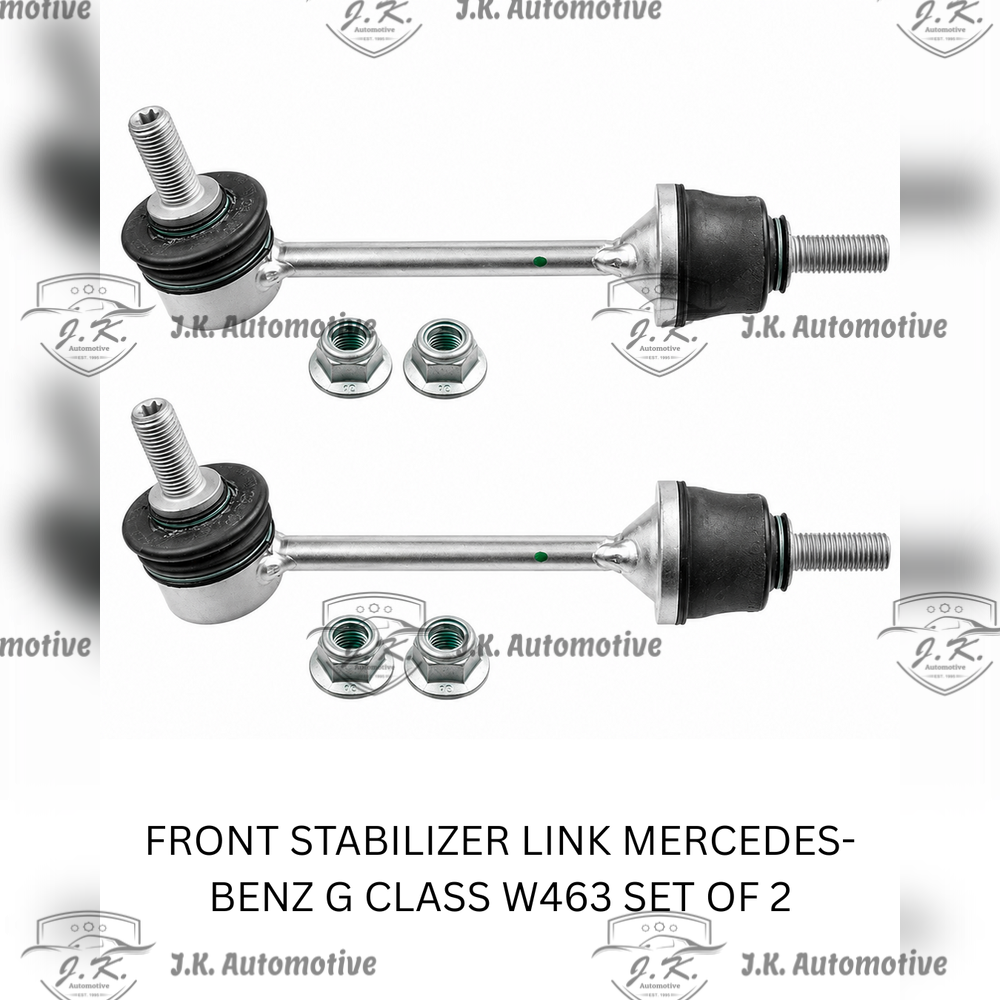
The Stokes Germany Front Stabilizer Link Rod Set of 2 for Mercedes-Benz G-Class W463 A4633201200 is a premium replacement suspension component designed for compatible Mercedes-Benz G-Class W463 vehicles that use OEM reference A4633201200. This product includes two front stabilizer link rods so that the left and right sides of the front suspension can be serviced together when required. The stabilizer link rod is a relatively compact suspension component, but it performs an important job in connecting the vehicle's front suspension movement with the stabilizer or anti-roll bar system. When the Mercedes-Benz G-Class travels around a corner, crosses an uneven road, passes over a speed breaker, enters a driveway or experiences different suspension movement between the left and right wheels, the stabilizer system helps control unnecessary body movement. The stabilizer link rods form part of the mechanical connection that allows this system to work correctly. These components are also commonly known as sway bar links, sway links, anti-roll bar links, stabiliser links, stabilizer link rods or coupling rods depending on the parts catalogue and market. Mercedes-Benz identifies A4633201200 as a front left and right torsion-bar linkage for G-Class 463 applications, confirming its relationship with the front stabilizer system. The Stokes Germany replacement set is intended for customers who want to replace worn, loose or damaged front links while retaining an application matched to the required OEM reference. Over time, stabilizer link joints can experience repeated movement, vibration, road shock, dirt, water and changing loads, particularly on vehicles regularly driven on rough or uneven road surfaces. When wear develops, the driver may begin to hear knocking, rattling or clunking noises from the front suspension. The vehicle may also feel less composed when travelling across uneven surfaces or changing direction, although these symptoms should always be professionally diagnosed because other suspension components can create similar problems. Replacing confirmed worn links can restore a secure connection within the anti-roll system and help the suspension operate as intended. Supplying the product as a set of two is useful because both front links operate under broadly similar driving conditions and can accumulate comparable mileage. If both sides show wear, they can therefore be renewed during the same repair instead of replacing only one side and potentially returning to the workshop later for the other. Correct fitment is extremely important with Mercedes-Benz suspension parts, so customers should verify OEM reference A4633201200 against the vehicle VIN, existing component or professional parts catalogue before installation. A visual resemblance alone should never be used as the only method of confirming compatibility. When the application is correctly confirmed, this Stokes Germany set provides a practical replacement solution for maintaining the front stabilizer linkage of the Mercedes-Benz G-Class W463.
What does the front stabilizer link rod do on the Mercedes-Benz G-Class W463?
The front stabilizer link rod on the Mercedes-Benz G-Class W463 performs an important mechanical role within the front suspension and anti-roll system because it helps transfer suspension movement to the stabilizer bar. A vehicle's left and right wheels do not always move in exactly the same way, especially when the vehicle is cornering, travelling over uneven surfaces or crossing road imperfections. During a turn, the vehicle body naturally tends to lean toward the outside of the corner as weight transfers across the chassis. The stabilizer bar is designed to resist excessive difference in suspension movement between the two sides and therefore contributes to controlling body roll. Mercedes-Benz technical literature describes the stabilizer bar as a component that helps minimize front sway during turns and helps the vehicle maintain a flatter attitude relative to the road. The stabilizer link rods are part of the connection that allows the suspension and stabilizer bar to interact. When the suspension moves, force is transferred through the link so that the stabilizer bar can perform its intended function. This means that even though the link rod is much smaller than a control arm, shock absorber or stabilizer bar, its mechanical condition remains important to the overall operation of the anti-roll system. The link is subjected to frequent movement whenever the suspension works, and this can happen thousands of times during ordinary driving. Indian road conditions can add additional demands because vehicles may regularly encounter potholes, speed breakers, broken road surfaces, construction areas, steep ramps and uneven transitions. A Mercedes-Benz G-Class may also be used in conditions where the suspension experiences significant articulation and repeated load changes. Over extended use, joints and related parts in the stabilizer linkage can develop wear or excessive clearance. When this occurs, the link may no longer provide the same tight mechanical connection between the suspension and stabilizer bar. One possible symptom is a knocking, tapping or rattling sound from the front of the vehicle when crossing small bumps or uneven surfaces. Depending on the severity of the wear, the front suspension may also feel less controlled during directional changes. The purpose of installing a correct replacement link is therefore not to modify the original suspension characteristics but to restore the connection required for normal operation. The Stokes Germany front stabilizer link rod set provides two replacement links for the corresponding Mercedes-Benz G-Class W463 application using OEM reference A4633201200. Mercedes-Benz lists this reference for front left and right usage. Correct installation can help the stabilizer bar respond properly to suspension movement when the rest of the system is in serviceable condition. However, if suspension noise or instability remains after link replacement, other components such as stabilizer bushes, control-arm bushes, steering joints, shock absorbers, mounts and related suspension parts should also be inspected. The stabilizer link is therefore one component within a complete suspension system, and its condition should always be considered together with the condition of surrounding components.
What are the symptoms of worn front stabilizer link rods on a Mercedes-Benz G-Class W463?
Worn front stabilizer link rods on a Mercedes-Benz G-Class W463 can produce several noticeable symptoms, although the exact behaviour depends on the amount of wear and the condition of the rest of the front suspension. One of the most common signs associated with worn sway bar links is a knocking, clunking, tapping or rattling noise coming from the front suspension when the vehicle travels over uneven surfaces. The noise may be particularly noticeable while crossing speed breakers, small potholes, rough roads, driveway entrances or broken sections of road where the left and right front wheels move differently. In the early stages of wear, the sound may be occasional and difficult to identify. As clearance inside the worn joint increases, the noise may become more frequent and easier to reproduce. Another possible symptom is a less settled feeling from the front suspension during changes of direction. Because the stabilizer link forms part of the connection between the suspension and anti-roll bar, excessive play can prevent that connection from operating as tightly as intended. A driver might therefore feel additional movement or notice that the vehicle does not feel as composed as before, particularly during cornering or quick directional changes. This does not mean every handling problem is caused by a stabilizer link. The Mercedes-Benz G-Class W463 has several suspension and steering components that can produce overlapping symptoms when worn. Control-arm bushes, stabilizer bushes, steering joints, shock absorbers, mounts, wheel bearings and other joints may all contribute to noises or changes in vehicle behaviour. For this reason, replacing stabilizer links simply because a knocking sound exists is not the correct diagnostic approach. A technician should inspect the front suspension, physically check the stabilizer links for unwanted movement or joint play, examine the boots and mounting areas, and inspect surrounding components at the same time. If the existing link has visible damage, excessive movement or confirmed wear and OEM reference A4633201200 is required for the vehicle, the Stokes Germany front stabilizer link rod set can be used as the corresponding replacement option. Mercedes-Benz's parts information identifies A4633201200 as a front left and right linkage for G-Class 463 applications. Because the product contains two link rods, both front sides can be replaced together when inspection shows that this is appropriate. This can be especially useful on an older or higher-mileage vehicle where both links have been exposed to similar operating conditions. After replacement, a properly functioning stabilizer linkage can help eliminate noises that were specifically caused by worn links and restore a secure mechanical connection within the anti-roll system. However, customers should not expect new stabilizer links to repair unrelated suspension faults. If another component is worn, that component must also be diagnosed and repaired. Proper inspection before replacement and a final suspension check after installation provide the best approach to resolving front suspension complaints on the G-Class W463.
Why is it recommended to replace both front stabilizer link rods together on the Mercedes-Benz G-Class W463?
Replacing both front stabilizer link rods together on the Mercedes-Benz G-Class W463 can be a sensible maintenance approach when the vehicle has accumulated significant mileage or when inspection shows comparable deterioration on both sides. The front left and front right stabilizer links operate as part of the same anti-roll system and are continuously exposed to suspension movement while the vehicle is driven. Every time the G-Class travels across an uneven road, enters a corner, crosses a speed breaker, moves through a pothole or experiences different wheel movement between the two sides, the stabilizer linkage is working. Although the left and right links do not necessarily wear at exactly the same rate, they normally share the same vehicle mileage and are exposed to broadly similar age, weather, contamination and road conditions. If one link has developed significant wear after prolonged service, it is therefore reasonable for the technician to inspect the opposite side carefully. The Stokes Germany product is supplied as a set of two, allowing both front links to be renewed during the same suspension repair when required. Mercedes-Benz identifies OEM A4633201200 as applicable to the front left and right positions of relevant G-Class 463 vehicles. Replacing both worn links at the same time can provide a consistent service condition across the front stabilizer linkage instead of having one newly replaced component working alongside another link that may already have substantial mileage or developing play. Pair replacement can also reduce duplicated workshop labour if the second side is already close to the end of its useful service condition. A customer who changes only one worn link and then develops similar noise from the opposite side shortly afterward may need to return for another inspection and repair. However, this does not mean both links must automatically be replaced whenever only one has a problem. Professional inspection should determine the actual condition of each component. The mechanic should also inspect the stabilizer bar bushes, mounting hardware, control-arm bushes, steering components and other nearby suspension parts because replacing link rods cannot correct wear elsewhere. If both links are confirmed worn or the customer is carrying out a planned front suspension refresh, installing the complete two-piece set can be a practical solution. Correct installation is also important. Fasteners should be installed and tightened according to appropriate workshop procedures, and the link should not be damaged during fitting. Once installed correctly, the replacement links restore serviceable connection points between the suspension and stabilizer system. This helps the anti-roll bar perform its intended function without the unwanted clearance associated with worn link joints. For a premium SUV such as the Mercedes-Benz G-Class W463, maintaining both sides of the suspension in good mechanical condition contributes to predictable suspension behaviour, reduced unwanted noise and a more properly maintained vehicle.
Is A4633201200 the correct OEM reference for the Mercedes-Benz G-Class W463 front stabilizer link rod?
A4633201200 is a Mercedes-Benz OEM reference associated with the front stabilizer linkage of applicable G-Class 463 vehicles, and it is the key reference used for this Stokes Germany front stabilizer link rod set. Mercedes-Benz's original-parts catalogue describes A4633201200 as a torsion-bar linkage for the front left and right of G-Class 463 applications. This information is particularly useful because the same type of component can be described differently across automotive catalogues and markets. One catalogue may call it a stabilizer link, another may call it a sway bar link, anti-roll bar link, stabiliser link rod, coupling rod or torsion-bar linkage. The OEM reference helps remove much of this naming ambiguity because it identifies the component through the manufacturer's part-number system. However, customers should understand that seeing “G-Class W463” in a product title does not mean every vehicle carrying the W463 designation automatically uses exactly the same suspension component. The G-Class has existed across many production years and has been offered with numerous engines, configurations, markets and technical variations. Vehicle components can therefore change according to production specification. The safest method of ordering is to verify the OEM reference against the customer's specific vehicle. This can be done by checking the number on the removed component when visible, consulting a professional Mercedes-Benz electronic parts catalogue, or checking the vehicle identification number through a qualified parts specialist. If the vehicle catalogue confirms A4633201200 for the required front stabilizer linkage, the Stokes Germany set can then be selected against that OEM reference. Mercedes-Benz's parts information also indicates that A4633201200 replaces the earlier reference A2313200889, which can be useful when researching older catalogue information. Customers should avoid selecting suspension parts purely from photographs because two stabilizer links can appear extremely similar while having different dimensions, mounting details, joint configurations or thread specifications. Even a small dimensional difference can make a visually similar component unsuitable for the intended application. The same caution applies when purchasing by vehicle name alone. Matching the chassis and OEM number significantly improves the accuracy of parts selection. This is particularly important with steering and suspension components because incorrect fitment can create installation difficulties or prevent the suspension system from operating as intended. The Stokes Germany product therefore uses A4633201200 as its primary OEM matching reference for the corresponding Mercedes-Benz G-Class W463 application, while final compatibility should always be confirmed against the exact vehicle before installation.
How can the Stokes Germany front stabilizer link rod set improve the suspension after worn links are replaced?
Installing the Stokes Germany front stabilizer link rod set on a compatible Mercedes-Benz G-Class W463 can help restore the proper mechanical connection within the front stabilizer system when the existing links have been confirmed as worn, loose or damaged. The purpose of replacement is restoration rather than modification. A new stabilizer link does not increase engine performance, alter the fundamental suspension design or turn the vehicle into a different handling specification. Instead, it replaces a component that has developed unwanted wear and allows the anti-roll system to work through a serviceable connection again. The stabilizer bar helps control body sway as the vehicle corners, and Mercedes-Benz technical information describes its role in minimizing front sway during turns and maintaining a flatter vehicle attitude relative to the road. The stabilizer links form part of the mechanical path through which suspension movement reaches that bar. When a link joint develops excessive clearance, the suspension movement may first take up that unwanted play instead of being transmitted through a tight connection. This can contribute to knocking, rattling or clunking noises and can reduce the precise mechanical connection within the stabilizer system. Replacing the worn component removes that excessive clearance from the affected point. If both links have deteriorated, installing the supplied set of two can restore serviceable link connections on both front sides. This may result in a quieter front suspension when the original noise was specifically caused by the worn links. The vehicle may also feel more settled because the anti-roll system is once again connected through components without excessive joint play. The improvement should be understood as a return toward correct operating condition rather than an upgrade beyond the vehicle's intended design. Results will also depend heavily on the condition of the remaining suspension. A G-Class with worn stabilizer bushes, control-arm bushes, shock absorbers, steering joints, mounts or other damaged parts may continue to produce noise or undesirable handling even after new sway links have been fitted. This is why a complete front suspension inspection is recommended rather than treating every symptom as a stabilizer-link problem. The Stokes Germany set corresponds with OEM reference A4633201200 for the relevant application, which Mercedes-Benz identifies for front left and right use on applicable G-Class 463 vehicles. When fitment is confirmed and installation is carried out correctly, the replacement links can contribute to smoother and quieter suspension operation by eliminating wear at those specific connection points. For customers maintaining an older, high-mileage or regularly driven Mercedes-Benz G-Class W463, replacing confirmed worn suspension components at the appropriate time can also help prevent persistent noises and preserve the controlled driving characteristics expected from a properly maintained vehicle.
When should I replace the front stabilizer link rods on my Mercedes-Benz G-Class W463?
The front stabilizer link rods on a Mercedes-Benz G-Class W463 should be replaced when a proper suspension inspection confirms that the existing links have developed excessive wear, looseness, joint play, physical damage or deterioration that prevents them from maintaining the correct connection within the front stabilizer system. There is no single replacement mileage that applies to every G-Class because stabilizer-link service life depends heavily on road conditions, vehicle usage, driving environment, component age and the condition of the surrounding suspension. A vehicle that regularly travels over rough roads, potholes, broken surfaces, large speed breakers or uneven terrain may place different loads on suspension components compared with a vehicle used mainly on smooth highways. The Mercedes-Benz G-Class is also a substantial SUV, and its suspension can experience repeated movement and load changes during everyday driving. One of the first symptoms that may encourage an owner to have the stabilizer links inspected is a knocking, tapping, rattling or clunking sound from the front suspension. This noise may become noticeable when driving slowly over uneven roads, entering a driveway, crossing a speed breaker or passing over small sharp bumps. The sound can sometimes appear minor at first and gradually become more noticeable as wear increases. Another reason for inspection is a change in how controlled the front of the vehicle feels during directional changes or on uneven roads. Because the sway bar links form part of the mechanical connection between the suspension and anti-roll bar, significant wear can affect how securely that system is connected. However, these symptoms are not exclusive to stabilizer links. Worn stabilizer bushes, control-arm bushes, steering joints, shock absorbers, mounts and other suspension parts can produce similar noises or behaviour. This is why diagnosis should be based on physical inspection rather than symptoms alone. A qualified technician can raise the vehicle safely, examine the link rods, check their joints and mounting points, look for damaged protective components and identify excessive movement where applicable. If the front links are confirmed to be worn and the vehicle requires OEM reference A4633201200, the Stokes Germany Front Stabilizer Link Rod Set of 2 can be used as the corresponding replacement option. Mercedes-Benz identifies A4633201200 as a front left and right linkage for relevant G-Class 463 applications. Because the Stokes Germany package contains two link rods, both front sides can be renewed together if both are worn or if pair replacement is considered appropriate during the repair. Replacing the links before excessive deterioration progresses can help restore a secure stabilizer connection and address suspension noises that are specifically being caused by the worn links. Owners should also consider having the suspension inspected periodically on older or higher-mileage G-Class vehicles even if no major noise is currently present. Early identification of worn components can make maintenance more predictable and help ensure that the front suspension continues to operate correctly. The objective is not to replace stabilizer links unnecessarily but to identify wear accurately and replace the components when their mechanical condition requires it.
Can worn stabilizer link rods cause knocking or clunking noises in a Mercedes-Benz G-Class W463?
Yes, worn front stabilizer link rods can be one possible cause of knocking, tapping, rattling or clunking noises from the front suspension of a Mercedes-Benz G-Class W463, particularly when the vehicle travels across uneven road surfaces. A stabilizer link works as a mechanical connection between the suspension and the stabilizer or anti-roll bar system, and its joints are repeatedly loaded as the suspension moves. When these joints are in good condition, they maintain the intended connection while still allowing the movement required by the suspension design. As the component wears, unwanted clearance can develop in the joint or mounting area. When the wheel moves upward or downward over a bump, that clearance can allow movement before the load is transferred through the link, and the resulting contact or movement can produce an audible knock or clunk. Drivers may notice this type of sound most clearly at relatively low speeds on broken roads, over small potholes, while crossing speed breakers or when entering and leaving driveways. In some cases, the noise may be more noticeable when only one front wheel encounters a bump because the left and right suspension sides are moving differently and the anti-roll system is being loaded. The noise may initially be light and intermittent but can become more obvious as component wear progresses. Some drivers describe worn sway links as producing a repetitive light knocking sound rather than one heavy impact. However, sound alone cannot conclusively identify the faulty component. A Mercedes-Benz G-Class W463 contains numerous suspension and steering parts that can generate similar noises. Stabilizer-bar bushes can wear, control-arm bushes can deteriorate, steering joints can develop clearance, shock-absorber-related components can become worn and mounting hardware can sometimes contribute to unwanted sounds. Therefore, replacing the stabilizer links without checking the rest of the suspension can result in unnecessary parts replacement and may fail to solve the original complaint. A workshop should reproduce the customer's noise where possible and then physically inspect the suspension. The technician can check the link rods and their mounting points for excessive movement, damaged areas or other evidence of deterioration. If the links are confirmed as the source of the noise and the required reference is A4633201200, the Stokes Germany Front Stabilizer Link Rod Set of 2 provides replacement links for the corresponding application. Mercedes-Benz lists A4633201200 for front left and right use on relevant G-Class 463 applications. When worn links are replaced correctly, the unwanted clearance at those connection points is removed. If that clearance was responsible for the knocking noise, the suspension should become quieter after the repair. If a noise remains, the workshop should continue diagnosing other front suspension components rather than assuming the new links are responsible. Correct diagnosis, OEM-reference verification and professional installation are therefore the best approach when dealing with front suspension noise on the G-Class W463.
Is the Stokes Germany A4633201200 stabilizer link set suitable for regular city, highway and rough-road driving?
The Stokes Germany A4633201200 front stabilizer link rod set is intended as a replacement suspension component for compatible Mercedes-Benz G-Class W463 applications that require this OEM reference, and a correctly fitted stabilizer link is expected to perform its normal mechanical function across the types of road conditions for which the vehicle is being used. In ordinary city driving, the front suspension continuously operates while the G-Class crosses speed breakers, potholes, road joints, ramps, parking entrances and uneven patches of tarmac. During highway driving, suspension movement may be smaller for extended periods, but the stabilizer system continues to play an important role whenever the vehicle changes direction, enters a curve or encounters differences in road surface. Rougher road conditions can subject suspension components to more frequent and severe movement because each wheel may move through a greater range and the left and right sides may experience different loads. The stabilizer link is designed to provide the mechanical connection required between the suspension and anti-roll system throughout these movements. The suitability of a replacement component, however, begins with correct application. The customer should first confirm that A4633201200 is the required OEM reference for the particular Mercedes-Benz G-Class W463 being repaired. Mercedes-Benz identifies A4633201200 as a front left and right torsion-bar linkage for relevant G-Class 463 applications. Correct fitment is especially important because G-Class vehicles can differ according to production specification, model derivative and other vehicle details. Once fitment has been verified, professional installation is equally important. Even a correctly selected suspension component can fail to perform as intended if it is installed incorrectly, damaged during fitting or used alongside severely worn surrounding components. The condition of the stabilizer bushes, control arms, steering components, shock absorbers and mounting points should therefore be checked when the links are replaced. Driving conditions also influence service life. A vehicle that spends most of its time on smooth highways may place different demands on the stabilizer linkage than a G-Class regularly driven across heavily damaged roads or demanding terrain. It would therefore be misleading to promise an identical service life for every vehicle regardless of operating conditions. Routine suspension inspection remains important, particularly after severe impacts or when unusual noise develops. The Stokes Germany set contains two front link rods, allowing both sides to be serviced together when appropriate. This is useful for vehicles where both links have accumulated similar mileage and both show deterioration. When correctly matched, professionally installed and used with the rest of the suspension in good condition, the replacement links are intended to restore normal operation of the front stabilizer linkage across everyday driving conditions rather than change the original suspension design of the vehicle.
Why is correct fitment and professional installation important for the Mercedes-Benz G-Class W463 A4633201200 front stabilizer link set?
Correct fitment and professional installation are extremely important when replacing the Mercedes-Benz G-Class W463 front stabilizer link rods because these components form part of the vehicle's suspension system and must correspond correctly with the intended mounting arrangement. The first step should always be confirming that OEM reference A4633201200 is applicable to the exact vehicle being repaired. Mercedes-Benz lists A4633201200 as a front left and right linkage for relevant G-Class 463 applications, but customers should still verify the individual vehicle rather than relying only on the general model name. Mercedes-Benz G-Class vehicles have been produced in many specifications, and components can vary according to production details and configuration. A VIN-based parts check, confirmation from a professional catalogue or comparison with the existing OEM reference is therefore recommended before installation. Once the correct component has been identified, the installation procedure also deserves proper attention. Stabilizer links are mounted within an active suspension system and are subjected to repeated movement and load whenever the vehicle is driven. Mounting points and fasteners therefore need to be handled correctly so that the replacement component is secured as intended. Incorrect installation can potentially create noise, premature wear or other problems that may incorrectly be blamed on the replacement part itself. A professional workshop also has the advantage of being able to inspect the surrounding suspension while the vehicle is raised. This is particularly important when the customer originally visited the workshop because of a knocking or rattling sound. The technician should not assume that every suspension noise comes from the sway bar links. Stabilizer bushes, control-arm bushes, steering joints, shock absorbers, mounts and other components can generate similar symptoms. If one of those parts remains worn, the noise may continue even after new stabilizer links are installed. A complete inspection therefore improves the likelihood that the actual cause of the complaint is identified. The workshop can also compare both sides of the vehicle and determine whether replacing the complete two-piece set is appropriate. The Stokes Germany product contains two front stabilizer link rods, allowing the left and right links to be renewed together where required. After installation, the technician should verify that the components are seated correctly and that there is no unwanted interference or abnormal movement. Any relevant manufacturer workshop procedure should be followed for fastener installation and tightening. A road test may then help confirm whether the original noise or suspension complaint has been resolved. Correct parts selection and installation are particularly important with a premium, heavy vehicle such as the Mercedes-Benz G-Class because suspension components contribute directly to the way the vehicle behaves on the road. Professional fitting therefore protects the quality of the repair and helps the replacement stabilizer links perform their intended function within the complete front suspension system.
Why is Stokes Germany a European-quality alternative to Lemförder, FAG, FEBI Bilstein and Meyle for Mercedes-Benz G-Class W463 front stabilizer link rods?
Stokes Germany offers the Mercedes-Benz G-Class W463 owner an aftermarket replacement choice for the front stabilizer link application when OEM reference A4633201200 has been confirmed for the vehicle, while established European aftermarket names such as Lemförder, FAG, FEBI Bilstein and Meyle are also widely recognised within the automotive replacement-parts market. The most important consideration when comparing suspension components should be whether the specific part is correctly engineered for its stated application, corresponds with the required dimensions and mounting arrangement, provides consistent manufacturing quality and is supported by an appropriate supplier warranty rather than relying only on the name printed on the box. Stokes Germany positions its suspension products for customers seeking European-oriented aftermarket quality and application-focused replacement parts for premium vehicles such as Mercedes-Benz. For this G-Class application, the product is supplied as a set of two front stabilizer link rods and is matched against OEM reference A4633201200. Mercedes-Benz identifies that reference as a front left and right torsion-bar linkage for relevant G-Class 463 applications. This OEM-reference approach is important because it gives the customer and workshop a clear starting point for verifying compatibility before installation. In the modern automotive aftermarket, manufacturing is international, and European replacement-parts brands may source or manufacture different product ranges across multiple countries and supplier networks rather than producing every component in one single facility. For that reason, country-of-origin assumptions alone are not a reliable method of comparing two replacement parts. What matters more is the specification, quality-control process, material selection, dimensional consistency, joint construction, application accuracy and supplier support for the actual component being purchased. Stokes Germany products are positioned with this practical aftermarket requirement in mind, giving workshops and vehicle owners another replacement option alongside established European brands. For a stabilizer link, correct dimensions and joint operation are especially important because the component experiences repeated movement as the suspension travels and the anti-roll bar responds to changing wheel loads. A poorly matched component can create installation problems, unwanted noise or incorrect operation regardless of the brand name. Customers should therefore verify the OEM reference and vehicle application before comparing prices or choosing between brands. The Stokes Germany A4633201200 set also provides both front link rods together, which can be convenient when a workshop determines that the left and right links should be renewed during the same repair. When comparing it with Lemförder, FAG, FEBI Bilstein, Meyle or another aftermarket option, customers should consider the complete proposition: application accuracy, component specification, warranty terms, seller support, availability and value. Claims that different brands are manufactured on exactly the same production line or in the same factory should only be made when they can be verified for the specific components being compared, because manufacturing arrangements can differ by part number and over time. For the G-Class owner, the practical objective is to purchase a correctly matched, dependable replacement component that restores the intended stabilizer linkage after the original part has worn. Stokes Germany provides an alternative for that requirement while allowing customers to retain the OEM-number-based selection process commonly used when purchasing premium European vehicle suspension components.

Reviews
There are no reviews yet.