What is the Stokes Germany Rear Stabilizer Link Rod Set of 2 for Mercedes-Benz E-Class W213 A2053260317 & A2053260417?
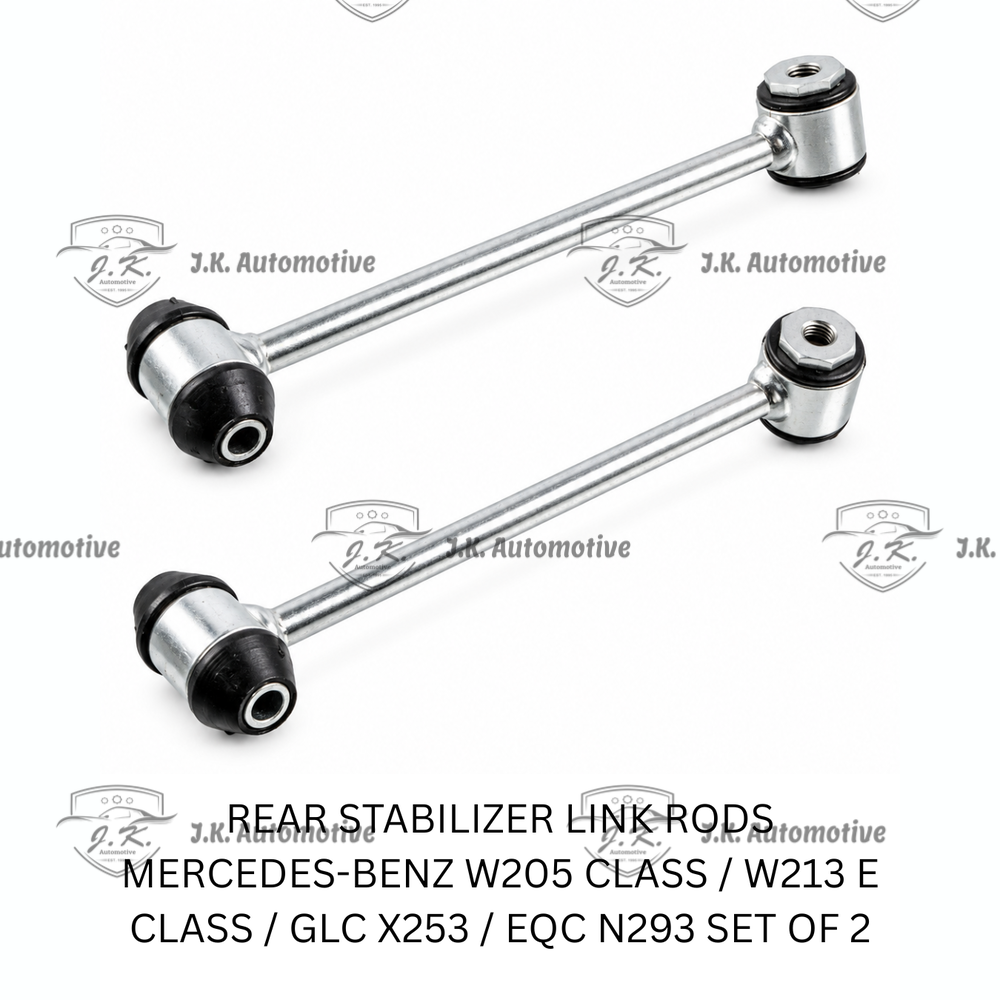
The Stokes Germany Rear Stabilizer Link Rod Set of 2 is a premium aftermarket suspension replacement designed for compatible Mercedes-Benz E-Class W213 models requiring OEM references A2053260317 and A2053260417. The set contains the corresponding rear stabilizer link rods for the left and right sides of the vehicle, making it a convenient replacement option when both original links are worn or require attention. These suspension components are commonly known as Sway bar links, Sway links, Anti roll link rods and Stabiliser sway links, and the different names describe the same general type of suspension linkage used within the stabilizer or anti-roll bar system. During everyday driving, the rear suspension of the Mercedes-Benz E-Class W213 continuously moves as the vehicle turns, brakes, accelerates, crosses speed breakers, travels through potholes, enters parking ramps or passes over uneven road surfaces. The Sway bar links operate with these suspension movements and maintain the required mechanical connection within the stabilizer system. Although these links are relatively small compared with suspension arms or shock absorbers, they work repeatedly whenever the rear suspension moves. Over extended mileage, continuous joint movement, road vibration, pothole impacts, moisture, dirt and normal ageing can gradually contribute to wear inside the Sway links. When the joints develop excessive clearance, looseness or deterioration, unwanted movement can occur at the stabilizer connection points. Worn Anti roll link rods may then contribute to knocking, tapping, rattling or clunking noises from the rear suspension, particularly while travelling slowly over rough roads, potholes or speed breakers. The Stokes Germany set is intended to replace worn Stabiliser sway links and restore serviceable mechanical connections at these particular points of the rear stabilizer system. Supplying two links together is convenient when inspection confirms that both corresponding components require replacement. The purpose of installing new stabilizer links is not to alter the original ride height or unnecessarily change the factory suspension characteristics of the Mercedes-Benz E-Class W213. Instead, the replacement renews worn linkage so the existing stabilizer system can continue operating through serviceable components. Before ordering, A2053260317 and A2053260417 should always be verified against the exact vehicle VIN, original components or professional Mercedes-Benz parts information because suspension specifications can vary between vehicle configurations. When these references are confirmed for the exact E-Class W213 and the original links are diagnosed as worn, the Stokes Germany Rear Stabilizer Link Rod Set of 2 provides a practical replacement for renewing the corresponding rear Sway bar links, Sway links, Anti roll link rods and Stabiliser sway links.
What do the rear stabilizer link rods do on the Mercedes-Benz E-Class W213?
The rear stabilizer link rods on the Mercedes-Benz E-Class W213 provide an important mechanical connection within the rear stabilizer or anti-roll bar system and operate whenever the rear suspension responds to vehicle movement or changing road conditions. In simple words, these Sway bar links connect the stabilizer system with the relevant suspension points so the system can perform its intended function as the rear wheels move. During everyday driving, the left and right rear wheels do not always move in exactly the same way because one wheel may travel over a pothole, road joint, speed breaker or broken section while the opposite wheel remains on a smoother surface. The rear suspension also responds whenever the E-Class W213 turns, changes direction, accelerates or brakes. The Sway links operate with these movements and maintain the required mechanical connection within the stabilizer system. These components can also be described as Anti roll link rods, Stabiliser sway links, coupling rods, drop links or simply rear stabilizer links. Different workshops and spare-parts catalogues may use different terminology, but the general function remains the same. When the links are in serviceable condition, their joints allow the required suspension movement while maintaining a controlled connection within the stabilizer system. Because the joints move repeatedly throughout normal vehicle use, they can gradually develop wear as mileage increases. Potholes, speed breakers, road vibration, dirt, moisture, rough surfaces and repeated suspension movement can contribute to deterioration. Once excessive clearance develops inside the Sway bar links, their joints may begin moving more than intended. This unwanted movement can contribute to knocking, tapping, rattling or clunking noises from the rear suspension. Such noises may become easier to notice while travelling slowly over broken roads or when one rear wheel moves differently from the opposite wheel. Replacing confirmed worn Sway links restores serviceable mechanical connections at those particular points of the stabilizer system. However, a rear suspension noise should not automatically be treated as proof that the stabilizer links have failed because stabilizer bushes, suspension arms, suspension bushes, shock absorbers, mounts and other joints can create similar symptoms. A professional technician should therefore inspect the complete rear suspension before replacing components. OEM references A2053260317 and A2053260417 should also be checked against the exact Mercedes-Benz E-Class W213 before ordering. When these numbers are confirmed for the individual vehicle and the existing Anti roll link rods are diagnosed as worn, the Stokes Germany set provides the corresponding rear Stabiliser sway links needed to renew the affected stabilizer linkage.
What are the common symptoms of worn rear Sway bar links on a Mercedes-Benz E-Class W213?
Common symptoms of worn rear Sway bar links on a Mercedes-Benz E-Class W213 can include knocking, tapping, rattling or clunking noises from the rear suspension, particularly when the vehicle is travelling slowly over potholes, speed breakers, broken roads, road joints, parking ramps or uneven surfaces. These sounds can occur because the joints inside the Sway links operate continuously as the suspension compresses and extends during everyday driving. When these joints remain in serviceable condition, they allow the necessary movement while maintaining a controlled mechanical connection within the stabilizer or anti-roll bar system. Over extended mileage, repeated suspension movement, road vibration, pothole impacts, moisture, dirt and general ageing can gradually contribute to deterioration. When excessive clearance develops inside the Anti roll link rods, their joints may move more than intended. A small amount of unwanted movement can initially produce a light tapping or rattling noise that may be difficult to notice while driving on smooth roads. As the wear becomes greater, the sound may develop into a stronger knocking or clunking noise. Worn Stabiliser sway links may sometimes become particularly noticeable when one rear wheel travels over an uneven section while the opposite wheel remains relatively level because the two sides of the rear suspension are moving differently. Drivers may also notice the sound when crossing a speed breaker at an angle, travelling over small repeated road imperfections or entering and leaving parking ramps. However, these symptoms should not automatically be treated as proof that the Sway bar links require replacement. The Mercedes-Benz E-Class W213 has a sophisticated rear suspension containing several components that can develop wear and create similar sounds. Stabilizer bushes, suspension arms, suspension bushes, shock absorbers, shock mounts and other suspension joints should therefore also be inspected. A professional technician can physically check the Sway links for excessive joint play, looseness, damaged joint protection, corrosion or other deterioration. If one rear link is found to have substantial wear, the corresponding component on the opposite side should also be inspected because both links normally experience similar mileage and general operating conditions. When A2053260317 and A2053260417 are confirmed for the exact Mercedes-Benz E-Class W213 and the existing links are diagnosed as worn, the Stokes Germany set provides the corresponding replacement pair. Replacing confirmed worn Sway bar links, Sway links, Anti roll link rods or Stabiliser sway links removes excessive play from those particular stabilizer connection points and can help restore quieter rear suspension operation when worn stabilizer links are genuinely responsible for the unwanted noise.
Why should the rear Sway links on the Mercedes-Benz E-Class W213 be replaced as a set of 2?
Replacing the rear Sway links as a set of two can be a practical maintenance approach when both corresponding components on the Mercedes-Benz E-Class W213 are worn or approaching replacement condition because the left and right Sway bar links operate within the same rear stabilizer system and generally experience similar vehicle mileage, age and road conditions. Every time the E-Class W213 turns, travels through a pothole, crosses a speed breaker, enters a parking ramp or moves over an uneven road surface, the rear suspension responds and the Anti roll link rods work with this suspension movement. Because both Stabiliser sway links perform the same general function throughout the vehicle's service life, they may develop wear over a similar period. This does not mean that both components will always wear at exactly the same rate because one side of the vehicle can experience stronger pothole impacts, greater road contamination or different operating loads than the opposite side. However, when one Sway link has developed significant joint play, looseness or deterioration after considerable mileage, inspecting the corresponding component on the opposite side is sensible workshop practice. The Stokes Germany product is supplied as a set of two rear stabilizer link rods, making it convenient to renew both corresponding components during the same suspension repair when inspection confirms that both require replacement. Installing the complete pair can provide serviceable Sway bar links at both corresponding stabilizer connection points rather than installing one new component alongside another heavily used link that may already be developing wear. This may also reduce the possibility of another workshop visit shortly afterward if the opposite old link begins producing similar knocking, tapping, rattling or clunking noises. However, supplying the product as a set of two does not mean that a serviceable component must automatically be replaced. A professional technician should inspect both Sway links individually and determine their actual mechanical condition. The stabilizer bushes, suspension arms, suspension bushes, shock absorbers, mounts and surrounding rear suspension components should also be inspected because replacing the Anti roll link rods cannot correct wear elsewhere in the suspension. Correct component identification is equally important, so A2053260317 and A2053260417 should be checked against the exact Mercedes-Benz E-Class W213 VIN or original components before installation. When compatibility is confirmed and both original links require replacement, the Stokes Germany set provides the corresponding rear Stabiliser sway links as a convenient pair for renewing the affected rear stabilizer linkage.
Are A2053260317 and A2053260417 the correct rear stabilizer link references for the Mercedes-Benz E-Class W213?
A2053260317 and A2053260417 should be verified against the exact Mercedes-Benz E-Class W213 VIN before ordering, because the W213 platform was produced with different versions and suspension configurations and an OEM reference that is correct for one configuration should not automatically be assumed to fit every W213. These two references are used as corresponding rear stabilizer link numbers within Mercedes-Benz applications, with A2053260317 associated with the rear-left link and A2053260417 with the corresponding rear-right link on supported applications. For the specific E-Class W213 listing, the safest parts-identification method is therefore to confirm both references using the exact vehicle identification number or professional Mercedes-Benz EPC information rather than relying only on the model name. These components may be described as rear Sway bar links, Sway links, Anti roll link rods, Stabiliser sway links, coupling rods, drop links or stabilizer link rods, but differences in terminology do not determine compatibility. The OEM number, installation position and exact vehicle specification are much more important. Customers should also avoid selecting replacement links simply because photographs look similar. Stabilizer links used across Mercedes-Benz platforms can have very similar overall shapes while differing in dimensions, joint design, thread specifications, mounting arrangements or suspension applications. Therefore, visual comparison alone is not a reliable final fitment method. If the original links remain fitted to the vehicle and their numbers are readable, those references can be compared with A2053260317 and A2053260417 as an additional confirmation. VIN-based parts information provides an even stronger check because it can account for the precise vehicle configuration. Correct component identification should also be separated from mechanical diagnosis. A knocking, rattling or clunking sound from the rear suspension does not automatically mean the Sway bar links have failed. Stabilizer bushes, suspension arms, suspension bushes, shock absorbers, mounts and other suspension joints can create similar symptoms. A professional technician should therefore inspect the suspension and establish whether the original Anti roll link rods actually have excessive joint play, looseness or deterioration. If A2053260317 and A2053260417 are confirmed by VIN or original-part comparison for the exact Mercedes-Benz E-Class W213 and the existing links are diagnosed as worn, the Stokes Germany Rear Stabilizer Link Rod Set of 2 can be selected as the corresponding replacement. In simple words, do not rely only on “E-Class W213” when ordering this pair; verify A2053260317 and A2053260417 against the exact vehicle first, and once those references are confirmed, the Stokes Germany Sway bar links, Sway links, Anti roll link rods or Stabiliser sway links can be used for the specified rear application.
How can replacing worn rear Anti roll link rods help the Mercedes-Benz E-Class W213 suspension?
When should the rear stabilizer link rods be replaced on a Mercedes-Benz E-Class W213?
The rear stabilizer link rods on the Mercedes-Benz E-Class W213 should be inspected when the vehicle starts producing knocking, tapping, rattling or clunking sounds from the rear suspension, especially while travelling slowly over potholes, speed breakers, broken roads, road joints, parking ramps or uneven surfaces. These Sway bar links operate whenever the rear suspension moves and provide an important mechanical connection within the stabilizer or anti-roll bar system. During everyday driving, the rear suspension continuously responds to cornering, braking, acceleration and changes in road conditions, which means the Sway links repeatedly move with the suspension. Over extended mileage, this repeated movement, together with vibration, pothole impacts, dirt, moisture and normal ageing, can gradually contribute to wear inside the link joints. Once excessive clearance develops inside the Anti roll link rods, the joints may move more than intended and create unwanted suspension noise. Early wear may produce a light tapping or rattling sound, while more advanced wear can result in a stronger knocking or clunking sound. These symptoms can become particularly noticeable when one rear wheel travels over an uneven section while the opposite wheel remains on a smoother surface. There is no single fixed mileage at which every Stabiliser sway link on the E-Class W213 must be replaced because service life depends heavily on road conditions, driving environment, vehicle usage and the condition of surrounding suspension components. A W213 regularly driven over rough roads, potholes and large speed breakers can place greater repeated loads on its Sway bar links than a vehicle mainly driven on smooth highways. For this reason, the actual mechanical condition of the links should determine replacement rather than mileage alone. A professional technician can inspect the Sway links for excessive joint play, looseness, damaged joint protection, corrosion or other deterioration. If one rear link has developed significant wear, the corresponding component on the opposite side should also be inspected because both generally experience similar vehicle mileage. Stabilizer bushes, suspension arms, suspension bushes, shock absorbers, mounts and other rear suspension parts should also be checked because they can create similar noises. For the W213, RIW identifies A2053260317 as the rear-left stabilizer link and A2053260417 as the rear-right stabilizer link, while Teknorot lists the same handed arrangement and specifies a total link length of 257 mm. When these OEM references are confirmed for the exact vehicle and the existing links are diagnosed as worn, the Stokes Germany set provides the corresponding rear Sway bar links, Sway links, Anti roll link rods and Stabiliser sway links needed to renew the affected stabilizer linkage.
Can worn rear Sway bar links cause knocking or rattling noises in the Mercedes-Benz E-Class W213?
Yes, worn rear Sway bar links can be one possible cause of knocking, tapping, rattling or clunking sounds from the rear suspension of a Mercedes-Benz E-Class W213, particularly while the vehicle travels over potholes, speed breakers, broken roads, parking ramps, road joints or other uneven surfaces. The Sway links contain joints that move repeatedly whenever the rear suspension compresses or extends. When these joints remain in serviceable condition, they allow the necessary suspension movement while maintaining the required mechanical connection within the stabilizer or anti-roll bar system. Over extended vehicle use, repeated suspension movement, road vibration, pothole impacts, moisture, dirt and normal ageing can gradually contribute to wear inside the Anti roll link rods. Once excessive clearance develops, the joints may begin moving slightly more than intended, creating unwanted movement at the stabilizer connection points. A small amount of wear may initially produce a light tapping or rattling noise that is difficult to notice on a smooth road. As joint wear increases, the sound can become a stronger knock or clunk. Worn Stabiliser sway links may be particularly noticeable when one rear wheel passes over an uneven section while the opposite wheel remains relatively level because the two sides of the suspension are moving differently. The driver may also notice noises when crossing a speed breaker diagonally or entering a parking ramp. However, every knocking sound from the W213 rear suspension should not automatically be blamed on the Sway bar links because several other components can create similar symptoms. Stabilizer bushes, suspension arms, suspension bushes, shock absorbers, shock mounts and other suspension joints can also develop wear. Professional inspection is therefore recommended before replacing components. A technician can physically inspect the Sway links for excessive movement, loose joints, damaged protection or deterioration while also checking surrounding suspension parts. A2053260317 and A2053260417 are documented W213 rear stabilizer-link references; RIW identifies the former as rear left and the latter as rear right. Actual W213 rear-part listings also show both A2053260317 and A2053260417 in rear applications, providing additional application evidence. When these references match the exact vehicle and excessive movement is found in the original links, replacing the worn Anti roll link rods removes unwanted play from those specific connection points. If the old links are genuinely responsible for the noise, installing serviceable Stokes Germany Sway bar links, Sway links and Stabiliser sway links can help restore quieter operation of the rear stabilizer linkage.
Are A2053260317 and A2053260417 the correct rear stabilizer link references for the Mercedes-Benz E-Class W213?
Yes, A2053260317 and A2053260417 are documented rear stabilizer link references for compatible Mercedes-Benz E-Class W213 applications, and there is strong catalogue evidence supporting this fitment. The important detail is that these two OEM numbers represent two different sides of the rear suspension rather than simply being two interchangeable references for one identical component. A2053260317 corresponds to the rear-left stabilizer link, while A2053260417 corresponds to the rear-right stabilizer link. RIW's Mercedes-Benz E-Class W213/S213 4x2 catalogue specifically identifies A2053260317 as Rear Left and A2053260417 as Rear Right, and its W213/S213 4x4 catalogue shows the same rear-left and rear-right arrangement. Teknorot independently lists A2053260317 as a Rear Left Suspension Stabilizer Bar Link for the Mercedes-Benz E-Class W213 4x2 2016–2022 and lists A2053260417 as its handed Rear Right counterpart for the same W213 application. Gepard's steering and suspension catalogue provides further independent confirmation by listing A2053260317 as “LINK STABILIZER REAR LH” and A2053260417 as “LINK STABILIZER REAR RH” for the Mercedes E-Class W213/S213. In simple words, A2053260317 is the left rear Sway bar link and A2053260417 is the right rear Sway bar link for compatible W213 applications. These components may also be described as Sway links, Anti roll link rods, Stabiliser sway links, coupling rods, drop links or rear stabilizer links depending on the catalogue or workshop terminology. Customers should not select replacement links only because they look similar to the existing components because stabilizer links used across different Mercedes-Benz models can have similar appearances while differing in dimensions, mounting arrangements or vehicle applications. OEM-number matching is considerably more reliable. Teknorot specifies both of these handed components with a total length of 257 mm, M10 x 1.5 bolt metric and one link per respective side of the vehicle. The Stokes Germany product listing also identifies the pair A2053260317 and A2053260417 for the Mercedes-Benz E-Class W213. Therefore, yes, these are supported rear stabilizer-link references for compatible E-Class W213 applications. Even with this strong catalogue evidence, checking the exact VIN remains recommended before installation because Mercedes-Benz model and suspension variations can affect final parts selection. When the references match the exact vehicle, A2053260317 and A2053260417 form the corresponding rear-left and rear-right pair of Sway bar links, Sway links, Anti roll link rods or Stabiliser sway links.
Why should the rear Anti roll link rods be replaced as a set of 2 on the Mercedes-Benz E-Class W213?
Replacing the rear Anti roll link rods as a set of two can be a practical maintenance approach when both corresponding components on the Mercedes-Benz E-Class W213 are worn or approaching replacement condition because the left and right links work within the same rear stabilizer system and generally experience similar vehicle mileage, age and road conditions. For this application, the pair consists of two handed components rather than two identical interchangeable links: A2053260317 corresponds to the rear-left position and A2053260417 corresponds to the rear-right position. This arrangement is documented for W213 applications by RIW, Teknorot and other suspension catalogues. These Sway bar links repeatedly operate whenever the rear suspension responds to cornering, braking, acceleration, potholes, speed breakers, parking ramps and uneven roads. Because both Sway links perform the same general function throughout the vehicle's service life, they can develop wear over a similar period. However, this does not mean that both components will always wear at exactly the same rate. One side of the vehicle may experience stronger pothole impacts, different road contamination or different loads than the other. When one Anti roll link rod develops significant joint wear after considerable mileage, the corresponding component on the opposite side should therefore be inspected. If both are worn, replacing the pair provides serviceable Stabiliser sway links at both corresponding rear stabilizer connection points instead of fitting one new component next to another heavily used link. This can also reduce the possibility of a second workshop visit shortly afterward if the remaining old link begins producing similar knocking, tapping, rattling or clunking noises. The Stokes Germany product is supplied as a set of two, which provides the corresponding components needed for the left and right rear positions when both require replacement. However, supplying a set of two does not mean that a serviceable suspension component must always be replaced unnecessarily. A professional technician should inspect both links individually and determine their mechanical condition. Stabilizer bushes, suspension arms, suspension bushes, shock absorbers, mounts and other related components should also be checked because new Sway bar links cannot repair unrelated suspension wear. The exact OEM references should additionally be confirmed against the vehicle VIN before installation. When A2053260317 and A2053260417 are confirmed and both original links require attention, the Stokes Germany set provides the corresponding rear Sway bar links, Sway links, Anti roll link rods and Stabiliser sway links for renewing both sides of the W213 rear stabilizer linkage.
Why is Stokes Germany a European-quality alternative to Lemförder, FEBI, Meyle and other established brands for Mercedes-Benz E-Class W213 rear stabilizer links?



Reviews
There are no reviews yet.