How do Stokes Germany rear stabilizer link rods LR048092 (Left) & LR048093 (Right) function within the rear multi-link suspension architecture, D7x aluminum monocoque chassis, and Terrain Response 2 system of the Land Rover Defender L663?
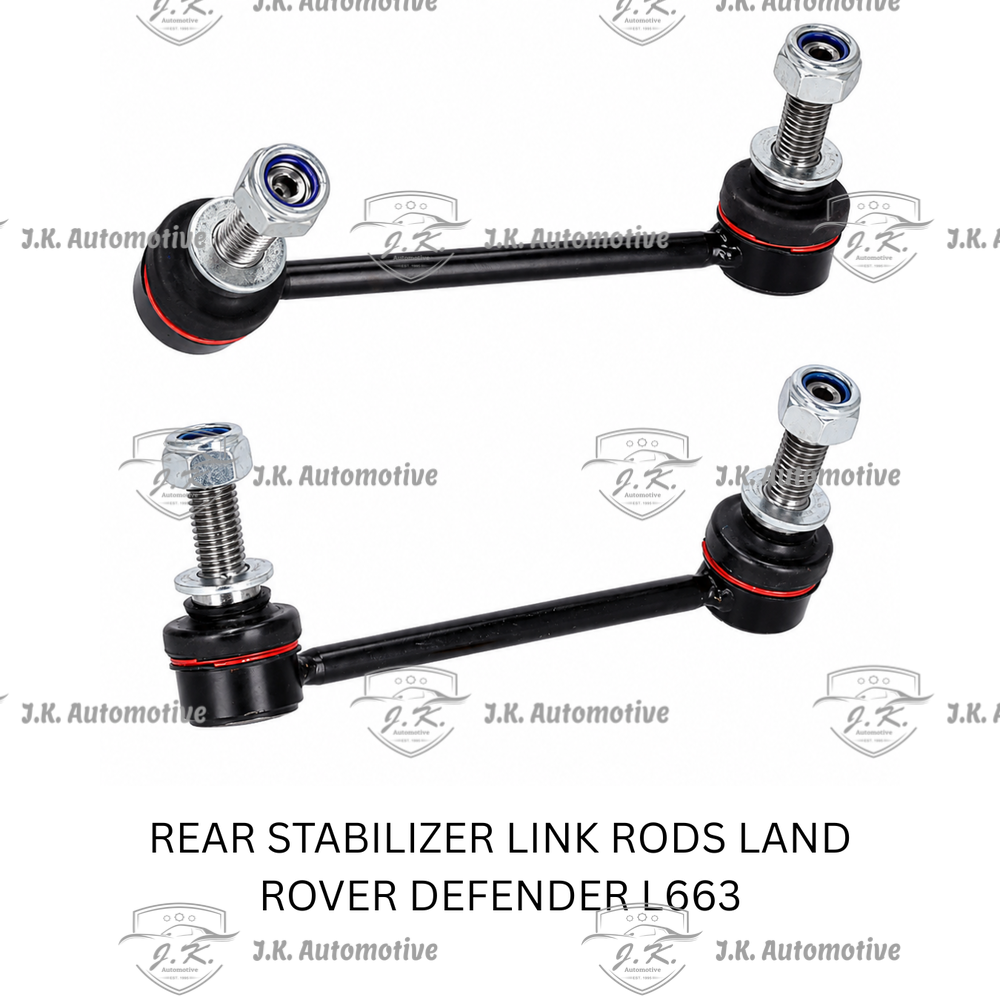
The modern Land Rover Defender L663 (produced from 2020 onward across 90, 110, and 130 wheelbase configurations) is built upon the ultra-rigid D7x (Lightweight Aluminum Monocoque) architecture. The rear axle utilizes an advanced integral-link multi-link suspension system combined with either electronic air suspension or heavy-duty coil springs. The Stokes Germany rear stabilizer link rods—part numbers LR048092 (Rear Left / LH) and LR048093 (Rear Right / RH)—serve as the critical kinetic linkage connecting the rear anti-roll (sway) bar lever arms directly to the rear lower suspension knuckles or wheel carriers. When the Defender L663 corners at speed, enters an off-camber gradient, or encounters uneven trail terrain, one rear wheel compresses (bump stroke) while the opposite wheel extends (rebound stroke). The anti-roll bar acts as a torsional spring, resisting this asymmetrical wheel displacement by transferring torsional energy across the rear subframe via the twin stabilizer links. High-performance Stokes Germany link rods feature heat-treated forged steel shafts, precision-machined ball studs housed in low-friction POM (polyoxymethylene) socket races, and synthetic grease reservoirs enclosed by chloroprene rubber dust boots. This heavy-duty construction ensures zero axial play and minimal deflection under high torsional loads (exceeding $3,000text{ Nm}$ of anti-roll bar torque during severe cornering), preserving crisp lateral stability, suppressing high-speed body roll, and maintaining precise rear wheel alignment geometry without restricting vertical suspension articulation required by the Terrain Response 2 system during extreme off-road rock crawling or deep rut navigation.
How do Stokes Germany rear stabilizer link rods LR048092 and LR048093 integrate into the suspension geometry, D7x aluminum monocoque architecture, and Terrain Response 2 system of the Land Rover Defender L663?
The Stokes Germany rear stabilizer link rod set—comprising part numbers LR048092 for the rear left-hand position and LR048093 for the rear right-hand position—serves as the primary kinematic linkage connecting the ends of the rear anti-roll (sway) bar directly to the rear lower wheel carrier assemblies within the Land Rover Defender L663 (2020+ models across 90, 110, and 130 body lengths). Built upon Land Rover's ultra-rigid D7x lightweight aluminum monocoque platform, the rear multi-link suspension relies on these heavy-duty drop links to convert kinetic wheel motion into torsional resistance whenever the vehicle experiences asymmetrical suspension travel during high-speed highway cornering, off-camber road angles, or aggressive trail maneuvers. As one rear wheel compresses into bump stroke while the opposite wheel extends into rebound stroke, the anti-roll bar twists to counteract chassis roll, transferring torsional loads across the rear subframe through the twin drop links to suppress body lean and stabilize the vehicle's high center of gravity. Stokes Germany manufactures these link rods using cold-forged, high-tensile alloy steel shafts equipped with precision-machined induction-hardened ball studs housed inside low-friction polyoxymethylene (POM) socket races, ensuring near-zero axial lash and zero flex under loads exceeding 3,000 Nm of anti-roll torque. This precise structural integrity prevents dynamic suspension geometry deflection, maintains exact rear tire contact patch orientation, and preserves sharp yaw control without restricting the extreme vertical axle articulation required by the Terrain Response 2 system during off-road rock crawling, mud navigation, or deep rut traversal. Furthermore, the links feature heavy-duty chloroprene rubber dust boots packed with high-temperature synthetic lithium-complex grease, providing a sealed low-friction joint that resists thermal breakdown, prevents moisture and grit intrusion, and ensures smooth, noise-free suspension operation under maximum payload capacity and demanding 4X4 conditions.
What physical symptoms, NVH anomalies, dynamic handling faults, and wheel alignment shifts indicate worn or failing rear stabilizer links LR048092 and LR048093 on the Land Rover Defender L663?
Over extended service intervals, exposure to heavy towing loads, extreme off-road wheel articulation, deep mud submergence, and salt-laden winter road spray can degrade the internal ball sockets and protective rubber boots of rear drop links LR048092 and LR048093 on the Land Rover Defender L663. The most common early warning indicator of wear is a distinct metallic clunking, rattling, or knocking sound originating from the rear wheel arches whenever the vehicle passes over speed bumps, potholed pavement, expansion joints, or washboard gravel tracks, caused by radial play inside the ball socket allowing the steel stud to hammer against its housing. Dynamically, as the internal polyoxymethylene socket lining degrades, free rotational slack develops before the anti-roll bar can engage, introducing a noticeable mechanical delay during cornering initiation that causes the Defender's body to lean excessively, float through high-speed turns, and exhibit vague, sluggish rear-end tracking. Off-road, worn link joints can bind or pop loudly under extreme suspension articulation when the angle between the sway bar arm and wheel carrier reaches its limit, leading to harsh thudding noises over rough terrain. Visually, compromised links often show torn, cracked, or dry-rotted chloroprene dust boots, visible grease leakage mixed with dirt, or heavy surface rust around the ball stud flanges. Furthermore, the uncontrolled rear body roll allowed by failed links alters dynamic rear camber and toe angles under cornering stress, accelerating uneven tread edge wear on the rear tires and forcing the Dynamic Stability Control (DSC) system to intervene prematurely during sudden evasive maneuvers or high-speed highway lane changes, making immediate replacement with a fresh Stokes Germany link set essential for restoring full vehicle safety and driving dynamics.
How do premium Stokes Germany heavy-duty stabilizer link rods differ from low-cost aftermarket alternatives in terms of steel tensile strength, ball-joint boot sealing, and severe off-road durability on the Defender L663?
The Land Rover Defender L663 is a high-performance, heavy-duty vehicle weighing up to 2.6 metric tons with a 3,500 kg towing capacity and a 900 mm water wading depth, requiring suspension components engineered to withstand extreme stress levels that quickly destroy standard budget aftermarket parts. Stokes Germany heavy-duty stabilizer link rods (LR048092 and LR048093) are manufactured with cold-forged 42CrMo alloy steel connecting shafts and induction-hardened ball studs, delivering exceptionally high yield and tensile strength to resist bending, snapping, or fatigue failure under high-impact off-road side loads and maximum GVWR operation. In contrast, low-cost alternatives typically utilize cheap low-carbon steel tubing or thin cast rods that buckle easily when subjected to high torsional sway bar loads or trail impacts. Internally, Stokes Germany links feature precision ball studs seated within low-friction polyoxymethylene (POM) synthetic races, which maintain consistent joint preload and smooth rotational movement without wearing out prematurely under heavy vertical loads, whereas cheap links rely on soft recycled PVC or nylon inserts that quickly develop excessive play. Sealing is handled by heavy-duty chloroprene (CR) synthetic rubber dust boots secured at both ends with double-wound stainless steel retaining rings, creating a permanently sealed barrier that prevents high-pressure water, road salt, fine sand, and trail mud from breaching the joint during deep river crossings or winter driving. Additionally, the internal joint is pre-lubricated with high-viscosity, water-resistant synthetic lithium grease capable of operating reliably from -40°C to +130°C without breaking down or washing out, ensuring superior corrosion protection, smooth movement, and extended component longevity compared to budget links that use thin generic grease and fragile vinyl boots prone to cracking and tearing.
What specific diagnostic trouble codes (DTCs), active chassis control errors, and terrain program restrictions can be triggered on Defender L663 models equipped with Electronic Air Suspension when drop links LR048092 and LR048093 are severely worn?
On Land Rover Defender L663 models fitted with Electronic Air Suspension (EAS) or adaptive chassis management, the rear anti-roll bar, height sensors, and dampening controls operate in continuous closed-loop communication with the Chassis Control Module (CCM), Restraints Control Module, and ABS/DSC processor. Each rear wheel corner features a rotary height sensor connected via a small linkage to the control arm to track real-time chassis position and body roll angles. When rear stabilizer links LR048092 or LR048093 suffer from severe internal mechanical play or break completely, the rear anti-roll bar loses its ability to equalize left-to-right wheel displacement, causing abnormal, uncoupled body lean during cornering and off-road maneuvering. This discrepancy creates conflicting position readings between the left and right rear height sensors that do not match predicted roll gradients based on steering wheel angle and lateral g-force sensors, prompting the CCM to register signal plausibility faults such as C1A05-14 (Rear Left Height Sensor Signal Invalid) or C1A06-14 (Rear Right Height Sensor Signal Invalid). Additionally, the unexpected body roll acceleration can trigger Dynamic Stability Control errors like C1A00-00 (Control Module Internal Electronic Failure) or C1A96-62 (Suspension Leveling Interrupted), illuminating an amber suspension fault light on the digital dashboard alongside warning messages such as "Suspension Fault - Speed Limited" or "Special Programs Unavailable." When these fault flags are raised, the ECU defaults to a fail-safe mode that locks the air suspension at standard height and disables advanced Terrain Response 2 programs like Rock Crawl, Sand, and Mud & Ruts to prevent vehicle instability. Installing a new pair of Stokes Germany link rods restores correct mechanical roll resistance, eliminating sensor telemetry errors and re-enabling full air suspension and Terrain Response functionality.
What is the exact step-by-step technical installation procedure, counter-holding technique, and torque specification required when replacing rear stabilizer link rods LR048092 and LR048093 on the Land Rover Defender L663?
Replacing the rear stabilizer link rods (LR048092 left and LR048093 right) on a Land Rover Defender L663 requires specific service steps to ensure the ball joint seals and internal sockets are not damaged during mounting. Begin by parking the vehicle on a flat, level surface, setting the Electronic Air Suspension to Access Height, and activating 'Jack Mode' or 'Service Mode' via the central touchscreen menu before hoisting the rear subframe safely on jack stands and removing the rear road wheels. Spray penetrating fluid onto the exposed top and bottom mounting stud threads on both sides to ease removal of road grime and corrosion. To unfasten the 18 mm nylon lock nuts securing the link studs to the anti-roll bar end and lower wheel carrier, insert an internal 5 mm hex wrench (or Torx key) directly into the recessed tip of the ball stud to hold it completely stationary while turning the 18 mm nut with an open-end or ratcheting box wrench; never use an impact wrench directly without counter-holding the stud, as uncontrolled high-speed spinning will destroy the internal POM socket liner and tear the new rubber boot. Thoroughly clean the mounting bracket mating surfaces with a wire brush to remove rust and dirt, ensuring the flange of the fresh link sits flush against the metal. Install the position-specific Stokes Germany links—placing LR048092 on the rear left and LR048093 on the rear right—and hand-thread the new zinc-plated locking nuts onto the studs. Finally, counter-hold the inner stud flat with the hex tool and torque both the upper and lower securing nuts using a calibrated torque wrench to exactly 115 Nm (85 lb-ft) while the suspension is settled, then reinstall the wheels, torque wheel nuts to 140 Nm (103 lb-ft), lower the vehicle, turn off Jack Mode, and conduct a road test to verify silent, stable operation.
How do high GVWR payloads, rooftop accessories, and maximum 3,500 kg towing capacity stress the structural integrity of rear stabilizer link rods LR048092 and LR048093 on the Defender L663?
When a Land Rover Defender L663 is loaded to its maximum Gross Vehicle Weight Rating (GVWR) with roof top tents, expedition gear, or heavy tongue-weight trailers up to $3,500text{ kg}$, the rear axle experiences significantly higher vertical static loads and elevated dynamic roll moments during cornering and highway lane changes. Because the vehicle's center of gravity shifts higher and further rearward under heavy loading, lateral weight transfer during turns forces the rear anti-roll bar to exert extreme counter-torsional torque across the left and right drop links to prevent excessive chassis lean. Under these high-stress conditions, standard low-grade drop link shafts can experience high bending moments, while inferior plastic socket liners deform or crush, creating permanent internal lash that leads to accelerated joint play and premature metallic clunking. Stokes Germany rear link rods (LR048092 and LR048093) are specifically engineered for heavy overland and towing applications, utilizing cold-forged $42text{CrMo}$ alloy steel shafts and induction-hardened ball studs capable of withstanding severe shear and tensile forces. By maintaining rigid structural alignment and housing the ball studs within high-density polyoxymethylene (POM) socket races, these links prevent lateral deflection under maximum payload, ensuring consistent anti-roll bar leverage, reducing trailer-induced sway, and maintaining stable rear axle tracking across highway speeds and rugged off-road terrain.
Are there specific procedural differences when replacing rear drop links LR048092 and LR048093 on Defender L663 models with standard coil springs versus Electronic Air Suspension (EAS)?
While the physical mounting locations and bolt torque specifications ($115text{ Nm} / 85text{ lb-ft}$) for rear link rods LR048092 and LR048093 are identical across all Defender L663 variants, servicing vehicles equipped with Electronic Air Suspension (EAS) requires critical software setup steps to avoid system errors or component damage. On air suspension models, the technician must activate 'Jack Mode' or 'Service Mode' via the central touchscreen or a diagnostic scan tool before lifting the chassis; failing to do so causes the Chassis Control Module to attempt auto-leveling as wheel droop occurs, potentially damaging height sensor linkages or forcing air compressor venting. Conversely, coil-spring models do not require electronic suspension locking, though care must still be taken on both setups not to strain or twist the adjacent height sensor arm linkages located near the lower control arms during tool swing. Additionally, when installing the new drop links on either suspension type, final torqueing of the $18text{ mm}$ mounting nuts must be performed with the vehicle lowered onto level ground at normal curb height (or with the suspension supported at normal ride height using jack stands under the wheel carriers) to ensure the internal ball joints settle in their natural neutral plane rather than being pre-torqued under full droop, which prevents premature rubber dust boot twisting and seal wear.
How do worn rear stabilizer links LR048092 and LR048093 affect the performance of the Active Rear Locking Differential and Torque Vectoring by Braking systems on the Land Rover Defender L663?
The Land Rover Defender L663 relies heavily on its Electronic Active Rear Differential (e-diff) and Torque Vectoring by Braking (TVBB) systems to optimize traction, agility, and off-road capability across low-friction surfaces and dynamic cornering maneuvers. These electronic chassis control systems function by continuously analyzing vehicle wheel speed sensors, steering wheel angle inputs, yaw rate gyros, lateral acceleration sensors, and suspension height sensor data to apply targeted braking forces to the inner wheels or lock the rear differential clutch pack during high-speed cornering or technical trail obstacles. When rear stabilizer link rods LR048092 and LR048093 develop mechanical play or fail entirely, the rear anti-roll bar can no longer distribute torsional resistance evenly across the rear axle, resulting in uncoupled body roll, delayed weight transfer, and irregular vertical tire loading between the inside and outside rear wheels during cornering. This asymmetrical tire contact patch loading causes unpredictable wheel slip speed differences that confuse the torque vectoring algorithms, prompting the ABS/DSC module to trigger aggressive, premature brake vectoring interventions on the inside rear brake rotor to correct artificial body lean. Over time, driving with compromised rear drop links forces the e-diff motor to constantly adjust clutch pack lockup pressures to compensate for unstable axle articulation, leading to accelerated friction plate wear inside the rear differential unit, elevated rear brake pad temperature spikes, rapid brake rotor glazing, and inconsistent power delivery when exiting sharp turns or navigating slippery off-road inclines. Replacing worn drop links with a rigid Stokes Germany link set restores true mechanical sway bar leverage, providing predictable wheel load distribution that allows the active differential and torque vectoring systems to operate precisely as engineered.
What are the key diagnostic and functional differences between replacing rear stabilizer link rods LR048092/LR048093 versus replacing rear sway bar subframe bushings on the Land Rover Defender L663?
While both the rear stabilizer link rods (LR048092 left and LR048093 right) and the rear anti-roll bar mounting bushings serve to stabilize the anti-roll system on the Land Rover Defender L663, they operate at different kinematic points and exhibit distinct diagnostic failure symptoms. The stabilizer link rods act as the dynamic vertical connectors between the rotating ends of the anti-roll bar and the rear lower wheel carriers, featuring dual ball joints that allow multi-axis pivoting during wheel articulation. When the link rods fail due to internal socket wear or lost lubrication, they generate sharp, high-frequency metallic "clunking," "rattling," or "knocking" noises whenever a single rear wheel hits a sharp obstacle such as a pothole, expansion joint, or speed bump. In contrast, the sway bar subframe bushings are split synthetic rubber or polyurethane mounts that secure the main horizontal tube of the anti-roll bar directly to the rear subframe structure; when these bushings dry out, harden, or wear internally, they produce low-frequency "creaking," "squeaking," or "groaning" sounds during dual-wheel vertical suspension compression, such as driving over large speed humps or dips where both rear wheels move simultaneously. Diagnostically, link rod failure can be verified by grabbing the center shaft and feeling radial play inside the ball sockets or observing torn rubber boots, whereas bushing failure is identified by visual gap spacing around the sway bar tube or lateral sliding of the bar within its subframe brackets. While replacing link rods requires unfastening the 18 mm ball stud nuts while counter-holding the inner hex, servicing the subframe bushings involves unbolting the heavy steel saddle clamps mounted to the top of the rear subframe, which often requires lowering the subframe slightly for tool access. Servicing both the drop links and sway bar bushings simultaneously during high-mileage overhauls ensures complete noise elimination and maximum anti-roll bar efficiency across all road conditions.
How do aftermarket suspension lifts, rod lifts, and modified air suspension ride heights impact the operating angles and long-term durability of rear drop links LR048092 and LR048093 on the Defender L663?
Installing aftermarket lift kits, sensor lift rods, or altered air suspension height calibration profiles on the Land Rover Defender L663 increases static vehicle ride height by 1 to 2 inches (25 mm to 50 mm), which directly alters the resting geometric plane of the rear suspension links relative to the chassis. Under factory ride height conditions, the rear anti-roll bar arms and drop links LR048092 / LR048093 sit in a nearly neutral angular relationship, allowing the internal ball studs to rotate symmetrically through their full range of motion during both compression (bump) and extension (rebound) cycles. When a chassis lift is installed without extending the drop link length, the anti-roll bar ends are pulled downward at rest, forcing the drop link ball studs to operate at an extreme resting angle near the mechanical limit of their sockets. This constant angular offset reduces available ball joint articulation during deep off-road wheel droop, causing the ball stud neck to bind against the lip of the steel socket housing when traversing extreme trail articulation or lifting a wheel off-road. This binding action places severe shear stresses on the cold-forged connecting rod shaft, stretches the chloroprene rubber dust boots beyond their elastic limit until they tear open, and forces synthetic grease out of the housing, resulting in rapid grit contamination and joint failure. For Defender L663 owners operating lifted suspension setups or frequent off-road extension modes, installing high-strength Stokes Germany replacement link rods ensures the induction-hardened ball studs and heavy-duty chloroprene boots can withstand the increased angular stress and severe tension without snapping, tearing, or binding during full off-road articulation.
What specific diagnostic inspection methods allow a technician to isolate noise from rear drop links LR048092/LR048093 versus worn integral links, lower control arm bushings, or air strut mounts on the Defender L663 chassis?
Isolating the precise source of rear chassis noise on a Land Rover Defender L663 requires a systematic diagnostic inspection technique because the complex multi-link rear suspension contains multiple potential noise-emitting components, including the drop links, lower control arm hydraulic bushings, upper guide arms, integral links, and air strut top mounts. To isolate a failing drop link (LR048092 or LR048093), first perform a four-post drive-on hoist test or place the vehicle on level ground so the suspension remains fully loaded under normal curb weight; this is critical because lifting the chassis on a frame hoist unloads the anti-roll bar tension, which can temporarily jam a loose ball joint stud and hide internal play. With the vehicle sitting at curb height, have an assistant vigorously rock the vehicle side-to-side from the roof rack or rear pillar while a technician physically grasps the upper and lower ball joint housings of each link rod by hand; any internal socket lash will be felt immediately as a distinct mechanical "click" or "thump" in the palm of your hand. Next, use a small pry bar placed carefully between the end of the anti-roll bar arm and the lower wheel carrier bracket to apply moderate vertical leverage; if the ball stud moves radially inside its housing before the sway bar flexes, the drop link is depleted and requires replacement. To rule out integral links or control arm bushings, use a larger pry bar directly against the knuckle attachment points while checking for squishy fluid leaks on hydraulic control arm bushings or lateral movement in the integral link ball joints. Finally, inspect the upper air strut mounts for top-plate rubber separation and check for leaking shock absorber fluid. Confirming that noise originates specifically from the drop link assembly prevents unnecessary component replacement and ensures a targeted, cost-effective repair.

Reviews
There are no reviews yet.