What is the Stokes Germany Rear Stabilizer Link Rod Set of 2 for Audi Q7 4L?
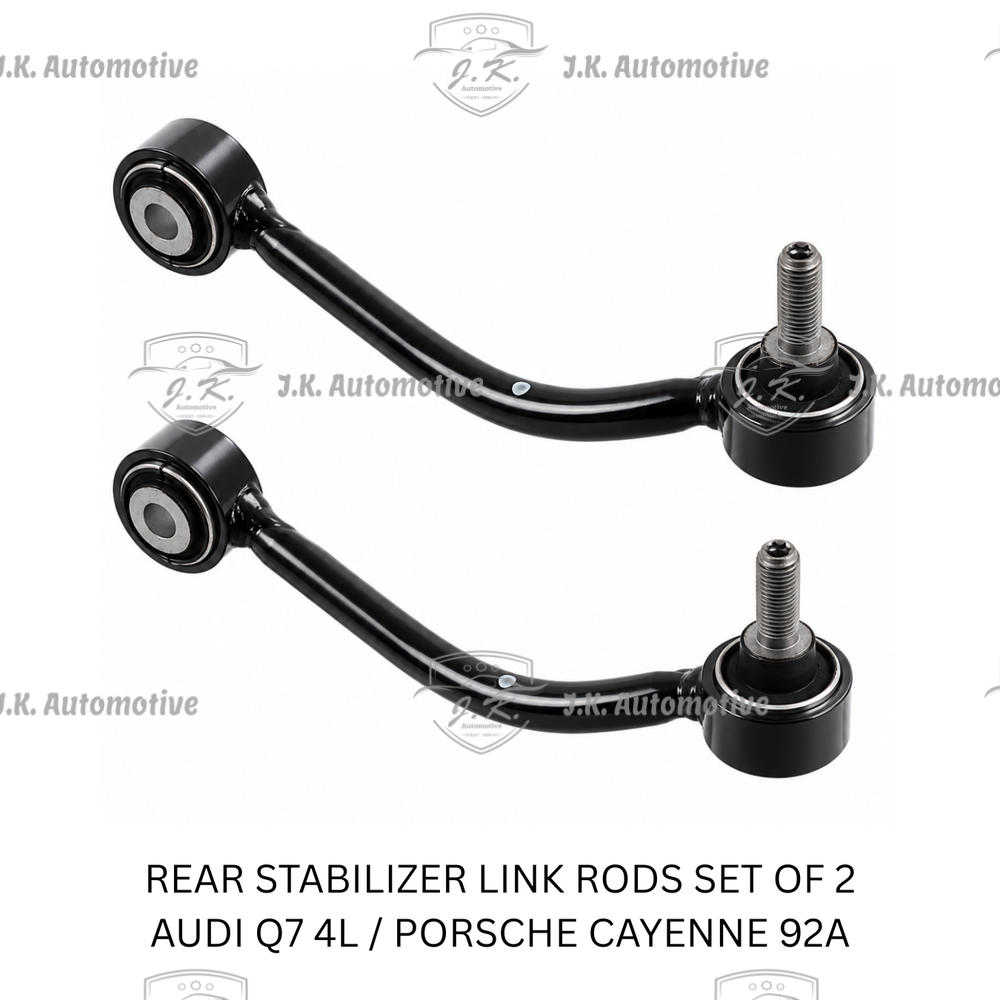
The Stokes Germany Rear Stabilizer Link Rod Set of 2 for Audi Q7 4L is a premium aftermarket suspension replacement for compatible Audi Q7 4L vehicles requiring references 7L0505465D / 7L0505465C and 7L0505466D / 7L0505466C. Supplied as a complete set of 2, these components provide the corresponding rear stabilizer connections when the existing links have developed excessive play, looseness, joint wear or other mechanical deterioration. These suspension components are commonly known as Sway bar links, Sway links, Anti roll link rods, Stabiliser sway links, rear drop links, anti-roll bar links, coupling rods or stabilizer end links. During everyday driving, the Audi Q7 4L rear suspension continuously responds to cornering, acceleration, braking, potholes, speed breakers, expansion joints, broken roads and uneven surfaces. When one rear wheel moves vertically by a different amount from the opposite wheel, the Sway bar links articulate as part of the rear stabilizer arrangement. If one wheel enters a pothole while the opposite wheel remains on smoother pavement, the difference in suspension travel creates movement through the stabilizer linkage. Crossing a speed breaker diagonally creates a similar operating condition because one rear wheel begins travelling upward before the opposite wheel reaches the raised surface. The Sway links therefore experience a very large number of articulation cycles throughout normal vehicle operation. Cornering also changes suspension loading between the inside and outside sides of the vehicle, while acceleration and braking introduce additional changes in chassis loading. The Anti roll link rods accommodate these repeated suspension movements while maintaining the required mechanical connections within the rear stabilizer system. Because the Stabiliser sway links operate underneath the vehicle and close to the road environment, they experience continuous vibration together with exposure to road dirt, dust, water, moisture and changing temperatures. Over extended mileage, repeated articulation and environmental exposure can gradually contribute to component wear. Excessive clearance in deteriorated links can permit unwanted movement and may contribute to tapping, rattling, knocking or clunking noises from the rear suspension. Replacing confirmed worn links renews these specific mechanical connection points within the existing stabilizer arrangement. When both corresponding rear components require renewal, the Stokes Germany set of 2 provides a practical pair-replacement solution. The supplied OEM references should be verified against the exact Audi Q7 4L VIN and installed suspension specification before ordering or installation.
What do the rear stabilizer link rods do on the Audi Q7 4L?
The rear stabilizer link rods on the Audi Q7 4L provide mechanical connections within the vehicle's rear stabilizer or anti-roll bar arrangement and repeatedly articulate as the suspension responds to differences in wheel movement, road irregularities, cornering forces and changing vehicle loads. These components are also commonly described as Sway bar links, Sway links, Anti roll link rods, Stabiliser sway links, rear drop links, coupling rods or stabilizer end links. During normal driving, the left and right rear wheels do not always experience exactly the same amount of vertical movement. If one rear wheel enters a pothole while the opposite wheel remains on smoother pavement, the two sides of the suspension experience different amounts of travel. The Sway bar links articulate as the stabilizer arrangement responds to this difference in wheel movement. A similar situation occurs when the Audi Q7 4L crosses a speed breaker diagonally because one rear wheel begins travelling upward before the opposite wheel reaches the raised section. Broken roads, drainage covers, damaged road edges, expansion joints and uneven parking ramps can create additional suspension movement. Cornering creates another important operating condition because the inside and outside sides of the vehicle experience different suspension loads as the Audi changes direction. Acceleration and braking introduce further changes in chassis loading. Consequently, the Sway links operate repeatedly throughout everyday driving and can complete an extremely large number of articulation cycles over thousands of kilometres. The Anti roll link rods accommodate these movements while maintaining their required mechanical connections within the rear stabilizer arrangement. When the Stabiliser sway links remain mechanically serviceable, they allow the necessary articulation without excessive unwanted clearance. As deterioration develops, additional movement can appear within the joints or mounting connections. This unwanted movement may eventually contribute to tapping, rattling, knocking or clunking noises from the rear suspension. Replacing worn Sway bar links renews these specific mechanical connection points rather than fundamentally changing the vehicle's suspension design. Correctly specified Sway links are service components and are not intended to alter the Audi Q7 4L ride height simply because worn components have been renewed. When both corresponding rear links require replacement, the Stokes Germany set of 2 provides the pair needed for the repair. References 7L0505465D / 7L0505465C and 7L0505466D / 7L0505466C should be checked against the exact vehicle specification before installation.
What are the common symptoms of worn rea Sway bar links on the Audi Q7 4L?
Common symptoms associated with worn rear Sway bar links on the Audi Q7 4L can include tapping, rattling, clicking, knocking or clunking noises from the rear suspension, particularly while travelling at lower speeds across potholes, speed breakers, broken roads, expansion joints and repetitive uneven surfaces. During normal vehicle operation, the rear suspension repeatedly compresses and extends as the Audi responds to changing road conditions, cornering, acceleration and braking. Whenever the left and right rear wheels experience different amounts of vertical movement, additional articulation occurs through the stabilizer arrangement and its Sway links. When the Anti roll link rods remain mechanically serviceable, they accommodate this movement while maintaining their required mechanical connections without excessive unwanted clearance. As deterioration develops within the Stabiliser sway links, additional play may appear within the joints, bushes or mounting areas. During the early stages of wear, the driver may notice only a relatively light tapping or rattling sound while travelling slowly over small potholes or repetitive road irregularities. The noise can become less noticeable on smooth highways because suspension articulation is less abrupt and general tyre or road noise may mask minor mechanical sounds. As the Sway bar links deteriorate further, a relatively minor tapping noise may potentially develop into a clearer knocking or clunking sound. Unequal movement between the rear wheels can make these symptoms easier to notice. If one rear wheel enters a pothole while the opposite wheel remains on smooth pavement, the difference in suspension travel creates additional articulation through the Sway links. Crossing a speed breaker diagonally, entering an uneven parking ramp or travelling across a damaged road edge can create similar conditions. However, rear suspension noise alone should never be considered definite proof that the stabilizer links have failed. Rear control arms, suspension bushes, shock absorbers, shock mounts, stabilizer-bar bushes and loose mounting hardware can produce similar symptoms. A technician should therefore inspect the complete rear suspension and identify the actual source of excessive movement before replacing parts. When unwanted play is specifically confirmed within the Anti roll link rods and the relevant OEM references match the exact Audi Q7 4L application, replacing the worn components renews those particular stabilizer connections. When both Stabiliser sway links show significant deterioration, the Stokes Germany set of 2 provides the corresponding pair required for replacement.
Are 7L0505465D / 7L0505465C and 7L0505466D / 7L0505466C the correct rear stabilizer link references for the Audi Q7 4L?
The references 7L0505465D / 7L0505465C and 7L0505466D / 7L0505466C should be retained exactly as supplied for this Audi Q7 4L rear stabilizer-link product, while final compatibility should be confirmed against the exact vehicle VIN, production information and installed rear suspension configuration before ordering or installation. The presence of different 465 and 466 reference numbers is particularly important because suspension catalogues can use separate reference families for corresponding components according to installation side or component revision, while the final suffix letter can represent a revision or supersession within the OEM numbering system. For this reason, none of these numbers should be shortened, combined into a different number or modified in the product catalogue without verified technical information. The applicable components may be described as rear stabilizer link rods, Sway bar links, Sway links, Anti roll link rods, Stabiliser sway links, rear drop links, coupling rods or stabilizer end links. Although terminology varies between workshops, manufacturers and distributors, OEM numbers provide a much more precise method of identifying replacement suspension components. Stabilizer links that appear visually similar can differ in overall dimensions, mounting geometry, joint orientation, thread specification or intended suspension configuration. Visual comparison alone should therefore not be considered sufficient evidence of compatibility. The Audi Q7 model, 4L chassis, rear installation position, original component numbers and installed suspension equipment should all be considered during final verification. If the original components removed from the vehicle carry 7L0505465C, 7L0505465D, 7L0505466C or 7L0505466D, or an authoritative VIN-based catalogue identifies a valid replacement relationship between these references, that provides stronger confirmation for the application. During operation, the rear Sway bar links repeatedly articulate as the suspension responds to cornering, braking, acceleration and uneven roads. Over extended mileage, repetitive movement, vibration and environmental exposure can contribute to deterioration within the Sway links and Anti roll link rods. Excessive clearance within worn Stabiliser sway links can then permit unwanted movement and potentially contribute to rear suspension noise. Therefore, retain the supplied references exactly as 7L0505465D / 7L0505465C & 7L0505466D / 7L0505466C in the product information and perform VIN-based verification as the final compatibility check.
Why does this Audi Q7 4L rear stabilizer link set have 465 and 466 OEM references?
The Stokes Germany Audi Q7 4L rear stabilizer-link set contains the supplied reference families 7L0505465D / 7L0505465C and 7L0505466D / 7L0505466C because the corresponding rear suspension links can be identified using different OEM numbers rather than one identical number being used for both components, and these references should therefore remain individually visible in the product title and technical information. In automotive OEM numbering systems, corresponding suspension components can have different reference numbers because they may represent different installation sides, component orientations or revisions, while suffix letters such as C and D can identify different revisions or supersessions within a particular part-number family. This is why a set of 2 can legitimately contain two related but different reference families rather than simply providing two components carrying exactly the same OEM number. These components are commonly called Sway bar links, Sway links, Anti roll link rods, Stabiliser sway links, rear drop links, coupling rods or stabilizer end links. The two links operate within the same general rear stabilizer arrangement and accumulate the same overall vehicle mileage, although they do not necessarily deteriorate at exactly the same rate. During everyday driving, the Sway bar links repeatedly articulate as the Audi Q7 4L travels across potholes, speed breakers, broken roads, expansion joints and uneven surfaces. The Sway links also experience changing suspension loads during cornering, acceleration and braking. When one rear wheel moves vertically by a different amount from the opposite wheel, additional articulation occurs through the Anti roll link rods and rear stabilizer arrangement. Over thousands of kilometres, the Stabiliser sway links can therefore complete an extremely large number of movement cycles. Both components are also exposed to road vibration, dirt, dust, water, moisture and changing temperatures. If one link develops substantial wear after considerable mileage, inspection of the corresponding component is sensible. However, pair replacement should still be based on the mechanical condition of both components rather than assuming that both have automatically failed at exactly the same time. When both links show excessive clearance or significant deterioration, replacing the set renews both corresponding rear stabilizer connections during the same repair. References 7L0505465D / 7L0505465C and 7L0505466D / 7L0505466C should be verified against the exact Audi Q7 4L VIN before installation to confirm the applicable pair.
How can replacing worn rear Stabiliser sway links help the Audi Q7 4L suspension?
Replacing worn rear Stabiliser sway links on the Audi Q7 4L helps renew the specific mechanical connections within the rear stabilizer arrangement when the existing components have developed excessive clearance, looseness, deterioration or another confirmed mechanical fault. During everyday driving, the rear suspension continuously responds to acceleration, braking, cornering, potholes, speed breakers, expansion joints, broken roads and changing road surfaces. The Sway bar links repeatedly articulate during these suspension movements while maintaining their required mechanical connections within the stabilizer system. When one rear wheel moves vertically by a different amount from the opposite wheel, additional articulation occurs through the Sway links. Over thousands of kilometres, these repeated movements can create an extremely large number of articulation cycles within the Anti roll link rods. Road vibration, dirt, dust, water, moisture and temperature changes create additional operating exposure because the Stabiliser sway links work underneath the vehicle close to the road environment. When these components remain mechanically serviceable, they accommodate the required suspension movement without excessive unwanted clearance. Once deterioration develops, additional movement can occur whenever the rear suspension compresses, extends or changes direction. This excessive movement may contribute to tapping, rattling, knocking or clunking noises, particularly while travelling at lower speeds across rough or uneven surfaces. Replacing confirmed worn links renews the mechanical connection points where excessive play has developed and can eliminate unwanted movement originating specifically from those components. When both existing Sway bar links show significant wear, installing the Stokes Germany set of 2 allows both corresponding rear stabilizer connections to be renewed during the same repair. Correctly specified Sway links do not fundamentally alter the Audi Q7 4L suspension geometry or intended ride height; instead, they replace worn service components within the existing suspension arrangement. Other rear suspension components such as control arms, bushes, shock absorbers, mounts, stabilizer bushings and mounting hardware should also be inspected because they can produce similar noises and symptoms. Once 7L0505465D / 7L0505465C and 7L0505466D / 7L0505466C are confirmed for the exact vehicle, the Stokes Germany set provides the Sway bar links, Sway links, Anti roll link rods and Stabiliser sway links required for renewing the applicable Audi Q7 4L rear stabilizer linkage.
When should the rear stabilizer link rods be replaced on the Audi Q7 4L?
The rear stabilizer link rods on the Audi Q7 4L should be considered for replacement when a proper rear suspension inspection confirms excessive joint play, looseness, deterioration, damaged protective components, abnormal movement, worn mounting points or another mechanical problem within the rear stabilizer linkage. These components are commonly known as Sway bar links, Sway links, Anti roll link rods, Stabiliser sway links, rear drop links, coupling rods or stabilizer end links. There is no single fixed mileage at which every Audi Q7 4L automatically requires replacement because service life depends on total mileage, road quality, driving conditions, vehicle loading, suspension condition and the frequency of impacts from potholes and uneven roads. A Q7 regularly driven over broken roads, deep potholes, speed breakers, expansion joints, damaged road edges and uneven parking ramps can subject its Sway bar links to considerably more repetitive articulation than a vehicle primarily driven on smooth highways. The Sway links move whenever the rear suspension compresses and extends, while additional articulation occurs whenever the left and right rear wheels experience different amounts of vertical travel. If one rear wheel enters a pothole while the opposite wheel remains on smoother pavement, the difference in wheel movement creates additional articulation through the stabilizer arrangement. Crossing a speed breaker diagonally creates a similar operating condition because one rear wheel begins moving upward before the opposite wheel reaches the raised section. Cornering changes suspension loading between the inside and outside sides of the vehicle, while acceleration and braking introduce additional changes in chassis loading. Consequently, the Anti roll link rods can complete an extremely large number of articulation cycles during normal vehicle use. The Stabiliser sway links also operate underneath the vehicle, where they experience continuous vibration together with exposure to road dirt, dust, moisture, water and changing temperatures. Over extended mileage, these conditions can gradually contribute to wear and excessive clearance. Early deterioration may produce a light tapping or rattling sound on uneven roads, whereas more advanced wear can contribute to clearer knocking or clunking noises. However, rear suspension noises should not automatically be diagnosed as failed stabilizer links because suspension bushes, control arms, shock absorbers, mounts, stabilizer bushes and loose mounting hardware can create similar symptoms. A complete rear suspension inspection should therefore identify the actual source of unwanted movement. When excessive play is confirmed within the links, replacing the worn components renews those specific mechanical connections. For this application, 7L0505465C / 7L0505465D correspond to the rear-left side, while 7L0505466C / 7L0505466D correspond to the rear-right side.
Can worn rear Sway bar links cause knocking or rattling noises in the Audi Q7 4L?
Yes, worn rear Sway bar links can be one possible source of tapping, rattling, clicking, knocking or clunking noises from the Audi Q7 4L rear suspension, particularly when deterioration creates excessive clearance within the link joints or mounting connections and permits movement beyond the intended operating range. These rear links are separate left- and right-side components: RIW identifies 7L0505465C / 7L0505465D for the rear-left position and 7L0505466C / 7L0505466D for the rear-right position. During normal driving, the Sway bar links repeatedly articulate as the rear suspension responds to potholes, speed breakers, expansion joints, broken roads, cornering, acceleration and braking. When the Sway links remain mechanically serviceable, they accommodate the required suspension movement while maintaining their intended mechanical connections without excessive unwanted clearance. As deterioration develops within the Anti roll link rods, additional play can allow the linkage to move more than intended whenever suspension loading changes. During early wear, the driver may notice only a relatively light tapping or rattling sound while travelling slowly across small potholes, rough roads or repetitive road joints. The same noise may become considerably less noticeable on smooth highways because the suspension experiences less abrupt articulation and general tyre or road noise can mask smaller mechanical sounds. As the Stabiliser sway links continue to deteriorate, a relatively minor tapping noise may potentially develop into a clearer knocking or clunking sound. Unequal movement between the rear wheels can make these symptoms particularly noticeable. If one rear wheel enters a pothole while the opposite wheel remains on smooth pavement, the difference in suspension travel creates additional articulation through the stabilizer arrangement. Crossing a speed breaker diagonally, entering an uneven parking ramp or travelling across a damaged road edge can create similar operating conditions. The noise may therefore appear mainly on certain road surfaces rather than remaining constant throughout every journey. However, a knocking or rattling sound alone does not prove that the Sway links are defective. Rear control arms, suspension bushes, shock absorbers, shock mounts, stabilizer-bar bushes and loose mounting hardware can produce similar symptoms. A technician should therefore inspect the complete rear suspension and physically locate the source of unwanted movement. When excessive clearance is specifically confirmed within the Anti roll link rods, replacing them renews those particular mechanical connection points. If both corresponding links show significant wear, the Stokes Germany set of 2 provides the left and right Stabiliser sway links required for a complete pair replacement.
Are 7L0505465D / 7L0505465C and 7L0505466D / 7L0505466C the correct rear stabilizer link references for the Audi Q7 4L?
Yes, these are documented rear stabilizer-link references for the Audi Q7 4L, and importantly they are side-specific rather than four unrelated numbers. RIW's Audi Q7 4L catalogue identifies 7L0505465C and 7L0505465D as rear-left Link Stabilizer references and identifies 7L0505466C and 7L0505466D as rear-right Link Stabilizer references. OCAP independently lists 7L0505465C and 7L0505466C as rear-axle stabilizer links for the Audi Q7 4L, further supporting the component type and installation position. A vehicle-parts catalogue provides additional detail showing 7L0505465C and 7L0505465D on the left side and 7L0505466C and 7L0505466D on the right side, with the C references appearing in earlier production information and the D references in later production information. This means the product title structure is technically useful because it preserves both left and right reference families: 7L0505465D / 7L0505465C for one side and 7L0505466D / 7L0505466C for the corresponding opposite side. These components are commonly described as Sway bar links, Sway links, Anti roll link rods, Stabiliser sway links, rear drop links, anti-roll bar links, coupling rods or stabilizer end links. Different manufacturers and workshops may use different terminology, but OEM numbers provide a considerably more precise method of identifying the required suspension component. The C and D suffixes should also remain intact because the revision letter forms part of the OEM reference and should not be removed when creating catalogue information. Your current JK Automotive listing uses exactly these four references for the Stokes Germany Audi Q7 4L rear set and identifies the application as Audi Q7 4L 2005–2015. For installation, however, the exact VIN and production specification should still be checked because OEM applicability can vary according to production date and suspension configuration. During everyday operation, these Sway bar links repeatedly articulate as the rear suspension responds to cornering, braking, acceleration and uneven road surfaces. Over extended mileage, repetitive articulation can contribute to wear within the Sway links. Excessive clearance within worn Anti roll link rods or Stabiliser sway links can then permit unwanted movement and potentially contribute to rear suspension noise. Therefore, 7L0505465D / 7L0505465C & 7L0505466D / 7L0505466C are appropriate cross-reference numbers to retain for this product, with the 465 family representing the rear-left component and the 466 family representing the rear-right component.
Why should worn rear Anti roll link rods be replaced as a set of 2 on the Audi Q7 4L?
Replacing worn rear Anti roll link rods as a set of 2 can be a practical repair approach on the Audi Q7 4L when inspection confirms significant deterioration in both corresponding components because the rear stabilizer arrangement uses separate left- and right-side links. Specifically, catalogue information identifies 7L0505465C / 7L0505465D for the rear-left side and 7L0505466C / 7L0505466D for the rear-right side. These components are also commonly described as Sway bar links, Sway links, Stabiliser sway links, rear drop links, stabilizer end links or coupling rods. During everyday driving, both rear Sway bar links repeatedly articulate as the Audi Q7 4L travels across potholes, speed breakers, expansion joints, broken roads, drainage covers, uneven parking ramps and other road irregularities. The Sway links also experience changing suspension loads during acceleration, braking and cornering. When one rear wheel moves vertically by a different amount from the opposite wheel, the stabilizer arrangement experiences additional articulation and the links accommodate this difference in suspension movement. Over thousands of kilometres, both Anti roll link rods can therefore complete an extremely large number of articulation cycles. The Stabiliser sway links operate underneath the vehicle and experience continuous vibration together with exposure to road dirt, dust, moisture, water and changing temperatures. These broadly shared operating conditions mean that when one rear link develops substantial wear after considerable mileage, inspecting the corresponding component on the opposite side is sensible. However, both Sway bar links do not necessarily deteriorate at exactly the same rate because real-world road exposure is rarely perfectly symmetrical. One side of the vehicle may repeatedly encounter deeper potholes, damaged road edges or stronger suspension impacts than the opposite side, allowing one Sway link to develop excessive clearance earlier. Pair replacement should therefore be based on the actual mechanical condition of both components rather than being treated as automatically mandatory whenever only one link is defective. When both Anti roll link rods show excessive play, looseness, joint deterioration or damaged connection points, replacing the complete set renews both corresponding rear stabilizer connections during the same repair. This also avoids retaining one heavily used Stabiliser sway link alongside a newly installed component when both have accumulated similar overall service mileage. The Stokes Germany set includes the corresponding left and right rear components, making it convenient when both links require replacement. Correct fitment remains essential, so the exact VIN and production specification should be checked before installation.
Why is Stokes Germany a European-quality alternative to Lemförder, FEBI, Meyle and other established brands for Audi Q7 4L?
Stokes Germany can be positioned as a premium aftermarket replacement option for Audi Q7 4L owners, workshops and spare-parts buyers looking for rear Sway bar links, Sway links, Anti roll link rods or Stabiliser sway links corresponding to 7L0505465D / 7L0505465C and 7L0505466D / 7L0505466C, particularly when customers want an alternative to established suspension brands such as Lemförder, FEBI, Meyle and other aftermarket manufacturers. The first consideration in any comparison should be technically correct fitment, and the supplied OEM references are well supported for this application: RIW identifies the 465C/D family as rear-left and the 466C/D family as rear-right for the Audi Q7 4L, while OCAP independently identifies 7L0505465C and 7L0505466C as rear-axle stabilizer links. Another replacement-parts catalogue specifically lists Lemförder rear components for the Audi Q7 using 7L0505465D on the driver/left side and 7L0505466D on the passenger/right side, demonstrating that customers searching these OEM references can compare alternatives within the established aftermarket. Once the correct application is established, customers can compare Sway bar links according to material construction, joint design, protective sealing, manufacturing consistency, corrosion protection, quality-control procedures, warranty support, availability and overall replacement value rather than selecting solely according to the brand name printed on the packaging. These Sway links operate in a demanding suspension environment because they repeatedly articulate whenever the Q7 responds to cornering, acceleration, braking, potholes, speed breakers and uneven roads. The Anti roll link rods must accommodate repeated suspension movement while maintaining their required mechanical connections within the stabilizer arrangement. The Stabiliser sway links also operate underneath the vehicle and therefore experience vibration, dirt, dust, moisture, water and changing environmental conditions throughout their operating life. Stokes Germany can therefore be presented as an aftermarket alternative for customers seeking a balance between application-specific fitment, replacement quality, availability, warranty support and competitive value. Claims that this exact Stokes Germany component comes from the same factory or production line as Lemförder, FEBI, Meyle or another specific manufacturer should only be published when documentation for this exact product substantiates that statement. Warranty comparisons should similarly use the actual warranty applicable to each product rather than assuming identical terms between brands. For an Audi Q7 4L owner or workshop, the strongest comparison therefore remains verified OEM cross-reference, correct left/right application, component construction, quality control, warranty coverage, availability and overall value. Once compatibility has been confirmed, the Stokes Germany set provides the corresponding rear-left and rear-right stabilizer links required when pair replacement is appropriate.

Reviews
There are no reviews yet.