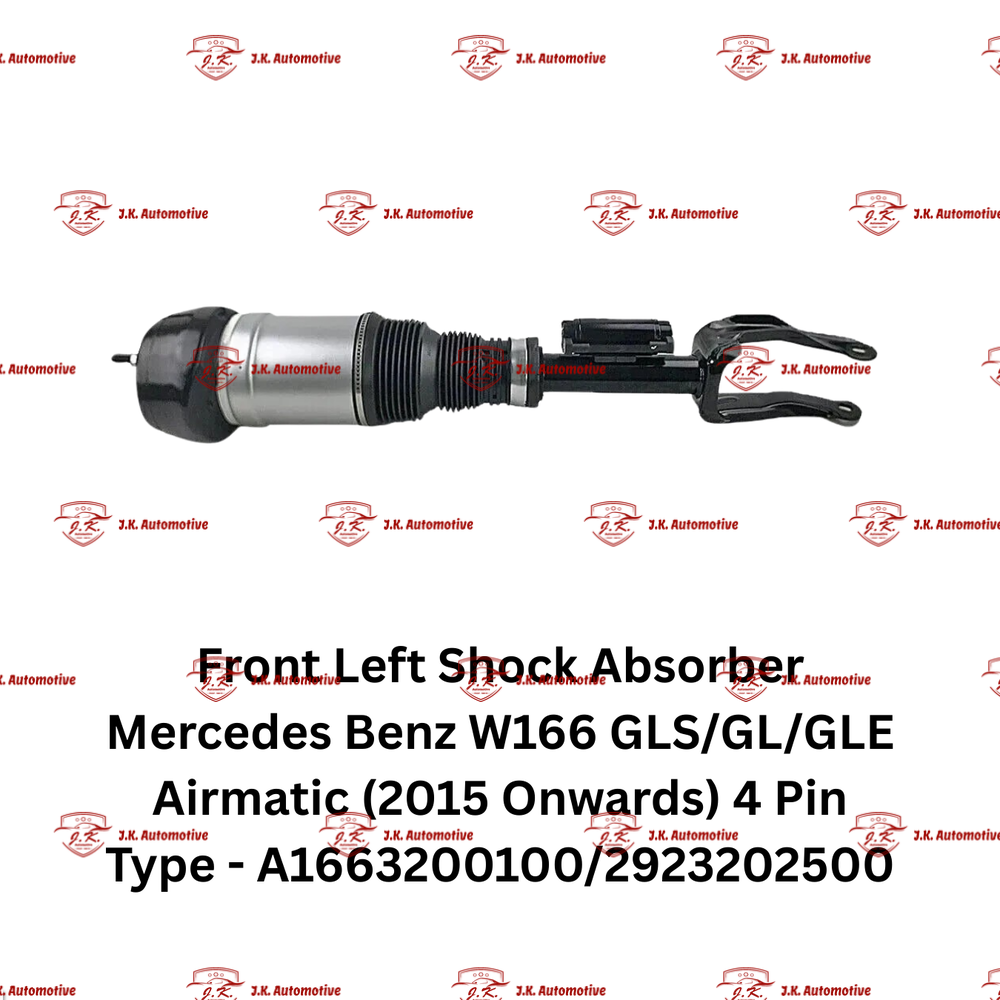
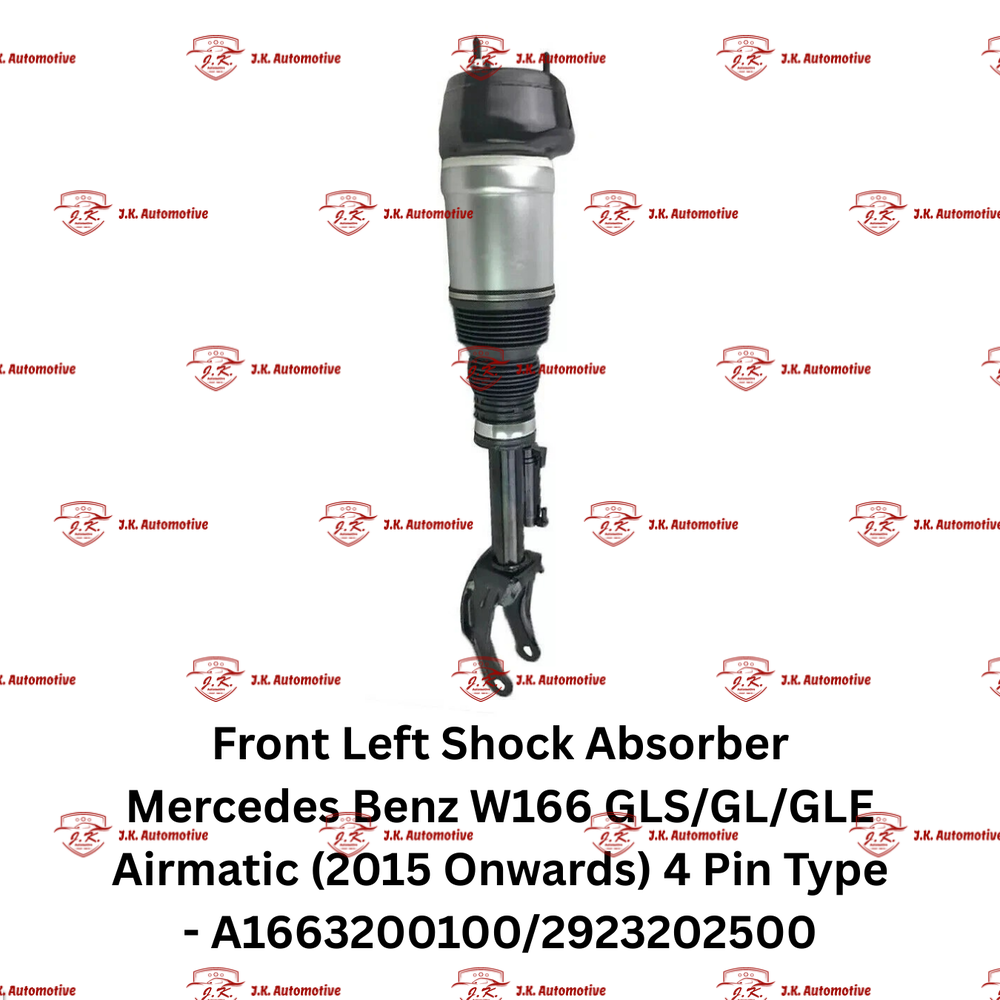
What is the Front Left Airmatic Shock Absorber A1663200100 / A2923202500 for Mercedes Benz GLS X166?
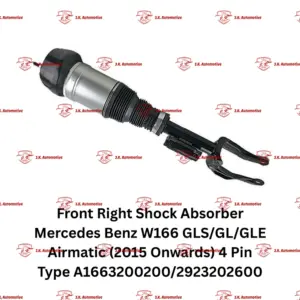
The Front Left Airmatic Shock Absorber A1663200100 / A2923202500 is specifically identified for the Front Left suspension position of the stated Mercedes Benz GLS X166 application with the supplied 2012–2019 year range and is described as a 4 Pin Type component, making the installation side, electrical connector configuration, pneumatic interface, mechanical mounting arrangement and exact supplied references important compatibility points before ordering or installation. This component forms part of the applicable Airmatic suspension arrangement and combines the functions associated with pneumatic suspension operation and controlled damping at the front-left wheel. During normal driving, the front-left wheel constantly moves in response to bumps, depressions, road joints, uneven surfaces, changes in road level and other disturbances, and the suspension unit must respond to these movements while helping the wheel and vehicle body return progressively toward their normal operating positions. The damping function controls the rate of compression and rebound so that the suspension does not continue oscillating unnecessarily after the wheel has passed over a disturbance. During braking, vehicle load transfers toward the front axle and increases the forces acting through the front suspension, while acceleration changes the load distribution in the opposite direction. Cornering also creates different forces between the left and right suspension positions, meaning the Front Left unit operates continuously under changing conditions. The pneumatic portion works within the applicable air-suspension system and therefore depends on appropriate pressure generation, distribution and retention elsewhere in the system. A problem affecting vehicle height does not automatically mean the suspension unit itself is defective because air lines, pneumatic connections and other pressure-control components can also influence ride height. Similarly, excessive bouncing can indicate a damping concern even when pneumatic pressure is being retained. The product is specifically identified as Front Left and should not automatically be substituted for a Front Right component. The supplied 4 Pin Type description should also be verified physically against the connector on the vehicle because connector configuration is an important compatibility factor. Both supplied references A1663200100 and A2923202500 should be preserved exactly when checking the application. Before ordering, compare the existing component and replacement for overall construction, upper and lower mounting interfaces, pneumatic connection, electrical connector and relevant brackets. Where available, VIN-based information can provide an additional verification step. Vehicles with previous suspension conversion, accident repair or modification should receive additional physical inspection because the currently installed arrangement may differ from the expected configuration. Surrounding front suspension components should also be inspected because worn control arms, bushes, ball joints, mounts, sway bar links, sway links, anti roll link rods and stabiliser sway links can produce noises or handling symptoms that may initially appear to originate from the Airmatic shock. Correct product identification should therefore retain Mercedes Benz GLS X166, Front Left position, Airmatic Shock Absorber, 4 Pin Type, A1663200100 / A2923202500 and the supplied 2012–2019 application.
How do I confirm A1663200100 / A2923202500 Front Left Airmatic Shock Absorber fits my Mercedes Benz GLS X166?
To confirm whether the A1663200100 / A2923202500 Front Left Airmatic Shock Absorber is suitable for the stated Mercedes Benz GLS X166, compatibility should be established from several details together rather than relying only on the vehicle model, year range or one part number. Begin by confirming the supplied 2012–2019 application and then establish that the component required on the vehicle is specifically the Front Left suspension unit because this product is position-specific and should not automatically be treated as interchangeable with the Front Right side. Next, inspect the existing electrical connector and verify that the vehicle requires the stated 4 Pin Type configuration. Count and inspect the pins where appropriate and compare the physical connector shape, orientation, locking arrangement and vehicle-side interface with the replacement component. The replacement should connect naturally to the existing vehicle wiring without cutting, splicing, bypassing or modifying the harness simply to make an incompatible connector fit. Both exact supplied references A1663200100 and A2923202500 should be checked against suitable vehicle-specific information and any accessible identification on the existing suspension component. Do not alter, shorten or interchange digits in these references because even a small numerical difference can identify another component or application. Physical comparison should then include the overall construction of the unit, upper mounting interface, lower mounting arrangement, relevant brackets, pneumatic connection and electrical connection. The replacement should correspond with the existing component without requiring drilling, welding, reshaping or improvised mechanical modification. The pneumatic interface should be inspected carefully because an incorrect air connection can prevent proper installation or pressure retention. Where available, VIN-based parts information can provide another useful compatibility check, particularly when multiple suspension configurations may exist within a vehicle range. If the vehicle has undergone previous suspension repair, conversion, accident repair or modification, the component physically installed on the vehicle should be inspected carefully rather than relying exclusively on model information. Compare the opposite front suspension only as a diagnostic reference and do not assume the left and right components are interchangeable. Inspect the surrounding suspension while confirming fitment because existing control-arm, bush, ball-joint or mounting wear can influence the symptoms that led to the replacement decision. Sway bar links, sway links, anti roll link rods and stabiliser sway links should also be examined where knocking or looseness is present. Correct compatibility should ultimately combine Mercedes Benz GLS X166, Front Left position, Airmatic suspension arrangement, 4 Pin Type, A1663200100 / A2923202500, physical mounting compatibility and the supplied 2012–2019 application.
What are the symptoms of a bad Front Left Airmatic Shock Absorber on Mercedes Benz GLS X166?
A Front Left Airmatic Shock Absorber on the stated Mercedes Benz GLS X166 may require detailed inspection when the front-left corner gradually becomes lower after parking, the suspension repeatedly moves after bumps, the vehicle feels less controlled over uneven roads, damping performance appears reduced, the pneumatic system operates more frequently than expected, a suspension-related warning appears or there is a noticeable difference between the behaviour of the front-left and front-right suspension positions, but none of these symptoms should automatically be treated as confirmation that the suspension unit itself has failed. Diagnosis should first distinguish pneumatic pressure-loss symptoms from damping symptoms because the two functions can produce different patterns of behaviour. If the front-left corner becomes lower after the vehicle remains parked, investigate pressure retention within the relevant pneumatic circuit. The suspension unit can be one possible leak location, but the associated air line, pneumatic connection and other components responsible for pressure distribution and retention should also be considered. Observe whether the height loss occurs immediately or gradually over several hours and whether the vehicle restores the correct height when the suspension system operates again. If the system repeatedly restores height, increased pressure-system activity may be a response to pressure loss elsewhere rather than proof that the compressor itself is defective. If the vehicle maintains an appropriate ride height but the front-left suspension continues bouncing after bumps or takes longer to settle, the damping portion of the suspension unit should be evaluated separately. Excessive body movement during braking or cornering can also justify a closer suspension inspection, although these symptoms can originate from more than one component. If a suspension-related warning appears, inspect the electrical connection and associated wiring because this product is specifically identified as 4 Pin Type. Appropriate diagnostic equipment can provide relevant fault information where applicable, but stored faults should be interpreted together with physical inspection and testing rather than used alone to justify replacement. Mechanical noises require their own diagnosis because control arms, bushes, ball joints, mounts and other joints can produce knocking or looseness. Sway bar links, sway links, anti roll link rods and stabiliser sway links should be inspected when noise is most noticeable over smaller road irregularities. Tyres should also be checked for pressure, condition and unusual wear when handling concerns exist. Compare the behaviour of both front suspension positions, but remember that this listing is specifically Front Left. If replacement is confirmed, verify the exact A1663200100 / A2923202500 references, 4 Pin connector, pneumatic interface, mounting arrangement and the supplied Mercedes Benz GLS X166 2012–2019 application before ordering.
What does 4 Pin Type mean for Mercedes Benz GLS X166 Front Left Airmatic Shock Absorber A1663200100 / A2923202500?
The 4 Pin Type description for the Mercedes Benz GLS X166 Front Left Airmatic Shock Absorber A1663200100 / A2923202500 identifies the stated electrical connector configuration associated with this particular suspension component and should be treated as a significant compatibility requirement rather than a minor descriptive detail because a component with a different connector arrangement should not automatically be assumed to fit or operate correctly even when the vehicle model and physical appearance seem similar. Before ordering, inspect the electrical connector fitted to the existing Front Left suspension unit and verify the number of pins together with the physical connector shape, orientation, locking mechanism and corresponding vehicle-side interface. The replacement connector should correspond naturally with the existing wiring and should not require cutting, splicing, bypassing, rewiring or improvised adaptation simply to install a component with a different electrical configuration. Inspect the vehicle-side connector for broken locking tabs, contamination, visible wiring damage or evidence of previous repair because replacing the suspension unit will not correct an independent wiring or connector problem. Both supplied references A1663200100 and A2923202500 should also be checked because electrical connector configuration is only one part of compatibility verification. Confirm that the required installation position is Front Left and do not assume that a Front Right suspension unit can be substituted merely because some dimensions appear similar. The pneumatic connection should be compared with the existing component because the applicable Airmatic system also requires a correct air interface. Upper and lower mounting points, bracket positions and overall construction should be physically compared before final installation. Where available, VIN-based vehicle information can provide an additional compatibility check and can be particularly useful when a vehicle family has different suspension configurations. If the vehicle has previously undergone suspension conversion, accident repair or modification, inspect what is actually fitted because previous work may have changed the expected configuration. Do not force an electrical connector, pneumatic fitting or mechanical mounting point into place if it does not correspond correctly. The stated 4 Pin Type should therefore be considered together with the exact Front Left position, Airmatic suspension arrangement, A1663200100 / A2923202500 references and supplied Mercedes Benz GLS X166 2012–2019 application. This multi-point verification helps reduce the risk of ordering a visually similar component that differs in electrical, pneumatic or mechanical configuration.
Can a leaking Front Left Airmatic Shock Absorber cause Mercedes Benz GLS X166 to sit lower on one side after parking?
A pneumatic leak associated with the Front Left Airmatic suspension unit can potentially cause the front-left corner of the stated Mercedes Benz GLS X166 to become lower after the vehicle remains parked, but uneven ride height should be treated as a diagnostic symptom rather than immediate proof that the Airmatic shock itself is defective because pressure can potentially be lost through the suspension unit, relevant air line, pneumatic connection or another component involved in pressure distribution and retention. Begin by parking the vehicle on a reasonably level surface and observing the relative height of the front-left, front-right and rear corners. If the front-left side gradually becomes lower while the other positions remain comparatively stable, investigate the pneumatic circuit associated with that corner. Note whether the change occurs shortly after parking or develops over several hours because the rate of height loss can provide useful diagnostic information even though it does not identify the leak location by itself. The suspension unit and its pneumatic connection should be inspected using an appropriate leak-detection procedure, and the associated air line should also be checked carefully. If no leakage is found at the suspension unit, diagnosis should continue through the relevant pneumatic system rather than replacing the shock absorber by assumption. Observe whether the vehicle returns to its expected height when the suspension system operates. If the system repeatedly needs to restore height, pressure is potentially being replenished after being lost, which can increase demand on the pressure-generation system. Frequent compressor activity therefore does not automatically prove that the compressor is the original failed component. The damping function should also be evaluated independently because a suspension unit can potentially retain pneumatic pressure while its damping performance deteriorates, or it can develop a pneumatic concern without showing the same damping symptoms. If the vehicle maintains its height but continues bouncing after bumps, investigate damping performance rather than focusing only on pressure loss. Electrical concerns should also be considered if warnings or inconsistent suspension behaviour occur, particularly because the product is specified as 4 Pin Type. Inspect the connector and associated wiring as part of the complete diagnosis. Mechanical suspension components can also influence vehicle stance or handling, so control arms, bushes, ball joints and mounts should be checked where appropriate. If replacement is confirmed, preserve Front Left, 4 Pin Type, A1663200100 / A2923202500 and the supplied Mercedes Benz GLS X166 2012–2019 application during compatibility verification.
What should be checked before installing A1663200100 / A2923202500 Front Left Airmatic Shock Absorber on Mercedes Benz GLS X166?
Before installing the A1663200100 / A2923202500 Front Left Airmatic Shock Absorber on the stated Mercedes Benz GLS X166, the vehicle's existing suspension configuration, exact installation position, electrical connection, pneumatic connection, mechanical mounting points and surrounding suspension condition should all be inspected so that an incorrect component or unresolved system fault is not carried into the repair. Begin by confirming that the required position is specifically Front Left because this listing is side-specific and should not automatically be substituted for the opposite front position. Verify both exact supplied references A1663200100 and A2923202500 using suitable vehicle-specific information and compare them with accessible identification on the removed component where possible. Preserve the supplied 2012–2019 application exactly. Next, inspect the electrical connector and confirm the stated 4 Pin Type configuration, including the number of pins, connector shape, orientation, locking arrangement and condition of the vehicle-side wiring. The connector should fit naturally without cutting, splicing or modifying the harness to overcome an incompatibility. Inspect the pneumatic connection and relevant air line for damage, incorrect seating or evidence of leakage. If the original complaint involved the front-left corner lowering after parking, complete an appropriate pressure-loss diagnosis before fitting the replacement so that another leak source is not overlooked. Compare the replacement and removed components side by side where practical, checking overall construction, upper mounting interface, lower mounting arrangement, relevant brackets, electrical connector and pneumatic fitting. Do not install the component if significant physical differences indicate a compatibility concern. Inspect the surrounding control arms and bushes for deterioration or excessive movement and assess ball joints and mounting components according to an appropriate workshop procedure. Sway bar links, sway links, anti roll link rods and stabiliser sway links should be inspected if the vehicle has knocking or looseness over uneven roads. Check the front tyres for condition and irregular wear because existing suspension or geometry problems may be visible through tyre wear patterns. If the vehicle displays a suspension warning, appropriate diagnostic testing should be performed before replacement and again where necessary after installation. Installation should follow an appropriate procedure for pneumatic suspension components, including safe management of suspension pressure. After fitting, verify the electrical and pneumatic connections, inspect for leakage where appropriate, confirm suspension operation and perform a suitable functional or road test. Wheel geometry should be evaluated where required. Final compatibility should preserve Mercedes Benz GLS X166, Front Left, 4 Pin Type, A1663200100 / A2923202500 and the supplied 2012–2019 application.
How does the Front Left Airmatic Shock Absorber A1663200100 / A2923202500 work on Mercedes Benz GLS X166?
The Front Left Airmatic Shock Absorber A1663200100 / A2923202500 for the stated Mercedes Benz GLS X166 operates within the applicable Airmatic suspension arrangement while controlling compression and rebound movement at the front-left wheel, allowing the suspension to respond progressively as the vehicle travels over bumps, depressions, road joints, uneven surfaces, changing road levels and different driving conditions. This component is specifically identified as Front Left and 4 Pin Type for the supplied 2012–2019 application, making the exact installation side, electrical connector, pneumatic interface, mounting arrangement and supplied references important compatibility points. During normal driving, the wheel continuously moves vertically in response to road inputs while the suspension works to manage the movement between the wheel and vehicle body. When the wheel encounters a raised surface, the suspension moves through compression, and when the wheel passes beyond that disturbance, the suspension returns through rebound. The damping function controls the rate of these movements so the suspension does not continue oscillating unnecessarily after the original road disturbance has passed. The pneumatic portion works within the applicable air-suspension system, where pressurized air forms part of suspension operation. Pressure generation, distribution and retention elsewhere in the system therefore also influence overall suspension behaviour. During braking, load transfers toward the front axle and changes the forces acting through the front suspension. During acceleration, the load distribution changes again, while cornering creates different forces between the left and right sides. The suspension unit must therefore respond continuously rather than operating only when a large bump is encountered. The stated 4 Pin electrical connection is another important part of the supplied configuration and should correspond with the existing vehicle-side connector without improvised wiring modification. A pneumatic leak and deteriorated damping should be diagnosed separately because either can affect suspension behaviour in a different way. Mechanical components including control arms, bushes, ball joints, mounts, sway bar links, sway links, anti roll link rods and stabiliser sway links should also be inspected when related symptoms are present. Correct identification should preserve Front Left, 4 Pin Type, A1663200100 / A2923202500 and the supplied Mercedes Benz GLS X166 2012–2019 application.
Can A1663200100 / A2923202500 cause the front left side of Mercedes Benz GLS X166 to drop after parking or increase compressor operation?
A pressure-retention problem associated with the Front Left Airmatic suspension unit A1663200100 / A2923202500 can potentially be present when the front-left corner of the stated Mercedes Benz GLS X166 gradually becomes lower after the vehicle remains parked, and an unresolved pneumatic leak can also cause the pressure-generation system to operate more frequently as it attempts to restore the required suspension pressure, but neither symptom automatically proves that the shock absorber itself or the compressor is defective. Begin diagnosis by parking the vehicle on a reasonably level surface and comparing the front-left ride height with the front-right and rear positions. Observe whether the height difference appears immediately or develops gradually over several hours. A gradual drop can indicate pressure loss somewhere within the relevant pneumatic circuit, but the leak location still needs to be identified. Inspect the suspension unit, pneumatic connection and associated air line using an appropriate leak-detection procedure. If no leak is identified at the unit itself, continue checking the applicable pressure-distribution and retention components rather than replacing the shock absorber based solely on the vehicle sitting lower. Observe what happens when the suspension system operates again. If the front-left corner returns to its expected position and later drops again, the system may be repeatedly replacing lost pressure. This can increase demand on the compressor, but frequent compressor activity can be the consequence of another pneumatic leak rather than the original fault. Damping behaviour should also be assessed separately because a suspension unit may maintain its height but still have reduced ability to control compression and rebound. If the front-left corner remains at the expected height but the vehicle continues bouncing after bumps, damping deterioration may require closer investigation. If a suspension warning or inconsistent behaviour is present, inspect the stated 4 Pin connector and associated wiring and use appropriate diagnostic equipment where required. Both references A1663200100 and A2923202500 should be preserved during compatibility checking. If replacement is confirmed, verify Front Left position, 4 Pin configuration, pneumatic interface, mounting arrangement and the supplied Mercedes Benz GLS X166 2012–2019 application.
How can I diagnose whether A1663200100 / A2923202500 or another Airmatic component is causing the suspension problem?
Diagnosing whether the Front Left Airmatic Shock Absorber A1663200100 / A2923202500 or another component is responsible for a suspension problem on the stated Mercedes Benz GLS X166 requires separating pneumatic pressure loss, damping deterioration, electrical concerns and ordinary mechanical suspension wear because several different faults can create similar ride-height, noise, warning or handling symptoms. Begin by identifying the primary complaint rather than replacing parts based only on a general suspension symptom. If the front-left corner becomes lower after the vehicle is parked, investigate pressure retention within the relevant pneumatic circuit. Inspect the suspension unit, air connection and associated air line and then extend the diagnosis to other pressure-distribution and retention components if the leak is not found at the suspension unit. If the vehicle maintains its expected height but the front-left suspension repeatedly bounces after bumps or takes longer to settle, investigate damping performance separately. If the vehicle displays a suspension-related warning or the suspension behaves inconsistently, the electrical side should receive additional attention. Since this component is specifically identified as 4 Pin Type, inspect the connector, vehicle-side wiring and visible condition of the interface. Appropriate diagnostic equipment can help retrieve relevant suspension-system information where applicable, but fault information should be interpreted alongside physical inspection rather than being used as the sole reason for replacement. Compressor behaviour can provide another diagnostic clue. Frequent operation may indicate repeated pressure replenishment, but the actual pressure-loss source still needs to be identified before deciding that the compressor or suspension unit is defective. Mechanical diagnosis is equally important. Inspect control arms, bushes, ball joints and mounting components for wear, damage or excessive movement. Sway bar links, sway links, anti roll link rods and stabiliser sway links should be checked when knocking is present over smaller road irregularities. Compare front-left behaviour with the opposite front suspension position and inspect tyres when handling or abnormal wear is part of the complaint. If diagnosis confirms replacement, compare the existing unit physically with the replacement and verify A1663200100 / A2923202500, Front Left position, 4 Pin electrical connection, pneumatic interface and supplied Mercedes Benz GLS X166 2012–2019 application.
What other Airmatic and suspension components should be inspected when replacing A1663200100 / A2923202500 on Mercedes Benz GLS X166?
When replacing the Front Left Airmatic Shock Absorber A1663200100 / A2923202500 on the stated Mercedes Benz GLS X166, the related pneumatic, electrical and mechanical suspension components should also be inspected because fitting a new suspension unit will not correct an unresolved air leak elsewhere in the system, damaged electrical wiring, a worn control-arm bush, loose ball joint, deteriorated mounting component or another independent suspension problem. Begin with the pneumatic side of the system by inspecting the air connection at the front-left suspension unit and the associated air line for damage, incorrect seating or other conditions that could affect pressure retention. If the original complaint involves the front-left corner lowering while parked, an appropriate pressure-loss investigation should be completed rather than assuming that the suspension unit is the only possible source. Other components involved in pressure distribution and retention should be considered according to diagnostic findings. The pressure-generation system should also be evaluated if compressor activity has increased, but excessive compressor operation can result from an unresolved leak elsewhere and should not automatically be treated as confirmation of compressor failure. Next, inspect the electrical interface because this product is specifically described as 4 Pin Type. Check the connector, locking mechanism and vehicle-side wiring for visible damage, contamination or previous modification. Mechanical inspection should include the upper and lower suspension-unit mounting areas, control arms, bushes, ball joints and related joints. Sway bar links, sway links, anti roll link rods and stabiliser sway links should be inspected when the vehicle has knocking or looseness over uneven surfaces. The opposite front suspension position should also be assessed for comparison because differences in height or damping behaviour can provide useful diagnostic information. Inspect tyres for pressure, physical damage and irregular wear patterns. Before installation, compare the removed component with the replacement for overall construction, mounting interfaces, pneumatic fitting and electrical connection. Both supplied references A1663200100 and A2923202500 should remain part of compatibility verification. After installation, check pneumatic and electrical connections, confirm suspension operation, inspect for leakage where appropriate and perform a suitable functional or road test. Wheel geometry should be evaluated where required. Final identification should retain Front Left, 4 Pin Type and the supplied Mercedes Benz GLS X166 2012–2019 application.
How do I know if the Front Left Airmatic Shock Absorber is bad on my Mercedes Benz GLS X166?
The Front Left Airmatic Shock Absorber on the stated Mercedes Benz GLS X166 may require detailed diagnosis when the front-left corner gradually lowers after parking, the suspension takes longer to settle after bumps, repeated bouncing becomes noticeable, the front-left side feels less controlled over uneven roads, the pressure-generation system appears to operate more frequently, a suspension-related warning appears or the behaviour of the front-left suspension differs noticeably from the opposite side, but these symptoms should not automatically result in replacement because pneumatic leakage, damping deterioration, electrical faults and mechanical suspension wear can produce similar behaviour. Start by observing vehicle height on a reasonably level surface and compare the front-left corner with the remaining suspension positions. If the front-left side gradually becomes lower while parked, investigate the applicable pneumatic circuit for pressure loss. Inspect the suspension unit, its air connection and associated air line using an appropriate diagnostic procedure. If no leak is identified there, continue diagnosis through the relevant pressure-distribution and retention components rather than assuming the shock absorber is defective. If the vehicle retains its expected height but the front-left suspension repeatedly oscillates after bumps, damping performance should be evaluated because reduced damping can exist without an obvious pneumatic leak. If the suspension behaves inconsistently or a warning appears, inspect the 4 Pin electrical connector and associated wiring and use suitable diagnostic equipment where appropriate. Frequent compressor operation should also be interpreted carefully because the compressor may simply be replacing pressure lost somewhere else in the system. Mechanical noises require separate investigation. Control arms, bushes, ball joints and mounts can create looseness or knocking that may initially appear to originate from the Airmatic unit. Sway bar links, sway links, anti roll link rods and stabiliser sway links should also be checked when noise occurs over smaller road irregularities. Inspect tyre condition and wear when handling changes are part of the complaint. If testing confirms replacement, physically compare the existing unit with the new component and verify the Front Left position, 4 Pin Type, pneumatic interface, mounting arrangement and exact supplied references A1663200100 / A2923202500. Compatibility should preserve the stated Mercedes Benz GLS X166 2012–2019 application and should be confirmed from the complete vehicle configuration rather than from one symptom alone.


Reviews
There are no reviews yet.