What are the Front Lower Arms With Bracket Bush for MINI Cooper F55 and what is their function?
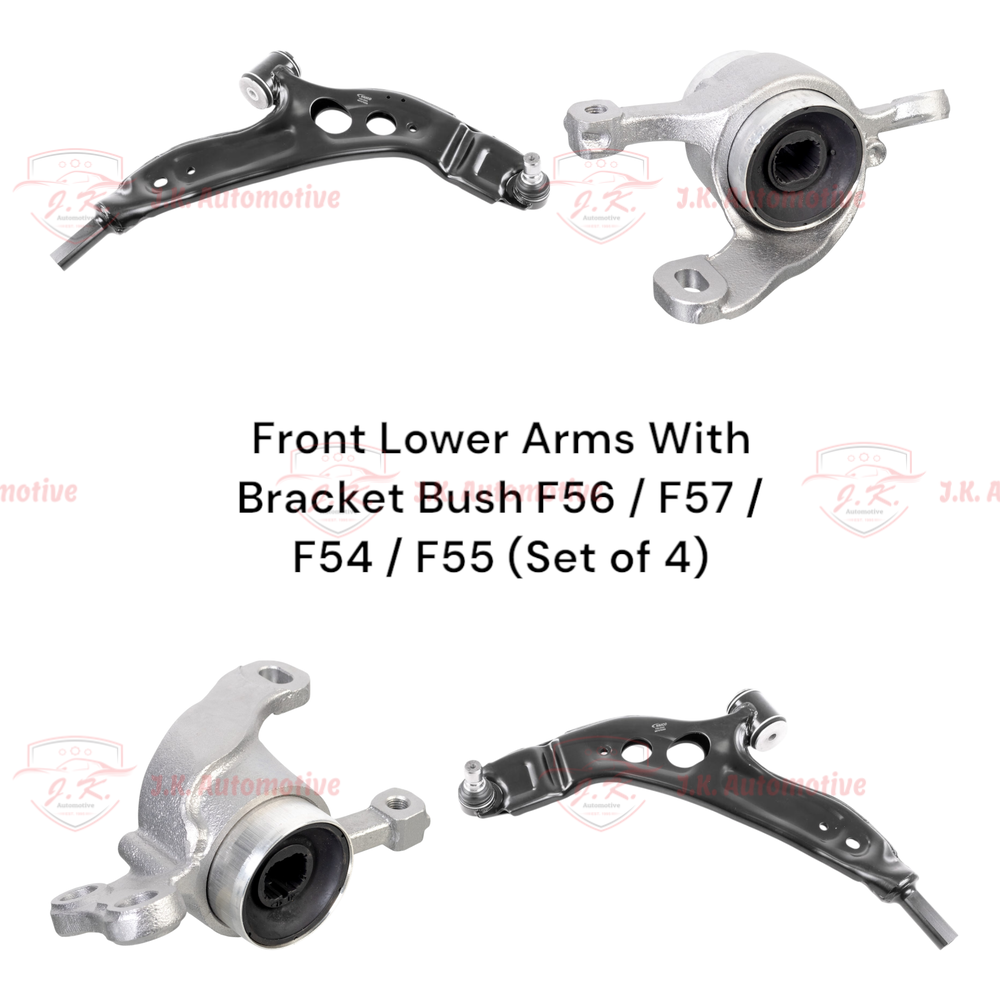
Front Lower Arms With Bracket Bush for MINI Cooper F55 are important front steering and suspension components designed to help maintain accurate wheel positioning, controlled suspension movement and stable steering behaviour. This product is supplied as a complete set of 4 for compatible MINI Cooper F55 models from 2014 to 2026 and corresponds with OEM reference numbers 31126879841, 31126879842, 31126882843 and 31126882844. The set combines the relevant left and right front lower control arms with their associated bracket bush assemblies, providing a comprehensive replacement solution when the original lower suspension arms and mounting bushes have developed wear or damage. Front lower control arms may also be described as lower suspension arms or front wishbones, and they form an important connection between the front wheel assemblies and the vehicle chassis. Their function is to permit controlled suspension movement while helping keep the wheels positioned correctly as the vehicle travels over smooth roads, potholes, speed breakers, road joints and uneven surfaces. During braking, acceleration and cornering, considerable forces pass through the front suspension, and the lower control arms help manage these loads while maintaining predictable wheel movement. The bracket bushes provide flexible mounting points within the lower-arm system. Rubber within these bushes allows a calculated amount of movement while helping isolate vibration and road harshness from the vehicle structure. With increasing age and mileage, the rubber can crack, soften, tear or separate, allowing excessive movement of the lower control arm. Common symptoms can include knocking or clunking from the front suspension, vague steering, steering-wheel vibration, pulling during braking, unstable straight-line behaviour, uneven tyre wear and recurring wheel-alignment problems. A lower control arm can also become physically bent following a severe pothole, kerb impact or accident, potentially changing suspension geometry even if the rubber bush appears serviceable. A complete steering and suspension inspection should therefore be performed before replacement. Ball joints, tie rod ends, shock absorbers, wheel bearings and other suspension bushes should be checked for wear. Sway bar links, sway links, anti roll link rods and stabiliser sway links should also be inspected because deterioration in these components can produce similar front suspension noises. Correct fitment should always be confirmed using the MINI Cooper F55 chassis, vehicle VIN and original OEM references 31126879841, 31126879842, 31126882843 and 31126882844. Professional installation followed by wheel alignment is recommended to help restore controlled suspension movement, accurate steering and consistent front wheel positioning.
Which MINI Cooper F55 models are compatible with Front Lower Arms With Bracket Bush 31126879841, 31126879842, 31126882843 and 31126882844?
Front Lower Arms With Bracket Bush corresponding with OEM references 31126879841, 31126879842, 31126882843 and 31126882844 are intended for compatible MINI Cooper F55 applications within the stated 2014–2026 model range. This product is supplied as a set of 4, combining the relevant front lower control arms with the corresponding bracket bush assemblies used within the front suspension system. Customers searching for MINI Cooper F55 Front Lower Arms, MINI F55 Lower Control Arms, MINI Cooper Front Wishbones or MINI F55 Bracket Bushes can use these OEM references as important identifiers when checking the required replacement components. However, compatibility should never be determined from model name or year range alone. Suspension components can vary according to vehicle production details and specification, so the vehicle VIN and the OEM references present on the original components should be checked before ordering. This is especially important when purchasing suspension parts online because visually similar control arms can differ in dimensions, geometry, mounting points or bush specifications. The MINI Cooper F55 lower control arms help maintain the position of the front wheels relative to the chassis while permitting controlled suspension movement. Their associated bracket bushes provide flexible mounting points that help control longitudinal movement of the arms during braking, acceleration and changing road conditions. When the original bracket bushes become cracked, torn, soft or separated, excessive control-arm movement can develop. The driver may experience knocking or clunking, vague steering, vibration, pulling during braking, uneven tyre wear or repeated alignment problems. Physical damage to the control arms can create similar symptoms, particularly following a severe pothole or kerb impact. Before replacing the set, the complete front suspension should be inspected. Ball joints should be checked for excessive movement, damaged protective boots and rough operation. Tie rod ends should be examined for steering-joint play, while shock absorbers should be checked for leakage and reduced damping performance. Wheel bearings should be inspected for play, roughness and abnormal noise. Sway bar links, sway links, anti roll link rods and stabiliser sway links should also be examined when knocking or rattling is present. Tyres should be checked for irregular wear and correct pressure because tyre problems can also influence steering and handling. When the F55 chassis, VIN and original OEM references confirm compatibility, this Front Lower Arms With Bracket Bush Set of 4 provides a comprehensive replacement option. Professional installation and wheel alignment are recommended after replacement.
What are the common symptoms of worn Front Lower Arms and Bracket Bushes on a MINI Cooper F55?
Common symptoms of worn Front Lower Arms and Bracket Bushes on a MINI Cooper F55 include knocking or clunking from the front suspension, vague steering, reduced steering precision, steering-wheel vibration, pulling during braking, unstable straight-line tracking, uneven tyre wear and recurring wheel-alignment problems. The Front Lower Arms With Bracket Bush for MINI Cooper F55 discussed here are supplied as a set of 4 for compatible 2014–2026 applications and correspond with OEM references 31126879841, 31126879842, 31126882843 and 31126882844. The front lower control arms help locate the wheels relative to the chassis, while their rubber-mounted bracket bushes allow controlled suspension movement and help isolate vibration. These rubber components are constantly subjected to compression, twisting and changing loads as the vehicle accelerates, brakes, corners and travels over uneven roads. With increasing age and mileage, rubber bushes can crack, soften, tear or separate. Potholes, speed breakers, poor road conditions and repeated heavy suspension impacts can accelerate deterioration. Knocking or clunking is one of the most common symptoms and may become particularly noticeable while driving over potholes, road joints or broken surfaces. Worn bracket bushes can also create movement when changing between acceleration and braking because the direction of force through the control arm changes. Vague steering may develop when unwanted suspension movement occurs before the front wheels respond consistently to steering input. The driver may notice that the MINI Cooper F55 requires more frequent steering corrections or feels less settled at speed. Worn bushes can also allow the wheel position to change slightly under braking, potentially contributing to pulling or an unsettled feeling through the steering wheel. Uneven tyre wear can occur because excessive mechanical movement prevents the suspension from maintaining consistent wheel geometry while driving. Repeated wheel-alignment problems can develop for the same reason because alignment cannot permanently compensate for mechanical play in worn suspension components. A bent lower control arm can create an even more significant geometry problem. Severe potholes, kerb impacts or accident damage can physically deform an arm and alter wheel position. However, these symptoms should not automatically be attributed to the lower arms. Ball joints, tie rod ends, wheel bearings, shock absorbers and other suspension bushes can produce similar symptoms. Sway bar links, sway links, anti roll link rods and stabiliser sway links are particularly important to inspect when the primary complaint is knocking over uneven roads. A complete mechanical inspection should therefore be carried out before replacement. If deterioration is confirmed, replacing the affected lower arms and bracket bushes followed by professional wheel alignment can help restore more controlled front suspension behaviour.
Why is it recommended to replace the Front Lower Arms and Bracket Bushes together on a MINI Cooper F55?
Replacing the Front Lower Arms and Bracket Bushes together on a MINI Cooper F55 can be beneficial when inspection confirms comparable wear across the corresponding suspension components because the lower control arms and their bracket-mounted bushes operate together to maintain controlled front wheel positioning. This complete set of 4 corresponds with OEM references 31126879841, 31126879842, 31126882843 and 31126882844 for the stated MINI Cooper F55 2014–2026 application. The lower control arms and bracket bushes are exposed to similar road conditions, mileage, suspension movement and braking forces throughout their service life. Consequently, when deterioration is age- or mileage-related rather than caused by an isolated impact, wear may be present in several components simultaneously. The rubber bracket bushes can become cracked, torn, excessively soft or separated, while the lower control arms may develop wear or physical damage. If a severely deteriorated bush is replaced while another heavily worn suspension component remains installed, unwanted movement or noise can continue after the repair. When both left and right components genuinely require replacement, fitting the corresponding components together can help restore more balanced suspension behaviour across the front axle. Similar bush stiffness and controlled movement on both sides can contribute to more predictable response during braking, acceleration and cornering. Replacing the complete set can also reduce repeated workshop labour when multiple original components are approaching the end of their serviceable condition. Instead of replacing one component, performing alignment and then returning shortly afterwards for another related repair, a comprehensive replacement can address several confirmed wear points during the same workshop operation. However, replacing all components should not be treated as mandatory if only one isolated component is damaged. For example, if one control arm has been damaged by a kerb strike but the remaining arms and bushes are confirmed fully serviceable, targeted replacement may be appropriate. The decision should always be based on physical inspection. The technician should inspect the lower control arms for bending, impact marks and structural damage and examine the bracket bushes for cracking, tearing, separation and excessive movement. Ball joints and tie rod ends should be checked for play, while shock absorbers and wheel bearings should also be inspected. Sway bar links, sway links, anti roll link rods and stabiliser sway links should be examined when suspension knocking is present. Tyres should be inspected for uneven wear because existing tread patterns can provide useful information about suspension or alignment problems. When multiple lower-arm and bracket-bush components are worn, installing the complete Front Lower Arms With Bracket Bush Set of 4 can provide a comprehensive repair solution. Correct professional installation followed by wheel alignment is recommended.
Can worn Front Lower Arms With Bracket Bush cause uneven tyre wear and wheel-alignment problems on MINI Cooper F55?
Yes, worn Front Lower Arms With Bracket Bush can contribute to uneven tyre wear and wheel-alignment problems on a MINI Cooper F55 because these components help maintain controlled front wheel position and suspension geometry while the vehicle is moving. This set of 4 corresponds with OEM references 31126879841, 31126879842, 31126882843 and 31126882844 for compatible MINI Cooper F55 models within the stated 2014–2026 application. When the front lower control arms and bracket bushes are in serviceable condition, they permit calculated suspension movement while limiting unwanted longitudinal and lateral movement of the front wheels. As the rubber bracket bushes deteriorate, they can become cracked, torn, separated or excessively soft. This allows the lower control arm to move farther than intended when the suspension is subjected to braking, acceleration or cornering forces. Even if a vehicle appears correctly aligned while stationary, excessive mechanical play can allow the effective wheel position to change dynamically on the road. This can contribute to irregular tyre wear, steering instability and inconsistent handling. The driver may notice excessive inner-edge wear, outer-edge wear, tread feathering or one front tyre wearing considerably faster than expected. Pulling to one side, an off-centre steering wheel or recurring alignment problems may also be present. Wheel alignment itself cannot repair a mechanically worn suspension component. If a deteriorated bracket bush allows the lower control arm to move after alignment has been completed, the wheel position will continue changing under load. Mechanical wear should therefore be diagnosed and repaired before final alignment. A physically bent lower control arm can create an even more persistent alignment problem because its geometry may have changed permanently. A severe pothole, kerb strike or accident should be considered when alignment measurements cannot be corrected despite normal adjustment. Other components should also be inspected because uneven tyre wear is not exclusive to lower control-arm problems. Ball joints and tie rod ends can affect wheel positioning when excessive play develops. Wheel bearings can permit unwanted movement, while weak or damaged shock absorbers can reduce control of tyre contact with the road. Sway bar links, sway links, anti roll link rods and stabiliser sway links should also be inspected where suspension noise is present. Tyre pressure, wheel condition and existing tread wear should be checked as part of the diagnosis. After worn MINI Cooper F55 Front Lower Arms and Bracket Bushes have been replaced, professional wheel alignment should be performed to help restore straight-line stability, predictable steering and more consistent tyre wear.
Is professional installation recommended for MINI Cooper F55 Front Lower Arms With Bracket Bush and what should be checked after replacement?
Professional installation is strongly recommended for MINI Cooper F55 Front Lower Arms With Bracket Bush because the lower control arms and their bracket-mounted bushes are safety-critical steering and suspension components that directly influence wheel positioning, suspension geometry and vehicle stability. This product is supplied as a set of 4 for compatible MINI Cooper F55 models within the stated 2014–2026 application and corresponds with OEM references 31126879841, 31126879842, 31126882843 and 31126882844. Before installation, the technician should verify the F55 chassis, vehicle VIN and original OEM references to confirm that the replacement components match the vehicle. Each left and right lower control arm and bracket bush assembly must be installed in the correct position and orientation. The mounting points, brackets, fasteners and surrounding suspension structure should be inspected while the original components are removed. Any bent mounting point, damaged bolt or corrosion issue should be addressed before the new components are fitted. Correct tightening procedures are particularly important for rubber-bushed suspension components because the bushes are designed to operate through a calculated movement range. Incorrect tightening can introduce unnecessary torsional preload into the rubber once the vehicle returns to its normal ride height. The appropriate vehicle repair procedure and specified tightening sequence should therefore be followed. Where required by the correct procedure, relevant bush-mounted fasteners should receive final tightening with the suspension positioned appropriately relative to normal ride height. During the repair, the complete front steering and suspension system should also be inspected. Ball joints should be checked for excessive movement, roughness and damaged protective boots. Tie rod ends should be examined for steering-joint play because worn tie rod ends can reduce steering accuracy and make correct alignment difficult. Shock absorbers should be inspected for leakage, physical damage and reduced damping performance. Wheel bearings should be checked for excessive play, rough operation or abnormal noise. Sway bar links and sway links should be inspected because worn stabiliser joints can create knocking over uneven roads. Anti roll link rods and stabiliser sway links should likewise be included in the suspension inspection. Other rubber bushes should be checked for cracking, tearing or separation. Tyres should be inspected for pressure, damage and existing irregular tread wear. After installing the new Front Lower Arms With Bracket Bush, professional wheel alignment should be performed because removing mechanical play can change the effective resting position of the wheels. Finally, the MINI Cooper F55 should receive a road test to check straight-line tracking, steering response, braking stability and abnormal suspension noise. Correct fitment verification, professional installation, proper bush tightening, complete suspension inspection and wheel alignment together provide the best approach to restoring dependable MINI Cooper F55 front suspension performance.
What is the difference between replacing only the bushes and replacing the complete Front Lower Arms With Bracket Bush on MINI Cooper F55?
Replacing only the suspension bushes and replacing the complete Front Lower Arms With Bracket Bush on a MINI Cooper F55 are two different repair approaches, and the correct option depends on the actual condition of the lower control arms, bracket bushes, mounting points and surrounding suspension components. For the stated MINI Cooper F55 2014–2026 application, this product is supplied as a set of 4 corresponding with OEM references 31126879841, 31126879842, 31126882843 and 31126882844. If the original front lower control arms remain straight, structurally sound and free from excessive wear or impact damage, replacing a deteriorated bush or bracket bush assembly may sometimes be sufficient. However, bush-only replacement does not correct a lower control arm that has been physically bent by a pothole, kerb impact or accident, and it does not address deterioration elsewhere in the control-arm assembly. The bracket bushes perform an important function because their rubber mounting allows controlled movement of the lower arm while limiting excessive longitudinal movement during acceleration and braking. As the rubber ages, it can crack, soften, tear or separate from the surrounding mounting structure. Excessive movement can then develop at the lower-arm mounting point, potentially producing knocking, vague steering, vibration, pulling during braking, uneven tyre wear or recurring wheel-alignment problems. When both the lower control arms and their bracket bushes show significant deterioration, replacing the complete relevant components provides a more comprehensive suspension repair than replacing only one worn rubber element. A complete set can also be useful when both sides have covered similar mileage and show comparable deterioration because matching suspension components can help restore more consistent behaviour across the front axle. This does not mean that every MINI Cooper F55 automatically requires all four components whenever one bush becomes worn. An isolated damaged component can be replaced individually when a professional inspection confirms that the remaining components are fully serviceable. Before deciding between bush-only and complete control-arm replacement, the technician should inspect the metal arms for bending, cracks and impact marks and examine all rubber bushes for tearing, separation and excessive movement. Ball joints should be inspected for play, roughness and damaged protective boots. Tie rod ends should be checked for steering-joint movement, while shock absorbers should be inspected for leakage and reduced damping performance. Wheel bearings should also be checked for play or roughness. Sway bar links, sway links, anti roll link rods and stabiliser sway links should be examined because deterioration in these components can create similar knocking noises. After the required MINI Cooper F55 Front Lower Arms and Bracket Bushes have been replaced, professional wheel alignment is recommended to restore accurate wheel positioning and predictable steering behaviour.
How long do Front Lower Arms With Bracket Bush normally last on a MINI Cooper F55?
There is no single fixed mileage or replacement interval for Front Lower Arms With Bracket Bush on a MINI Cooper F55 because their service life depends on road conditions, vehicle age, mileage, driving style, pothole exposure, speed breakers, suspension loading, tyre condition, wheel alignment, shock absorber performance and installation quality. The Front Lower Arms With Bracket Bush for MINI Cooper F55 discussed here are supplied as a set of 4 for the stated 2014–2026 application and correspond with OEM references 31126879841, 31126879842, 31126882843 and 31126882844. Lower control arms and their rubber mounting bushes are continuously subjected to changing loads while the vehicle accelerates, brakes, corners and travels over uneven roads. The bracket bushes are deliberately designed with flexible rubber because the suspension needs controlled movement rather than a completely rigid mounting point. Every time the suspension moves, the rubber is subjected to compression, deflection and torsional movement. Over a long period, repeated mechanical loading combined with heat, water, road contamination and ageing can gradually deteriorate the rubber. Potholes, broken roads, speed breakers and repeated sharp impacts can accelerate this process because they introduce higher loads into the control arms and suspension bushes. A severe impact can also bend a lower control arm even when the vehicle has relatively low mileage, which is why mileage alone should never determine replacement. Actual mechanical condition is more important. Signs that the MINI Cooper F55 Front Lower Arms or Bracket Bushes may require inspection include knocking or clunking over uneven surfaces, vague steering, steering-wheel vibration, pulling during braking, unstable straight-line behaviour, uneven tyre wear and recurring wheel-alignment problems. Visible cracking, tearing or separation of a rubber bush is another important indication of deterioration. The control arms should also be checked for deformation, impact marks or structural damage. Other front suspension components can produce similar symptoms, so they should be inspected at the same time. Ball joints should be checked for excessive movement, tie rod ends for steering-joint play, shock absorbers for leakage or poor damping and wheel bearings for movement, roughness or noise. Sway bar links, sway links, anti roll link rods and stabiliser sway links should also be examined when knocking or rattling is present. Correct tyre pressure and wheel alignment can help maintain predictable suspension behaviour, while worn shock absorbers or damaged tyres can place additional stress on the suspension system. Professional installation is equally important because incorrect tightening of rubber-bushed suspension components can introduce unnecessary preload. Therefore, MINI Cooper F55 Front Lower Arms With Bracket Bush should be replaced according to their actual physical and mechanical condition rather than according to an arbitrary kilometre figure. Regular inspection provides the most reliable method of determining when replacement is required.
Can damaged Front Lower Arms With Bracket Bush affect steering stability and braking performance on MINI Cooper F55?
Yes, damaged or excessively worn Front Lower Arms With Bracket Bush can affect steering stability and the way a MINI Cooper F55 behaves during braking because these suspension components help maintain controlled front wheel position while substantial forces are transferred through the tyres and suspension. The relevant set of 4 for the stated MINI Cooper F55 2014–2026 application corresponds with OEM references 31126879841, 31126879842, 31126882843 and 31126882844. During normal driving, the front lower control arms locate the wheels relative to the chassis while allowing the suspension to move vertically over changing road surfaces. The bracket bushes provide flexible mounting points that allow a calculated degree of movement while restricting excessive movement of the lower arms. During braking, considerable longitudinal force is transferred from the road through the tyres and wheel assemblies into the suspension. When a bracket bush is in good condition, it helps control the position of the lower arm under these loads. If the rubber becomes cracked, torn, separated or excessively soft, the arm can move farther than intended. This unwanted movement can allow the effective position of the front wheel to change during braking, potentially contributing to pulling, steering movement or an unsettled feeling from the front axle. If one side has considerably more bush movement than the other, the difference can become particularly noticeable under braking. Steering stability can also deteriorate because mechanical movement within the suspension may occur before the front wheels respond consistently to steering input. The MINI Cooper F55 may feel vague, require additional steering correction or feel less stable over uneven roads. A physically bent lower control arm can produce a more serious problem because it may permanently alter wheel position and suspension geometry. Pothole impacts, kerb strikes and accident damage should therefore be considered during diagnosis. It is important to understand that the lower control arms do not generate braking force. Brake pads, discs, calipers, tyres and the hydraulic braking system perform the actual braking function. The suspension components help keep the wheels correctly controlled while braking force is transmitted to the road. Consequently, a MINI Cooper F55 that pulls during braking should receive a complete brake, steering, tyre and suspension inspection rather than automatically being diagnosed with lower-arm wear. Ball joints, tie rod ends, wheel bearings, shock absorbers and other suspension bushes should be examined. Sway bar links, sway links, anti roll link rods and stabiliser sway links should also be checked when suspension knocking is present. If worn Front Lower Arms With Bracket Bush are confirmed as the cause, replacing the required components can help restore controlled wheel positioning and more predictable steering behaviour. Professional installation should be followed by wheel alignment and a road test.
Why is wheel alignment important after replacing Front Lower Arms With Bracket Bush on MINI Cooper F55?
Wheel alignment is important after replacing Front Lower Arms With Bracket Bush on a MINI Cooper F55 because the lower control arms and their mounting bushes influence the controlled position of the front wheels relative to the chassis. The relevant Front Lower Arms With Bracket Bush Set of 4 for the stated MINI Cooper F55 2014–2026 application corresponds with OEM references 31126879841, 31126879842, 31126882843 and 31126882844. When the original bracket bushes become worn, excessive mechanical movement can develop within the front suspension. The front wheels may then shift slightly under braking, acceleration, cornering or changing road loads. If wheel alignment is performed while this mechanical play remains present, the alignment machine can measure the vehicle while stationary, but those measurements cannot prevent the wheels from moving dynamically once the vehicle is driven. Replacing worn lower control arms and bracket bushes removes much of this unwanted movement and allows the wheels to settle into a tighter and more controlled position. The effective wheel geometry after replacement can therefore differ from the geometry that existed with the deteriorated components. Professional alignment helps establish the correct wheel position after the mechanical repair and supports straight-line stability, predictable steering response, a centred steering wheel and more consistent tyre wear. Alignment should only be treated as the final adjustment after all significant mechanical problems have been repaired. A wheel-alignment machine cannot compensate for loose ball joints, worn tie rod ends, damaged wheel bearings, bent control arms or severely deteriorated suspension bushes. These components should therefore be inspected before final alignment. Shock absorbers should also be checked because reduced damping can affect tyre contact and suspension control. Sway bar links, sway links, anti roll link rods and stabiliser sway links should be inspected when knocking or rattling is present. Tyre pressure and tread condition should also be checked because tyres with severe existing irregular wear may continue causing pulling, vibration or road noise even after the suspension geometry has been corrected. Correct installation of the bracket bushes is particularly important before alignment. Rubber suspension bushes are designed to operate through a calculated movement range, and inappropriate tightening can introduce unnecessary torsional preload. The correct vehicle repair procedure should therefore be followed, including appropriate final tightening of relevant bush-mounted fasteners. After the MINI Cooper F55 Front Lower Arms With Bracket Bush have been installed and the suspension is mechanically secure, professional wheel alignment should be performed. A road test should then confirm straight-line tracking, steering-wheel position, steering response and stable braking behaviour. Alignment is therefore an important final stage of a complete lower control-arm and bracket-bush replacement.
Why is Stokes Germany a European-quality alternative to Lemförder, FEBI, Meyle and other established brands for MINI Cooper F55?
Stokes Germany can be considered a European-oriented replacement alternative to established aftermarket suspension brands such as Lemförder, FEBI and Meyle for MINI Cooper F55 customers looking for correct application matching, dependable suspension performance and competitive replacement value. For this product, the Stokes Germany Front Lower Arms With Bracket Bush are supplied as a set of 4 for the stated MINI Cooper F55 2014–2026 application and correspond with OEM references 31126879841, 31126879842, 31126882843 and 31126882844. With front suspension components, correct geometry, mounting dimensions, bush construction and vehicle application are particularly important because the lower control arms directly influence front wheel positioning and suspension movement. The bracket bushes must provide controlled compliance so that the lower arms can articulate through their designed range while restricting excessive movement during braking, acceleration and cornering. Stokes Germany is positioned as a value-oriented replacement choice for customers who want a European-focused aftermarket option without necessarily paying the pricing associated with some long-established premium European suspension brands. Depending on the specific Stokes Germany product family and sourcing programme, manufacturing can involve automotive production regions including Germany, Poland, Russia, Turkey and England within a broader European and associated component supply network. Modern automotive-component manufacturing is international, so this should not be interpreted as meaning that every Stokes Germany component is manufactured in Germany or in one specific factory. Lemförder has a particularly strong reputation in steering and suspension and extensive OE involvement, while FEBI and Meyle operate established European aftermarket programmes with broad vehicle coverage. Stokes Germany should therefore be presented as an alternative choice rather than being described as identical to these brands. It should also not be claimed that Stokes Germany components are manufactured in the same factories or on the same production lines as Lemförder, FEBI or Meyle unless such a manufacturing relationship is specifically documented. For the MINI Cooper F55 owner, the practical benefit of this particular Stokes Germany product is the coordinated set format containing the relevant front lower control-arm and bracket-bush applications under OEM references 31126879841, 31126879842, 31126882843 and 31126882844. Correct OEM and VIN verification remains essential before ordering because suspension specifications can vary by vehicle production details. Professional installation is equally important. Ball joints, tie rod ends, shock absorbers, wheel bearings, suspension bushes, sway bar links, sway links, anti roll link rods and stabiliser sway links should be inspected during the repair so that another worn component does not continue causing noise or unstable handling. Wheel alignment should follow installation. Warranty support may also form part of the purchase decision, with any Stokes Germany warranty coverage remaining subject to the exact terms applicable to the individual product. For customers searching for MINI Cooper F55 Front Lower Arms With Bracket Bush, Stokes Germany can therefore provide a competitively positioned European-oriented replacement option when the correct OEM application is verified and the components are professionally installed and aligned.


Reviews
There are no reviews yet.