What are Stokes Germany Front Lower Control Arms for Mercedes-Benz E-Class W214 and what is their function?
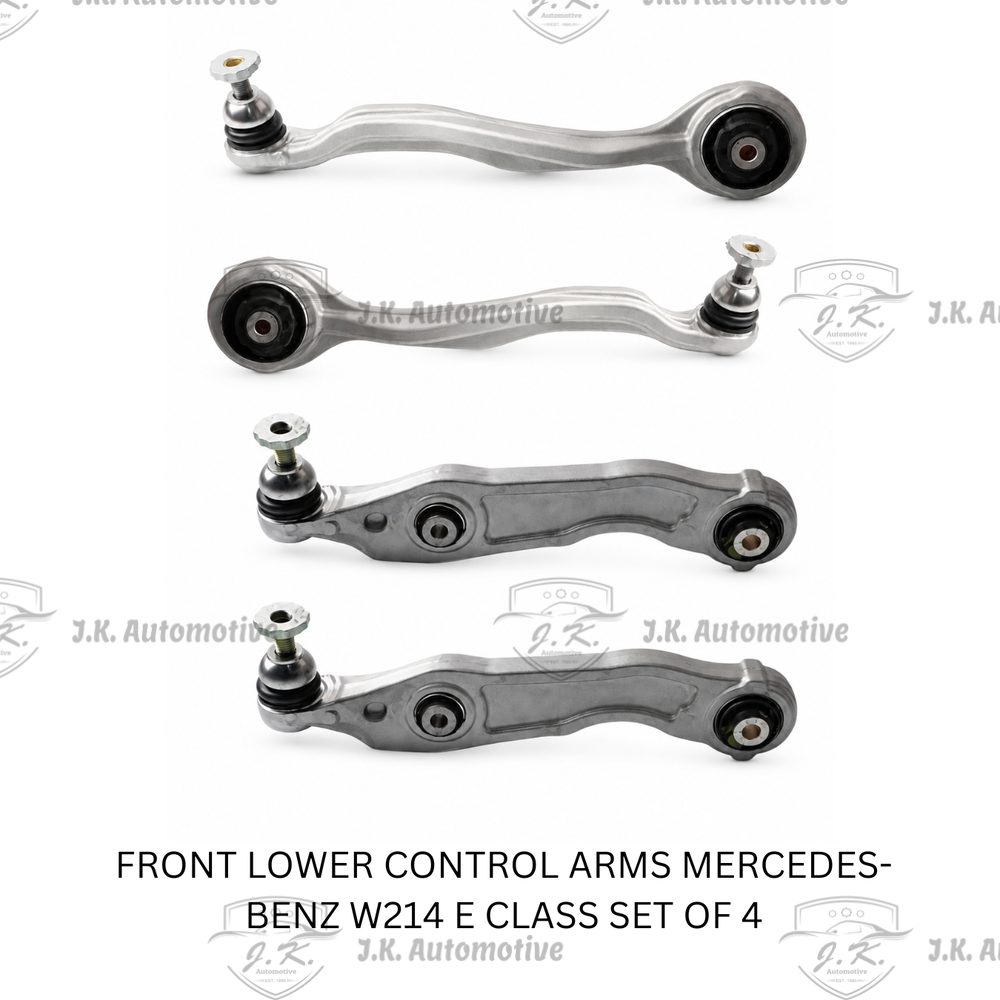
Mercedes E-Class W214 Front Lower Control Arms are important components of the front suspension system that help guide the front wheel assemblies, control suspension movement and maintain the designed relationship between the wheels and vehicle chassis. This Stokes Germany package is supplied as a complete set of 4 corresponding with OEM references A2143305700 & A2143305800 & A2143305400 & A2143305300 for the applicable front lower suspension positions. The four references are grouped with the W214 front suspension system in available application data, while A2143305700/A2143305800 and A2143305300/A2143305400 are identified as different lower suspension-arm/link positions rather than four identical pieces. The lower control arms may also be commonly searched as lower suspension arms, front wishbones, lower wishbone arms, suspension links or tension-related suspension arms depending on the exact component position and catalogue terminology. These components work together with the upper control arms, suspension bushes, ball joints, steering tie rod ends, shock absorbers and other suspension links to guide the wheels while allowing the suspension to move through its designed operating range. During everyday driving, the front suspension continuously responds to changes in the road surface. When the Mercedes-Benz E-Class W214 travels over potholes, speed breakers, broken roads or uneven surfaces, forces pass through the tyres and wheels into the suspension. The lower suspension arms help guide the wheel assemblies through this movement and limit unwanted movement relative to the chassis. Braking also transfers additional load towards the front axle, creating longitudinal forces through the tyres, wheels, bushes and control arms. Cornering generates lateral forces that must be managed by the suspension system as the vehicle changes direction. Correctly functioning lower arms therefore contribute to controlled wheel movement, predictable steering response and stable front suspension behaviour. Over time, repeated road impacts, normal mileage, ageing and continuous movement can cause deterioration in the bushes, joints or mounting areas associated with the lower arms. When excessive wear develops, possible symptoms can include knocking or clunking from the front suspension, steering vibration, vague steering response, unwanted wheel movement, reduced directional stability or irregular tyre wear. These symptoms should not automatically be blamed on the lower arms because several other components can produce similar problems. Upper control arms should be inspected for bush or joint wear, while steering tie rod ends and ball joints should be checked for excessive movement. Shock absorbers should be examined for leakage, damage or reduced damping, and wheel bearings should be inspected when noise, vibration or wheel play is present. Sway bar links, Sway links, Anti roll link rods and Stabiliser sway links should also be checked when knocking or rattling occurs over uneven roads. Tyres and wheels should be inspected for abnormal wear, damage, incorrect pressure and balancing problems. If professional diagnosis confirms deterioration in the applicable lower suspension components, replacing the diagnosed arms can remove excessive movement associated with those worn parts. Before ordering this set, A2143305700, A2143305800, A2143305400 and A2143305300 should be compared with the vehicle VIN and original components. Professional installation is recommended, followed by a wheel alignment check to verify suspension geometry after the repair.
Are A2143305700, A2143305800, A2143305400 and A2143305300 suitable for Mercedes-Benz E-Class W214?
A2143305700, A2143305800, A2143305400 and A2143305300 are relevant part references within the Mercedes-Benz E-Class W214 front suspension system, and the Stokes Germany product combines these four references as a Front Lower Control Arm Set of 4. Available W214 control-arm repair-kit data lists all four numbers within the front suspension application, while separate catalogue information identifies A2143305800/A2143305700 and A2143305400/A2143305300 as different front lower suspension-arm groups. Your current product specification lists the complete Stokes Germany set for Mercedes-Benz E-Class W214 2024–2026. However, suspension parts should never be selected only because the vehicle carries an E-Class W214 model designation. Modern Mercedes-Benz suspension configurations can vary according to drivetrain, suspension type, exact production specification and other vehicle equipment. One available W214 repair-kit application containing these references, for example, specifically identifies a 2WD vehicle without air suspension, which demonstrates why VIN-level verification is valuable before purchase. The safest selection method is therefore to verify the OEM references against the specific vehicle VIN and compare the original components before ordering. A2143305700, A2143305800, A2143305400 and A2143305300 should not automatically be treated as interchangeable numbers because they can correspond to different positions within the lower suspension arrangement. Correct component positioning is important because every suspension arm has specific mounting geometry and performs a particular role in controlling wheel movement. An incorrectly specified control arm should never be installed merely because it appears visually similar to the original component. Before purchasing the replacement set, the vehicle should also be professionally inspected to confirm that the lower arms are actually responsible for the reported suspension problem. Knocking or clunking can result from deteriorated lower-arm bushes or joints, but similar noises can originate from upper control arms, ball joints, steering tie rod ends or other suspension bushes. Shock absorbers can affect suspension control, while wheel bearings can produce noise, vibration or wheel play. Sway bar links, Sway links, Anti roll link rods and Stabiliser sway links should also be inspected because worn stabilizer components frequently produce knocking or rattling over uneven surfaces. Tyres and wheels should be checked for damage, incorrect pressure, balancing problems and irregular tread wear. If professional diagnosis confirms that the applicable lower arms require replacement and all four supplied references match the vehicle configuration, this Stokes Germany set provides the corresponding components together for the repair. Professional installation is recommended, and a wheel alignment check should be completed after replacement to verify the final suspension geometry.
Why does this Mercedes E-Class W214 Front Lower Control Arm package come as a set of 4?
This Mercedes E-Class W214 Front Lower Control Arms package is supplied as a set of 4 because the applicable front lower suspension arrangement uses multiple suspension arms or links rather than a single identical lower arm on each side, and this Stokes Germany package groups the corresponding components under OEM references A2143305700, A2143305800, A2143305400 and A2143305300. Available catalogue information groups A2143305700/A2143305800 separately from A2143305300/A2143305400 within the W214 front lower suspension system, supporting the fact that the four-piece package covers different corresponding positions rather than simply providing four copies of the same arm. A W214 front suspension repair-kit listing also includes these four OEM numbers together within its front control-arm package. This type of multi-link suspension arrangement uses several components to control wheel movement under different driving forces. As the Mercedes-Benz E-Class W214 travels over uneven surfaces, the wheel assembly needs to move vertically while remaining controlled relative to the chassis. During acceleration and braking, longitudinal forces are transferred through the tyres, wheels and suspension links, while cornering produces lateral loads through the front suspension. The different control arms and links help manage these forces and maintain controlled wheel positioning. Because several lower suspension components operate within the same system, more than one arm can eventually develop deterioration after prolonged mileage and exposure to poor road surfaces. However, all four components do not necessarily wear at exactly the same rate. One arm or bush may deteriorate earlier because of repeated pothole impacts, road-edge impacts or other operating conditions. Therefore, the fact that this product is supplied as a set of 4 does not mean that every arm must automatically be replaced whenever one component develops wear. A professional technician should inspect each arm, bush, joint and mounting area and determine which components require replacement. When all four applicable lower suspension components have significant wear, replacing the diagnosed set during the same workshop visit can provide a more comprehensive repair. It also makes sourcing convenient because the corresponding suspension components are supplied together rather than requiring separate purchases. Worn lower suspension arms can contribute to knocking, clunking, steering looseness, vibration, excessive wheel movement or irregular tyre wear when their bushes or joints develop excessive play. Replacing correctly diagnosed worn components can address the mechanical source of those symptoms, but new lower arms cannot correct unrelated faults elsewhere in the suspension. Upper control arms should also be inspected, along with steering tie rod ends, ball joints, shock absorbers, wheel bearings and other suspension bushes. Sway bar links, Sway links, Anti roll link rods and Stabiliser sway links should be checked when suspension noise is present. Before ordering the complete set, A2143305700, A2143305800, A2143305400 and A2143305300 should be verified using the vehicle VIN and original components. Professional installation followed by a wheel alignment check is recommended after replacement.
What are the common symptoms of worn front lower control arms on Mercedes-Benz E-Class W214?
Common symptoms associated with worn Mercedes E-Class W214 Front Lower Control Arms can include knocking or clunking noises from the front suspension, vague or loose steering response, steering vibration, unwanted wheel movement, reduced directional stability and irregular tyre wear, although the exact symptoms depend on which arm, bush, joint or mounting area has deteriorated and how severe the wear has become. This Stokes Germany replacement package is supplied as a set of 4 corresponding with A2143305700, A2143305800, A2143305400 and A2143305300 for the applicable W214 front lower suspension arrangement. These four references appear within W214 front suspension application data and represent multiple lower suspension positions. The control arms operate continuously whenever the vehicle is driven because every change in the road surface creates movement and loading through the front wheel assemblies. Potholes can produce sudden impact loads through the tyres and wheels, while speed breakers repeatedly move the suspension through its operating range. Rough roads generate continuous vibration through the suspension bushes and joints. Braking transfers additional load towards the front axle, while cornering creates lateral forces through the tyres, wheels and suspension links. Over time, these repeated loads can contribute to deterioration of rubber bushes, joints or mounting areas. An early symptom may be a light knocking sound when the vehicle travels over rough roads or small road imperfections. The noise may initially be intermittent but can become more noticeable as suspension play increases. A worn bush can allow more movement than intended, potentially making the steering feel less precise or the front suspension less settled. In some situations, the driver may notice vibration through the steering wheel or additional steering correction may be required to maintain direction. Excessive movement can also influence wheel positioning and may contribute to abnormal tyre wear if suspension geometry is affected. However, these symptoms do not automatically prove that the lower arms require replacement. A complete front suspension inspection should be carried out before purchasing parts. Upper control arms can develop bush or joint wear and produce similar knocking or movement. Ball joints and steering tie rod ends can develop excessive play that affects steering precision. Shock absorbers should be checked for leakage, physical damage or poor damping, while wheel bearings should be inspected if humming, vibration or wheel play is present. Sway bar links, Sway links, Anti roll link rods and Stabiliser sway links are especially important to inspect when rattling or knocking occurs over uneven surfaces because their worn joints can produce similar noises. Tyres should be checked for irregular wear, damage and correct pressure, while wheels should be examined for damage or balancing problems. If professional diagnosis confirms excessive wear in the applicable lower suspension components, the required arms can then be replaced. Before purchase, A2143305700, A2143305800, A2143305400 and A2143305300 should be verified against the VIN and existing components. Professional installation and a subsequent wheel alignment check are recommended.
What are the benefits of replacing Mercedes E-Class W214 Front Lower Control Arms as a set of 4?
Replacing Mercedes E-Class W214 Front Lower Control Arms as a set of 4 can provide a more comprehensive front lower suspension repair when professional inspection confirms significant deterioration across all four corresponding suspension components. This Stokes Germany package combines A2143305700, A2143305800, A2143305400 and A2143305300 in one set, allowing the applicable lower suspension arms or links to be sourced together rather than purchased separately. Your current product specification identifies the package as a set of four for the Mercedes-Benz E-Class W214 2024–2026. The lower suspension arms work as part of the same front suspension system and experience repeated movement whenever the vehicle is driven. Potholes, speed breakers, broken roads and other surface irregularities generate repeated loads through the tyres, wheels, bushes and control arms. Braking produces longitudinal forces through the suspension, while cornering generates lateral forces that must be controlled as the wheel assemblies change direction. Although all four components operate within the same suspension system, they do not necessarily deteriorate at exactly the same rate. One arm may experience more wear because of road impacts or differences in loading, while another component may remain serviceable for longer. For this reason, replacing the complete set should be based on professional inspection rather than automatically changing four components simply because one has developed wear. When all four applicable lower arms or their bushes and joints show significant deterioration, replacing them during the same repair can bring those components to a more consistent mechanical condition. It can also reduce the need to perform multiple closely related repairs at different times when several components are already approaching replacement condition. Correctly functioning lower suspension arms help limit unwanted wheel movement and contribute to controlled suspension behaviour. If worn bushes or joints are responsible for knocking, steering looseness or abnormal wheel movement, replacing the diagnosed components can address the mechanical source of those symptoms. The repair should still include an inspection of the surrounding suspension system because installing new lower arms cannot correct unrelated wear. Upper control arms should be checked for excessive movement, while ball joints and steering tie rod ends should be inspected carefully. Shock absorbers should be checked for leakage or reduced damping and wheel bearings should be examined when noise or wheel play is present. Sway bar links, Sway links, Anti roll link rods and Stabiliser sway links should also be inspected when suspension noise is reported. Tyres should be examined for existing abnormal tread wear because suspension replacement cannot reverse tyre damage that has already occurred. Before ordering the complete set, all four OEM references should be verified using the vehicle VIN and original components. Once correct fitment is confirmed, professional installation and a wheel alignment check are recommended to complete the repair properly.
Why choose Stokes Germany Front Lower Control Arm Set of 4 for Mercedes-Benz E-Class W214?
Why are Mercedes E-Class W214 Front Lower Control Arms important for steering, suspension and road stability?
Mercedes E-Class W214 Front Lower Control Arms are important components of the front suspension because they help guide the front wheel assemblies, control unwanted wheel movement and maintain the designed relationship between the wheels and vehicle chassis while driving. This Stokes Germany package is supplied as a set of 4 corresponding with OEM references A2143305700, A2143305800, A2143305400 and A2143305300 for the applicable front lower suspension positions. The W214 front suspension uses multiple links rather than relying on one simple lower arm on each side, which allows different suspension components to manage the various forces created during acceleration, braking, cornering and vertical wheel movement. A2143305700 and A2143305800 are catalogued as left and right front lower control-arm assemblies, while A2143305300 and A2143305400 correspond with left and right lower rearward positions. When the Mercedes-Benz E-Class W214 travels over a smooth road, the suspension components help maintain controlled wheel positioning as the tyres follow small changes in the road surface. When the vehicle encounters potholes, speed breakers or damaged roads, considerably larger forces travel through the tyres, wheels and suspension system. The lower control arms help guide the wheel assemblies through this movement instead of allowing uncontrolled movement relative to the chassis. During braking, weight transfers towards the front of the vehicle and longitudinal forces are transmitted through the front suspension. During cornering, lateral forces pass through the tyres, wheel assemblies and suspension links as the vehicle changes direction. The different lower arms therefore have an important role in controlling suspension geometry under changing driving conditions. Their bushes and joints are also important because they allow the required suspension movement while limiting excessive play. As mileage increases, repeated movement, ageing, road impacts and operating conditions can gradually cause deterioration in the bushes, joints or mounting areas. Excessive wear may allow unwanted movement within the wheel assembly and can contribute to knocking or clunking from the front suspension. The steering may begin to feel less precise, particularly when braking, cornering or travelling over uneven roads. Some drivers may notice vibration, additional steering correction or a less settled feeling from the front end. Significant suspension wear can also influence wheel positioning and may contribute to irregular tyre wear. However, these symptoms should be professionally diagnosed because lower control arms are only one part of the complete steering and suspension system. Upper control arms should also be inspected for worn bushes or joints. Ball joints and steering tie rod ends should be checked for excessive play, while shock absorbers should be inspected for leakage, physical damage or reduced damping. Wheel bearings should be checked when noise, vibration or wheel movement is present. Sway bar links, Sway links, Anti roll link rods and Stabiliser sway links should also be inspected when knocking or rattling occurs over rough roads. Tyres and wheels should be examined for damage, incorrect pressure, abnormal tread wear and balancing problems. If professional inspection confirms significant deterioration in the applicable lower suspension components, replacing the diagnosed arms can remove excessive movement associated with those worn parts. Before ordering, A2143305700, A2143305800, A2143305400 and A2143305300 should be verified against the VIN and original components. Professional installation followed by a wheel alignment check is recommended after replacement.
Is wheel alignment required after replacing Stokes Germany Front Lower Control Arms on Mercedes-Benz E-Class W214?
A professional wheel alignment check is strongly recommended after replacing Mercedes E-Class W214 Front Lower Control Arms because these components form part of the front suspension system responsible for locating and guiding the wheel assemblies relative to the vehicle chassis. This Stokes Germany package contains four corresponding lower suspension components represented by OEM references A2143305700, A2143305800, A2143305400 and A2143305300, so replacing the complete set represents substantial work within the front suspension. The control arms and their bushes help maintain controlled wheel positioning while the suspension moves, and excessive deterioration can allow unwanted movement that may affect how consistently the wheel remains positioned during driving. Replacing the worn components removes the excessive movement associated with those parts, but simply installing new arms does not confirm that the final wheel geometry is within the required specification. This is why a professional alignment check is an important final stage of a comprehensive suspension repair. Wheel alignment equipment measures relevant wheel angles and allows the technician to determine whether permitted adjustments are necessary after the suspension work. Correct geometry is important because the tyres need to maintain appropriate positioning relative to the road while the vehicle travels in a straight line, brakes and changes direction. If the alignment is outside specification, the driver may notice that the vehicle pulls towards one side or that the steering wheel does not remain correctly centred while travelling straight. Incorrect geometry can also make steering behaviour feel inconsistent and can contribute to accelerated or uneven tyre wear. Tyres can be expensive components, so completing the alignment check after substantial suspension work can also help protect the replacement suspension work from being followed by unnecessary tyre wear caused by incorrect geometry. Before alignment is performed, however, the workshop should inspect the complete steering and suspension system because excessive play in another component can interfere with accurate measurements. Upper control arms should be inspected for worn bushes and joints. Steering tie rod ends and ball joints should be checked carefully for excessive movement. Shock absorbers should be examined for leakage, damage or reduced damping, while wheel bearings should be inspected if wheel play, humming or vibration is present. Sway bar links, Sway links, Anti roll link rods and Stabiliser sway links should also be checked when suspension noise is present. Tyre pressure should be corrected before alignment and existing tread wear should be inspected. Wheels should be checked for damage and wheel balancing should be considered separately if vibration occurs at particular road speeds. Wheel balancing and wheel alignment are different procedures: balancing concerns the rotational mass distribution of the wheel and tyre assembly, while alignment concerns wheel geometry relative to the vehicle. Correct part fitment is equally important before any alignment work is completed. A2143305700, A2143305800, A2143305400 and A2143305300 should therefore be verified using the VIN and original components before installation. Once the correct arms are professionally installed and all related steering and suspension components are confirmed to be serviceable, a professional wheel alignment check helps complete the repair and supports predictable steering response, straight-line stability and balanced tyre wear.
What problems can occur if worn Mercedes E-Class W214 Front Lower Control Arms are not replaced?
Worn Mercedes E-Class W214 Front Lower Control Arms can contribute to progressively increasing suspension noise, unwanted wheel movement, vague steering response, vibration, reduced directional stability and irregular tyre wear when significantly deteriorated bushes, joints or mounting areas remain in service. This Stokes Germany set corresponds with A2143305700, A2143305800, A2143305400 and A2143305300 for the applicable W214 front lower suspension positions, and these components operate continuously whenever the vehicle is being driven. Every pothole, speed breaker and uneven road surface creates movement through the tyres, wheels and suspension links. Braking produces additional longitudinal forces through the front axle, while cornering generates lateral loads as the vehicle changes direction. These forces are repeatedly transmitted through the lower control arms, bushes, joints and mounting points throughout the operating life of the vehicle. Rubber-to-metal bushes can gradually deteriorate because of ageing and repeated movement, while joints and other mechanical interfaces can develop play as mileage accumulates. When wear is relatively minor, the driver may initially notice only an occasional knock or clunk while travelling over a rough road. As deterioration becomes more significant, the noise can become more frequent and suspension movement may become easier to detect. The steering may begin to feel vague or less precise because excessive movement within a suspension component can affect how consistently the wheel is controlled. During braking, the front end may feel less settled if substantial play is present in one or more lower suspension arms. During cornering or rapid directional changes, unwanted movement may also affect the consistency of steering response. Excessive suspension play can influence wheel positioning and may contribute to irregular tyre wear when geometry is affected. Continuing to drive for an extended period with a significantly worn suspension component can allow the associated symptoms to become progressively more noticeable. It may also complicate diagnosis later because multiple components can develop wear over time. However, replacing the lower arms without diagnosis is not recommended because similar symptoms can originate from several other components. Upper control arms can develop worn bushes or joints and produce knocking or wheel movement. Steering tie rod ends and ball joints can create steering looseness when excessive play develops. Shock absorbers can lose damping performance and make the front suspension feel less controlled. Wheel bearings can produce humming, vibration or wheel movement. Sway bar links, Sway links, Anti roll link rods and Stabiliser sway links are particularly important to inspect when rattling or knocking occurs over small road imperfections because their worn joints can create similar sounds. Tyres and wheels should also be inspected because damaged tyres, irregular tread wear, incorrect pressure, wheel imbalance or bent wheels can cause vibration and steering problems. A complete suspension inspection is therefore the correct approach before ordering replacement parts. If A2143305700, A2143305800, A2143305400 and A2143305300 are confirmed for the specific vehicle and professional diagnosis identifies excessive wear in the applicable lower arms, replacing the worn components can address the mechanical source of that movement. Professional installation is recommended, followed by a wheel alignment check to verify suspension geometry after the repair.
Why is replacing the Mercedes E-Class W214 Front Lower Control Arms as a complete set of 4 beneficial when all four are worn?
Replacing Mercedes E-Class W214 Front Lower Control Arms as a complete set of 4 can be beneficial when professional inspection confirms significant deterioration in all four corresponding lower suspension components because the affected parts can then be renewed during the same front suspension repair. This Stokes Germany package combines OEM references A2143305700, A2143305800, A2143305400 and A2143305300 in one set, providing the applicable lower suspension components together rather than requiring each arm to be sourced separately. The four references do not simply represent four identical pieces: available catalogue data identifies A2143305700 as front left lower, A2143305800 as front right lower, A2143305300 as front left lower rearward and A2143305400 as front right lower rearward. These components therefore perform corresponding roles within the multi-link front suspension arrangement and collectively help guide the wheel assemblies under changing road and driving forces. During normal use, all four components are repeatedly exposed to suspension movement caused by potholes, speed breakers, uneven surfaces and general road vibration. Braking generates longitudinal forces through the suspension, while cornering creates lateral loads through the tyres, wheels and suspension links. Although all four arms work within the same suspension system, they do not necessarily deteriorate at exactly the same rate. One bush or joint can wear sooner because of repeated pothole impacts or different road loading on one side of the vehicle. Therefore, replacing a complete set should be based on actual inspection rather than automatically replacing four serviceable components because one arm has developed wear. When all four corresponding lower arms have significant bush, joint or mounting-area deterioration, however, replacing them during the same repair can bring those components to a more consistent mechanical condition. A complete set can also simplify parts sourcing because the corresponding lower suspension arms are available together. It may reduce the need for multiple closely related workshop visits if several arms have already been diagnosed as requiring replacement. Correctly functioning lower control arms help limit unwanted wheel movement, so replacing worn components can address knocking, vague steering or abnormal suspension movement when those symptoms have been correctly traced to the arms. The rest of the suspension should still be inspected because installing four new lower arms cannot correct unrelated wear elsewhere. Upper control arms should be checked for bush and joint deterioration. Steering tie rod ends and ball joints should be inspected for excessive movement. Shock absorbers should be checked for leakage, damage or reduced damping, while wheel bearings should be examined when noise or wheel play is present. Sway bar links, Sway links, Anti roll link rods and Stabiliser sway links should also be inspected when knocking or rattling is reported. Tyres should be examined for existing irregular tread wear because suspension repair cannot reverse tyre damage that has already occurred. Before ordering the set, all four OEM references should be checked against the VIN and original suspension components. Once compatibility and the need for replacement are confirmed, professional installation followed by a wheel alignment check provides the appropriate approach to completing the suspension repair.
Why is Stokes Germany a European-quality alternative to Lemförder, FEBI, Meyle and other established brands for Mercedes E-Class W214?
Stokes Germany can be considered as an alternative when purchasing Mercedes E-Class W214 Front Lower Control Arms if the supplied OEM cross-references, component specifications, vehicle compatibility, package contents, warranty, price, availability and after-sales support meet the customer's requirements. This Stokes Germany package provides a set of 4 corresponding with A2143305700, A2143305800, A2143305400 and A2143305300 for the applicable W214 front lower suspension positions, and the current product listing identifies the package for Mercedes-Benz E-Class W214 2024–2026 with a six-month warranty against manufacturing defects. When comparing Stokes Germany with established suspension brands such as Lemförder, FEBI, Meyle and other aftermarket manufacturers, correct fitment should always be the first consideration rather than selecting a component solely because of its brand name or appearance. Suspension arms offered for the same general vehicle application can have differences in dimensions, bush specifications, joint design, mounting geometry and application coverage. The four OEM references should therefore be verified against the vehicle VIN and original components before purchase. This is especially important with the W214 because available repair-kit data demonstrates that front control-arm application can depend on vehicle configuration; one documented kit containing these references, for example, specifies 2WD without air suspension. Once compatibility is established, customers can compare replacement options according to the factors that matter for their particular repair, including the number of components supplied, specification, warranty terms, price, product availability and supplier support. Stokes Germany, Lemförder, FEBI and Meyle remain separate brands with their own product ranges, manufacturing arrangements and warranty policies, so their components should not automatically be described as identical simply because they cross-reference the same Mercedes-Benz application. Likewise, sharing an OEM reference does not by itself prove identical materials, manufacturing processes or service life. A useful advantage of this Stokes Germany package is that the four corresponding lower suspension components are supplied together when a workshop has diagnosed wear across the complete applicable group. Replacing correctly diagnosed worn lower arms can remove excessive movement associated with deteriorated bushes, joints or mounting areas. This can help address knocking, clunking, vague steering or abnormal suspension movement when those symptoms are actually caused by the existing lower arms. However, component quality is only one part of a successful suspension repair. Correct diagnosis, accurate fitment verification and installation quality are equally important. Upper control arms should be inspected for deterioration, while ball joints and steering tie rod ends should be checked for excessive play. Shock absorbers should be examined for leakage or reduced damping, and wheel bearings should be inspected when noise or wheel movement is present. Sway bar links, Sway links, Anti roll link rods and Stabiliser sway links should also be checked because their worn joints can create suspension noise. Tyres and wheels should be inspected for abnormal wear, damage and balancing problems. The selected arms should then be professionally installed using appropriate suspension procedures and tightening specifications. A wheel alignment check should follow the repair to verify the final geometry. Therefore, when A2143305700, A2143305800, A2143305400 and A2143305300 are confirmed for the specific Mercedes-Benz E-Class W214 and all four corresponding lower suspension components require replacement, Stokes Germany can be evaluated alongside Lemförder, FEBI, Meyle and other established options based on fitment, specification, value, warranty, availability and after-sales support rather than unsupported claims of identical construction or superiority.
Reviews
There are no reviews yet.