What are Mercedes-Benz GLE W166 Front Lower Arms and what is their function in the suspension?
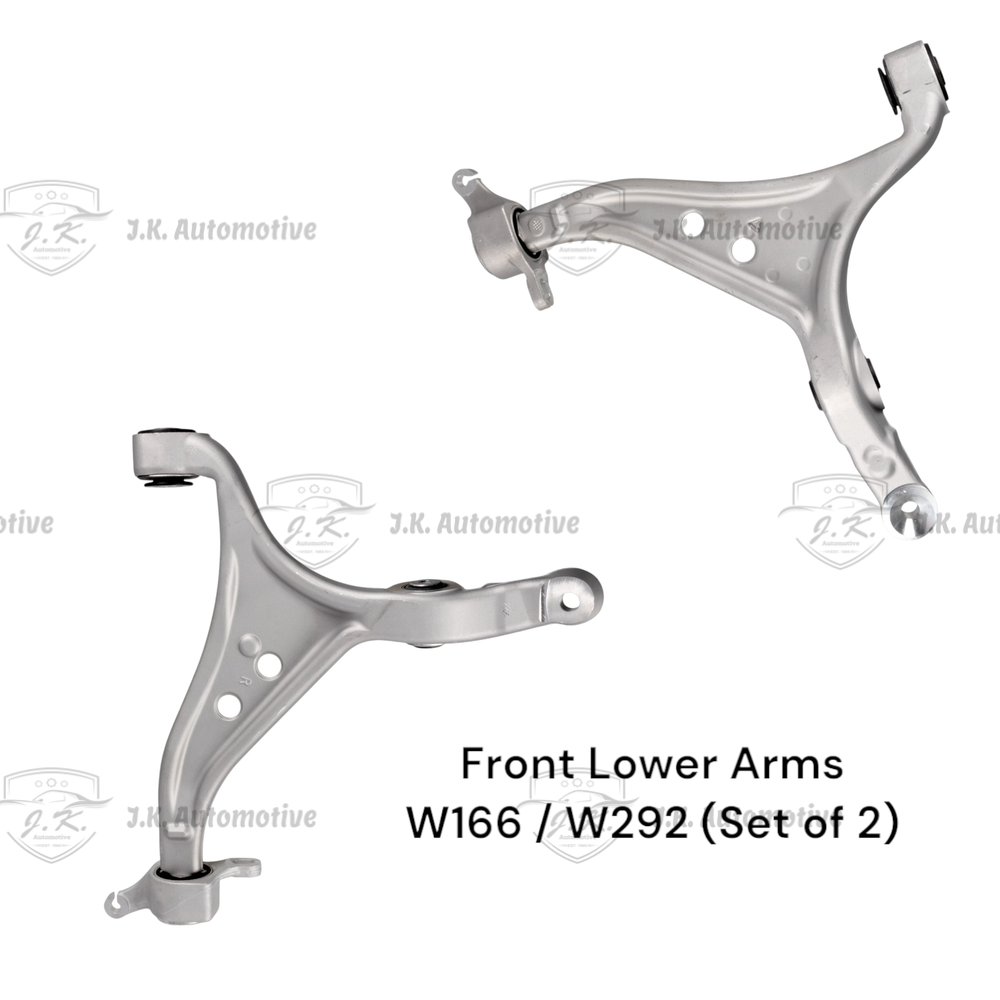
Mercedes-Benz GLE W166 Front Lower Arms are major front suspension components designed to help connect and control the front wheel assemblies relative to the vehicle chassis while maintaining stable suspension geometry, controlled wheel movement and predictable steering behaviour. This product is supplied as a set of 2 for the stated Mercedes-Benz GLE W166 2011–2019 application with OEM references A1663300107 & A1663300207, with A1663300107 corresponding to the left-side lower control arm and A1663300207 corresponding to the right-side lower control arm. These components may also be described as lower control arms, front lower suspension arms, wishbone arms or transverse control arms, and they work together with the ball joints, suspension bushes, steering components, shock absorbers and other chassis parts. During normal driving, the front wheels must move vertically as the suspension responds to potholes, speed breakers, broken roads, road joints and changing surfaces. The lower arms help guide this movement while helping restrict excessive forward, backward or sideways movement of the wheel assemblies. When the vehicle brakes, significant load transfers towards the front axle and the lower suspension arms experience changing forces through their bushes, joints and mounting points. During acceleration, cornering and lane changes, the arms continue helping maintain controlled wheel positioning. Because these components operate continuously, their bushes and joints can gradually deteriorate as mileage increases. Rubber bushes may harden, crack, deform or develop excessive movement, while joints and mounting areas can also develop unwanted play. Possible symptoms of worn lower arms include knocking or clunking noises, vibration, loose steering response, reduced stability during braking, irregular tyre wear and repeated wheel-alignment problems. Replacing professionally diagnosed worn components can help restore more controlled suspension movement, but lower arms should not automatically be blamed for every front-end noise. Upper control arms, ball joints, steering tie rod ends, wheel bearings, shock absorbers and other suspension bushes should also be inspected. Sway bar links, Sway links, Anti roll link rods and Stabiliser sway links should be checked when knocking or rattling occurs over uneven roads. Before ordering, A1663300107 & A1663300207 should be compared with the original components and verified against the VIN and exact vehicle specification. Professional installation followed by a wheel alignment check is recommended.
Are OEM A1663300107 & A1663300207 suitable for Mercedes-Benz GLE W166 models from 2011–2019?
OEM references A1663300107 & A1663300207 are the references supplied with this set of Mercedes-Benz GLE W166 Front Lower Arms for the stated 2011–2019 application, and available parts catalogues identify A1663300107 as a left-side control arm and A1663300207 as the corresponding right-side lower control arm for the W166 platform. Your current JK Automotive catalogue also lists a GLE W166 product using these two OEM numbers and the 2011–2019 year range. However, customers should not rely only on the model name and year range when ordering suspension components because exact compatibility can depend on VIN, production date, drivetrain, suspension specification and other vehicle-specific configurations. The safest method is to compare A1663300107 & A1663300207 with the OEM numbers associated with the existing suspension components and confirm compatibility using the vehicle VIN before ordering. This is particularly important with premium European vehicles because suspension components can look visually similar while having different mounting dimensions, bush arrangements or application requirements. Once compatibility has been established, the lower control arms form an important part of the front suspension assembly. They help guide the wheel assemblies while the suspension moves over uneven roads and help maintain controlled wheel positioning during braking, acceleration and cornering. The bushes and joints associated with these components experience repeated mechanical loads throughout normal driving. With increasing mileage or frequent rough-road use, bushes can crack, deform, soften or develop excessive movement. Worn components may contribute to knocking, steering vibration, vague handling, instability during braking or irregular tyre wear. These symptoms are not exclusive to lower arms, so professional diagnosis is important. Upper control arms, ball joints, tie rod ends, wheel bearings, shock absorbers and other suspension bushes should be checked at the same time. Sway bar links, Sway links, Anti roll link rods and Stabiliser sway links should also be inspected when knocking or rattling is present. Tyre condition, tyre pressure, wheel balancing and alignment should additionally be examined where appropriate. After the correct arms have been verified and professionally installed, a wheel alignment check is recommended to help maintain correct suspension geometry and balanced tyre wear.
What is the difference between A1663300107 and A1663300207 in this Mercedes-Benz GLE W166 Front Lower Arm set?
The main difference between A1663300107 and A1663300207 is their installation side within the front suspension assembly: available suspension catalogues identify A1663300107 as the front lower left control arm and A1663300207 as the front lower right control arm, which is why this Mercedes-Benz GLE W166 product is supplied as a set of 2 rather than two identical interchangeable arms. Mercedes-Benz's parts catalogue also describes 1663300207 as the bottom-right transverse control arm, further supporting its right-side positioning. This distinction is important because left and right suspension arms can have mirrored shapes, different mounting orientations and position-specific geometry even though they perform the same general suspension function. A customer should therefore never assume that A1663300107 can simply be installed in the position intended for A1663300207 or vice versa. Both arms work together across the front axle to guide wheel movement and help maintain controlled suspension geometry. During normal driving, the front wheels move vertically as the suspension responds to road conditions, while braking and cornering also create longitudinal and lateral forces. The lower arms help control these movements through their mounting points, bushes and associated joints. When one or both arms become worn, the vehicle may develop knocking or clunking noises, excessive movement, steering vibration, reduced stability or abnormal tyre wear. Replacing the corresponding left and right components can provide a more complete repair when both sides have been professionally diagnosed as worn. However, a workshop should inspect the complete suspension rather than automatically replacing parts based only on age or mileage. Upper control arms, ball joints, steering tie rod ends, shock absorbers, wheel bearings and suspension bushes can produce similar symptoms. Sway bar links, Sway links, Anti roll link rods and Stabiliser sway links should also be checked, particularly when the main complaint is knocking over smaller bumps. Before ordering, both A1663300107 and A1663300207 should be checked against the vehicle VIN and existing components. Correct left/right installation according to the appropriate repair procedure is essential, and a professional wheel alignment check is recommended after replacement.
What are the common symptoms of worn Mercedes-Benz GLE W166 Front Lower Arms?
Common symptoms of worn Mercedes-Benz GLE W166 Front Lower Arms can include knocking or clunking noises from the front suspension, vibration through the steering wheel or vehicle body, vague or loose steering response, reduced stability during braking, inconsistent handling, abnormal tyre wear and repeated wheel-alignment problems. The lower control arms with OEM references A1663300107 & A1663300207 operate whenever the front suspension moves, with A1663300107 used for the left-side application and A1663300207 for the right-side application. Every time the vehicle passes over a pothole, speed breaker, broken road or uneven surface, the front wheels move through their suspension travel and mechanical forces pass through the control arms, bushes, joints and mounting points. Additional loads are generated during braking, acceleration and cornering. Over time, rubber bushes can harden, crack, deform, separate or develop excessive movement. Joints and mounting points can also develop wear, and a suspension arm itself can potentially become damaged following a significant pothole impact, kerb strike or accident. A common early symptom is knocking or clunking from the front end, especially when travelling over uneven roads. As suspension play increases, steering may begin to feel less precise because the wheel assembly can move more than intended when forces change. During braking, excessive bush movement may contribute to an unsettled front end, while prolonged suspension wear can contribute to abnormal tyre wear or difficulty maintaining consistent alignment. However, these symptoms do not automatically confirm that the lower arms require replacement. Upper control arms can create similar noises or unwanted wheel movement. Ball joints and steering tie rod ends can contribute to steering play. Wheel bearings can create vibration or noise, while worn shock absorbers can reduce suspension control. Sway bar links, Sway links, Anti roll link rods and Stabiliser sway links should be carefully inspected when knocking or rattling is most noticeable over small road irregularities. Tyre damage, incorrect tyre pressure, wheel imbalance and incorrect alignment can also contribute to vibration and tyre wear. A professional inspection should therefore identify the actual source of the symptoms before parts are ordered. If the lower arms are confirmed as worn, verify A1663300107 & A1663300207 against the VIN and original components, install them professionally and perform a wheel alignment check afterwards.
What are the benefits of replacing Mercedes-Benz GLE W166 Front Lower Arms as a set of 2?
Replacing Mercedes-Benz GLE W166 Front Lower Arms as a set of 2 can provide a more complete front suspension repair when both corresponding lower control arms have been inspected and confirmed as worn, damaged or excessively loose. This product contains the left-side A1663300107 and right-side A1663300207 lower control arms, allowing the corresponding components on both sides of the front axle to be replaced during the same repair when required. Suspension components on the left and right sides experience broadly similar mileage, road conditions, braking forces and suspension movement, although they do not necessarily wear at exactly the same rate. Vehicles regularly driven over potholes, speed breakers or damaged roads can place substantial repeated loads on suspension bushes and joints. When both lower arms have deteriorated, replacing the pair can help provide more consistent bush condition and suspension response across the front axle rather than combining a new component on one side with a heavily worn component on the opposite side. Serviceable lower arms help guide and control the front wheel assemblies during suspension travel while maintaining more predictable wheel positioning during braking, acceleration and cornering. If worn bushes allow excessive movement, the driver may experience knocking, vibration, vague steering, instability or irregular tyre wear. Replacing the diagnosed worn pair can help eliminate unwanted movement originating from those components. However, replacing both arms should be based on actual condition rather than assuming that every vehicle automatically needs both sides replaced. The complete suspension should be inspected before the repair. Upper control arms, ball joints, steering tie rod ends, shock absorbers, wheel bearings and surrounding suspension bushes should all be examined. Sway bar links, Sway links, Anti roll link rods and Stabiliser sway links should be checked because these parts can produce similar knocking or rattling noises. Tyres should also be inspected for abnormal wear or physical damage. Before purchasing the set, A1663300107 & A1663300207 should be compared with the original parts and verified using the VIN and exact vehicle specification. Once compatibility has been confirmed and the arms have been professionally installed according to the appropriate suspension repair procedure, a wheel alignment check is recommended to help maintain stable steering, correct wheel geometry and balanced tyre wear.
Can replacing worn Mercedes-Benz GLE W166 Front Lower Arms improve steering stability, handling and driving comfort?
Replacing worn Mercedes-Benz GLE W166 Front Lower Arms can help restore more controlled steering, predictable handling and consistent suspension behaviour when excessive movement in the original lower control arm bushes, joints or mounting areas has been professionally identified as the source of the problem. This set uses OEM references A1663300107 & A1663300207 for the stated Mercedes-Benz GLE W166 2011–2019 application, providing the corresponding left and right suspension components as a pair. The lower control arms help control the relationship between the wheel assemblies and vehicle chassis while allowing the suspension to move over potholes, speed breakers, road joints and other changing surfaces. During braking, acceleration and cornering, the arms and their bushes are subjected to substantial changing forces. When the bushes and joints remain serviceable, they permit the required suspension movement while helping restrict excessive unwanted movement. As these components deteriorate, additional movement can develop around the wheel assembly. This may make the steering feel less precise, produce knocking or clunking noises or make the vehicle feel less settled during braking and cornering. Replacing professionally diagnosed worn lower arms can help remove excessive movement originating from those components, which can contribute to more controlled front suspension operation and predictable steering behaviour. It can also help address alignment-related tyre wear when worn arm bushes were contributing to inconsistent wheel positioning. However, new lower arms cannot correct faults elsewhere in the vehicle. Upper control arms, steering tie rod ends, ball joints, shock absorbers, wheel bearings and other suspension bushes should therefore be inspected at the same time. Sway bar links, Sway links, Anti roll link rods and Stabiliser sway links should be checked if knocking or rattling noises remain because these components can create similar symptoms. Tyres should be inspected for abnormal wear or damage, and wheel balancing should be considered if vibration remains after the suspension repair. Exact compatibility of A1663300107 & A1663300207 should be verified against the existing components, VIN and vehicle specification before ordering. Correct professional installation is important because suspension mounting points and fasteners must be handled according to the appropriate repair procedure. After replacement, a professional wheel alignment check is recommended to help maintain correct suspension geometry, stable steering response, controlled road behaviour and balanced tyre wear.
Why are good-quality Mercedes-Benz GLE W166 Front Lower Arms important for steering, suspension performance and road stability?
Mercedes-Benz GLE W166 Front Lower Arms are important parts of the front suspension system because they help guide the front wheel assemblies and maintain controlled wheel positioning while the vehicle accelerates, brakes, corners or travels over uneven roads. This product is supplied as a set of 2 with OEM references A1663300107 & A1663300207 for the stated Mercedes-Benz GLE W166 2011–2019 application, with A1663300107 corresponding to the front lower left position and A1663300207 corresponding to the front lower right position. Lower control arms are continuously subjected to mechanical forces during everyday driving. When the vehicle travels over potholes, speed breakers, broken roads or road joints, the front wheels move vertically through the suspension travel while the lower arms help control their relationship with the chassis. During braking, substantial load transfers towards the front axle, while cornering generates lateral forces that also pass through the suspension components. During acceleration and lane changes, the lower arms continue working with bushes, joints and other chassis components to help maintain predictable wheel movement. Good-quality, correctly specified replacement arms are therefore important when the existing components have been professionally diagnosed as worn or damaged. Worn bushes can allow excessive forward, backward or sideways movement of the wheel assembly, potentially contributing to knocking or clunking noises, steering vibration, vague handling, braking instability or uneven tyre wear. The condition of the lower arms can also influence how consistently the suspension maintains its geometry under changing road loads. However, replacing lower arms should be based on proper diagnosis because similar symptoms can originate from several other components. Upper control arms, ball joints, steering tie rod ends, shock absorbers, wheel bearings and other suspension bushes should be inspected. Sway bar links, Sway links, Anti roll link rods and Stabiliser sway links should also be checked when knocking or rattling occurs over uneven roads. Tyre condition, wheel balancing and alignment should be considered when vibration or abnormal tyre wear is present. Correct OEM matching is especially important because suspension configurations can differ, and Mercedes-Benz's parts information notes application-specific suspension requirements for these components. Before ordering, A1663300107 & A1663300207 should therefore be compared with the original components and confirmed against the VIN and exact suspension specification. Professional installation and a wheel alignment check are recommended after replacement.
Should wheel alignment be done after replacing Mercedes-Benz GLE W166 Front Lower Arms?
Yes, a professional wheel alignment check is strongly recommended after replacing Mercedes-Benz GLE W166 Front Lower Arms because the lower control arms directly influence how the front wheel assemblies are located relative to the chassis and work as part of the system responsible for maintaining suspension geometry. This product is supplied as a left and right pair using OEM references A1663300107 & A1663300207 for the stated Mercedes-Benz GLE W166 2011–2019 application. Available suspension catalogues identify A1663300107 as the front lower left control arm and A1663300207 as the corresponding front lower right control arm. When the bushes or joints in an old lower arm become worn, the wheel assembly may develop unwanted movement under braking, acceleration or cornering loads. If this deterioration continues for a long period, tyre wear patterns and steering behaviour may also change. Installing new suspension arms removes excessive movement originating from the replaced components, but the vehicle's wheel geometry should still be measured afterwards. Wheel alignment allows a technician to check whether the front wheels are positioned according to the required specifications and whether adjustment is needed. Incorrect alignment can contribute to inner-edge or outer-edge tyre wear, steering pull, an off-centre steering wheel and reduced steering consistency. Alignment is therefore not simply about making the steering wheel appear straight; it is an important measurement of the relationship between the wheels and chassis. Before alignment is performed, the workshop should inspect the remaining steering and suspension components because excessive play elsewhere can interfere with accurate alignment measurements. Upper control arms, ball joints, steering tie rod ends, shock absorbers, wheel bearings and surrounding suspension bushes should be checked for deterioration or unwanted movement. Sway bar links, Sway links, Anti roll link rods and Stabiliser sway links should also be inspected when knocking or rattling noises are present. Tyre pressures should be correct and tyres should be inspected for abnormal wear or damage. Wheel balancing should be considered when vibration remains. Correct installation of the lower arms is equally important because suspension fasteners and bush mounting points must be handled according to the appropriate repair procedure. The exact compatibility of A1663300107 & A1663300207 should be verified through the VIN and original part numbers before installation, particularly because suspension configuration can affect application. Once the repair is complete, professional wheel alignment helps ensure that the suspension is operating from a properly checked geometric baseline and supports stable steering, predictable handling and balanced tyre wear.
Can worn Mercedes-Benz GLE W166 Front Lower Arms cause knocking, steering vibration, braking instability and uneven tyre wear?
Yes, worn Mercedes-Benz GLE W166 Front Lower Arms can contribute to knocking or clunking noises, steering vibration, loose or vague handling, instability during braking and uneven tyre wear when their bushes, joints or mounting areas develop excessive deterioration or unwanted movement. A1663300107 and A1663300207 are catalogued as the corresponding left and right front lower control arms, and Mercedes-Benz describes the right-side component as a lower suspension or transverse control arm that incorporates multiple bushings and a bearing bracket in applicable configurations. These bushes are important because they allow the suspension to move where required while helping restrict uncontrolled movement of the wheel assembly. During normal driving, the arms experience repeated forces whenever the vehicle passes over potholes, speed breakers, road joints or damaged surfaces. Braking creates significant longitudinal loading through the suspension, while cornering adds lateral forces. As rubber bushes age, they can harden, crack, deform, separate or develop excessive movement. A suspension joint or mounting point can also wear, and the metal arm itself may potentially be damaged following a severe pothole impact, kerb strike or accident. One possible symptom is a knocking or clunking sound from the front suspension when travelling over uneven roads. If bush movement becomes excessive, the wheel may move more than intended when braking, which can make the vehicle feel less settled. Steering may become vague or require more correction because wheel position can change slightly as loads move through the suspension. Abnormal tyre wear can develop if excessive movement contributes to inconsistent suspension geometry over an extended period. However, these symptoms do not automatically confirm that A1663300107 & A1663300207 require replacement. Upper arms, ball joints, steering tie rod ends, shock absorbers and wheel bearings can produce similar symptoms. Sway bar links, Sway links, Anti roll link rods and Stabiliser sway links should be inspected particularly carefully when the main complaint is knocking or rattling over smaller road irregularities. Tyre damage, incorrect pressure, wheel imbalance and incorrect alignment can also cause vibration or uneven wear. A professional inspection of the complete front suspension is therefore recommended before replacement parts are ordered. If the lower arms are confirmed as worn, the original OEM references, VIN and suspension specification should be checked before installation, followed by professional wheel alignment after the repair.
Why should worn Mercedes-Benz GLE W166 Front Lower Arms be replaced at the correct time?
Worn Mercedes-Benz GLE W166 Front Lower Arms should be replaced when professional inspection confirms excessive bush deterioration, joint play, physical damage or uncontrolled movement because these components have an important role in maintaining front wheel position and controlled suspension behaviour. The set uses OEM references A1663300107 & A1663300207, which are documented as left and right front lower control arms respectively. Every time the vehicle accelerates, brakes, corners or travels over uneven roads, forces are transferred through the lower suspension arms and their bushes. Potholes, speed breakers and broken road surfaces add repeated impact loading, while the weight and momentum of the vehicle create substantial loads during braking and directional changes. As mileage increases, rubber bushes can gradually harden, crack, deform or separate, allowing more movement than intended. A suspension arm may also become bent or damaged after a severe road impact. Early wear may initially cause only an occasional knock or clunk over uneven surfaces, but as deterioration increases the vehicle can develop more noticeable steering looseness, vibration, braking instability or irregular tyre wear. Replacing a professionally diagnosed worn component at the appropriate time can help remove unwanted movement originating from that component and restore more consistent suspension operation. Waiting until a bush is severely deteriorated can allow the suspension to operate with increased movement for a longer period, potentially contributing to tyre wear or making other front-end symptoms more noticeable. However, parts should not be replaced solely because a noise is present. The complete front suspension should first be inspected to determine the actual source. Upper control arms, ball joints, tie rod ends, shock absorbers, wheel bearings and suspension bushes can all produce symptoms similar to worn lower arms. Sway bar links, Sway links, Anti roll link rods and Stabiliser sway links should be inspected when the main complaint is knocking over smaller bumps or rough surfaces. Tyres should be examined for abnormal wear or damage, while wheel balancing should be considered if vibration is present. Correct part identification is also essential. Mercedes-Benz lists A1663300207 as a front right lower control arm and notes suspension-specific application conditions, so VIN verification should form part of the ordering process. Once the correct A1663300107 & A1663300207 components have been verified and professionally installed, a wheel alignment check is recommended to help maintain controlled steering, correct suspension geometry and balanced tyre wear.
Why is Stokes Germany a European-quality alternative to Lemförder, FEBI, Meyle and other established brands for Mercedes-Benz GLE W166?


Reviews
There are no reviews yet.