What are Front Upper Arms for Jaguar XE X760 T4N1130 & T4N1128, and what is included in this Set of 2?
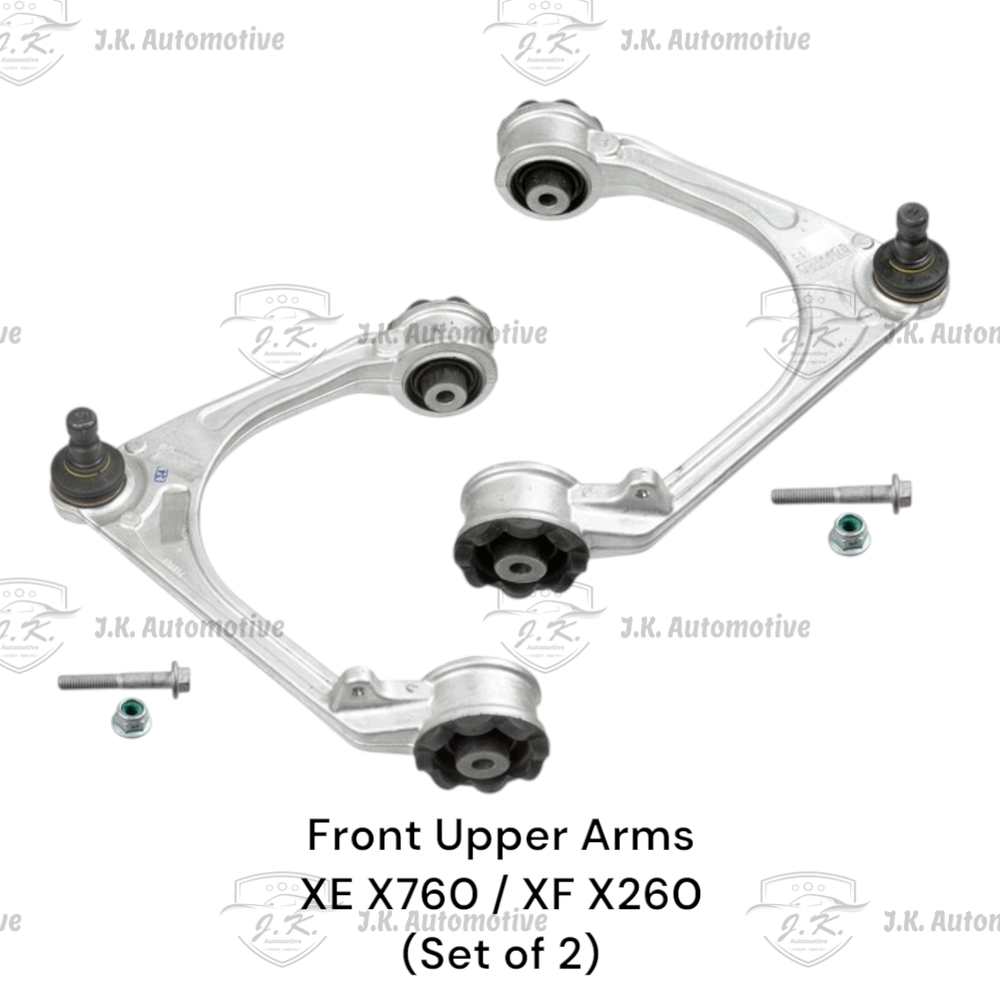
Front Upper Arms for Jaguar XE X760 are important front suspension components supplied as a complete Set of 2 for Jaguar XE X760 models from 2015–2026 with OEM references T4N1130 & T4N1128. The set contains the corresponding left and right front upper suspension arms required for the specified application, allowing both sides of the upper front suspension to be renewed together when wear has been professionally diagnosed. These components are also commonly known as front upper control arms, upper wishbones or upper suspension arms and form an important part of the Jaguar XE X760 steering and suspension system. The upper control arms help guide the front wheel assemblies through controlled suspension movement while maintaining the intended relationship between the wheels, steering system, suspension and vehicle chassis. As the Jaguar XE travels over smooth highways, potholes, speed breakers, broken roads and uneven surfaces, the suspension continuously moves to absorb road inputs while the upper arms help keep wheel movement controlled. During braking, significant vehicle weight transfers toward the front axle and increases the forces passing through the suspension arms, bushes and joints. During acceleration and cornering, the upper arms continue to support stable wheel positioning and consistent suspension geometry. This is particularly important for a premium sports sedan such as the Jaguar XE X760, where steering precision, refined ride comfort, stable road holding and responsive driving dynamics depend heavily on the mechanical condition of the front suspension. T4N1130 corresponds with the front upper left control-arm position, while T4N1128 corresponds with the front upper right position. The upper control arms work together with lower control arms, steering tie rod ends, shock absorbers, suspension bushes, wheel bearings and other front suspension components. When these upper arms or their associated bushes and joints become worn, excessive movement can develop within the suspension. Drivers may notice knocking or clunking sounds when travelling over potholes or uneven roads. Steering can become vague, less precise or require additional correction when maintaining a straight path. The vehicle may also feel less stable during braking or directional changes if wheel movement is no longer being controlled correctly. Worn suspension components can also contribute to irregular tyre wear because unwanted movement can influence wheel geometry while the vehicle is being driven. Inner-edge wear, outer-edge wear, feathering or recurring alignment concerns should therefore prompt a complete front suspension inspection. Replacing professionally diagnosed worn Front Upper Arms for Jaguar XE X760 can help restore more consistent wheel control and suspension movement. During replacement, lower control arms, steering tie rod ends, shock absorbers, suspension bushes and wheel bearings should also be inspected. Sway bar links, sway links, anti roll link rods and stabiliser sway links should be checked because wear in these components can produce similar knocking or rattling noises. Tyres should also be inspected for abnormal wear and wheels checked where vibration or impact damage is suspected. Professional installation is recommended to ensure correct fitting of the upper arms and associated mounting hardware. After replacement, professional wheel alignment should be carried out to verify suspension geometry. Correctly functioning front upper arms combined with serviceable related suspension components and accurate wheel geometry can help maintain even tyre wear, precise steering, stable braking, refined ride quality and the premium driving characteristics expected from a properly maintained Jaguar XE X760.
Which Jaguar XE X760 models are compatible with Front Upper Arms T4N1130 & T4N1128?
Front Upper Arms T4N1130 & T4N1128 are supplied as a Set of 2 for the stated Jaguar XE X760 2015–2026 product application, and these exact OEM references should be used as important identifiers when checking the suspension components required for the vehicle. The vehicle model, X760 chassis designation, supplied 2015–2026 year range and OEM references T4N1130 & T4N1128 should all be considered before ordering. The two arms are position-specific rather than two identical interchangeable components, with T4N1130 corresponding to the front upper left position and T4N1128 corresponding to the front upper right position. Because suspension components can vary according to vehicle specification and production details, customers should verify the required OEM references against their vehicle before installation. Where there is any uncertainty, checking the VIN and existing suspension component with a qualified parts specialist or workshop is recommended. Correct compatibility is particularly important for control arms because they are wheel-locating suspension components that influence suspension geometry and wheel movement. A component that looks similar externally should not automatically be considered suitable because mounting dimensions, bush specifications, joint positions and suspension geometry can differ between applications. When the correct Front Upper Arms for Jaguar XE X760 are installed, they work with the remaining front suspension components to guide the wheels through their intended range of movement. The upper arms help maintain controlled wheel positioning while allowing the suspension to respond to changing road surfaces. During braking, they help manage the increased loads acting through the front axle. During cornering, they contribute to stable wheel positioning as lateral forces increase. During normal road driving, serviceable suspension bushes and joints help maintain a balance between controlled movement and ride refinement. This balance contributes to the responsive steering and premium driving dynamics associated with the Jaguar XE X760. If an incorrect control arm is installed, the intended relationship between the suspension mounting points and wheel assembly may be compromised, which is why correct OEM verification should take place before installation. The supplied T4N1130 & T4N1128 references are therefore important when identifying the required Set of 2. Owners should also remember that suspension symptoms alone cannot confirm fitment or prove that the upper arms are responsible for a particular problem. Knocking noises can originate from lower control arms, bushes, sway bar links, sway links, anti roll link rods or stabiliser sway links. Steering looseness may originate from tie rod ends or other steering components. Vibration may be related to tyres, wheels or wheel bearings. Poor ride control can also result from worn shock absorbers or mounts. For this reason, professional inspection of the complete front suspension is recommended before replacement. If the upper arms are confirmed as worn and T4N1130 & T4N1128 match the vehicle requirement, replacing the corresponding left and right components together can provide a comprehensive upper front suspension repair. During installation, surrounding mounting points and suspension components should also be inspected for wear or damage. Tyres should be checked for irregular tread wear because abnormal wear patterns may provide evidence of suspension movement or alignment concerns. Once the mechanical suspension repair has been completed, professional wheel alignment should be performed. Correct fitment, professional installation and accurate wheel geometry together help support precise steering, predictable handling, even tyre wear and refined Jaguar XE X760 ride quality.
What OEM numbers are included in the Jaguar XE X760 Front Upper Arms Set of 2?
The Jaguar XE X760 Front Upper Arms Set of 2 includes the exact OEM references T4N1130 & T4N1128 for the stated Jaguar XE X760 2015–2026 application. T4N1130 identifies the front upper left control arm, while T4N1128 identifies the front upper right control arm, meaning the Set of 2 provides corresponding components for both sides of the upper front suspension. These OEM numbers are particularly important when purchasing steering and suspension parts because visual appearance alone is not sufficient to guarantee compatibility. Suspension control arms can look extremely similar while having different dimensions, bush designs, joint positions or mounting specifications. Customers should therefore retain the exact OEM references T4N1130 & T4N1128 when checking fitment and should verify the required application using vehicle information where necessary. The upper control arms perform an important wheel-locating function within the Jaguar XE X760 front suspension. They help guide the front wheels as the suspension moves while maintaining controlled positioning relative to the chassis. This becomes important whenever the vehicle accelerates, brakes, corners or travels over uneven road surfaces because suspension loads are constantly changing. During braking, additional weight transfers toward the front axle, increasing the forces passing through the suspension arms and bushes. During cornering, lateral loads place additional demands on the control arms as they help maintain consistent wheel positioning. On uneven roads, the upper arms allow controlled suspension movement while helping prevent excessive changes in wheel position. The condition of the associated bushes and joints is therefore important for steering precision and refined ride quality. As these components deteriorate, excessive movement may develop and produce symptoms such as knocking, clunking, steering vagueness or reduced stability. The vehicle may feel less planted when travelling over uneven roads or during directional changes. Worn upper suspension components can also contribute to abnormal tyre wear when mechanical play affects wheel geometry. Repeated alignment concerns can sometimes indicate that mechanical suspension wear needs to be corrected before alignment settings can remain stable. Replacing the appropriate T4N1130 & T4N1128 components can help renew both front upper suspension control points when professional inspection confirms wear. However, the complete front suspension should be inspected during the repair because several components work together to control the wheels. Lower control arms and their bushes should be checked for excessive movement. Steering tie rod ends should be inspected for play. Shock absorbers and mounts should be checked for deterioration, and wheel bearings should be inspected for unwanted movement or abnormal noise. Sway bar links, sway links, anti roll link rods and stabiliser sway links should also be examined because worn stabiliser components can create similar front suspension noises. Tyres should be checked for inner-edge wear, outer-edge wear, feathering and other irregular patterns. Correct installation is important because upper control arms directly influence wheel position and suspension operation. Once T4N1130 & T4N1128 have been installed and any additional worn components repaired, professional wheel alignment should be performed. Correct mechanical condition combined with accurate wheel geometry helps support even tyre wear, straight-line stability, steering precision, controlled braking and the premium handling expected from the Jaguar XE X760.
What are the common symptoms of worn Front Upper Arms on a Jaguar XE X760?
Worn Front Upper Arms on a Jaguar XE X760 can cause several suspension, steering, handling and tyre-related symptoms because these components help locate and guide the front wheels while the suspension operates. One of the most noticeable symptoms can be knocking or clunking from the front suspension when travelling over potholes, speed breakers, broken roads or smaller surface irregularities. As the control-arm bushes or associated joints deteriorate, unwanted movement can develop at important suspension mounting points, creating noise as loads change. Another possible symptom is vague or imprecise steering. The Jaguar XE X760 is designed to provide responsive steering and controlled handling, so deterioration in wheel-locating suspension components can become noticeable when steering inputs no longer produce the same consistent response. The driver may find that more steering correction is required on uneven roads or that the front end feels less planted during directional changes. Braking behaviour can also reveal suspension wear because significant vehicle weight transfers toward the front axle when the brakes are applied. If an upper control arm, bush or joint has excessive movement, the front suspension may feel less settled under braking loads. Cornering can expose similar problems because lateral forces increase the loads acting through the control arms and their mounting points. The vehicle may feel less predictable through bends or may lose some of the refined steering precision normally associated with the Jaguar XE. Vibration through the steering wheel or vehicle body may sometimes accompany suspension wear, although vibration should never automatically be blamed on the upper control arms because tyres, wheel balance, bent wheels, wheel bearings and other steering or suspension components can produce similar symptoms. Uneven tyre wear is another important warning sign. Excessive movement within the suspension can contribute to inconsistent wheel positioning, potentially producing inner-edge wear, outer-edge wear, feathering or accelerated tread wear. Repeated wheel-alignment problems are also important because alignment adjustments cannot permanently compensate for mechanical play within a worn suspension arm, bush or steering joint. The suspension should therefore be mechanically inspected before repeated alignment corrections are attempted. For this Jaguar XE X760 application, OEM references T4N1130 & T4N1128 identify the corresponding front upper left and right control arms. If these components are professionally diagnosed as worn, replacing the Set of 2 can help renew both sides of the upper front suspension. However, diagnosis should cover the complete front axle rather than replacing parts based only on noise. Lower control arms, suspension bushes, tie rod ends, shock absorbers and wheel bearings should all be inspected. Sway bar links, sway links, anti roll link rods and stabiliser sway links should also be checked because these components can create similar knocking sounds. Tyres should be inspected for wear patterns, damage and correct inflation, while wheels should be checked where vibration or impact damage is suspected. Correctly replacing worn Front Upper Arms for Jaguar XE X760 can help reduce excessive suspension movement and restore more consistent wheel control. Professional installation is recommended, followed by complete wheel alignment after all diagnosed suspension faults have been corrected. This combination can help restore precise steering, stable braking, predictable cornering, even tyre wear and refined premium ride quality.
What are the benefits of replacing the complete Set of 2 Front Upper Arms T4N1130 & T4N1128 on a Jaguar XE X760?
Replacing the complete Set of 2 Front Upper Arms T4N1130 & T4N1128 on a Jaguar XE X760 can provide a comprehensive upper front suspension repair when both corresponding components have been professionally diagnosed as worn. T4N1130 is used for the front upper left position and T4N1128 for the front upper right position, allowing the two sides of the upper suspension to be renewed together. One important benefit of replacing worn upper control arms is improved control of front-wheel movement. Control arms are responsible for guiding the wheel assemblies as the suspension moves, and excessive wear in their bushes or joints can allow unwanted changes in wheel position. Renewing worn components can help restore a more stable mechanical relationship between the wheel assemblies and chassis. This can contribute to more consistent steering response and improved straight-line stability when the remaining steering and suspension components are serviceable. Another potential benefit is more predictable behaviour during braking. Significant loads act through the front suspension when vehicle weight transfers forward, and serviceable control arms help keep wheel movement controlled as these forces increase. Cornering can also benefit because the upper arms help maintain stable wheel positioning when lateral loads act on the tyres and suspension. For a premium performance-oriented sedan such as the Jaguar XE X760, maintaining accurate suspension control is important for preserving refined ride quality and responsive handling. Replacing worn upper arms may also help reduce knocking or clunking when excessive movement at the original components was responsible for the noise. However, suspension noise should always be diagnosed properly because lower arms, bushes, steering components and stabiliser links can produce similar symptoms. Tyre wear is another important consideration. Excessive movement within the front suspension can contribute to changing wheel geometry, which may accelerate irregular tyre wear. Correcting worn mechanical components and then performing professional wheel alignment can provide a more stable foundation for even tyre contact. Replacing the corresponding left and right components together can also be practical when both have comparable wear, helping avoid a situation where one renewed side operates alongside another significantly deteriorated component. Nevertheless, components should be replaced based on diagnosis rather than automatically assuming that both are defective. During the repair, lower control arms, tie rod ends, suspension bushes, shock absorbers, mounts and wheel bearings should be inspected. Sway bar links, sway links, anti roll link rods and stabiliser sway links should also be checked for looseness or joint wear. Tyres should be inspected for abnormal tread patterns that may indicate previous suspension or alignment problems. Before installation, T4N1130 & T4N1128 should be verified against the required Jaguar XE X760 application. Professional fitting is recommended to ensure correct mounting and suspension operation. Once all mechanical problems have been corrected, complete wheel alignment should be performed. Renewed Front Upper Arms for Jaguar XE X760 combined with serviceable related components and accurate wheel geometry can help restore steering precision, controlled braking, road holding, refined ride comfort, stable tyre contact and the premium driving dynamics expected from the Jaguar XE X760.
Is wheel alignment required after replacing Jaguar XE X760 Front Upper Arms T4N1130 & T4N1128?
Professional wheel alignment is strongly recommended after replacing Jaguar XE X760 Front Upper Arms T4N1130 & T4N1128 because upper control arms are wheel-locating suspension components and their condition can influence the relationship between the wheel assemblies and suspension geometry. Before replacement, worn bushes or joints may allow excessive movement that causes wheel position to change under acceleration, braking or cornering loads. Once the worn components are replaced, the suspension operates from renewed control points, making it important to verify the final wheel geometry rather than assuming that the previous alignment remains correct. This Set of 2 contains the corresponding front upper left and right control arms, with T4N1130 for the left position and T4N1128 for the right position. When these components are renewed, professional alignment allows the workshop to assess the wheel geometry after the mechanical repair has been completed. Correct geometry helps maintain appropriate tyre contact with the road and supports predictable steering behaviour. It can also help reduce abnormal tyre wear where incorrect geometry would otherwise place excessive load on the inner or outer portions of the tread. Alignment is particularly important if the vehicle previously displayed steering pull, uneven tyre wear or repeated geometry problems. However, wheel alignment should be treated as the final stage of a complete suspension repair rather than a substitute for repairing worn mechanical components. Before alignment, the technician should verify that the new front upper arms are installed correctly and that other steering and suspension components are serviceable. Lower control arms and bushes should be inspected for excessive movement. Steering tie rod ends should be checked for play because worn steering joints can prevent accurate geometry from being maintained. Shock absorbers and their mounts should be inspected for deterioration or damage. Wheel bearings should be checked for unwanted movement, roughness or abnormal noise. Sway bar links, sway links, anti roll link rods and stabiliser sway links should also be examined because these components influence front suspension behaviour even though they are not normally used to set wheel alignment. Tyres should be checked for correct pressure, tread condition and existing irregular wear. Wheels should also be inspected for bending or impact damage if necessary. If additional worn components are discovered, they should normally be repaired before final alignment so the measurements are taken with the suspension in proper mechanical condition. Correct installation of the upper control arms and associated hardware is equally important because poor installation can compromise suspension operation. After the Set of 2 has been installed and all other necessary repairs completed, the wheel geometry should be measured and corrected according to the appropriate vehicle specification and adjustment provisions. Accurate geometry combined with serviceable Front Upper Arms for Jaguar XE X760 can help support even tyre wear, straight-line stability, accurate steering and predictable cornering. It can also contribute to the refined road behaviour and premium driving dynamics expected from the Jaguar XE X760. Therefore, professional wheel alignment should be considered an important final step after replacement of T4N1130 & T4N1128 rather than an optional procedure.
Why should worn Jaguar XE X760 Front Upper Arms T4N1130 & T4N1128 be replaced in time?
Worn Jaguar XE X760 Front Upper Arms should be replaced when professional inspection confirms excessive wear because these components are directly involved in controlling front-wheel movement and maintaining stable suspension geometry. This Set of 2 is specified for Jaguar XE X760 models from 2015–2026 with OEM references T4N1130 & T4N1128, covering the corresponding left and right front upper control-arm positions. The upper control arms connect important suspension points and help guide the front wheels as the suspension moves over different road surfaces. When the control-arm bushes and joints remain in good condition, the wheels can move through their intended suspension path while maintaining more consistent alignment and tyre contact. As these components wear, unwanted movement can gradually develop within the front suspension. Initially, the symptoms may be relatively minor, such as occasional knocking over potholes or a small reduction in steering precision. Continued deterioration can make the suspension noise more noticeable and may cause the vehicle to feel less stable on uneven roads. Steering response can become vague because the wheel assembly is no longer being located as precisely as intended. During braking, significant load transfers toward the front axle, and worn upper arms can allow additional movement as these forces increase. This may make the front end feel less settled under braking. Cornering places lateral loads on the suspension, and excessive movement at the upper control arms can reduce predictable wheel control. For a premium performance-oriented sedan such as the Jaguar XE X760, deterioration in these suspension components can reduce the refined steering response and road holding expected from the vehicle. Tyre wear is another important reason not to ignore worn control arms. If mechanical play allows the wheel position to vary while driving, tyre contact can become inconsistent. This can contribute to inner-edge wear, outer-edge wear, feathering or other abnormal tread patterns. Repeated wheel alignment without repairing mechanical play is unlikely to provide a lasting solution because the wheel can continue moving after the alignment settings have been adjusted. Suspension noise should nevertheless be diagnosed correctly before replacing parts. Lower control arms, tie rod ends, wheel bearings, shock absorbers and other bushes can produce symptoms similar to upper control-arm wear. Sway bar links, sway links, anti roll link rods and stabiliser sway links are particularly important to inspect when diagnosing knocking noises over uneven roads. Once T4N1130 & T4N1128 have been confirmed as worn, replacing the corresponding Set of 2 can help renew both upper front suspension control points. Correctly functioning upper arms can help restore more consistent wheel positioning during acceleration, braking and cornering. They can also support steering precision, stable tyre contact and refined suspension behaviour. The surrounding suspension components should be inspected during replacement so that another worn component does not compromise the repair. Tyres should also be checked because existing abnormal wear may indicate how long the suspension has been operating with excessive movement. Professional installation is recommended because suspension-arm positioning, mounting hardware and tightening procedures are important for correct operation. After installation and completion of any additional suspension repairs, professional wheel alignment should be performed. Addressing worn Jaguar XE X760 Front Upper Arms in time can therefore help prevent continued deterioration in suspension control, reduce the possibility of accelerated tyre wear and restore the precise steering, stable braking, refined ride comfort and premium driving dynamics expected from the Jaguar XE X760.
Can worn Jaguar XE X760 Front Upper Arms T4N1130 & T4N1128 cause knocking noise, steering problems and uneven tyre wear?
Yes, worn Jaguar XE X760 Front Upper Arms can contribute to knocking noises, reduced steering precision and irregular tyre wear because the upper control arms are responsible for helping locate the front wheels while allowing controlled suspension movement. For this Set of 2, the supplied OEM references are T4N1130 & T4N1128 for the Jaguar XE X760 2015–2026 product application. T4N1130 is identified as the left upper control arm and T4N1128 as the right upper control arm, and parts catalogs describe these assemblies as including bushings and ball-joint functionality. When wear develops in these areas, additional movement can occur between the wheel assembly and suspension mounting points. A knocking or clunking sound may be heard when the vehicle travels over potholes, speed breakers, rough roads or broken surfaces because suspension loads change rapidly in these conditions. Worn bushes or joints may allow the arm to move beyond its intended controlled range, producing noise as the suspension changes direction. Steering problems can develop for the same reason. The upper control arms help maintain wheel position relative to the chassis, so excessive movement can reduce the consistency of steering response. The driver may notice vague steering, wandering, additional correction on uneven roads or a less planted front end during directional changes. The Jaguar XE X760 is designed around responsive steering and controlled road behaviour, making deterioration in suspension locating components particularly noticeable. During braking, weight transfers toward the front axle and increases the forces passing through the control arms and bushes. Excessive play can therefore become more noticeable during firm braking. During cornering, lateral forces increase and can expose unwanted movement within worn suspension components. Tyre wear can also develop because mechanical suspension play may cause the wheel position to change dynamically while the vehicle is moving. Even if the static wheel alignment appears acceptable, excessive suspension movement under braking or cornering loads can still influence tyre contact. Inner-edge wear, outer-edge wear, feathering or irregular tread wear should therefore be investigated rather than treated only as a tyre problem. However, these symptoms are not exclusive to the upper control arms. Knocking noises can also originate from lower control arms, shock absorber mounts, sway bar links, sway links, anti roll link rods or stabiliser sway links. Steering looseness may be caused by tie rod ends or other steering components. Wheel bearings can contribute to unwanted movement or noise, while damaged tyres or wheels can cause vibration. This is why professional diagnosis should precede replacement. A technician should inspect T4N1130 & T4N1128 together with the complete front suspension and steering system. The rubber bushes should be checked for cracking, deterioration or excessive movement, and the joints should be inspected for unwanted play. Lower control arms and steering components should be examined at the same time. Shock absorbers should be checked for leakage or reduced damping performance, while wheel bearings should be inspected for roughness and excessive movement. If the Jaguar XE X760 Front Upper Arms are confirmed as worn, replacing the required Set of 2 can help restore controlled wheel positioning and reduce suspension movement associated with the worn components. Professional fitting should then be followed by wheel alignment after all necessary mechanical repairs have been completed. Correctly functioning upper arms and accurate geometry can help improve steering precision, maintain more consistent tyre contact, support even tyre wear and restore the refined handling expected from the Jaguar XE X760.
Should Jaguar XE X760 Front Upper Arms T4N1130 & T4N1128 be replaced as a Set of 2?
Replacing Jaguar XE X760 Front Upper Arms as a Set of 2 can be a sensible suspension repair approach when professional inspection confirms comparable wear on both corresponding upper control arms. This product is supplied as a Set of 2 with OEM references T4N1130 & T4N1128 for the stated Jaguar XE X760 2015–2026 application. The two components are position-specific, with T4N1130 identified for the front upper left position and T4N1128 for the front upper right position. They are therefore not simply two identical interchangeable arms but corresponding components designed for opposite sides of the front suspension. Both sides operate under similar driving conditions and experience repeated suspension movement, braking loads, cornering forces and road impacts throughout the vehicle's service life. As mileage increases, rubber bushes and joints on both sides may deteriorate, although the exact rate of wear can differ depending on road conditions, impacts and previous repairs. When both sides show deterioration, replacing them together can provide a more balanced upper suspension repair. A renewed left arm working alongside a heavily worn right arm may still leave unwanted movement in the front suspension, which can affect steering consistency and wheel control. Replacing the professionally diagnosed worn pair can help establish a more consistent mechanical condition across the front axle. This is particularly valuable on the Jaguar XE X760 because the vehicle's premium driving characteristics depend on accurate steering response and controlled suspension geometry. A complete Set of 2 replacement can also make sense from a workshop perspective when both components are already near the end of their useful service condition. It may reduce the likelihood of returning shortly afterwards to replace the corresponding arm on the opposite side. However, replacement decisions should still be based on inspection rather than automatically replacing serviceable components. The technician should check the bushes and joints for deterioration, cracking, looseness or excessive movement. If only one arm has been damaged by a specific impact while the opposite component remains in good mechanical condition, the repair strategy may differ. The complete suspension should also be inspected because replacing the upper arms will not correct problems originating elsewhere. Lower control arms should be checked for bush and joint wear. Tie rod ends should be inspected for steering play. Shock absorbers and mounts should be examined for leakage, deterioration or damage. Wheel bearings should be checked for excessive movement and abnormal noise. Sway bar links, sway links, anti roll link rods and stabiliser sway links should also be inspected because worn stabiliser components can produce front-end noises that resemble control-arm wear. Tyres should be checked for irregular wear, particularly on the inner and outer edges. Existing tyre wear can provide useful evidence of suspension or alignment problems but cannot identify the defective component by itself. Correct OEM verification is also essential before installation. The required left and right positions should match T4N1130 & T4N1128 for the applicable vehicle specification. Professional installation is recommended so that mounting hardware and suspension joints are fitted correctly. After the Set of 2 has been installed and any additional worn components repaired, complete wheel alignment should be carried out. Renewing both professionally diagnosed worn Jaguar XE X760 Front Upper Arms can help restore balanced wheel control, steering precision, stable braking, predictable cornering and refined premium suspension performance while providing a strong foundation for accurate wheel geometry and even tyre wear.
What other suspension parts should be inspected when replacing Jaguar XE X760 Front Upper Arms T4N1130 & T4N1128?
When replacing Jaguar XE X760 Front Upper Arms T4N1130 & T4N1128, the complete front steering and suspension system should be inspected because control arms operate as part of an interconnected system rather than as isolated components. The Set of 2 covers the corresponding front upper left and right suspension positions for the stated Jaguar XE X760 2015–2026 application, but several other components work simultaneously to control wheel movement, steering response, ride quality and tyre contact. The front lower control arms are among the first components that should be inspected because they work with the upper arms to locate the wheel assemblies. Their bushes and joints can deteriorate and produce unwanted movement, knocking noises or steering instability. If the upper arms are renewed while heavily worn lower arms remain in service, some of the original symptoms may continue. Steering tie rod ends should also be inspected because they transmit steering movement to the wheel assemblies. Excessive play in the steering linkage can produce vague steering, wandering or inconsistent wheel positioning. Ball joints and other articulated suspension connections should be checked for unwanted movement or damaged protective boots. Shock absorbers are another important part of the inspection because they control suspension oscillation and wheel movement after road impacts. A leaking or weak shock absorber can reduce ride control even when the control arms are new. Shock absorber mounts and related mounting hardware should also be inspected for deterioration or damage. Wheel bearings should be checked for excessive movement, roughness or abnormal noise because a worn bearing can influence wheel stability and can sometimes create symptoms that are mistaken for suspension-arm problems. Sway bar links, sway links, anti roll link rods and stabiliser sway links should receive particular attention when diagnosing knocking noises. These components connect the anti-roll system to the suspension and their joints can wear over time, producing rattling or knocking sounds on uneven surfaces. Stabiliser bushes should also be inspected where applicable because deterioration can contribute to unwanted movement or noise. Tyres form an important part of the diagnostic process. The technician should examine the inner and outer tread edges for uneven wear, feathering or other irregular patterns. Tyre pressure should be checked because incorrect inflation can alter handling and produce misleading wear patterns. Wheels should be inspected for bending, cracking or impact damage where the vehicle has experienced severe potholes or road impacts. The mounting areas for T4N1130 & T4N1128 should be checked before installation to ensure that the new components can be fitted correctly. Fasteners and related hardware should be inspected and replaced where required by the appropriate repair procedure. The steering knuckles and surrounding connections should also be checked for damage where necessary. Once all mechanical suspension faults have been identified, the required components should be repaired before final wheel alignment. Performing alignment while worn bushes, joints or steering components remain in the vehicle can result in inconsistent measurements because the wheel position can move after adjustment. After the Jaguar XE X760 Front Upper Arms and any other worn components have been replaced, professional wheel alignment should be performed. A complete repair approach helps the new upper arms work correctly with the remaining suspension system and can support accurate steering, controlled wheel movement, even tyre wear, refined ride comfort and the precise premium handling expected from the Jaguar XE X760.
Why is Stokes Germany a European-quality alternative to Lemförder, FEBI, Meyle and other established brands for Jaguar XE X760?
Stokes Germany Jaguar XE X760 Front Upper Arms can be considered as an aftermarket replacement option for customers looking for a complete Set of 2 for the stated Jaguar XE X760 2015–2026 application with OEM references T4N1130 & T4N1128. The important starting point when comparing any suspension brand with established manufacturers such as Lemförder, FEBI, Meyle and other European aftermarket suppliers is correct fitment and component specification rather than the brand name alone. For this application, T4N1130 corresponds to the front upper left control-arm position and T4N1128 corresponds to the front upper right position. Independent suspension catalog data also identifies these references for the Jaguar XE X760, while Jaguar parts listings describe the assemblies as upper control arms incorporating bushings and ball-joint components. This makes accurate geometry, joint operation, bush characteristics and mounting dimensions important considerations when selecting replacement components. Stokes Germany provides the product as a corresponding left-and-right Set of 2, allowing both professionally diagnosed worn upper suspension positions to be renewed together. For owners maintaining a premium vehicle such as the Jaguar XE X760, the objective of suspension replacement should be to restore controlled wheel movement, stable steering response and refined ride behaviour rather than simply replacing a noisy component. The front upper control arms operate continuously as the vehicle accelerates, brakes, corners and travels over uneven roads. They must allow the required suspension articulation while limiting unwanted movement that could affect steering and tyre contact. When evaluating Stokes Germany against Lemförder, FEBI, Meyle or another established aftermarket option, customers should compare the exact OEM reference, vehicle application, construction, included bushes and joints, warranty terms and supplier support available for the specific product rather than assuming every control arm marketed for the XE is identical. The T4N1130 & T4N1128 application is position-specific, making correct left-and-right identification particularly important. Proper installation is equally important regardless of the selected brand because even a correctly manufactured suspension arm cannot provide the intended performance if installed incorrectly or combined with heavily worn related components. Lower control arms, steering tie rod ends, shock absorbers, wheel bearings and suspension bushes should therefore be inspected during installation. Sway bar links, sway links, anti roll link rods and stabiliser sway links should also be checked because wear elsewhere in the suspension can continue to produce noise even after new upper arms have been installed. Tyre condition should be assessed and any abnormal wear investigated. Professional wheel alignment should then be completed after the mechanical suspension is confirmed to be serviceable. This helps the replacement upper arms operate within correctly measured wheel geometry and supports stable tyre contact, steering precision and even tyre wear. For customers considering premium aftermarket suspension parts for the Jaguar XE X760, the Stokes Germany Set of 2 provides an alternative option built around the required T4N1130 & T4N1128 application. The purchasing decision should ultimately be based on verified fitment, product specification, quality assurance, warranty and value relative to established brands such as Lemförder, FEBI and Meyle. When correctly selected, professionally installed and combined with accurate wheel alignment and serviceable surrounding suspension components, replacement Jaguar XE X760 Front Upper Arms can help restore controlled front-wheel movement, refined ride comfort, precise steering and the premium driving dynamics expected from the Jaguar XE X760.



Reviews
There are no reviews yet.