What are the Front Lower Arms Without Lower Arm Ball Joints for Audi A3 8V and what is their function?
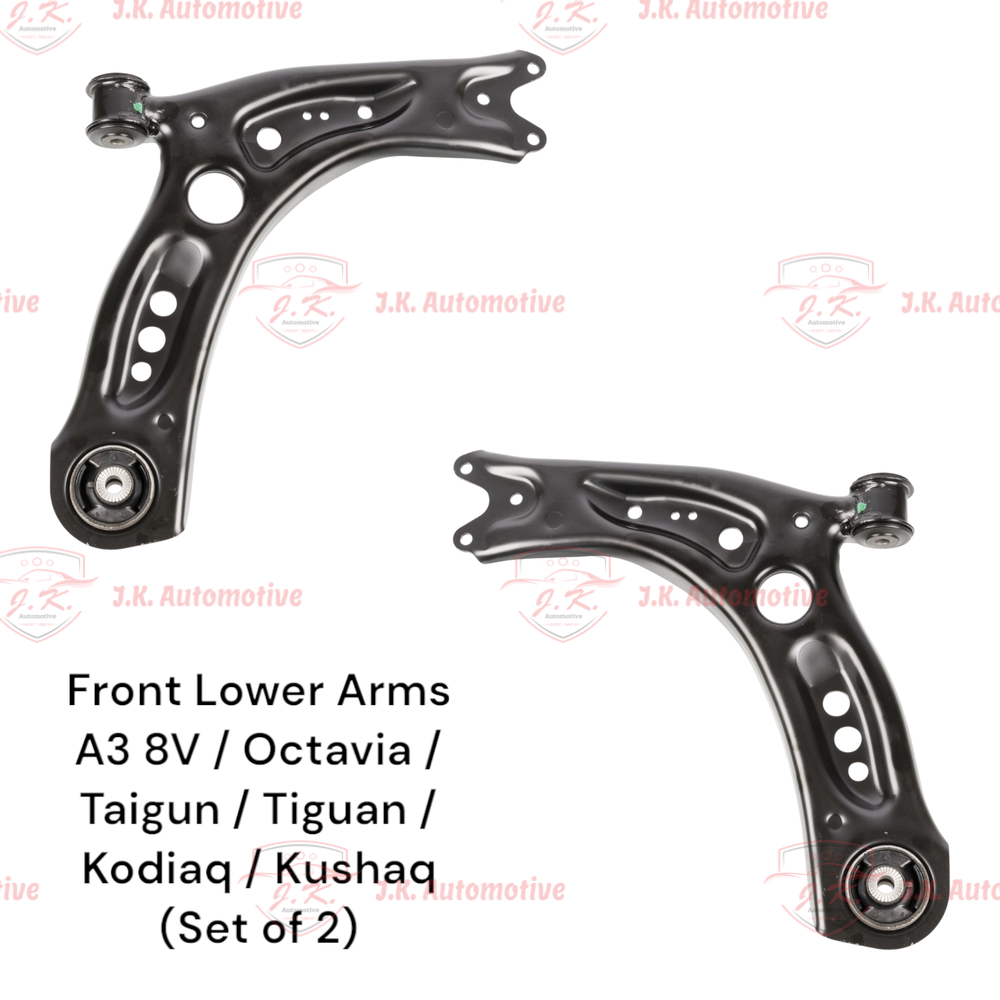
The Front Lower Arms Without Lower Arm Ball Joints for Audi A3 8V are important front suspension components designed to connect and position the front wheel assemblies relative to the vehicle chassis while helping control wheel movement, steering geometry, braking stability and overall front axle behaviour. This product is supplied as a set of 2 for compatible Audi A3 8V models produced from 2013 to 2020 and corresponds with OEM reference numbers 5Q0407151J and 5Q0407152J, subject to VIN and original part-number verification. These lower control arms are supplied without lower arm ball joints, which means the relevant ball joints must either be reused if fully serviceable and compatible or sourced separately as required during installation. The lower arms work as key structural links in the front suspension and help guide the position of the wheel assembly as the suspension moves over potholes, road joints, speed breakers and uneven surfaces. Their rubber bushes absorb road forces while allowing controlled movement between the suspension and chassis. The lower control arms also help manage the longitudinal and lateral loads created during braking, acceleration and cornering. When the bushes become cracked, softened, torn or separated, the arms can move more than intended and this can affect steering precision, tyre wear, braking stability and wheel alignment. On an Audi A3 8V, worn lower arms may cause knocking or clunking noises, vague steering, steering-wheel vibration, pulling during braking, uneven tyre wear or repeated alignment problems. A bent or physically damaged lower arm can also alter suspension geometry and may prevent a workshop from achieving correct alignment until the damaged component is replaced. Because this product is supplied as a pair of 2, it provides a practical left-and-right front suspension repair option when both lower control arms show similar deterioration. Replacing worn arms on both sides can help restore more balanced bush stiffness and front axle response. Since the ball joints are not included, their condition should be inspected carefully during the repair because a worn ball joint can produce similar symptoms and may compromise the result of fitting new lower arms. These components also work together with tie rod ends, shock absorbers, wheel bearings, sway bar links, sway links, anti roll link rods, stabiliser sway links and other suspension bushes. A complete front suspension inspection is therefore recommended before replacement. Correct OEM-number matching is essential because lower arms that appear similar can still differ in length, bush position, mounting shape or joint interface. OEM references 5Q0407151J and 5Q0407152J should therefore be checked against the original fitted components and vehicle VIN before ordering. Once correctly selected and professionally installed, the Front Lower Arms Without Lower Arm Ball Joints can help restore controlled suspension movement, steering stability and more accurate wheel positioning. Professional wheel alignment should normally be carried out after replacement so the suspension geometry can be checked around the new components.
Which Audi A3 8V models are compatible with Front Lower Arms 5Q0407151J and 5Q0407152J without Lower Arm Ball Joints?
These Front Lower Arms Without Lower Arm Ball Joints are intended for compatible Audi A3 8V models produced from 2013 to 2020 and are supplied as a set of 2 corresponding with OEM references 5Q0407151J and 5Q0407152J, subject to final VIN and original part-number confirmation. The Audi A3 8V was available with different engines, drivetrain configurations, suspension specifications and equipment levels, so compatibility should not be determined only from the model name or production year. The most reliable method is to confirm the chassis code 8V, check the vehicle VIN and compare the OEM references fitted to the original lower control arms. These arms are supplied without lower arm ball joints, so the original or separately purchased ball joints must also be checked for compatibility with the replacement arms. The lower control arms occupy specific positions on the left and right sides of the front suspension and must have the correct shape, bush configuration, mounting points and ball-joint interface for proper installation. A visually similar arm may still have different dimensions or mounting geometry, so visual comparison alone should not be relied upon. This set of 2 is especially useful when both front lower arms show worn bushes, excessive movement, structural damage or age-related deterioration. Workshops may recommend replacing both sides together when wear is similar because the components generally experience comparable mileage, road impacts and braking loads. Vehicles frequently driven over potholes, rough roads and speed breakers can develop accelerated bush deterioration, especially as mileage increases. If the Audi A3 8V develops front suspension knocking, vague steering, steering-wheel vibration, abnormal tyre wear or recurring wheel-alignment problems, the lower control arms should be inspected carefully. Because the ball joints are not included in this set, their condition should also be checked for play, rough movement or damaged protective boots before the new arms are installed. If the existing ball joints are worn, fitting new lower arms while retaining defective joints may leave some steering or suspension symptoms unresolved. Related components including tie rod ends, shock absorbers, wheel bearings, sway bar links, sway links, anti roll link rods and stabiliser sway links should also be checked because they can produce similar symptoms. Before ordering, OEM references 5Q0407151J and 5Q0407152J should be compared directly with the original fitted arms wherever possible, and the VIN should be used for final confirmation. Once compatibility has been verified, professional installation is recommended because suspension fasteners must be tightened according to correct procedures. Certain bush-mounted bolts may require final tightening at normal ride height to prevent unnecessary rubber preload. After installation, professional wheel alignment should be completed because replacing lower control arms can change the resting position of the front wheels. Using the correct Front Lower Arms Without Lower Arm Ball Joints for Audi A3 8V can help restore intended suspension geometry, steering stability and more consistent tyre wear.
What are the common symptoms of wor Front Lower Arms on an Audi A3 8V?
The common symptoms of worn Front Lower Arms on an Audi A3 8V can include knocking or clunking noises from the front suspension, vague or loose steering, steering-wheel vibration, uneven tyre wear, pulling during braking, repeated wheel-alignment problems and a general reduction in front-end stability. The lower control arms help locate the front wheel assemblies and their rubber bushes allow controlled movement while resisting excessive forward, backward and sideways displacement. When these bushes become cracked, softened, torn or separated, the arm can move more than intended under road load. One of the most common symptoms is a dull knocking or clunking noise when the vehicle passes over potholes, speed breakers, road joints or broken surfaces. This can occur because the worn bush allows the lower control arm to shift excessively against its mounting points. The driver may also notice steering that feels less precise or requires more correction to maintain a straight path. Uneven tyre wear can develop because the wheel position changes dynamically while the vehicle is accelerating, braking or cornering. The inner or outer edges of the front tyres may wear faster, and feathering can occur if toe behaviour changes under load. Steering-wheel vibration may also appear, particularly on rough roads or during braking, when excessive movement is present in the suspension. Under stronger braking, worn lower-arm bushes can allow the wheel assembly to move slightly backward or forward, which can temporarily alter suspension geometry and cause the vehicle to pull to one side. A bent lower control arm caused by a pothole impact, kerb strike or accident can create more serious alignment problems because the physical geometry of the suspension has changed. In such cases, repeated wheel alignment will not provide a lasting solution until the damaged arm is replaced. The relevant replacement set for compatible Audi A3 8V models corresponds with OEM references 5Q0407151J and 5Q0407152J and is supplied as a set of 2 without lower arm ball joints, subject to VIN confirmation. Since the ball joints are not included, they should be inspected separately because worn ball joints can cause similar knocking, looseness and steering symptoms. A professional workshop should check the lower arm bushes for cracks, rubber separation and excessive movement, inspect the metal arms for bending or impact damage and assess the condition of the existing ball joints. Related suspension components including tie rod ends, shock absorbers, wheel bearings, sway bar links, sway links, anti roll link rods and stabiliser sway links should also be inspected because several parts can produce similar front-end noises. If both lower arms show similar deterioration, replacing the pair can help restore more balanced suspension response. Professional wheel alignment should be carried out after replacement so the front wheels can be adjusted around the new components.
Why is it recommended to replace both Front Lower Arms together on an Audi A3 8V?
Replacing both Front Lower Arms together on an Audi A3 8V is often recommended when both sides show similar wear because the left and right lower control arms normally experience comparable mileage, pothole impacts, braking forces and age-related deterioration. This product is supplied as a set of 2 for compatible Audi A3 8V models produced from 2013 to 2020 and corresponds with OEM references 5Q0407151J and 5Q0407152J, subject to VIN and original part-number verification. The lower arms on both sides of the front axle work together to maintain balanced wheel position, suspension geometry and steering response. Their bushes are subjected to repeated compression and twisting as the vehicle accelerates, brakes, corners and travels over uneven roads. If one lower arm bush has developed significant cracking or excessive movement because of age and mileage, the component on the opposite side may have experienced similar conditions and may also be approaching the end of its useful service life. Replacing both worn arms together can help provide more consistent bush stiffness across the front axle. If one side is new and tight while the other remains heavily worn, the wheel assemblies may respond differently under braking, cornering or road impact. A matched pair replacement can therefore help restore more balanced front-end behaviour. From a workshop perspective, replacing both sides during one repair can also reduce the possibility of a second similar repair shortly afterward if the remaining original arm fails. This allows the vehicle to undergo one suspension repair followed by one professional wheel alignment rather than repeating similar labour later. However, replacing both arms should not automatically be treated as mandatory if one arm has suffered isolated impact damage and the opposite side is confirmed to be in excellent condition. The correct repair should always be based on professional inspection. Since these Front Lower Arms are supplied without lower arm ball joints, the condition of the existing ball joints should be checked carefully on both sides. If a ball joint is worn, loose or has a damaged protective boot, it may be sensible to replace it during the same repair rather than refitting a defective joint to a new lower arm. The metal arms should also be inspected for bending or impact damage. Related components including tie rod ends, shock absorbers, wheel bearings, sway bar links, sway links, anti roll link rods and stabiliser sway links should also be inspected because worn surrounding components can continue causing noise or instability after the lower arms are replaced. Once both worn arms are renewed, professional wheel alignment should be completed because new bushes can restore the front wheels to a different and more stable position compared with the old components. Correct alignment helps protect tyre life and supports consistent steering response. Using a matched pair of Front Lower Arms Without Lower Arm Ball Joints can therefore provide a practical and comprehensive repair when both sides of the Audi A3 8V front suspension show similar lower-arm wear.
Can worn Front Lower Arms cause uneven tyre wear and wheel-alignment problems on Audi A3 8V?
Yes, worn Front Lower Arms can cause uneven tyre wear and repeated wheel-alignment problems on an Audi A3 8V because these components help maintain the position of the front wheels while the vehicle is accelerating, braking, cornering and travelling over changing road surfaces. The lower control-arm bushes help prevent excessive movement of the arm relative to the chassis while still allowing the controlled flexibility required for suspension travel. When the bushes become cracked, torn, softened or separated, the wheel can move more than intended under load. This means the wheel geometry measured while the vehicle is stationary on an alignment machine may not remain stable while the car is actually being driven. Excessive lower-arm movement can influence effective toe, caster behaviour and overall wheel position, which can contribute to accelerated tyre wear. The tyre may wear more heavily on the inner or outer edge, develop feathering across the tread or show different wear patterns between the left and right sides. The vehicle may also pull to one side, require frequent steering correction or develop an off-centre steering wheel. If the lower arm itself is bent after a pothole impact, kerb strike or accident, the suspension geometry may remain incorrect even after an alignment attempt. In that situation, the damaged component must be replaced before accurate wheel geometry can be restored. Repeatedly aligning the vehicle without correcting worn bushes or bent lower arms will not provide a lasting solution because the underlying mechanical movement remains present. The relevant replacement set for compatible Audi A3 8V models corresponds with OEM references 5Q0407151J and 5Q0407152J and is supplied as a set of 2 without lower arm ball joints, subject to VIN and original part-number confirmation. Because the ball joints are not included, they should be inspected separately for excessive movement, rough operation or damaged protective boots. A worn ball joint can also affect wheel stability and may contribute to alignment or tyre-wear problems, so retaining a defective ball joint with a new lower arm would reduce the effectiveness of the repair. When abnormal tyre wear or recurring alignment issues are present, a workshop should inspect the lower-arm bushes, existing ball joints, tie rod ends and wheel bearings before performing alignment. The tyres themselves should also be checked because tyres with severe pre-existing irregular wear can continue causing vibration, road noise or pulling even after the suspension has been repaired. Shock absorbers, sway bar links, sway links, anti roll link rods and stabiliser sway links should also be inspected because worn surrounding components can affect front-end behaviour. Tyre pressures should be set correctly before alignment because unequal pressures can influence tracking and tyre wear. The best repair sequence is to eliminate mechanical suspension wear first, confirm that the lower arms and ball joints are secure and then perform professional wheel alignment. Once the Front Lower Arms and surrounding components are operating correctly, the Audi A3 8V can maintain more stable wheel positioning, improved steering response and more consistent tyre wear.
Is professional installation recommended for Audi A3 8V Front Lower Arms Without Lower Arm Ball Joints and what should be checked after replacement?
Yes, professional installation is strongly recommended for Audi A3 8V Front Lower Arms Without Lower Arm Ball Joints because these are safety-critical front suspension components that directly influence wheel position, steering response, tyre wear, braking stability and overall vehicle control. Replacing a set of 2 lower arms requires the vehicle to be safely raised and supported, the front wheels removed and the relevant suspension mounting points accessed before the original control arms can be disconnected from the chassis and wheel assemblies. The replacement parts corresponding with OEM references 5Q0407151J and 5Q0407152J should first be compared with the original fitted components and verified using the vehicle VIN before installation. Because these lower arms are supplied without lower arm ball joints, the existing ball joints must be removed from or disconnected from the original arms and carefully inspected before being reused, or suitable replacement ball joints must be sourced separately if the originals are worn. Reusing a ball joint with excessive play, rough movement or a damaged protective boot can compromise the benefit of fitting new control arms. Correct positioning is essential because the left and right arms must be fitted to their proper locations and the ball-joint connection must align correctly with the new arm. Professional installation is especially important because suspension fasteners must be tightened according to correct procedures and torque specifications. Loose fasteners can allow unwanted movement, while excessive tightening can damage threads or mounting hardware. Rubber-bush mounting bolts also require particular attention because certain bushes are designed to operate around the normal ride-height position. Final tightening may therefore need to be completed with the suspension appropriately loaded rather than hanging at full droop. If a bush is tightened in the wrong position, it can remain twisted after the vehicle is lowered and may deteriorate prematurely. During replacement, the workshop should inspect all surrounding steering and suspension components because symptoms attributed to the lower arms can also originate elsewhere. The existing lower arm ball joints, tie rod ends, shock absorbers, wheel bearings, top mounts, sway bar links, sway links, anti roll link rods, stabiliser sway links and other suspension bushes should all be checked for wear or excessive movement. The tyres should also be inspected for abnormal tread wear caused by the previous suspension condition. Once the new lower arms are installed, professional wheel alignment should be carried out because replacing these components can change the front wheel position. The vehicle should then be road-tested to confirm stable straight-line tracking, predictable steering response, braking stability and absence of abnormal suspension noises. Correct professional installation, proper bush tightening, careful ball-joint inspection and accurate wheel alignment are all important steps in achieving a reliable and long-lasting repair for the Audi A3 8V.
What is the difference between replacing only the bushes and replacing the complete Front Lower Arms Without Lower Arm Ball Joints on Audi A3 8V?
The difference between replacing only the bushes and replacing the complete Front Lower Arms Without Lower Arm Ball Joints on an Audi A3 8V depends on the condition of the original control arms, the amount of bush wear, whether either arm is bent or damaged, the condition of the separate ball joints, workshop labour and the long-term reliability expected from the repair. If the original metal lower arm is straight, structurally sound and free from impact damage or significant corrosion, a workshop may consider replacing only the worn bushes where the correct bush specification is available. However, bush-only replacement requires suitable pressing equipment and accurate installation because the bush must be fitted in the correct orientation and position. If a bush is pressed incorrectly, damaged during installation or installed into a worn housing, it may operate under unnecessary stress and fail prematurely. Complete lower arm replacement is generally a more comprehensive repair because the whole arm and its pre-fitted bush assembly are renewed instead of retaining an older structural component. For compatible Audi A3 8V models produced from 2013 to 2020, this product is supplied as a set of 2 corresponding with OEM references 5Q0407151J and 5Q0407152J, subject to VIN and original part-number confirmation. These lower arms are supplied without lower arm ball joints, which is an important distinction because the ball joints must be inspected separately and either reused if fully serviceable or replaced separately if worn. A new lower arm should not automatically be paired with an old ball joint that has excessive play, rough movement or a damaged protective boot, because that can leave steering or suspension symptoms unresolved. Complete arm replacement becomes especially important if the original lower arm is bent, the bush housing is damaged or the arm has suffered a pothole, kerb or accident impact. Installing a new bush into a bent arm will not restore correct suspension geometry because the physical shape of the arm remains altered. Replacing both lower arms together can also help restore more consistent bush stiffness across the front axle when both sides have similar wear. From a labour perspective, complete arm replacement can reduce the additional work involved in removing and pressing individual bushes into older arms. However, replacing both complete arms should not automatically be considered necessary if only one bush is worn and the corresponding original arm remains structurally excellent. The correct repair should always be based on professional inspection. Both lower arms should be examined for bending, damaged mounting points and bush deterioration, while the separate ball joints should be checked for looseness and boot condition. Related components including tie rod ends, shock absorbers, wheel bearings, sway bar links, sway links, anti roll link rods, stabiliser sway links and other suspension bushes should also be inspected because they can create similar noises or handling symptoms. Whether only bushes or complete lower arms are replaced, correct tightening procedures and professional wheel alignment remain important afterward. In practical terms, bush-only replacement may be suitable when the original arm remains fully serviceable, while complete Front Lower Arm replacement is generally the more comprehensive option when the arm itself, its bush housing or several suspension components have deteriorated.
How long do Front Lower Arms normally last on an Audi A3 8V?
The service life of Front Lower Arms on an Audi A3 8V can vary considerably because durability depends on road quality, mileage, driving style, vehicle loading, tyre condition, wheel alignment, suspension condition, installation quality and the environment in which the vehicle is used. There is no single fixed kilometre interval at which every lower control arm must be replaced because these components should primarily be judged by their actual physical condition. Some Audi A3 8V vehicles may retain serviceable original lower arms for many years, while others may develop cracked bushes, excessive movement or structural damage earlier because of potholes, rough roads, speed breakers, kerb strikes or demanding city driving. The rubber bushes inside the lower arms are repeatedly compressed and twisted while the vehicle accelerates, brakes, corners and travels over uneven surfaces. These bushes are also exposed to heat, dust, water, road contamination and temperature changes, all of which can gradually affect the rubber material. Over time, the bushes may harden, soften, crack, tear or separate from their mounting surfaces. Vehicles used mainly on smooth highways may place less repetitive impact stress on the control-arm bushes than vehicles driven frequently on damaged urban roads. Hard braking can increase the longitudinal loads passing through the lower arms, while aggressive cornering increases lateral suspension forces. Worn shock absorbers can also contribute to faster lower-arm bush deterioration because they allow greater uncontrolled suspension movement and repeated loading. Incorrect wheel alignment may place additional abnormal stresses on the tyres and suspension system. Installation quality is another important factor because bush-mounted suspension bolts may need final tightening at normal ride height. If these fasteners are fully tightened while the suspension is hanging, the rubber bush can remain twisted once the vehicle is lowered and may wear prematurely. The Front Lower Arms corresponding with OEM references 5Q0407151J and 5Q0407152J should therefore be inspected according to actual condition rather than replaced based only on mileage. Common signs requiring inspection include knocking or clunking noises, vague steering, steering-wheel vibration, pulling during braking, uneven tyre wear and repeated wheel-alignment problems. A workshop should inspect the bushes for cracks, tearing and excessive movement while also checking the metal arms for bending or impact damage. Because this product is supplied without lower arm ball joints, the existing ball joints should also be inspected separately for looseness, rough movement or damaged protective boots. A worn ball joint can create similar steering and suspension symptoms even if the lower arm itself is in good condition. Related components such as tie rod ends, shock absorbers, wheel bearings, sway bar links, sway links, anti roll link rods and stabiliser sway links should be checked at the same time. Regular suspension inspections, correct tyre pressures, timely wheel alignment and prompt replacement of worn related components can help support longer service life. If both lower arms show similar deterioration, replacing the pair can help restore more balanced front suspension behaviour. After replacement, professional wheel alignment should be performed so the new components operate within the intended geometry. In practical terms, Audi A3 8V Front Lower Arms should be replaced when inspection confirms excessive bush wear, structural damage or unwanted suspension movement rather than according to a fixed service interval.
Can damaged Front Lower Arms affect steering stability and braking performance on Audi A3 8V?
Yes, damaged or excessively worn Front Lower Arms can affect steering stability and braking behaviour on an Audi A3 8V because these suspension components help control the exact position of the front wheels relative to the vehicle chassis under changing road loads. When the lower-arm bushes are in good condition, they allow controlled movement while preventing the wheel assemblies from shifting excessively during braking, acceleration and cornering. Once the bushes become cracked, softened, torn or separated, the arm can move more than intended and this can alter how the vehicle responds to steering input. The driver may notice vague steering, delayed response, extra steering corrections while travelling straight or a less settled front end during lane changes and cornering. Braking can make worn lower-arm components more noticeable because substantial longitudinal forces are transferred through the front suspension when the vehicle slows down. A worn lower-arm bush can allow the wheel assembly to move slightly backward or forward under braking, temporarily changing wheel position and suspension geometry. If wear differs between the left and right sides, the vehicle may pull under braking or feel unstable through the steering wheel. A knocking or clunking sensation can also be felt when suspension load changes direction between braking and acceleration. The lower arms do not generate braking force themselves, so they do not replace properly functioning brake pads, brake discs, calipers or hydraulic components. However, they influence how securely the front wheels remain positioned while the braking system is working. A bent lower control arm can create an even more serious geometry issue because the physical position of the wheel may remain incorrect even when the vehicle is stationary. This can result in continuous pulling, an off-centre steering wheel, uneven tyre wear or alignment readings that cannot be restored until the damaged arm is replaced. The relevant replacement set for compatible Audi A3 8V applications corresponds with OEM references 5Q0407151J and 5Q0407152J and is supplied as a set of 2 without lower arm ball joints, subject to VIN and original part-number confirmation. Because the ball joints are separate, they should also be inspected during diagnosis because excessive ball-joint play can create similar steering instability and knocking symptoms. If steering or braking instability is present, the complete front suspension and braking system should be inspected because similar symptoms can also result from worn tie rod ends, wheel bearings, shock absorbers, tyres, brake discs or incorrect tyre pressures. Sway bar links, sway links, anti roll link rods and stabiliser sway links should also be checked because front-end noise and instability can originate from several suspension components. Once the worn lower arms are replaced, professional wheel alignment is important because the new bushes can restore the wheels to a more stable position compared with the old components. The vehicle should then be road-tested to confirm straight-line stability, predictable steering response and controlled braking behaviour. When the Front Lower Arms, separate ball joints and surrounding suspension components are all in good condition, the Audi A3 8V can maintain more consistent wheel positioning and more predictable front-end performance.
Why is wheel alignment important after replacing Front Lower Arms Without Lower Arm Ball Joints on Audi A3 8V?
Wheel alignment is important after replacing the Front Lower Arms Without Lower Arm Ball Joints on an Audi A3 8V because these suspension components directly influence the position and movement of the front wheel assemblies and replacing worn lower-arm bushes or complete arms can change the resting geometry of the front suspension. Old bushes may have softened, compressed, torn or developed excessive movement over time, allowing the wheel assemblies to sit slightly outside their intended positions. If the vehicle was previously aligned while those worn components were still installed, the alignment settings may effectively have been adjusted around a suspension condition that no longer exists after the new lower arms are fitted. Once the new arms are installed, the wheels can return to a tighter and more stable position, which means the previous wheel geometry may no longer be correct. Professional wheel alignment should therefore be considered an important final stage of the repair rather than an optional service. Alignment helps ensure that the front wheels are positioned correctly relative to each other and to the chassis so the Audi A3 8V tracks straight, the steering wheel remains centred and the tyres wear as evenly as possible. Toe is especially important because even a relatively small incorrect setting can cause rapid tyre wear or steering instability. Caster characteristics and overall wheel position can also be influenced by lower control-arm condition because these arms help locate the wheels longitudinally and laterally. The replacement components corresponding with OEM references 5Q0407151J and 5Q0407152J can eliminate excessive bush movement that previously influenced the wheel position, so alignment should be checked after installation. Because the product is supplied without lower arm ball joints, the condition and fitment of the existing or separately replaced ball joints should also be confirmed before alignment. Performing an alignment while a ball joint has excessive play can produce inaccurate or temporary results because the wheel position can move after adjustment. Before alignment, the workshop should confirm that all lower-arm fasteners are installed and tightened correctly and that bush-mounted bolts have been set appropriately relative to normal ride height. The complete steering and suspension system should also be checked for remaining play, particularly the tie rod ends, wheel bearings and ball joints. Tyre pressures should be corrected before alignment, and the tyres themselves should be inspected for significant pre-existing irregular wear. A tyre that already has severe uneven wear may continue causing vibration, pulling or road noise after the suspension geometry is corrected. A professional alignment machine allows the technician to measure the actual wheel positions and compare them with the required vehicle specification. The available adjustments can then be made so the steering wheel is centred and the wheels operate in the intended relationship with the road. After alignment, the Audi A3 8V should be road-tested to confirm stable straight-line tracking, predictable steering response and absence of abnormal tyre scrub. Proper wheel alignment after replacing the Front Lower Arms can therefore help protect tyre life, improve steering stability and allow the new components to operate as intended.
Why is Stokes Germany a European-quality alternative to Lemförder, FEBI, Meyle and other established brands for Audi A3 8V?
Stokes Germany can be considered a European-quality alternative to Lemförder, FEBI, Meyle and other established aftermarket suspension brands for the Audi A3 8V because the brand is positioned to provide steering and suspension replacement components focused on correct fitment, durable construction, practical warranty support and competitive value for owners maintaining premium European vehicles. For a product such as Front Lower Arms Without Lower Arm Ball Joints for Audi A3 8V, important considerations include accurate arm dimensions, correct bush positions, reliable mounting points, proper ball-joint interface and compatibility with the specified OEM references rather than relying only on the brand name printed on the packaging. This set of 2 corresponds with OEM reference numbers 5Q0407151J and 5Q0407152J for compatible Audi A3 8V applications from 2013 to 2020, subject to final VIN and original part-number verification. These lower arms are supplied without lower arm ball joints, so buyers and workshops should understand that the existing ball joints need to be inspected and reused only if fully serviceable, or replacement ball joints must be sourced separately where required. Stokes Germany is positioned for customers who want European-oriented replacement-part quality while seeking a more competitive price than some of the highest-priced established suspension brands. Depending on the product family and manufacturing programme, Stokes Germany works with manufacturing sources in regions such as Germany, Poland, Russia, Turkey and England, which form part of the broader European and associated automotive production network. The automotive aftermarket commonly operates through specialist manufacturing facilities across several countries, and established brands may source different product categories from different production locations rather than manufacturing every component in a single country. Lemförder is widely recognised as a premium German steering and suspension brand with strong OE associations, while FEBI and Meyle are established European aftermarket brands with broad chassis-component coverage. Stokes Germany is positioned differently by focusing on a combination of application accuracy, practical availability, durable construction and competitive value. This can be relevant for Audi A3 8V owners because replacing both front lower control arms can become significantly more expensive when only the highest-priced aftermarket options are considered. Front Lower Arms are safety-critical components, so correct fitment, bush quality, arm construction and proper suspension geometry remain essential regardless of the selected brand. Stokes Germany components should therefore be selected by confirming the Audi A3 8V chassis, VIN and original OEM references rather than ordering solely by vehicle model name. Replacing the worn left and right lower arms together can provide a comprehensive solution when both sides show similar deterioration, helping restore more consistent bush stiffness and wheel control. Warranty support is another important consideration, and Stokes Germany products are positioned with practical aftermarket warranty coverage intended to be competitive within the European replacement-parts segment, subject to the exact terms applicable to the individual product. Customers should still compare fitment, warranty conditions, product specifications and installation requirements because each manufacturer uses its own sourcing and production model. Lemförder, FEBI, Meyle and Stokes Germany should not be treated as identical brands or assumed to manufacture every component in the same factories, but they all compete within the European-oriented replacement-parts market where fitment, material quality, durability and service performance are important purchase factors. For an Audi A3 8V owner looking for Front Lower Arms Without Lower Arm Ball Joints as a set of 2, Stokes Germany can therefore provide a European-quality alternative when OEM references 5Q0407151J and 5Q0407152J are confirmed, the ball joints are separately checked, professional installation is carried out, wheel alignment is completed afterward and the customer wants a balance of quality, fitment, warranty support and competitive pricing.

Reviews
There are no reviews yet.