What is the Stokes Germany Rear Lower Control Arm Complete Set of 4 for BMW X5 F15?
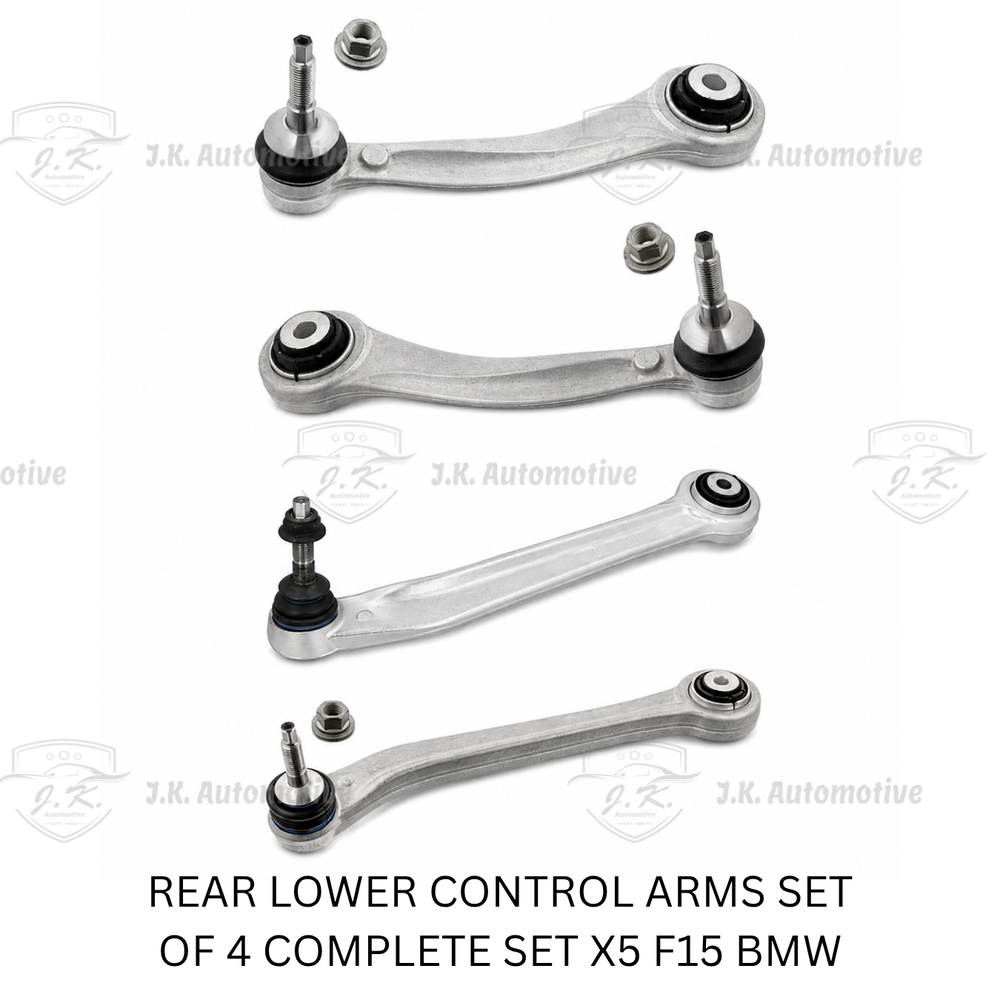
The Stokes Germany Rear Lower Control Arm Complete Set of 4 for BMW X5 F15 is a premium aftermarket rear suspension replacement set designed for the BMW X5 F15 from 2014–2019 and supplied as a complete Set of 4 corresponding to OEM references 33326795047 & 33326795048 & 33326796001 & 33326796002. The current JK Automotive listing confirms these exact four OEM references, BMW X5 (F15) compatibility, the 2014–2019 year range, a listed product weight of 20 kg and a 6-month warranty against manufacturing defects. The rear lower control arms form an important part of the vehicle's multi-link rear suspension because suspension arms help locate and control the rear wheel assembly as it moves vertically and responds to acceleration, braking, cornering and changing road surfaces. On a premium SUV such as the BMW X5 F15, maintaining controlled rear-wheel movement is important for preserving stable handling, ride comfort, predictable cornering and consistent tyre contact. As control arm bushes, joints or mounting areas wear, the suspension can develop excessive movement that may affect wheel geometry and vehicle behaviour. Common reasons for inspecting the rear control arms include knocking or clunking from the rear suspension, an unsettled rear axle, changes in handling, excessive movement over rough roads and abnormal rear tyre wear. The Set of 4 configuration is useful when professional diagnosis determines that the corresponding rear lower suspension arms require replacement together rather than repairing only one worn component while other related arms have accumulated similar mileage. The exact OEM references should always be checked before ordering because BMW suspension systems can use visually similar components with different applications. The four references supplied for this product are 33326795047, 33326795048, 33326796001 and 33326796002, and these numbers should be preserved exactly during compatibility verification. The product listing also provides Lemförder references 37858 01 & 37859 01 & 37856 01 & 37857 01, Meyle references 316 050 0039 & 316 050 0040 & 316 050 0041 & 316 050 0042, FEBI Bilstein references 37451 & 37452 & 37443 & 37444, and FAG references 821 0765 10 & 821 0766 10 & 821 0775 10 & 821 0776 10 for comparison and identification purposes. Professional diagnosis remains important because rear suspension noises and unstable handling can also be caused by other components. Rear upper control arms, bushes, wheel bearings, shock absorbers and mounting hardware should therefore be inspected during the repair. Sway bar links, sway links, anti roll link rods and stabiliser sway links should also be checked for looseness or deterioration. Rear tyres should be inspected across the full tread width for inner-edge wear, outer-edge wear, feathering or uneven tread depth. Professional installation is recommended, followed by a complete four-wheel alignment check after the required suspension repairs. Correctly functioning rear control arms combined with accurate wheel geometry help support refined ride quality, stable rear-axle behaviour, predictable handling and the premium SUV driving characteristics expected from the BMW X5 F15.
Which BMW X5 F15 models are compatible with this Rear Lower Control Arm Complete Set of 4?
This Stokes Germany Rear Lower Control Arm Complete Set of 4 is specified for the BMW X5 F15 from 2014–2019 with OEM references 33326795047 & 33326795048 & 33326796001 & 33326796002. The current JK Automotive catalogue identifies the vehicle brand as BMW, model as X5 (F15), year range as 2014–2019 and compatibility as BMW X5 (F15) 2014–2019. Before purchasing the set, the customer or workshop should verify the vehicle's exact model, F15 chassis designation, manufacturing year, rear suspension position, Set of 4 configuration and all four OEM numbers. This verification is particularly important for premium European vehicles because different chassis versions, production periods or suspension configurations may use components that appear similar but have different dimensions, mounting points or applications. Customers should therefore avoid selecting a rear control arm solely by looking at its shape in a photograph. OEM-number verification provides a much stronger method of identifying the required replacement. For this product, the exact references are 33326795047, 33326795048, 33326796001 and 33326796002. The current listing also provides cross-reference information from several established suspension brands, including Lemförder 37858 01, 37859 01, 37856 01 and 37857 01; Meyle 316 050 0039, 316 050 0040, 316 050 0041 and 316 050 0042; FEBI Bilstein 37451, 37452, 37443 and 37444; and FAG 821 0765 10, 821 0766 10, 821 0775 10 and 821 0776 10. These references can provide additional identification points when a workshop is comparing an existing suspension component or parts catalogue. The rear lower control arms help control the position and movement of the rear wheel assembly throughout suspension travel. During acceleration, braking and cornering, the rear suspension experiences substantial changing forces, and serviceable control arms and bushes help keep wheel movement controlled relative to the vehicle body. This contributes to suspension geometry, tyre contact, predictable handling and ride stability. If the vehicle develops rear suspension knocking, abnormal tyre wear, excessive rear-wheel movement or an unsettled feeling during cornering, the rear suspension should be professionally inspected. However, these symptoms alone do not confirm that all four control arms require replacement. A technician should inspect the individual arms and surrounding suspension before deciding which components require repair. Related rear suspension bushes, upper control arms, wheel bearings, shock absorbers and mounting hardware should also be examined. Sway bar links, sway links, anti roll link rods and stabiliser sway links should be checked because their worn joints can create similar suspension noises. Once correct compatibility has been confirmed and all required components have been professionally installed, a complete wheel-alignment check is recommended to help maintain accurate geometry, consistent tyre performance, stable rear-axle behaviour and the premium handling characteristics expected from the BMW X5 F15.
What are OEM numbers 33326795047 & 33326795048 & 33326796001 & 33326796002 for the BMW X5 F15?
OEM references 33326795047 & 33326795048 & 33326796001 & 33326796002 are the four exact OEM cross-reference numbers listed for this Stokes Germany Rear Lower Control Arm Complete Set of 4 for the BMW X5 F15 2014–2019. JK Automotive's current product information confirms these numbers together under the OEM Cross Reference field and identifies the product as a Rear Lower Control Arm Complete Set of 4 for the BMW X5 F15. These OEM numbers are important because they provide precise reference points for checking suspension-part compatibility before purchase. Customers should not remove, shorten, combine or interchange these references when verifying the product because each number forms part of the complete four-arm application supplied in this set. The first reference is 33326795047, the second is 33326795048, the third is 33326796001 and the fourth is 33326796002. Together they identify the corresponding components included in the advertised Set of 4. The listing also provides four Lemförder cross references: 37858 01, 37859 01, 37856 01 and 37857 01. Meyle references are listed as 316 050 0039, 316 050 0040, 316 050 0041 and 316 050 0042. FEBI Bilstein references are 37451, 37452, 37443 and 37444, while FAG references are 821 0765 10, 821 0766 10, 821 0775 10 and 821 0776 10. These cross references can be useful when workshops compare existing parts, aftermarket catalogues and replacement options, but the customer's vehicle application and exact required component should still be verified before ordering. Rear lower control arms form part of the wheel-locating suspension system and help guide the wheel as the suspension moves. During acceleration, braking, cornering and travel over uneven roads, the control arms and their associated bushes or joints experience continuous loads. If excessive wear develops, the wheel can move more than intended relative to the chassis, potentially contributing to changes in suspension geometry, irregular tyre wear, knocking noises and reduced stability. On the BMW X5 F15, maintaining serviceable suspension components is particularly important because the vehicle combines substantial SUV mass with premium ride and handling expectations. Professional diagnosis should therefore establish whether the corresponding arms are actually worn before replacement. Other rear suspension components should also be inspected because a worn wheel bearing, bush, upper control arm, shock absorber or stabiliser component can produce overlapping symptoms. Sway bar links, sway links, anti roll link rods and stabiliser sway links should be checked as part of a comprehensive suspension inspection. After the required control arms have been installed, complete wheel alignment should be checked and adjusted where necessary. Using the exact OEM numbers together with correct model, chassis, year and suspension-position verification helps reduce fitment errors and supports a more accurate BMW X5 F15 suspension repair.
What are the symptoms of worn Rear Lower Control Arms on a BMW X5 F15?
Worn Rear Lower Control Arms on a BMW X5 F15 can produce several symptoms involving suspension noise, wheel movement, tyre wear, ride quality and rear-axle stability, although professional diagnosis is necessary because many rear suspension faults can create similar behaviour. One common symptom is knocking or clunking from the rear suspension when driving over potholes, speed breakers, uneven roads or broken surfaces. As a control arm bush or joint develops excessive play, the suspension component can move beyond its intended range as loads change, producing noise or unwanted movement. Another possible symptom is an unsettled feeling from the rear axle during cornering or lane changes. The vehicle may feel less planted or less predictable because the rear wheel is not being controlled as precisely under changing suspension loads. Drivers may also notice changes during acceleration or braking because these actions transfer forces through the suspension links. Irregular tyre wear is another important reason to inspect the rear control arms. Inner-edge wear, outer-edge wear, feathering or rapid tread deterioration can indicate that wheel geometry is not remaining within the desired range, although incorrect alignment, tyre pressure and other suspension faults can produce similar patterns. Steering-wheel vibration should not automatically be blamed on the rear control arms, but excessive suspension movement elsewhere in the vehicle can contribute to an overall reduction in refinement. The Stokes Germany Rear Lower Control Arm Complete Set of 4 is specified for the BMW X5 F15 2014–2019 and corresponds to OEM references 33326795047 & 33326795048 & 33326796001 & 33326796002. When a technician identifies wear in the corresponding components, replacement can help restore the mechanical control required for stable wheel positioning. The Set of 4 provides the four corresponding rear lower control arms together, which can be useful when multiple related arms require replacement. However, all four components should not automatically be changed solely because one noise is present; the condition of each suspension component should be professionally assessed. Rear upper control arms, bushes, wheel bearings, shock absorbers and mounting points should be checked at the same time. Sway bar links, sway links, anti roll link rods and stabiliser sway links deserve particular attention when the main complaint is knocking over rough surfaces because worn stabiliser joints can create similar sounds. Rear tyres should be inspected across their full tread width, and tyre pressures should be checked. Once the required mechanical repairs have been completed, wheel alignment should be measured because replacing wheel-locating suspension arms can influence geometry. Correct diagnosis, serviceable control arms, healthy related suspension components and accurate alignment together help restore consistent tyre contact, stable rear-axle behaviour, predictable handling, refined ride quality and the premium driving experience expected from the BMW X5 F15.
What are the benefits of replacing the BMW X5 F15 Rear Lower Control Arms as a Complete Set of 4?
Replacing the BMW X5 F15 Rear Lower Control Arms as a Complete Set of 4 can provide a comprehensive rear suspension repair when professional inspection confirms that the corresponding arms have deteriorated or accumulated comparable wear. This Stokes Germany Rear Lower Control Arm Complete Set of 4 corresponds to OEM references 33326795047 & 33326795048 & 33326796001 & 33326796002 and is listed specifically for the BMW X5 F15 2014–2019. The primary benefit of replacing worn control arms is restoring the mechanical foundation required to control rear-wheel movement. The rear suspension must maintain wheel position while simultaneously allowing controlled vertical movement over bumps and road irregularities. During acceleration, braking and cornering, the suspension arms also manage changing longitudinal and lateral loads. When control arm bushes, joints or mounting areas become worn, the rear wheel may experience unwanted movement, potentially reducing stability and affecting suspension geometry. Replacing professionally diagnosed worn arms can help reduce this excessive movement and support more predictable handling. Another important benefit is the potential improvement in tyre contact and tyre-wear consistency once the suspension is mechanically sound and alignment is correctly adjusted. Worn wheel-locating components can contribute to geometry changes that may accelerate inner-edge or outer-edge tyre wear. Installing serviceable control arms before alignment gives the technician a more stable mechanical platform on which to establish correct wheel geometry. A complete Set of 4 can also simplify parts identification when the repair requires all four corresponding components because the required OEM references are supplied together under one product listing. The current listing additionally cross-references the four components to Lemförder 37858 01 & 37859 01 & 37856 01 & 37857 01, Meyle 316 050 0039 & 316 050 0040 & 316 050 0041 & 316 050 0042, FEBI Bilstein 37451 & 37452 & 37443 & 37444, and FAG 821 0765 10 & 821 0766 10 & 821 0775 10 & 821 0776 10. Replacing the required arms together may also reduce the likelihood of completing one repair only to discover another corresponding high-mileage arm requires attention shortly afterward, although replacement decisions should still be based on actual inspection rather than assumption. During installation, the complete rear suspension should be examined for other deterioration. Rear upper control arms, suspension bushes, shock absorbers, wheel bearings and mounting hardware should be checked. Sway bar links, sway links, anti roll link rods and stabiliser sway links should also be inspected. Tyres should be examined for uneven wear or physical damage. Professional installation followed by four-wheel alignment helps ensure that the benefits of the new components are fully realised. When combined with a healthy surrounding suspension system, serviceable rear lower control arms help support stable handling, refined ride comfort, accurate suspension geometry, consistent tyre performance and the controlled premium SUV driving characteristics expected from the BMW X5 F15.
Is wheel alignment required after replacing the Rear Lower Control Arm Complete Set of 4 on a BMW X5 F15?
Yes, a complete professional wheel-alignment check is strongly recommended after replacing the Rear Lower Control Arm Complete Set of 4 on a BMW X5 F15 because control arms are wheel-locating suspension components and replacing them can affect the relationship between the wheel assembly and chassis. This Stokes Germany Set of 4 is specified for BMW X5 F15 2014–2019 and corresponds to OEM references 33326795047 & 33326795048 & 33326796001 & 33326796002. Rear suspension geometry plays an important role in vehicle stability, tyre contact and tyre wear. If the previous control arms had deteriorated bushes, joints or mounting areas, the vehicle may already have been operating with unwanted suspension movement before replacement. Simply installing new components does not automatically confirm that the wheel geometry is correct. The suspension should therefore be mechanically inspected first and alignment measured after the required repairs have been completed. Four-wheel alignment is preferable because it evaluates the geometric relationship between the front and rear axles rather than considering the rear wheels in isolation. Before final alignment, the technician should verify that the newly installed control arms are correctly fitted and that there is no significant play elsewhere in the suspension. Rear upper control arms, remaining bushes, wheel bearings, shock absorbers and relevant mounting hardware should be inspected. Sway bar links, sway links, anti roll link rods and stabiliser sway links should also be checked for deterioration or excessive movement. The condition and pressure of all tyres should be checked because damaged, unevenly worn or incorrectly inflated tyres can influence vehicle behaviour and alignment assessment. If another wheel-locating suspension component has significant play, it should normally be repaired before the final alignment so that stable geometry can be established. Correct alignment after suspension repair can help improve straight-line stability, predictable cornering and consistent tyre contact while reducing the risk of accelerated irregular tyre wear caused by incorrect geometry. This is particularly important on the BMW X5 F15 because a premium SUV places substantial demands on its suspension while still being expected to provide refined ride quality and controlled handling. The current product listing itself recommends qualified installation followed by a complete wheel-alignment check and advises inspection of related stabilizer links, tie rod ends, ball joints, suspension bushes, shock absorbers, strut mounts and wheel bearings during replacement. Therefore, the preferred repair process is professional diagnosis, replacement of the required 33326795047 & 33326795048 & 33326796001 & 33326796002 components, inspection of the complete suspension, verification of tyre condition and then professional four-wheel alignment. This approach helps the new control arms operate within a correctly set suspension system and supports stable rear-wheel positioning, more consistent tyre performance, refined ride quality and the premium handling characteristics expected from the BMW X5 F15.
How do worn Rear Control Arms affect the handling, stability and ride quality of a BMW X5 F15?
Worn rear control arms can affect the BMW X5 F15 in several interconnected ways because the rear suspension relies on multiple links to locate the wheels accurately while allowing controlled suspension movement. This Stokes Germany Rear Lower Control Arm Complete Set of 4 corresponds to OEM references 33326795047 & 33326795048 & 33326796001 & 33326796002 for the supplied BMW X5 F15 2014–2019 application. BMW parts cataloguing identifies 33326795047 and 33326795048 as left and right guiding suspension links with rubber mounts, while 33326796001 and 33326796002 are identified as left and right control arms with rubber bushings. These components work together to help locate the rear wheels while the suspension responds to acceleration, braking, cornering, road undulations, potholes and changes in vehicle load. When rubber bushes or other connection points deteriorate, unwanted movement can develop between the suspension arm, wheel carrier and rear axle structure. This can make the rear of the vehicle feel less controlled, particularly during faster lane changes, highway driving, braking or cornering. A driver may notice that the BMW X5 F15 no longer feels as planted as before or that the rear axle requires more correction during directional changes. Worn suspension links may also contribute to knocking or clunking noises when travelling over speed breakers, potholes and uneven road surfaces. Because control arms participate in maintaining wheel position, deterioration can also contribute to changes in wheel geometry under load. This can result in abnormal tyre wear, including inner-edge wear, outer-edge wear, feathering or accelerated tread deterioration. A premium SUV such as the BMW X5 F15 depends on controlled suspension movement not only for handling but also for refined ride quality, road stability and consistent tyre contact. Replacing professionally diagnosed worn components can therefore help restore the mechanical foundation required for more predictable rear-wheel control. The complete rear suspension should nevertheless be inspected because similar symptoms can originate from other components. Rear upper suspension links, integral links, ball joints, wheel bearings, shock absorbers and suspension bushes should all be checked. Sway bar links, sway links, anti roll link rods and stabiliser sway links should also be inspected because worn stabiliser joints can create knocking or rattling that resembles control-arm deterioration. Tyres should be inspected across their complete tread width, and correct tyre pressure should be confirmed. Professional installation of the required 33326795047 & 33326795048 & 33326796001 & 33326796002 components should be followed by a complete four-wheel alignment check. When serviceable suspension components, healthy tyres and accurate geometry work together, they help preserve the stable rear-axle behaviour, refined ride comfort, predictable cornering and premium driving dynamics expected from the BMW X5 F15.
When should the BMW X5 F15 Rear Lower Control Arm Complete Set of 4 be replaced?
The BMW X5 F15 Rear Lower Control Arm Complete Set of 4 should be considered for replacement when professional inspection identifies excessive movement, deteriorated rubber bushes, damaged arms, deformation, damaged mounting areas or other wear affecting the corresponding rear suspension components. This Stokes Germany Set of 4 is specified for the BMW X5 F15 2014–2019 and corresponds exactly to OEM references 33326795047 & 33326795048 & 33326796001 & 33326796002. The current JK Automotive listing confirms the Set of 4 configuration, exact OEM numbers, X5 F15 application, 2014–2019 year range, 20 kg listed product weight and a 6-month warranty against manufacturing defects. There is no universal mileage at which every BMW X5 F15 requires these components to be replaced because suspension life varies according to road quality, driving conditions, vehicle loading, mileage, environmental exposure, pothole impacts and the condition of surrounding components. A vehicle frequently driven on damaged roads may place greater repetitive loads on suspension bushes and joints than one predominantly used on smoother roads. Inspection becomes particularly important if the driver notices knocking or clunking from the rear suspension, excessive movement over rough roads, an unsettled rear axle or changes in cornering behaviour. Abnormal tyre wear is another important warning sign because worn wheel-locating components can contribute to unwanted changes in suspension geometry. Inner-edge wear, outer-edge wear, feathering or unusually rapid tyre wear should therefore prompt inspection of both the suspension and alignment rather than simply replacing the tyres. BMW parts cataloguing confirms that the four references represent paired left/right rear suspension components: 33326795047 and 33326795048 are guiding suspension links with rubber mounts, while 33326796001 and 33326796002 are control arms with rubber bushings. This makes the complete set useful when inspection determines that all corresponding components require replacement. However, the presence of a Set of 4 does not mean all four arms should automatically be replaced without diagnosis. A qualified suspension technician should evaluate the condition of each arm and the rest of the rear suspension. Integral links, ball joints, other suspension links, wheel bearings, shock absorbers and relevant mounting hardware should be checked at the same time. Sway bar links, sway links, anti roll link rods and stabiliser sway links should also be examined for looseness or damaged joints. Tyre condition and pressure should be checked before final alignment. Once the professionally diagnosed worn components have been replaced, complete four-wheel alignment should be performed to verify the vehicle's geometry. A properly repaired suspension with accurate alignment can help maintain stable handling, consistent tyre contact, controlled rear-wheel movement and the premium ride characteristics expected from the BMW X5 F15.
What related suspension components should be inspected when replacing the BMW X5 F15 Rear Lower Control Arm Complete Set of 4?
When replacing the BMW X5 F15 Rear Lower Control Arm Complete Set of 4, the entire rear suspension should be professionally inspected because the four supplied components work as part of a larger multi-link suspension system rather than functioning independently. The Stokes Germany set corresponds to OEM references 33326795047 & 33326795048 & 33326796001 & 33326796002 for the supplied BMW X5 F15 2014–2019 application. BMW rear-axle parts cataloguing lists these components alongside other important wheel-suspension parts including the wheel carrier, ball joint, integral link, eccentric adjustment hardware and other mounting components. This makes a complete inspection particularly useful when the vehicle already has significant mileage or has been exposed to rough roads. The technician should first inspect other rear suspension links and their rubber bushes for cracking, separation, distortion or excessive movement. Ball joints should be checked for looseness or deterioration because unwanted joint movement can contribute to suspension noise and inaccurate wheel control. Integral links and their mounting points should also be examined because they form part of the rear wheel-locating system. Wheel bearings should be checked for excessive play, roughness or abnormal noise because bearing wear can sometimes produce symptoms that drivers interpret as suspension problems. Rear shock absorbers should be inspected for leakage, physical damage, deteriorated mounting points and reduced damping performance. Where applicable, air-suspension-related components should also be assessed according to the vehicle's actual suspension specification. Sway bar links, sway links, anti roll link rods and stabiliser sway links deserve particular attention when the main complaint is knocking or rattling over uneven surfaces because worn stabiliser joints can produce similar noises. Stabiliser bar bushes and mounting points should also be examined. Relevant eccentric bolts and adjustment hardware should be inspected because they are associated with the rear suspension assembly and can be important during alignment. BMW parts cataloguing shows eccentric hardware in the same rear axle support/wheel-suspension assembly as these control-arm references. Suspension mounting bolts and nuts should be inspected and handled according to appropriate BMW workshop procedures. The rear tyres should be examined across the complete tread width for inner-edge wear, outer-edge wear, feathering, cupping or uneven tread depth. Tyre pressure should also be verified because incorrect pressure can influence tyre wear and vehicle behaviour. The front suspension and steering should be considered if complete four-wheel alignment reveals additional geometry issues. Replacing only the four rear arms while ignoring another significantly worn suspension component can prevent the vehicle from achieving the intended improvement. For this reason, professional inspection should determine the complete repair requirement before final alignment. Once the 33326795047 & 33326795048 & 33326796001 & 33326796002 components and any other diagnosed worn parts have been installed, a complete four-wheel alignment check should be carried out. This comprehensive approach helps support accurate suspension geometry, controlled rear-wheel positioning, consistent tyre performance, refined ride comfort and stable premium-SUV handling.
Why is professional installation important for the BMW X5 F15 Rear Lower Control Arm Complete Set of 4?
Professional installation is strongly recommended for the BMW X5 F15 Rear Lower Control Arm Complete Set of 4 because these are structural wheel-locating suspension components whose mounting, positioning and interaction with the surrounding rear suspension can directly affect wheel geometry, handling and tyre behaviour. The Stokes Germany Set of 4 corresponds to OEM references 33326795047 & 33326795048 & 33326796001 & 33326796002 for BMW X5 F15 2014–2019. BMW parts cataloguing distinguishes the components by side and type: 33326795047 is the left guiding suspension link with rubber mount, 33326795048 is the corresponding right link, 33326796001 is the left control arm with rubber bushing and 33326796002 is the corresponding right control arm. Correctly identifying these individual positions is an important part of installation. A qualified suspension technician can safely raise and support the vehicle, identify each required arm, remove the existing components using suitable workshop equipment and inspect the surrounding mounting areas before fitting replacements. This also gives the technician an opportunity to identify worn parts that could otherwise reduce the effectiveness of the repair. The ball joints, integral links, other suspension links, wheel bearings, shock absorbers and bushes should be inspected for excessive movement or deterioration. Sway bar links, sway links, anti roll link rods and stabiliser sway links should also be checked, especially if suspension knocking or rattling was one of the original complaints. Relevant mounting bolts, nuts and eccentric adjustment hardware should be inspected and handled according to the appropriate repair procedure rather than relying on generic tightening practices. Correct suspension-arm installation is important because rubber-bushed components can be sensitive to mounting position and suspension loading conditions. A qualified BMW or European-car suspension technician should therefore follow appropriate vehicle-specific installation procedures. Tyres should also be examined for abnormal wear because pre-existing wear can indicate that the vehicle has been operating with suspension or alignment problems. After the four control-arm components and any other diagnosed worn parts have been installed, the suspension should be checked for secure mounting and correct movement. A complete four-wheel alignment check should then be performed because replacement of wheel-locating links can alter or expose existing geometry errors. The JK Automotive listing itself recommends qualified installation followed by a complete wheel-alignment check and inspection of related suspension components. Correct installation and alignment are especially important on the BMW X5 F15 because its suspension must manage SUV weight while still providing refined ride quality and controlled handling. A professional repair therefore helps ensure that the new components work as part of a mechanically sound suspension system and supports predictable cornering, stable rear-axle behaviour, consistent tyre contact, refined ride comfort and the premium driving characteristics expected from the BMW X5 F15.
Why is Stokes Germany a European-quality alternative to Lemförder, FEBI, Meyle, FAG and other established brands for BMW X5 F15?

Reviews
There are no reviews yet.