What are Stokes Germany Front Lower Control Arms for Audi Q3 Sportback F3N and what do they do?
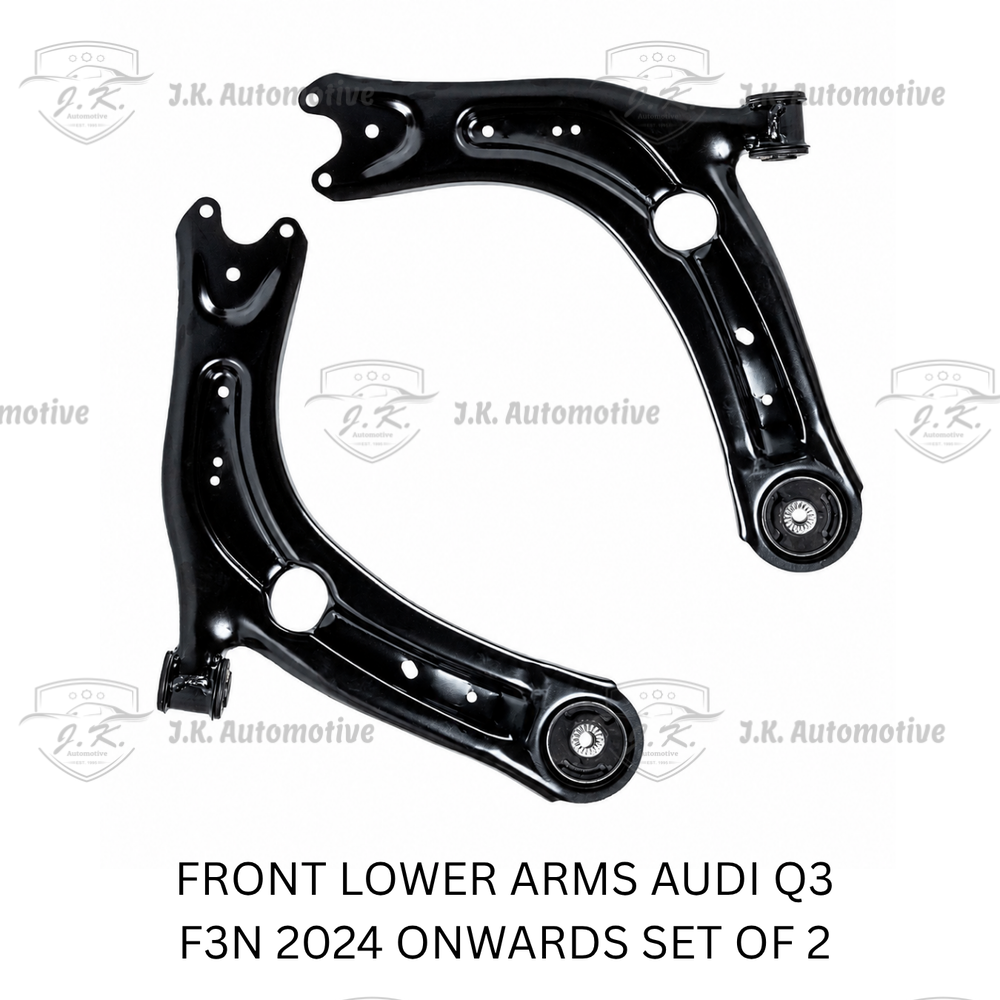
Audi Q3 Sportback F3N Front Lower Control Arms are important parts of the front suspension system that help locate and guide the front wheel assemblies while allowing controlled suspension movement during normal driving, braking, acceleration, cornering and travel over uneven road surfaces. This Stokes Germany Front Lower Control Arm Set of 2 is supplied with references 3Q0407152E and 3Q0407151E for the supplied Audi Q3 Sportback F3N 2024 Onwards application with the product year range retained as 2023–Present. The current JK Automotive catalog lists this exact combination of vehicle, references, brand and year range. The two control arms are handed components rather than identical interchangeable parts. Reference 3Q0407151E corresponds to the front left lower position, while 3Q0407152E corresponds to the front right lower position. Independent catalog data specifically lists 3Q0407151E for the Audi Q3 Sportback F3N as a front lower left control arm and 3Q0407152E as the corresponding front lower right component. During driving, these lower suspension arms help control the position and movement of the wheel assemblies as the suspension responds to potholes, speed breakers, expansion joints, broken roads and other changes in road surface. Braking introduces longitudinal forces through the front tyres and wheel assemblies, while cornering produces lateral forces that are also transmitted through the suspension system. The control arms and their bushes therefore experience repeated mechanical loading throughout normal vehicle use. The suspension bushes allow the controlled movement required by the suspension while helping restrict excessive displacement at the control-arm mounting points. With mileage, repeated road impacts and material ageing, bushes can crack, deform, separate or become excessively compliant. The arms and associated suspension mounting points can also suffer impact damage or develop unwanted movement. Worn Audi Q3 Sportback F3N Front Lower Control Arms may contribute to knocking or clunking, vague steering, movement during braking, reduced suspension precision or irregular tyre wear. These symptoms are not exclusive to the lower arms, however, so the complete front suspension should be inspected. Tie rods, wheel bearings, shock absorbers, tyres, wheels, Sway bar links, Sway links, Anti roll link rods and Stabiliser sway links can produce similar complaints. When 3Q0407151E and 3Q0407152E are confirmed as the required references, this Stokes Germany Set of 2 provides the corresponding left and right lower suspension arms. Professional installation and wheel alignment after suspension repair are recommended.
Are 3Q0407152E and 3Q0407151E suitable for Audi Q3 Sportback F3N?
References 3Q0407152E and 3Q0407151E are supported for Audi Q3 Sportback F3N applications, and the current JK Automotive catalog specifically lists these two references together as the Stokes Germany Front Lower Control Arm Set of 2 for Audi Q3 Sportback F3N with the supplied 2023–Present year range. Independent technical evidence also supports the underlying application. Autoparts24 identifies 3Q0407152E as a front lower right control arm and specifically lists Audi Q3 Sportback F3N among its applications, while its data for 3Q0407151E identifies the reference as the front lower left component for Audi Q3 Sportback F3N. Teknorot independently catalogs 3Q0407152E as a Front Right Lower suspension control arm and pairs it with the corresponding Front Left Lower arm; its compatible-vehicle information includes Audi Q3 Sportback. Its 3Q0407151E catalog entry similarly identifies the part family as Front Left Lower and lists Audi Q3 Sportback among compatible vehicles. This means the two references should not be treated as interchangeable. 3Q0407151E is the left-side component and 3Q0407152E is the right-side component. Correct side identification matters because handed suspension arms have position-specific geometry and mounting orientation. Although the reference family is supported for the Q3 Sportback F3N, customers should still verify the individual vehicle VIN, production date, suspension specification and exact existing OE references before ordering. The 3Q0 reference family appears across several Volkswagen Group vehicles and has multiple suffix revisions, so the complete reference should be checked rather than matching only the initial digits. The reason for replacement should also be professionally diagnosed. Knocking does not automatically mean the lower control arms are worn, while vibration can originate from tyres, wheel balance, wheels, wheel bearings or brakes. Steering tie rods should be checked when vague steering is present, and Sway bar links, Sway links, Anti roll link rods and Stabiliser sway links should be inspected when knocking or rattling occurs over smaller road irregularities. Once the individual Audi Q3 Sportback F3N is confirmed to require 3Q0407151E and 3Q0407152E, this Stokes Germany Set of 2 provides the corresponding left and right front lower suspension components.
What are the common symptoms of worn Audi Q3 Sportback F3N Front Lower Control Arms?
Common symptoms associated with worn Audi Q3 Sportback F3N Front Lower Control Arms can include knocking or clunking from the front suspension, vague or less precise steering, unwanted movement during braking, changes in handling response, instability over uneven roads, irregular tyre wear and, in some circumstances, vibration, although each symptom should be properly diagnosed because other suspension, steering, tyre, wheel and braking components can create similar complaints. This Stokes Germany Set of 2 contains 3Q0407151E for the front lower left position and 3Q0407152E for the front lower right position, and these positions are supported by independent catalog data for the Q3 Sportback F3N application. During normal operation, the lower control arms help guide the wheel assemblies through suspension travel. Their bushes provide controlled compliance while restricting excessive unwanted movement. Repeated suspension loads from braking, cornering, potholes, speed breakers and uneven roads can gradually affect the bushes and associated suspension components. When a control-arm bush cracks, separates, deforms or becomes excessively compliant, the arm may move farther than intended when road or driving forces change direction. This can sometimes create knocking or clunking when travelling over broken roads, potholes or speed breakers. Excessive movement can also become noticeable during braking because braking loads are transmitted through the front suspension. A driver may notice reduced steering precision or additional movement when braking or changing direction. Irregular tyre wear can sometimes accompany suspension deterioration because excessive movement can affect how consistently wheel geometry is maintained. However, abnormal tyre wear can also be caused by incorrect tyre pressure, existing alignment problems, damaged wheels and other suspension faults. Vibration requires particularly careful diagnosis because wheel imbalance, tyre deformation, bent alloy wheels, deteriorated wheel bearings and braking problems can produce vibration independently of 3Q0407151E or 3Q0407152E. Wheel bearings and hubs should therefore be checked for unwanted movement, roughness and abnormal noise. Shock absorbers should be checked for leakage, damage and damping condition. Steering tie rods and tie rod ends should be examined for free play. Sway bar links, Sway links, Anti roll link rods and Stabiliser sway links should also be inspected because worn stabilizer-link joints can create knocking or rattling from the same general front suspension area. The lower control-arm bushes, joints, arms and mounting points should be physically inspected for deterioration, free play, bending or impact damage. Replacing confirmed worn Audi Q3 Sportback F3N Front Lower Control Arms can correct unwanted movement originating from those positions, but it cannot correct unrelated wheel, tyre, steering, bearing or shock-absorber problems.
What is included in the Audi Q3 Sportback F3N Front Lower Control Arm Set of 2?
The Stokes Germany Audi Q3 Sportback F3N Front Lower Control Arm Set of 2 contains two corresponding front lower suspension arms supplied under references 3Q0407152E and 3Q0407151E for the supplied Audi Q3 Sportback F3N 2024 Onwards product with the year range 2023–Present. JK Automotive currently lists the exact product as a Set of 2, identifies the model as Q3 Sportback (F3N), gives the OEM cross references as 3Q0407152E & 3Q0407151E and specifies compatibility as Audi Q3 Sportback (F3N) 2023–Present. The pair contains position-specific left and right suspension components rather than two identical control arms. Reference 3Q0407151E corresponds to the front lower left position, while 3Q0407152E corresponds to the front lower right position. Autoparts24 independently lists these respective left and right positions for the Q3 Sportback F3N, while Teknorot catalogs the reference families as handed front lower control arms. This paired configuration makes the product useful when both corresponding front lower suspension positions require replacement after proper inspection. Customers should not assume that unrelated suspension components are included merely because this is a Set of 2. Tie rods, shock absorbers, wheel bearings, stabilizer-bar components, Sway bar links, Sway links, Anti roll link rods and Stabiliser sway links are separate components unless specifically stated as included. Customers should likewise verify the exact configuration of the supplied control arms and whether any ball joints, bolts, nuts or other mounting hardware are included rather than assuming this from the product title. Catalog variants for the 3Q0407151E/3Q0407152E family can be described either as suspension control arms or control-arm-and-ball-joint assemblies depending on the specific manufacturer and configuration, which makes inspection of the actual supplied package important. Before installation, 3Q0407151E should be identified for the left side and 3Q0407152E for the right side, and each new component should be compared with its corresponding removed arm. The vehicle VIN, production date and suspension configuration should be verified before ordering. Once exact fitment is confirmed, this Set of 2 provides the specified corresponding left and right Audi Q3 Sportback F3N Front Lower Control Arms.
What are the benefits of replacing worn Audi Q3 Sportback F3N Front Lower Control Arms as a Set of 2?
Replacing worn Audi Q3 Sportback F3N Front Lower Control Arms as a Set of 2 can provide a coordinated left-and-right suspension repair when professional inspection confirms meaningful deterioration in both corresponding lower control arms. The Stokes Germany package provides 3Q0407151E for the front lower left position and 3Q0407152E for the front lower right position, and the current JK Automotive catalog lists these exact references together for Audi Q3 Sportback F3N (2023–Present). Independent catalogs confirm the left/right positioning of the two reference families, making this a corresponding handed pair rather than two interchangeable suspension arms. If both original lower control arms have covered similar mileage and have experienced similar braking loads, cornering forces, potholes, speed breakers and general road impacts, their bushes and related suspension points may reach a similar stage of deterioration. When both sides show significant cracking, separation, deformation or excessive movement, replacing the corresponding left and right components during the same repair can address unwanted mechanical movement on both sides. A Set of 2 also simplifies parts sourcing because the workshop has the required left and right suspension arms available before dismantling the vehicle. However, both control arms do not have to be replaced automatically whenever one side develops a fault. Suspension wear is not always equal from side to side. One wheel may encounter more potholes, road edges or kerb impacts than the other, while previous repair history can mean that one control arm is substantially newer. The mechanical condition of each side should therefore determine the repair scope. Both control-arm bushes should be checked for cracking, separation, deformation and excessive movement. The physical arms should be checked for bending, cracking and impact damage, while associated joints and mounting points should be inspected for free play. Related components should also be examined. Tie rods and tie rod ends should be checked for steering free play, wheel bearings for excessive movement or roughness, shock absorbers for leakage and damping condition, and tyres and wheels for abnormal wear or impact damage. Sway bar links, Sway links, Anti roll link rods and Stabiliser sway links should also be checked whenever front suspension knocking is reported. When both 3Q0407151E and 3Q0407152E are confirmed as worn and exact fitment is established for the individual vehicle, replacing the Audi Q3 Sportback F3N Front Lower Control Arms as a Set of 2 provides a practical paired repair. Professional installation followed by a suspension inspection and wheel alignment is recommended.
What should be checked before buying Stokes Germany Audi Q3 Sportback F3N Front Lower Control Arms?
Can worn Audi Q3 Sportback F3N Front Lower Control Arms cause knocking, vibration, loose steering or uneven tyre wear?
Worn Audi Q3 Sportback F3N Front Lower Control Arms can contribute to knocking or clunking from the front suspension, vague or loose-feeling steering, unwanted wheel movement during braking or acceleration, reduced directional precision and irregular tyre wear, while vibration can sometimes occur but should never automatically be attributed to the control arms because tyres, wheel balance, alloy wheels, wheel bearings, hubs and braking components can produce similar symptoms. This Stokes Germany Front Lower Control Arm Set of 2 contains 3Q0407151E for the front lower left position and 3Q0407152E for the corresponding front lower right position; independent catalogs identify the references in these respective positions and specifically include the Audi Q3 Sportback among compatible applications. The lower control arms help locate the front wheel assemblies and control their movement as the suspension responds to road conditions. Their bushes provide controlled compliance between the suspension arms and their mounting points while helping prevent excessive unwanted movement. During normal driving, the Audi Q3 Sportback F3N Front Lower Control Arms repeatedly experience loads from braking, acceleration, cornering, potholes, speed breakers, broken roads and changing road surfaces. When a control-arm bush becomes cracked, separated, deformed or excessively compliant, the corresponding suspension arm can move farther than intended when forces change direction. This movement may produce a knock or clunk when travelling over potholes, broken surfaces or speed breakers, and it can sometimes become more noticeable when braking or accelerating because the suspension loading changes. Excessive control-arm movement may also contribute to vague steering because the wheel assembly can shift slightly instead of remaining consistently located. Irregular tyre wear can sometimes accompany worn suspension components if excessive movement affects how consistently wheel geometry is maintained, but tyre pressure, wheel alignment and other suspension problems should also be considered. Vibration requires particularly careful diagnosis because an unbalanced wheel, deformed tyre, bent alloy wheel, worn wheel bearing or brake-related problem can produce vibration even when the lower control arms remain serviceable. Steering tie rods and tie rod ends should therefore be checked for excessive free play. Wheel bearings and hubs should be inspected for unwanted movement, roughness and abnormal noise. Shock absorbers should be checked for leakage, physical damage and damping condition. Sway bar links, Sway links, Anti roll link rods and Stabiliser sway links should also be inspected because worn stabilizer-link joints can produce knocking and rattling from the same general front suspension area. Replacing 3Q0407151E and 3Q0407152E can correct unwanted movement originating from these lower suspension positions when they are genuinely worn, but it cannot correct unrelated steering, tyre, wheel, bearing or shock-absorber faults. Proper diagnosis should therefore precede replacement.
Should both Audi Q3 Sportback F3N Front Lower Control Arms be replaced together?
Both Audi Q3 Sportback F3N Front Lower Control Arms can be replaced together when inspection confirms meaningful deterioration in the corresponding left and right suspension arms, and this Stokes Germany Set of 2 conveniently provides the two handed components together: 3Q0407151E for the front lower left position and 3Q0407152E for the front lower right position. Technical catalogs identify these references as a left/right pair, with one component required for each corresponding side, and Q3 Sportback is listed among the supported applications. The current JK Automotive catalog also lists the exact Stokes Germany Front Lower Control Arm Set of 2 for Audi Q3 Sportback F3N 2024 Onwards 3Q0407152E & 3Q0407151E (2023–Present), preserving the supplied model and year range. Replacing both control arms during the same repair can be practical when both have accumulated similar mileage and both show significant deterioration. The left and right lower suspension arms experience repeated suspension travel, braking loads, cornering forces and road impacts throughout their working life, so their bushes may sometimes reach a similar stage of wear. When both sides show cracking, separation, deformation or excessive bush movement, replacing the corresponding left and right components together can remove unwanted movement from both lower suspension positions. Purchasing them as a Set of 2 can also simplify workshop preparation because both required handed components are available before the vehicle is dismantled. However, both arms should not automatically be replaced simply because one control arm is defective. Suspension wear is not always symmetrical. One side of the vehicle may repeatedly encounter deeper potholes, damaged road edges or kerb impacts, while previous suspension repairs may mean that one control arm is substantially newer than the opposite side. Each component should therefore be inspected independently. The bushes should be examined for cracking, tearing, separation, deformation and excessive movement. The physical control arms should be checked for bending, cracking or impact damage, and associated joints and mounting points should also be inspected. Tie rods, wheel bearings, shock absorbers, tyres and wheels should be examined as part of the same diagnosis. Sway bar links, Sway links, Anti roll link rods and Stabiliser sway links should also be inspected whenever suspension noise is present. If both 3Q0407151E and 3Q0407152E are confirmed as worn, replacing the Audi Q3 Sportback F3N Front Lower Control Arms as a Set of 2 provides a coordinated left-and-right suspension repair. VIN, production date and suspension configuration should be checked before ordering, and professional installation followed by wheel alignment is recommended.
What other suspension and steering parts should be inspected when replacing Audi Q3 Sportback F3N Front Lower Control Arms?
When replacing Audi Q3 Sportback F3N Front Lower Control Arms, the complete front suspension, steering system, wheel hubs, tyres and wheels should be inspected because 3Q0407151E and 3Q0407152E operate as part of an interconnected chassis system, and another worn component can continue producing knocking, vibration, vague steering or irregular tyre wear even after the lower control arms have been renewed. The supplied references correspond to the front lower left and front lower right positions respectively, and independent catalog information lists both reference families for Audi Q3 Sportback applications. Steering tie rods and tie rod ends should be inspected carefully for excessive free play because these components transmit steering movement to the front wheel assemblies. A worn tie rod or steering joint can create vague steering, inconsistent directional response and knocking that may initially be mistaken for lower-control-arm deterioration. Sway bar links, Sway links, Anti roll link rods and Stabiliser sway links should receive particular attention whenever the customer reports knocking or rattling over potholes, broken roads or smaller surface irregularities because worn stabilizer-link joints can generate noise from the same general front suspension area. Stabilizer-bar mounting bushes should also be inspected where applicable. Shock absorbers should be checked for fluid leakage, physical damage and damping condition because their ability to control wheel movement affects overall suspension behaviour even though they perform a different function from the control arms. Wheel bearings and hubs should be checked for excessive movement, roughness, humming and other abnormal noises. Tyres should be examined for correct inflation pressure, irregular tread wear, bulges, sidewall damage and deformation, while alloy wheels should be checked for bending, cracking or pothole-related damage. When vibration is primarily related to vehicle speed, tyre condition, wheel condition and wheel balance should receive particular attention. When vibration is mainly present during braking, brake discs, hubs and associated braking components should also be checked. The control-arm mounting points should be inspected for physical damage if the vehicle has experienced a significant pothole strike, kerb impact or accident. The bushes used with the lower control arms are also relevant: FRAP's Q3/Q3 Sportback suspension catalog associates these control arms with separate silent-block references in the same suspension assembly, illustrating why the complete mounting system should be considered during diagnosis. Mounting bolts, nuts and related hardware should be inspected during disassembly, and any fasteners specified as non-reusable by the applicable repair procedure should be renewed. After all confirmed steering and suspension problems have been repaired, the front axle should be checked again for mechanical free play before wheel alignment is performed. Inspecting tie rods, wheel bearings, shocks, tyres, wheels, stabilizer-bar components, Sway bar links, Sway links, Anti roll link rods and Stabiliser sway links alongside the Audi Q3 Sportback F3N Front Lower Control Arms provides a more complete approach to front suspension repair.
Is wheel alignment required after replacing Audi Q3 Sportback F3N Front Lower Control Arms?
Professional wheel alignment is strongly recommended after replacing Audi Q3 Sportback F3N Front Lower Control Arms because the lower control arms participate directly in locating the front wheel assemblies, and replacing worn bushes or complete control arms changes the mechanical condition under which the wheel geometry is maintained. The Stokes Germany Set of 2 contains the corresponding 3Q0407151E front lower left and 3Q0407152E front lower right components, with independent catalogs confirming these positions. When an existing control-arm bush becomes cracked, separated, deformed or excessively compliant, the suspension arm may move farther than intended when braking, cornering or road loads are applied. This unwanted movement can reduce the consistency of wheel location while the vehicle is moving. Once a deteriorated control arm is replaced, the wheel assembly operates from a mechanically different condition with the unwanted movement reduced, so checking wheel geometry after the repair is sensible. Wheel alignment becomes particularly important when both corresponding lower control arms have been renewed because suspension components affecting both front wheel positions have been disturbed during the repair. Before alignment, however, all meaningful mechanical free play should be corrected. Steering tie rods and tie rod ends should be checked because an alignment machine cannot compensate for loose steering joints. Wheel bearings should be inspected for excessive movement and roughness, while shock absorbers should be checked for leakage and physical damage. Tyres should have appropriate inflation pressure and should be inspected for severe irregular wear or deformation. Alloy wheels should also be checked for impact damage or bending. Sway bar links, Sway links, Anti roll link rods and Stabiliser sway links should be inspected if knocking remains after the control-arm replacement. Correct installation is equally important. 3Q0407151E must be installed in the appropriate left-side position and 3Q0407152E in the corresponding right-side position, and the applicable vehicle-specific procedure should be followed for mounting, fasteners and tightening requirements. Existing abnormal tyre wear cannot be reversed by replacing the lower control arms or performing alignment, but correcting the mechanical fault and setting the geometry correctly can help prevent continued abnormal wear caused by those conditions. Wheel alignment should therefore be treated as an important final stage after Audi Q3 Sportback F3N Front Lower Control Arms replacement, once the suspension and steering system has been confirmed mechanically sound.
Why is Stokes Germany a European-quality alternative to Lemförder, FEBI, Meyle and other established brands for Audi Q3 Sportback F3N Front Lower Control Arms?
Stokes Germany can be considered a European-quality alternative when customers compare Audi Q3 Sportback F3N Front Lower Control Arms with Lemförder, FEBI, Meyle and other established suspension brands, with the most useful comparison based on exact reference matching, correct vehicle fitment, package quantity, component configuration, warranty, availability, after-sales support and overall repair value rather than unsupported claims that products from different manufacturers are identical in construction, materials, manufacturing location, durability or expected service life. The current JK Automotive catalog lists the exact Stokes Germany Front Lower Control Arm Set of 2 for Audi Q3 Sportback F3N 2024 Onwards with 3Q0407152E & 3Q0407151E and preserves the supplied 2023–Present application. Independent technical catalogs identify 3Q0407151E as the front lower left reference and 3Q0407152E as the corresponding front lower right reference, while the Q3 Sportback is specifically included among the compatible vehicle applications. Customers comparing Stokes Germany with Lemförder, FEBI, Meyle or another brand should first ensure they are comparing the same component configuration and package quantity. A single left or right control arm should not be compared directly with a complete Stokes Germany Set of 2 without accounting for the fact that this product contains the corresponding left and right components. Another important consideration is whether a particular aftermarket control arm is supplied alone or as a control-arm-and-ball-joint assembly. Technical catalogs show both configurations within the 3Q0407151E/3Q0407152E reference family, so package contents should be checked rather than assumed from the OE reference alone. Different manufacturers can use different bush materials, manufacturing methods, component specifications and quality-control processes; therefore, without controlled comparative testing, it would not be appropriate to claim that Stokes Germany is identical to, superior to or guaranteed to outlast Lemförder, FEBI or Meyle. Instead, customers can evaluate whether the Stokes Germany Set of 2 provides the exact references required, whether the corresponding left and right components are included, what warranty and seller support are available, whether the product is readily obtainable in India and whether the complete package provides suitable overall value for the intended repair. Exact fitment verification remains necessary regardless of brand. The VIN, production date, suspension specification and required references should be checked before ordering, particularly because these 3Q0 reference families are used across multiple Volkswagen Group applications. The reason for replacement should also be properly diagnosed because knocking, vibration, vague steering and uneven tyre wear can originate from tie rods, wheel bearings, shock absorbers, tyres, wheels, Sway bar links, Sway links, Anti roll link rods or Stabiliser sway links. When 3Q0407151E and 3Q0407152E are confirmed as the required components for the individual vehicle, the Stokes Germany Audi Q3 Sportback F3N Front Lower Control Arm Set of 2 can therefore be evaluated alongside Lemförder, FEBI, Meyle and other established alternatives based on exact fitment, complete left/right coverage, package contents, warranty, availability, support and overall repair value.
Reviews
There are no reviews yet.