What are Stokes Germany Front Lower And Upper Control Arms for Audi A7 4G and what do they do?
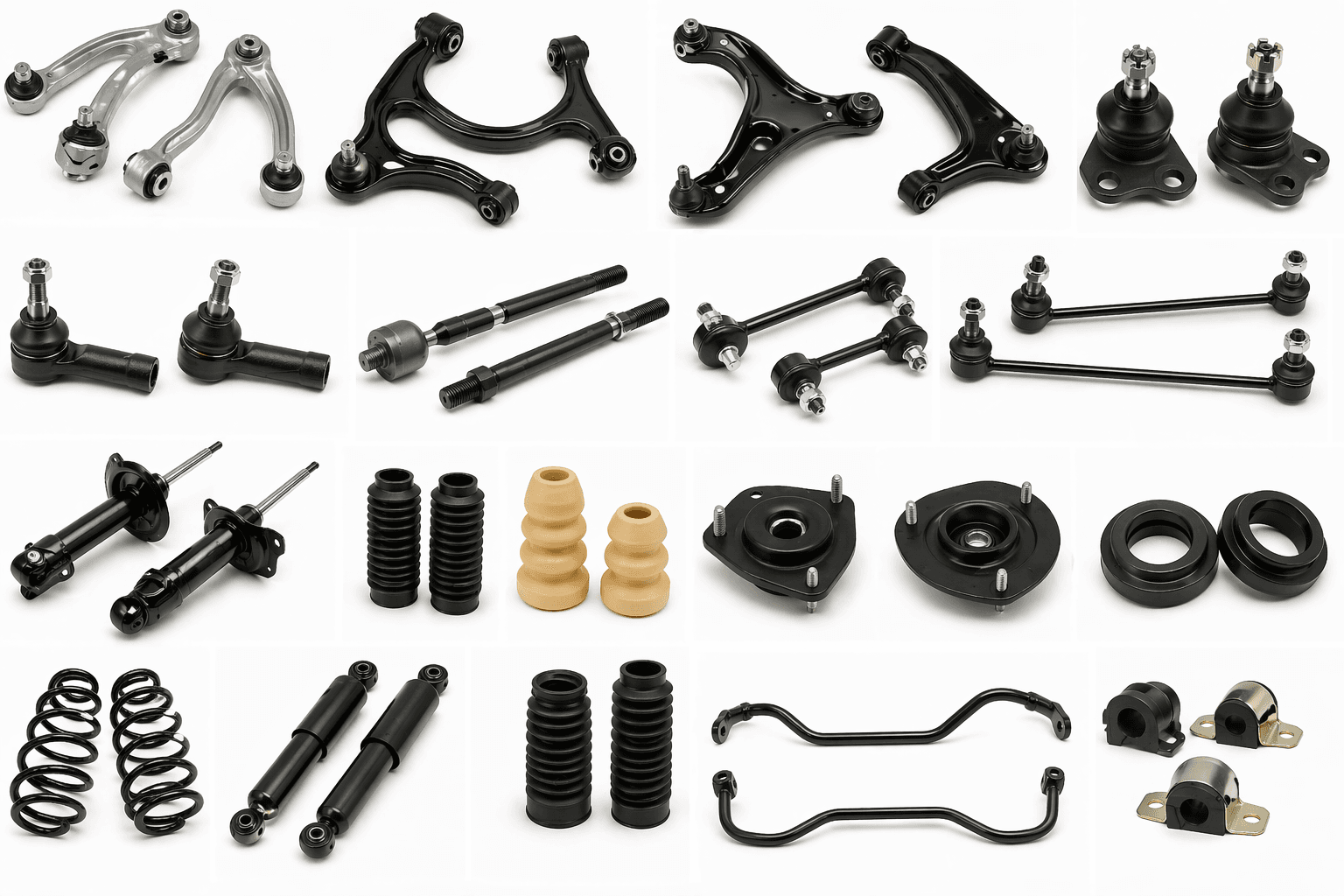
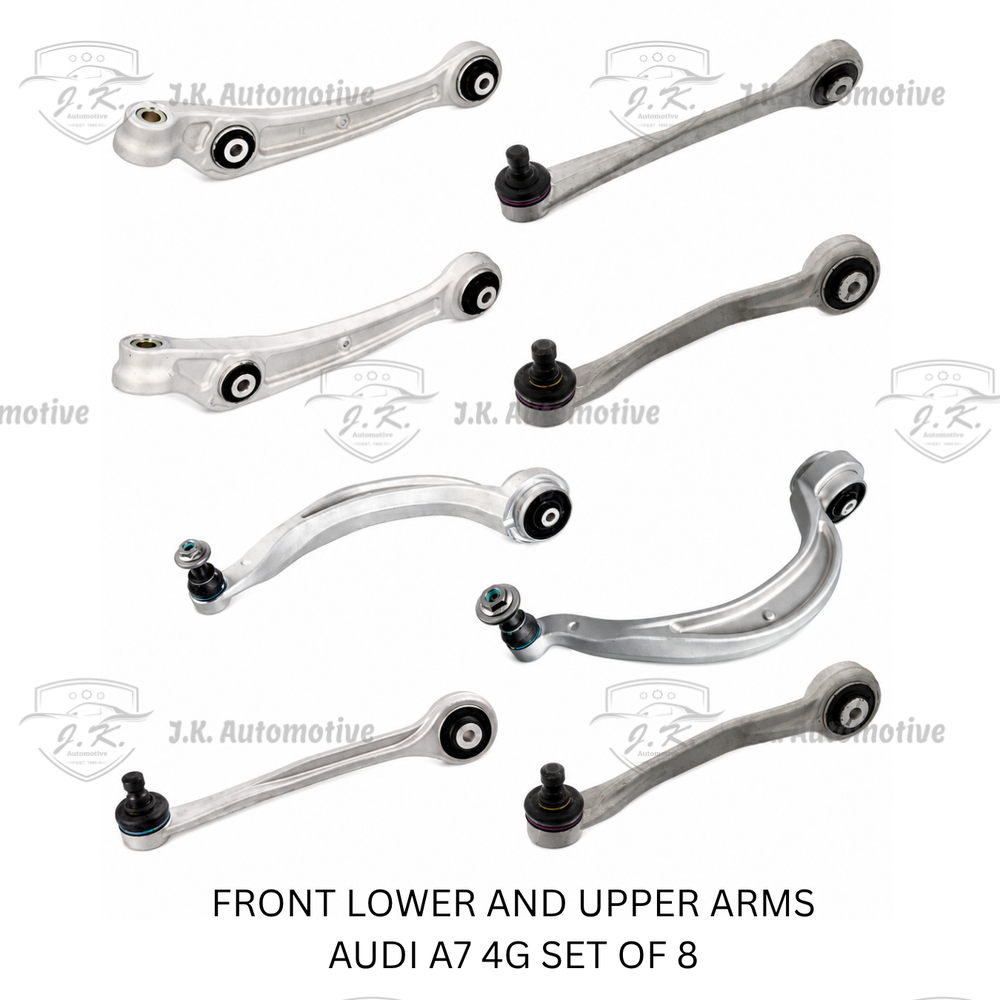
Audi A7 4G Front Lower And Upper Control Arms are important components within the front suspension system that help locate and guide the front wheel assemblies while allowing controlled suspension movement as the vehicle accelerates, brakes, corners and travels over uneven road surfaces. This Stokes Germany Front Lower And Upper Control Arm Set of 8 is supplied for Audi A7 Sportback (4G) 2011–2018 with exact references 4M0407693D, 4M0407694D, 4M0407151F, 4M0407152F, 4M0407505B, 4M0407506B, 4M0407509B and 4M0407510B, matching the current JK Automotive product data. These eight components should be understood as position-specific suspension arms rather than eight identical interchangeable parts, because the multi-link front suspension uses several individual links on each side to control wheel movement. The lower control arms manage important wheel-location loads closer to the lower section of the wheel carrier, while the upper control arms provide additional wheel guidance from the upper suspension positions. The four supplied 4M0407505B, 4M0407506B, 4M0407509B and 4M0407510B references form the front upper control-arm group; technical catalog data identifies 4M0407505B as front left upper forward, 4M0407506B as front right upper forward, 4M0407509B as front left upper rearward and 4M0407510B as front right upper rearward. During normal driving, these suspension links continuously react to forces generated by acceleration, braking, cornering and road irregularities. When the front wheels encounter potholes, speed breakers, expansion joints or broken road surfaces, the suspension moves vertically while the control arms help restrict unwanted movement in other directions. Rubber-to-metal bushes at suspension mounting points provide controlled compliance, while suspension joints allow the articulation required as the wheel travels through its suspension range. With mileage and repeated loading, bushes can deteriorate, crack, deform or develop excessive movement, while suspension joints can develop unwanted free play. When this happens, symptoms can include knocking or clunking, vague steering, excessive wheel movement, changes in handling response and irregular tyre wear. These symptoms are not exclusive to Audi A7 control arms, so the complete suspension and steering system should be inspected before replacement. Tie rods, wheel bearings, shock absorbers, tyres, wheels, Sway bar links, Sway links, Anti roll link rods and Stabiliser sway links can create similar complaints. Correctly selected Audi A7 4G Front Lower And Upper Control Arms help restore the mechanical integrity of the suspension positions in which the worn components are replaced. Exact OEM references, chassis code, year range and suspension configuration should be verified before ordering, followed by professional installation and wheel alignment.
Are 4M0407693D, 4M0407694D, 4M0407151F, 4M0407152F, 4M0407505B, 4M0407506B, 4M0407509B and 4M0407510B suitable for Audi A7 4G?
The Stokes Germany product listing specifies 4M0407693D, 4M0407694D, 4M0407151F, 4M0407152F, 4M0407505B, 4M0407506B, 4M0407509B and 4M0407510B as the eight references in this Front Lower And Upper Control Arm Set for Audi A7 Sportback (4G) 2011–2018, and the current JK Automotive product information explicitly lists the vehicle as Audi, model A7 Sportback (4G), year range 2011–2018 and compatibility as Audi A7 Sportback (4G) 2011–2018. Even with catalogued application data, exact fitment should still be checked against the individual vehicle because suspension components can vary according to production date, suspension specification, model derivative and previous part revisions. The supplied Set of 8 contains four references used for the lower portion of the package—4M0407693D, 4M0407694D, 4M0407151F and 4M0407152F—and four upper references—4M0407505B, 4M0407506B, 4M0407509B and 4M0407510B. Technical catalog information specifically maps the upper group as 4M0407505B front left upper forward, 4M0407506B front right upper forward, 4M0407509B front left upper rearward and 4M0407510B front right upper rearward. This demonstrates why individual suspension-arm positions matter: similar-looking arms cannot automatically be interchanged between the left and right sides or between forward and rearward positions. Before ordering Audi A7 4G Front Lower And Upper Control Arms, customers or workshops should check the VIN, chassis designation, production date and the references required for the vehicle. Where practical, the OE references from the components currently fitted should also be compared with the numbers supplied in the replacement package. This is particularly useful if the vehicle has undergone previous suspension work or accident repair because revised or replacement components may already have been installed. Visual appearance alone should not be treated as sufficient fitment confirmation because suspension arms can look similar while differing in length, mounting geometry, bush configuration or intended position. The reason for replacement should also be diagnosed before purchasing the complete package. Knocking does not automatically mean all eight control arms are worn, and vibration does not automatically indicate a suspension-arm fault. Tie rods, wheel bearings, shock absorbers, tyres, wheels, Sway bar links, Sway links, Anti roll link rods and Stabiliser sway links should be inspected as part of the diagnosis. Once the Audi A7 Sportback (4G) 2011–2018 application and all required references are confirmed, the Stokes Germany Set of 8 provides the corresponding supplied lower and upper control-arm package for the listing.
What are the common symptoms of worn Audi A7 4G Front Lower And Upper Control Arms?
Common symptoms associated with worn Audi A7 4G Front Lower And Upper Control Arms can include knocking or clunking from the front suspension, vague or less precise steering, excessive movement under braking, instability on uneven roads, changes in handling response, irregular tyre wear and vibration in certain circumstances, although these symptoms require proper diagnosis because control-arm wear is only one of several possible causes. This Stokes Germany Set of 8 is supplied with 4M0407693D, 4M0407694D, 4M0407151F, 4M0407152F, 4M0407505B, 4M0407506B, 4M0407509B and 4M0407510B for the listed Audi A7 Sportback (4G) 2011–2018 application. Control-arm bushes are designed to permit controlled movement while restricting excessive displacement at suspension mounting points. As these bushes age or experience repeated road impacts, the rubber can deteriorate, crack, separate, deform or permit more movement than intended. Suspension joints can also develop unwanted free play. Knocking or clunking may then become noticeable when the vehicle passes over potholes, speed breakers, broken roads or expansion joints because loads acting on the suspension change rapidly. A noise may also appear during braking or direction changes if a deteriorated bush allows the suspension arm to shift under load. Loose or vague steering can occur when excessive suspension movement allows the wheel carrier to move slightly as road and steering forces change. However, worn tie rods or steering joints can create similar symptoms and should therefore be checked before the control arms are blamed. Uneven tyre wear may sometimes accompany excessive suspension movement because deteriorated bushes or joints can reduce the consistency with which wheel geometry is maintained, but incorrect tyre pressure, damaged wheels, alignment problems and other suspension faults can also create abnormal tread wear. Vibration requires particularly careful diagnosis because wheel imbalance, tyre deformation, bent alloy wheels, deteriorated wheel bearings and brake-related faults can create vibration without any control-arm failure. Shock absorbers should be inspected for leakage, physical damage and damping condition, while wheel bearings should be checked for roughness, abnormal noise and excessive movement. Sway bar links, Sway links, Anti roll link rods and Stabiliser sway links are especially important to inspect when the main symptom is knocking or rattling over smaller bumps because worn stabilizer-link joints can produce noises that resemble control-arm wear. The suspension arms themselves should be checked for bush deterioration, joint play, damaged protective boots where applicable, bending, cracking and impact damage. Replacing confirmed worn Audi A7 4G Front Lower And Upper Control Arms can remove unwanted movement originating from those suspension positions, but it cannot correct an unrelated tyre, wheel, steering, bearing, brake or shock-absorber fault. Professional inspection, exact reference verification, correct installation and wheel alignment therefore provide the appropriate repair process.
What is included in the Audi A7 4G Front Lower And Upper Control Arm Set of 8?
The Stokes Germany Audi A7 4G Front Lower And Upper Control Arm Set of 8 contains eight specified front suspension references: 4M0407693D, 4M0407694D, 4M0407151F, 4M0407152F, 4M0407505B, 4M0407506B, 4M0407509B and 4M0407510B, with the current product listing identifying the application as Audi A7 Sportback (4G) 2011–2018. The package is designed as a combined lower-and-upper control-arm set rather than a collection of eight identical arms. References 4M0407693D, 4M0407694D, 4M0407151F and 4M0407152F constitute the four supplied lower-control-arm references in the set, while 4M0407505B, 4M0407506B, 4M0407509B and 4M0407510B constitute the four upper-control-arm references. The upper group has clear position-specific mapping in technical catalog information: 4M0407505B is front left upper forward, 4M0407506B is front right upper forward, 4M0407509B is front left upper rearward and 4M0407510B is front right upper rearward. These four upper arms therefore provide two different upper suspension links for each side of the front axle. The remaining four supplied references provide the lower section of the eight-arm package, giving the customer four supplied lower and four supplied upper suspension components. The current JK Automotive listing also provides Lemförder cross references 39304 01, 39305 01, 42633 01, 42634 01, 46157 01, 46158 01, 46310 01 and 46311 01 and Meyle cross references 116 050 0255, 116 050 0256, 116 050 0253, 116 050 0254, 116 050 0257, 116 050 0258, 116 050 0259 and 116 050 0260 for the listed package. Customers should not assume that other suspension and steering components are included unless they are explicitly shown or specified in the product listing. Tie rods, wheel bearings, shock absorbers, stabilizer-bar components and related hardware are separate suspension items unless expressly included. Sway bar links, Sway links, Anti roll link rods and Stabiliser sway links should therefore be inspected separately if suspension noise is present. Mounting bolts, nuts and other hardware should also be checked during installation, with any fasteners designated as non-reusable under the applicable repair procedure replaced accordingly. Each new suspension arm should be identified and compared with the corresponding removed component before installation. Correct left/right and forward/rearward positioning is particularly important because several components have very similar appearances. Customers should verify the Audi A7 Sportback (4G), 2011–2018 application, VIN, suspension configuration and exact required references before ordering the complete Set of 8.
What are the benefits of replacing worn Audi A7 4G Front Lower And Upper Control Arms as a Set of 8?
Replacing worn Audi A7 4G Front Lower And Upper Control Arms as a Set of 8 can provide a coordinated front suspension repair when inspection confirms deterioration across several corresponding suspension positions, while also allowing the specified lower and upper arms to be sourced together rather than ordering multiple individual components separately. The Stokes Germany package contains 4M0407693D, 4M0407694D, 4M0407151F, 4M0407152F, 4M0407505B, 4M0407506B, 4M0407509B and 4M0407510B and is currently listed for Audi A7 Sportback (4G) 2011–2018. When several suspension arms have covered similar mileage and experienced the same potholes, road impacts, braking forces and cornering loads, deterioration may develop across several bushes and joints during a similar service period. If inspection confirms excessive movement, bush cracking, separation, deformation or joint play across multiple suspension positions, replacing those confirmed worn components during one repair can remove unwanted movement from several wheel-location points. A complete eight-arm package can simplify workshop planning because the required suspension components can be available before the front suspension is dismantled. It can also reduce the need to order individual control arms at different stages of the repair. The four supplied upper references cover separate left/right and forward/rearward positions, while the four lower references complete the specified eight-piece package. However, replacing a Set of 8 should be based on actual mechanical condition rather than the assumption that all eight arms must be changed whenever one component develops wear. Suspension wear is not necessarily uniform. One side of the Audi A7 may encounter more potholes, broken-road impacts or kerb contact than the other side, and previous suspension repairs can mean that some arms are considerably newer than others. Every existing arm should therefore be inspected individually. Rubber bushes should be checked for cracking, separation, deformation and excessive movement, while joints should be checked for unwanted free play and protective-boot damage where applicable. The physical arms should be inspected for bending, cracking and impact damage. Related components should also be examined before determining the repair scope. Tie rods and steering joints should be checked for free play, wheel bearings for excessive movement or roughness, shock absorbers for leakage and damping condition, and tyres and wheels for abnormal wear or impact damage. Sway bar links, Sway links, Anti roll link rods and Stabiliser sway links should also be inspected whenever knocking or rattling is present. When several corresponding components are genuinely worn, replacing the Audi A7 4G Front Lower And Upper Control Arms as a Set of 8 can provide a convenient comprehensive repair approach, followed by correct installation and professional wheel alignment.
What should be checked before buying Stokes Germany Audi A7 4G Front Lower And Upper Control Arms?
Can worn Audi A7 4G Front Lower And Upper Control Arms cause knocking, vibration, loose steering or uneven tyre wear?
Worn Audi A7 4G Front Lower And Upper Control Arms can contribute to knocking or clunking noises from the front suspension, vague or loose-feeling steering, excessive suspension movement, reduced directional precision, changes in handling response, irregular tyre wear and vibration in certain situations, although these symptoms should always be diagnosed carefully because several other steering, suspension, wheel, tyre and braking components can produce very similar complaints. This Stokes Germany Front Lower And Upper Control Arm Set of 8 contains 4M0407693D, 4M0407694D, 4M0407151F, 4M0407152F, 4M0407505B, 4M0407506B, 4M0407509B and 4M0407510B under the supplied Audi A7 4G (2011–2018) application, and the exact eight references are also present in the current JK Automotive listing. The control arms form part of the multi-link suspension arrangement that guides the wheel assemblies as they move through their suspension travel. Rubber-to-metal bushes at suspension mounting points provide controlled compliance, while suspension joints permit the articulation required as the wheels move. With mileage, material ageing, repeated braking and cornering forces, pothole impacts and continuous suspension movement, bushes can crack, deform, separate or develop excessive movement. Suspension joints can similarly develop unwanted free play. When this happens, the affected suspension arm may move farther than intended as loads change, which can create a knock or clunk when the vehicle travels over potholes, broken roads, expansion joints or speed breakers. Noise can also become noticeable during braking or direction changes because longitudinal and lateral loads pass through the control-arm system. Vague steering can occur when unwanted movement permits the wheel carrier to shift slightly as road and steering forces change, but worn tie rods and steering joints can create very similar symptoms and must also be checked. Uneven tyre wear can sometimes accompany excessive suspension movement because worn bushes or joints can reduce the consistency with which wheel geometry is maintained, although incorrect tyre pressure, wheel-alignment problems, damaged wheels and other suspension faults can also cause abnormal tread wear. Vibration requires especially careful diagnosis because tyre deformation, wheel imbalance, bent alloy wheels, wheel-bearing deterioration and brake-related faults can generate vibration independently of the control arms. Wheel bearings should be checked for excessive movement, roughness and abnormal noise, while shock absorbers should be inspected for leakage, physical damage and damping condition. Sway bar links, Sway links, Anti roll link rods and Stabiliser sway links should also be inspected whenever knocking or rattling is present because worn stabilizer-link joints can create noises that resemble deteriorated control-arm bushes or joints. The upper-arm reference family 4M0407505B, 4M0407506B, 4M0407509B and 4M0407510B is documented as front-upper suspension components, reinforcing the importance of position-specific inspection rather than simply replacing parts based on noise alone. Replacing confirmed worn Audi A7 4G Front Lower And Upper Control Arms can remove unwanted movement originating from those suspension positions, but it cannot correct an unrelated steering, tyre, wheel, bearing, shock absorber or brake fault. Exact part-number verification, professional diagnosis, correct installation and wheel alignment are therefore recommended.
Should all eight Audi A7 4G Front Lower And Upper Control Arms be replaced together?
All eight Audi A7 4G Front Lower And Upper Control Arms can be replaced together when professional inspection confirms meaningful deterioration across several corresponding lower and upper suspension positions, but the availability of a complete Set of 8 should not be interpreted as a requirement to replace eight mechanically serviceable suspension arms simply because one component has developed wear. The Stokes Germany package contains 4M0407693D, 4M0407694D, 4M0407151F, 4M0407152F, 4M0407505B, 4M0407506B, 4M0407509B and 4M0407510B under the supplied Audi A7 4G (2011–2018) application. When several suspension arms have accumulated similar mileage and have experienced the same potholes, braking forces, cornering loads, speed breakers and road conditions, deterioration can develop across multiple bushes and joints during a similar service period. If inspection identifies cracking, separation, deformation, excessive bush movement or unwanted joint play at several suspension positions, replacing the confirmed worn lower and upper control arms during the same repair can remove mechanical free play from several wheel-location points. A complete Set of 8 can also simplify parts sourcing and workshop planning because the specified lower and upper suspension links are available together before the vehicle is dismantled. This can be particularly useful when a high-mileage vehicle requires a more comprehensive front suspension overhaul rather than replacement of a single isolated component. The four upper references are position-specific: technical catalog information identifies 4M0407505B as front left upper forward, 4M0407506B as front right upper forward, 4M0407509B as front left upper rearward and 4M0407510B as front right upper rearward. However, suspension wear is not always equal between all eight positions. One side of an Audi A7 may encounter substantially more pothole impacts, damaged road edges or kerb contact than the opposite side. Previous suspension repairs may also mean that one or more arms are considerably newer than the remaining components. Every existing control arm should therefore be inspected individually. Rubber bushes should be checked for cracking, separation, deformation and excessive movement, while suspension joints should be examined for unwanted play and protective-boot damage where applicable. The physical arms should be inspected for bending, cracking or impact damage. The workshop should also inspect steering tie rods, wheel bearings, shock absorbers, tyres and wheels before determining the complete repair scope. Sway bar links, Sway links, Anti roll link rods and Stabiliser sway links should be examined when the complaint includes knocking or rattling. If only one or two suspension arms are confirmed as defective and the remaining components are mechanically sound, a full Set of 8 is not automatically necessary. If multiple corresponding positions show substantial wear, however, using the complete Audi A7 4G Front Lower And Upper Control Arm Set of 8 can provide a coordinated repair approach. The final replacement decision should therefore be based on actual component condition, exact fitment verification, vehicle mileage and workshop diagnosis rather than package quantity alone.
What other suspension and steering parts should be inspected when replacing Audi A7 4G Front Lower And Upper Control Arms?
When replacing Audi A7 4G Front Lower And Upper Control Arms, the complete front suspension, steering system, wheel hubs, tyres and wheels should be inspected because the control arms operate as part of an interconnected chassis system, and another deteriorated component can continue producing knocking, vibration, vague steering, instability or irregular tyre wear even after the confirmed worn suspension arms have been replaced. The Stokes Germany Set of 8 contains 4M0407693D, 4M0407694D, 4M0407151F, 4M0407152F, 4M0407505B, 4M0407506B, 4M0407509B and 4M0407510B under the supplied Audi A7 4G (2011–2018) listing. Steering tie rods and tie rod ends should be among the first related components inspected because they transmit steering movement to the wheel assemblies, and excessive free play can produce vague steering, knocking or inconsistent directional response. Sway bar links, Sway links, Anti roll link rods and Stabiliser sway links should be inspected carefully whenever the customer's complaint involves rattling or knocking over smaller road irregularities because worn stabilizer-link joints can create noises from the same general suspension area as deteriorated control-arm bushes or joints. Stabilizer-bar mounting bushes should also be examined where applicable. Shock absorbers should be checked for fluid leakage, physical damage and damping condition because inadequate damping can affect wheel control even though the shock absorber performs a different function from the suspension arms. Wheel bearings and hubs should be checked for excessive movement, roughness, humming and abnormal noise. Tyres should be inspected for correct inflation pressure, abnormal tread wear, sidewall damage, bulges and deformation, while alloy wheels should be examined for bending, cracking and pothole-related impact damage. If vibration is strongest within a particular road-speed range, wheel balance and tyre condition deserve additional attention. If vibration occurs primarily during braking, the brake discs, hubs and associated braking components should also be inspected. Suspension mounting points should be checked if the vehicle has experienced severe pothole strikes, kerb impacts or accident damage. Mounting bolts, nuts and related hardware should be examined during disassembly, and any fasteners specified as non-reusable by the applicable repair procedure should be renewed. Correct suspension-arm identification is also essential because this package contains multiple position-specific components rather than eight interchangeable arms. Technical catalog information identifies 4M0407505B as front left upper forward, 4M0407506B as front right upper forward, 4M0407509B as front left upper rearward and 4M0407510B as front right upper rearward. Each replacement arm should therefore be matched against its corresponding removed component before installation. After all confirmed suspension and steering faults have been corrected, the front axle should be inspected again for unwanted mechanical movement before final wheel alignment. Inspecting tie rods, wheel bearings, shock absorbers, tyres, wheels, stabilizer components, Sway bar links, Sway links, Anti roll link rods and Stabiliser sway links alongside the Audi A7 4G Front Lower And Upper Control Arms helps reduce the risk that another worn component remains behind and continues producing the customer's original complaint.
Is wheel alignment required after replacing Audi A7 4G Front Lower And Upper Control Arms?
Professional wheel alignment is strongly recommended after replacing Audi A7 4G Front Lower And Upper Control Arms because these suspension links participate in locating and guiding the front wheel assemblies, and replacing worn bushes, joints or complete suspension arms changes the mechanical condition under which the wheel geometry is maintained. This Stokes Germany Set of 8 contains 4M0407693D, 4M0407694D, 4M0407151F, 4M0407152F, 4M0407505B, 4M0407506B, 4M0407509B and 4M0407510B under the supplied Audi A7 4G (2011–2018) application. When an old control-arm bush becomes cracked, separated, deformed or excessively compliant, the corresponding suspension arm can move farther than intended under braking, cornering and road loads. A worn suspension joint can similarly permit unwanted free play. Once those deteriorated components are replaced, this unwanted movement may be reduced or eliminated, meaning the repaired front suspension operates from a mechanically different condition than it did before the repair. Wheel geometry should therefore be measured once the replacement work is completed and the remaining suspension and steering components are confirmed to be mechanically sound. This becomes particularly important when several lower and upper control arms are renewed during one workshop visit because multiple wheel-location points have been serviced. Before alignment, steering tie rods and related steering joints should be checked for unwanted movement because an alignment machine cannot compensate for mechanical looseness. Wheel bearings should be inspected for excessive movement, roughness or abnormal noise. Shock absorbers should be examined for leakage and damage, while tyres should be correctly inflated and inspected for irregular wear, deformation and sidewall damage. Wheels should be checked for bending or other impact damage. Sway bar links, Sway links, Anti roll link rods and Stabiliser sway links should also be inspected if suspension noise remains after the control-arm repair. Correct component positioning is important because the four supplied upper references represent separate front-left-upper-forward, front-right-upper-forward, front-left-upper-rearward and front-right-upper-rearward positions. The applicable vehicle-specific installation procedure, fastener requirements and tightening specifications should therefore be followed. Existing abnormal tyre wear cannot be reversed by fitting new Audi A7 4G Front Lower And Upper Control Arms or performing wheel alignment, but correcting the mechanical fault and setting the wheel geometry can help prevent continued abnormal wear caused by those conditions. Wheel alignment should not be used as a substitute for repairing worn mechanical components; all meaningful suspension and steering free play should be corrected first. Once installation is complete, the vehicle should undergo professional wheel alignment so that the front wheel geometry can be measured and adjusted according to the applicable specification.
Why is Stokes Germany a European-quality alternative to Lemförder, FEBI, Meyle and other established brands for Audi A7 4G Front Lower And Upper Control Arms?
Stokes Germany can be considered a European-quality alternative when customers compare Audi A7 4G Front Lower And Upper Control Arms with Lemförder, FEBI, Meyle and other established suspension brands, with the comparison best made using exact fitment, OE-reference matching, package quantity, suspension position, warranty terms, product availability, seller support and overall repair value rather than making unsupported claims that products from different manufacturers are identical in construction, manufacturing origin, materials, durability or expected service life. The Stokes Germany Set of 8 contains 4M0407693D, 4M0407694D, 4M0407151F, 4M0407152F, 4M0407505B, 4M0407506B, 4M0407509B and 4M0407510B under the supplied Audi A7 4G (2011–2018) listing, and JK Automotive currently lists this exact eight-reference product combination. Package quantity should be compared carefully because the selling price of one individual Lemförder, FEBI or Meyle control arm cannot reasonably be compared directly with an eight-piece Stokes Germany lower-and-upper control-arm package. Customers should first establish whether the alternative listing contains one arm, a left/right pair, four upper arms or the same complete eight-position package. Exact references should then be compared because multi-link front suspension components are position-specific. The four upper references in this package are technically documented as separate suspension positions: 4M0407505B is front left upper forward, 4M0407506B is front right upper forward, 4M0407509B is front left upper rearward and 4M0407510B is front right upper rearward. Different aftermarket suspension manufacturers may use different materials, rubber compounds, joint designs, manufacturing processes and quality-control systems, so without direct comparative engineering testing it would not be responsible to state that Stokes Germany is identical to, superior to or guaranteed to outlast Lemförder, FEBI or Meyle. A more appropriate comparison is whether the selected Stokes Germany package provides the correct references for the vehicle, contains the suspension positions required for the repair, is supported by suitable warranty terms and after-sales assistance, and offers an acceptable total repair value. Customers purchasing Audi A7 4G Front Lower And Upper Control Arms should also consider product availability in India, delivery requirements and the convenience of obtaining several suspension components together. Regardless of brand, the vehicle VIN, production date, suspension specification and required OE references should be confirmed before ordering. The vehicle should also be professionally diagnosed because knocking, vibration, vague steering or uneven tyre wear can originate from tie rods, wheel bearings, shock absorbers, tyres, wheels, Sway bar links, Sway links, Anti roll link rods or Stabiliser sway links rather than the control arms themselves. When the exact fitment and required suspension positions are confirmed, Stokes Germany can therefore be evaluated alongside Lemförder, FEBI, Meyle and other established brands based on package completeness, exact reference matching, warranty, availability, support and overall value rather than unsupported claims of brand equivalence.





Reviews
There are no reviews yet.