What are Front Lower Arms And Upper Arms for Audi A4 8K, and what is included in this Set of 8?
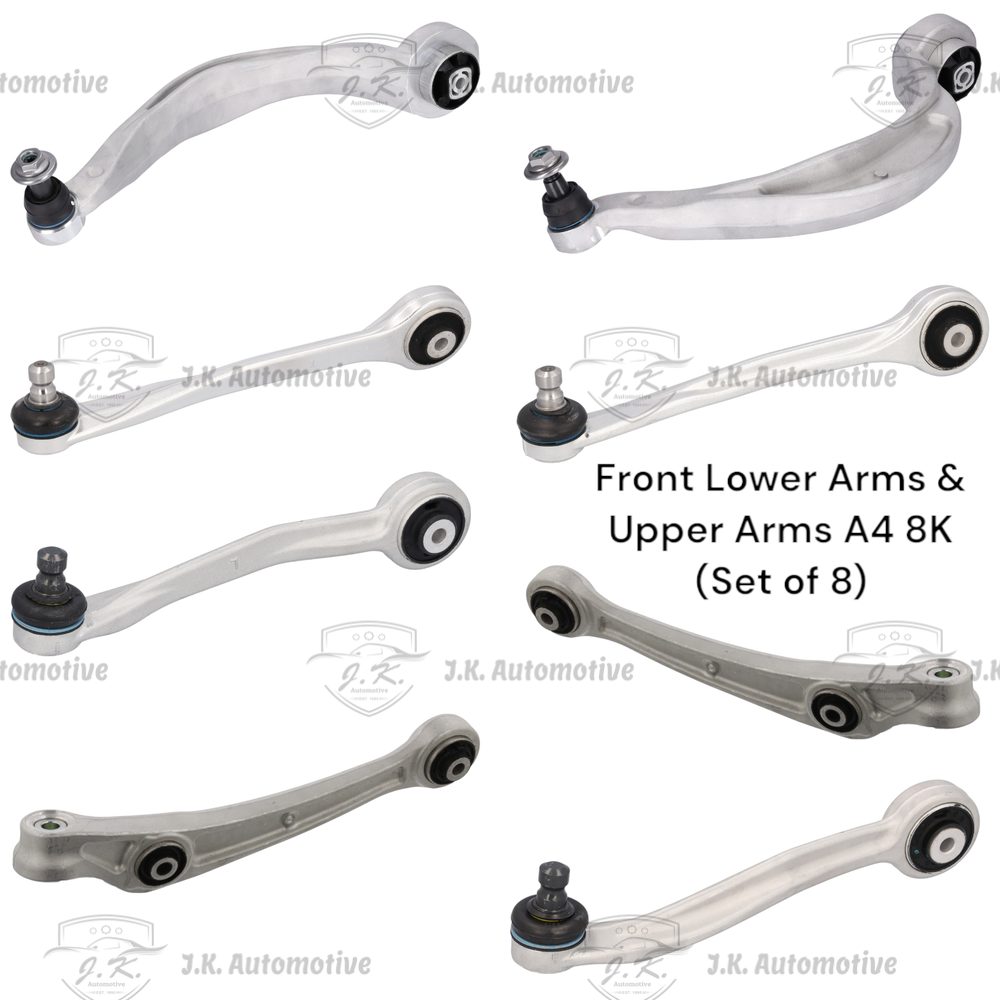
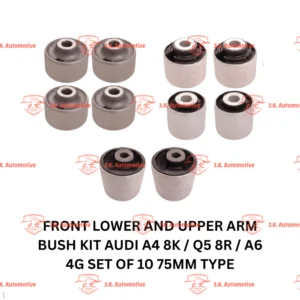
The Front Lower Arms And Upper Arms for Audi A4 8K are a complete Set of 8 front suspension control arms designed for Audi A4 8K models from 2008–2016, covering the supplied OEM references 8K0407693T & 8K0407694T & 8K0407151D & 8K0407152D & 8K0407505A & 8K0407506A & 8K0407509A & 8K0407510A. This complete suspension set includes the front lower and upper control-arm components required to renew important connecting points within the Audi A4 8K front suspension system. The control arms connect the wheel and steering assembly to the vehicle chassis or subframe and allow controlled vertical wheel movement while helping maintain accurate suspension geometry. Their operation directly influences steering response, straight-line stability, cornering behaviour, braking stability and consistent tyre contact with the road. The upper and lower arms work together rather than functioning as completely independent suspension parts, which is why wear in several arms can make the entire front suspension feel loose, noisy or less precise. Rubber bushes and jointed mounting points in the control-arm system are designed to absorb movement and vibration while keeping unwanted suspension movement under control. As these components age, rubber can deteriorate and joints can develop excessive movement, particularly on vehicles regularly driven over uneven roads, potholes and speed breakers. A worn suspension arm may cause knocking or clunking noises from the front, but noise is not the only indication of deterioration. Drivers can also experience vague steering, steering vibration, instability during braking, reduced cornering confidence, an unsettled ride or uneven tyre wear. A complete Set of 8 can therefore be a practical solution when inspection confirms that multiple original front suspension arms have reached the end of their serviceable condition. Replacing multiple worn arms together can help restore more uniform suspension behaviour rather than combining new components with several heavily worn ones. Serviceable front control arms help maintain wheel positioning as the suspension moves through its normal range of travel. They also help the tyres maintain more consistent contact with the road surface, which is important for braking, steering and handling performance. For a premium vehicle such as the Audi A4 8K, maintaining the condition of the multi-link front suspension is particularly important for preserving refined ride quality and precision handling. The Set of 8 should always be selected by checking the supplied OEM references rather than relying only on the vehicle name or appearance of the components. Customers should compare 8K0407693T, 8K0407694T, 8K0407151D, 8K0407152D, 8K0407505A, 8K0407506A, 8K0407509A and 8K0407510A with the required parts before ordering. Vehicle chassis details and existing component numbers should also be checked where necessary. During installation, the technician should inspect the remaining steering and suspension system rather than treating the control arms as isolated parts. Ball joints, tie rod ends, shock absorbers, strut components, wheel bearings, suspension bushes, sway bar links, sway links, anti roll link rods and stabiliser sway links should all be checked for wear. Any damaged related component can produce symptoms similar to worn control arms and can affect the final repair quality. Correct professional installation is therefore strongly recommended for this complete suspension set. Appropriate tightening procedures should be followed to avoid unnecessary stress on bushes and mounting points. Once installation has been completed, wheel alignment should be inspected and adjusted as required. Correct alignment helps maintain suspension geometry, steering stability, even tyre wear and predictable road behaviour. With the relevant worn components correctly replaced, the Audi A4 8K can regain a more controlled, quiet and refined front suspension response. For owners maintaining a premium Audi suspension system, a complete Set of 8 provides a comprehensive approach to renewing professionally diagnosed worn front lower and upper control arms.
Which Audi A4 8K models are compatible with these Front Lower Arms And Upper Arms?
These Front Lower Arms And Upper Arms are specified for Audi A4 8K models from 2008–2016 according to the supplied product application, and the complete Set of 8 carries OEM references 8K0407693T & 8K0407694T & 8K0407151D & 8K0407152D & 8K0407505A & 8K0407506A & 8K0407509A & 8K0407510A. The Audi A4 8K uses a sophisticated front suspension arrangement in which multiple control arms work together to manage wheel movement and maintain the geometry required for stable steering and handling. Because suspension configurations can vary according to vehicle specification, production date, drivetrain, factory suspension option and other application details, compatibility should always be confirmed before ordering. Customers should not rely only on the fact that their vehicle is an Audi A4 or falls within a similar year range. The supplied OEM references are among the most important identifiers for checking whether this complete Set of 8 corresponds with the suspension components required for the specific vehicle. The numbers 8K0407693T and 8K0407694T should be checked carefully against the required application. The same applies to 8K0407151D and 8K0407152D. Compatibility should also be confirmed for 8K0407505A, 8K0407506A, 8K0407509A and 8K0407510A. This is especially important because suspension arms that look similar in photographs can have different dimensions, mounting arrangements, bush specifications or joint orientations. A professional parts verification using the vehicle identification details can reduce the risk of ordering an unsuitable component. Correct fitment is essential because the upper and lower control arms must operate within the designed suspension geometry. An incorrectly selected component may prevent proper installation or negatively affect wheel positioning and suspension operation. When the correct Set of 8 is installed, the control arms help guide the front wheels through controlled suspension movement. They contribute to steering accuracy, road stability and predictable handling. They also help maintain consistent tyre contact as the suspension responds to braking, acceleration, cornering and uneven road surfaces. This becomes especially important for a premium vehicle where refined ride quality and precise steering characteristics are expected. The Audi A4 8K front suspension should therefore be treated as an interconnected system. If multiple control arms have deteriorated, a complete replacement set can help renew several important suspension mounting points during the same repair. However, replacement should be based on inspection rather than automatically assuming every noise originates from the control arms. Similar symptoms may be produced by tie rod ends, wheel bearings, shock absorbers, mounts, suspension bushes or stabilizer components. Sway bar links, sway links, anti roll link rods and stabiliser sway links should therefore be checked during suspension diagnosis. Tyres should also be examined for unusual wear patterns because excessive suspension movement can affect tyre contact and wheel geometry. If irregular tyre wear is present, the underlying mechanical cause should be repaired before assuming that alignment alone will solve the problem. Once the correct components have been installed, the suspension should be checked for unrestricted and properly controlled movement. Mounting hardware should be tightened according to the appropriate workshop procedure. A professional wheel-alignment inspection should then be carried out and adjustments made where applicable. This final step helps ensure that the renewed suspension operates with appropriate geometry. It can also help protect the tyres from unnecessary wear and restore more predictable steering behaviour. Therefore, for an Audi A4 8K from 2008–2016, the supplied model years provide the basic application range, while OEM-number and vehicle-specific verification should provide the final confirmation before purchasing this complete Set of 8.
What OEM numbers are included with the Audi A4 8K Front Lower Arms And Upper Arms Set of 8?
The Audi A4 8K Front Lower Arms And Upper Arms Set of 8 is supplied with the product references 8K0407693T & 8K0407694T & 8K0407151D & 8K0407152D & 8K0407505A & 8K0407506A & 8K0407509A & 8K0407510A for the specified 2008–2016 application. These OEM references are extremely important when selecting suspension components because they provide a more precise compatibility reference than simply searching by vehicle model name. The first supplied reference is 8K0407693T. The corresponding supplied reference 8K0407694T is also included in the complete set. The product additionally contains references 8K0407151D and 8K0407152D. The remaining supplied references are 8K0407505A, 8K0407506A, 8K0407509A and 8K0407510A. Together, these references make up the supplied Set of 8 front lower and upper control arms for the Audi A4 8K application. Customers should compare these numbers carefully with the suspension components required for their vehicle before placing an order. OEM-number verification is important because control arms may look almost identical while having differences that are difficult to identify from photographs. Differences can include arm dimensions, mounting positions, bush sizes, joint orientation or other application-specific characteristics. Using the correct parts helps the suspension operate within its intended geometry. The front control-arm system is responsible for guiding wheel movement while keeping unwanted movement under control. It also helps the vehicle maintain stable tyre contact with the road. During braking, serviceable suspension arms help keep wheel movement controlled and predictable. During cornering, they contribute to consistent suspension geometry and steering response. Over uneven surfaces, the bushes and joints help allow the required suspension movement while reducing the transmission of unnecessary vibration. As control-arm bushes or joints deteriorate, this controlled movement can gradually become excessive. The driver may then notice clunking, knocking, steering looseness or vibration. Excessive movement may also contribute to inconsistent braking behaviour and reduced high-speed stability. Tyre wear can become irregular if suspension geometry is affected by worn components. A complete Set of 8 can be particularly useful where inspection shows deterioration across multiple upper and lower arms. Replacing several worn components during the same repair can provide more consistent suspension behaviour. It may also reduce the need to repeatedly dismantle the front suspension as individual aged components fail at different times. However, the complete front suspension should still be inspected before installation. Steering tie rods, shock absorbers, wheel bearings, suspension bushes and other connecting components can all influence the vehicle's behaviour. Sway bar links, sway links, anti roll link rods and stabiliser sway links should also be inspected because looseness in these components can cause front-end noises. Correct installation procedures are essential for premium vehicle suspension components. Bushes should not be subjected to inappropriate preload caused by incorrect tightening procedures. Hardware and mounting points should be checked for condition before final assembly. After installation, professional wheel alignment should be performed or checked as appropriate. Alignment helps restore the intended relationship between the wheels, steering and suspension. This supports even tyre wear, stable straight-line behaviour and precise handling. Therefore, customers purchasing this Set of 8 should use the full OEM reference group as a key fitment check and have vehicle-specific compatibility confirmed whenever there is uncertainty.
What are the common symptoms of worn Front Lower Arms And Upper Arms on an Audi A4 8K?
Worn Front Lower Arms And Upper Arms on an Audi A4 8K can cause a wide range of suspension and steering symptoms, and recognising these symptoms can help owners arrange an inspection before deterioration becomes more severe. One common symptom is a knocking or clunking sound from the front suspension when the vehicle passes over potholes, rough roads or speed breakers. A worn bush or joint can allow unwanted movement that produces noise as suspension loads change. Drivers may also notice rattling sounds on uneven surfaces. Another possible symptom is a vague or loose steering sensation. The vehicle may not respond to steering inputs with the same precision that it previously had. The driver may find that small steering corrections are required more frequently during straight-line driving. Steering-wheel vibration can also occur, although vibration can have several other causes and should be professionally diagnosed. Worn control arms may contribute to an unsettled sensation during braking because excessive suspension movement can influence wheel positioning under load. The vehicle may feel less composed during sudden braking or directional changes. Cornering behaviour can also become less predictable when suspension joints or bushes develop excessive movement. A premium Audi suspension should provide controlled wheel movement and stable road behaviour, so deterioration may be noticeable as a reduction in refined ride quality. Uneven tyre wear is another important warning sign. Inner or outer tyre edges may wear faster when suspension geometry is no longer maintained correctly. Feathering or other irregular tread patterns can also indicate that the suspension and wheel alignment require inspection. Tyre wear should never automatically be blamed on alignment alone because worn mechanical components can prevent alignment settings from remaining stable. The condition of the Front Lower Arms And Upper Arms should therefore be checked before repeated alignment attempts. Visible cracks, splitting or deterioration in rubber bushes can provide additional evidence of wear. Excessive movement at a suspension joint during professional inspection may also indicate replacement is necessary. The complete Set of 8 with OEM references 8K0407693T & 8K0407694T & 8K0407151D & 8K0407152D & 8K0407505A & 8K0407506A & 8K0407509A & 8K0407510A can provide a comprehensive replacement option when multiple arms are diagnosed as worn. However, symptoms should not be used as the sole basis for purchasing parts. Many front suspension components can create similar noises and handling problems. Worn tie rod ends can affect steering precision. Damaged wheel bearings can create noise or unwanted movement. Worn shock absorbers can reduce suspension control and ride quality. Damaged mounts or other suspension bushes can also produce knocking noises. Sway bar links, sway links, anti roll link rods and stabiliser sway links are particularly important to inspect when the complaint involves noises over uneven roads. Tyre pressure and tyre condition should also be checked because they directly affect road behaviour. A qualified technician can isolate the actual source of the problem before replacement begins. If several front lower and upper control arms are worn, replacing them together can help restore more uniform suspension operation. Correctly functioning control arms support stable wheel positioning, precise steering and predictable handling. After replacement, wheel alignment should be checked and adjusted where necessary. This helps ensure that the repaired suspension provides correct geometry and reduces unnecessary tyre wear. Addressing worn components promptly can therefore help restore the Audi A4 8K's premium ride comfort, steering stability and controlled front suspension performance.
What are the benefits of replacing all 8 Front Lower Arms And Upper Arms together on an Audi A4 8K?
Replacing all 8 Front Lower Arms And Upper Arms together on an Audi A4 8K can provide several benefits when inspection confirms that multiple original control arms, bushes or joints are worn. The front suspension works as an interconnected system, which means each control arm contributes to wheel location and suspension geometry rather than operating completely independently. If one arm is new while several other arms have substantial bush or joint wear, the front suspension can still retain unwanted movement. A complete Set of 8 can therefore provide a more comprehensive suspension repair when deterioration is present across multiple components. The supplied set covers OEM references 8K0407693T & 8K0407694T & 8K0407151D & 8K0407152D & 8K0407505A & 8K0407506A & 8K0407509A & 8K0407510A. Replacing multiple worn arms at the same time can help restore more consistent movement on both sides of the front suspension. This can improve the way the suspension reacts to uneven roads and changing loads. Serviceable bushes help control movement while absorbing vibration. Serviceable joints allow the required articulation without excessive looseness. Together, these characteristics support more precise steering behaviour. They also contribute to better straight-line stability. During cornering, properly functioning control arms help maintain more consistent wheel positioning. During braking, they help control unwanted movement as load transfers toward the front axle. Maintaining stable tyre contact with the road is another important benefit of correctly functioning suspension components. Excessive control-arm movement can contribute to changing wheel geometry and irregular tyre loading. This can accelerate tyre wear and reduce the consistency of handling. A comprehensive replacement can therefore be particularly useful when the existing suspension has accumulated substantial age or mileage and several components have been diagnosed as deteriorated. It can also reduce the likelihood of paying for repeated suspension dismantling and alignment as individual aged arms require replacement one after another. However, replacing all eight arms should not be treated as a substitute for proper diagnosis. If only one component has failed and the remaining components are in excellent condition, the appropriate repair decision should be made by the technician and vehicle owner. Likewise, a complete control-arm replacement will not correct faults elsewhere in the steering or suspension system. Tie rod ends should be inspected for play. Shock absorbers should be checked for leakage or reduced damping performance. Wheel bearings should be checked for noise and unwanted movement. Suspension mounts and bushes should also be inspected. Sway bar links, sway links, anti roll link rods and stabiliser sway links should be checked because these components work close to the control-arm system and can create similar noises. Tyres should be examined for uneven wear, damage and appropriate pressure. Correct professional installation is essential when fitting the complete Set of 8. Mounting points should be inspected before new components are installed. Fasteners should be tightened according to the appropriate repair procedure. This is especially important for suspension bushes because incorrect tightening can create unnecessary stress during normal suspension travel. Once the installation is complete, a professional wheel-alignment check should be performed. Correct alignment supports even tyre wear, straight-line stability and precision handling. When all necessary worn components are replaced and the suspension is correctly aligned, the Audi A4 8K can regain more refined ride quality and controlled premium vehicle handling. Therefore, a Set of 8 provides the greatest benefit when it forms part of a complete, professionally diagnosed front suspension repair.
Is wheel alignment required after replacing the Front Lower Arms And Upper Arms on an Audi A4 8K?
A professional wheel-alignment check is strongly recommended after replacing the Front Lower Arms And Upper Arms on an Audi A4 8K because the control arms are fundamental components in determining wheel location and suspension geometry. The complete Set of 8 includes the supplied OEM references 8K0407693T & 8K0407694T & 8K0407151D & 8K0407152D & 8K0407505A & 8K0407506A & 8K0407509A & 8K0407510A for Audi A4 8K models from 2008–2016. Before replacement, worn bushes or joints may have allowed the wheels to move outside their intended positions under different driving loads. Once new serviceable components are installed, the suspension geometry can change because the excessive movement created by the old components has been removed. For this reason, the previous wheel-alignment condition should not simply be assumed to remain correct after suspension repair. Wheel alignment evaluates the relationship between the wheels and the vehicle's suspension and steering geometry. Toe is particularly important for tyre wear and straight-line behaviour. Camber influences how the tyre sits relative to the road surface. Caster and related suspension geometry contribute to steering stability and self-centering behaviour, although available adjustments depend on the vehicle's suspension design. A qualified alignment technician should work according to the appropriate vehicle specifications and available adjustment points. Before alignment is carried out, the mechanical condition of the suspension should be confirmed. Performing alignment while other components remain excessively worn can produce poor or short-lived results. Tie rod ends should therefore be inspected for unwanted movement. Wheel bearings should be checked for play or noise. Shock absorbers and mounting components should be inspected for deterioration. Other suspension bushes should also be examined. Sway bar links, sway links, anti roll link rods and stabiliser sway links should be checked for wear or looseness. Tyres should be inspected for abnormal wear and correct inflation. Wheel and tyre damage should also be considered if the vehicle has experienced strong impacts from potholes or road hazards. Correct installation of the Set of 8 must be completed before alignment begins. Suspension-arm mounting hardware should be installed and tightened according to the appropriate workshop procedure. Correct bush positioning and tightening are important because improper installation can place unnecessary torsional stress on rubber components. Once the mechanical work has been completed correctly, professional alignment can establish whether the wheel geometry is within the required specification. Correct alignment helps the vehicle track more consistently on a straight road. It can reduce unnecessary steering correction and improve steering-wheel centering. It also helps the tyres maintain more consistent contact with the road surface. This contributes to predictable braking and cornering behaviour. Proper geometry can help reduce premature inner-edge or outer-edge tyre wear. It also supports the refined ride quality and precision handling expected from a premium Audi suspension system. If the vehicle continues to pull, vibrate or wear tyres irregularly after replacement and alignment, further diagnosis should be carried out rather than repeatedly changing alignment settings. Other steering, wheel, tyre or suspension faults may still be present. For an Audi A4 8K receiving a complete Front Lower Arms And Upper Arms Set of 8, suspension inspection, correct installation and professional wheel alignment should therefore be considered parts of the same comprehensive repair process.
How do Audi A4 8K Front Lower Arms And Upper Arms affect steering, handling and ride quality?
The Audi A4 8K Front Lower Arms And Upper Arms play a major role in steering accuracy, suspension geometry, road stability, ride comfort and overall front-wheel control because the multi-link suspension depends on several individual arms working together to guide each wheel through its intended range of movement. This complete Set of 8 for Audi A4 8K models from 2008–2016 includes OEM references 8K0407693T & 8K0407694T & 8K0407151D & 8K0407152D & 8K0407505A & 8K0407506A & 8K0407509A & 8K0407510A. Each control arm contributes to locating the wheel relative to the chassis while allowing controlled vertical suspension movement as the vehicle passes over smooth roads, potholes, speed breakers and uneven surfaces. When the control arms, bushes and associated joints remain serviceable, they help keep the front wheels positioned consistently during acceleration, braking and cornering. This contributes to the precise steering response expected from the Audi A4 8K. The suspension arms also help maintain stable tyre contact with the road, which is important for predictable braking and cornering behaviour. The rubber bushes incorporated into suspension mounting points help isolate vibration while permitting the movement required by the suspension. As these bushes age, crack, soften or deteriorate, unwanted movement can develop between suspension components. This additional movement can make the steering feel vague or less responsive. The vehicle may require frequent steering correction while travelling on a straight road. Worn control arms may also contribute to knocking or clunking noises over rough surfaces. During braking, excessive movement can make the front of the vehicle feel less settled. During cornering, the vehicle may feel less precise because wheel geometry can change under load. At higher road speeds, deteriorated suspension components can reduce the driver's confidence in straight-line stability. Tyre wear may also become irregular when worn suspension components allow excessive movement. Inner-edge wear, outer-edge wear, feathering or other abnormal tread patterns should therefore lead to a complete suspension inspection rather than simply replacing tyres. Serviceable Front Lower Arms And Upper Arms help support more consistent suspension geometry and controlled wheel movement. They can contribute to sharper steering response and a more predictable connection between steering input and vehicle direction. They also help maintain the refined ride quality associated with a properly maintained premium Audi suspension system. However, the control arms do not work independently from the rest of the front suspension. Tie rod ends directly influence steering control and should be checked for play. Shock absorbers influence damping and wheel control and should be checked for leakage or reduced performance. Wheel bearings should be inspected for noise and unwanted movement. Sway bar links, sway links, anti roll link rods and stabiliser sway links should also be inspected because wear in these components can produce knocking noises and affect suspension behaviour. Tyres, wheels and other suspension bushes should be checked at the same time. If multiple control arms are professionally diagnosed as worn, replacing the complete Set of 8 can provide a more comprehensive suspension repair. Correct installation is essential because suspension components must operate in their intended positions and mounting hardware must be secured according to the appropriate repair procedure. Once the replacement work is completed, wheel alignment should be checked and adjusted as required. Proper suspension condition combined with correct wheel geometry helps support even tyre wear, stable steering, predictable braking, refined ride comfort and precision handling. For this reason, maintaining the Audi A4 8K Front Lower Arms And Upper Arms in serviceable condition is important for preserving the premium driving characteristics of the vehicle.
Can worn Front Lower Arms And Upper Arms cause uneven tyre wear on an Audi A4 8K?
Yes, worn Front Lower Arms And Upper Arms can contribute to uneven tyre wear on an Audi A4 8K because the control arms are directly involved in locating the wheels and maintaining suspension geometry as the vehicle is driven. This Set of 8 for Audi A4 8K models from 2008–2016 carries OEM references 8K0407693T & 8K0407694T & 8K0407151D & 8K0407152D & 8K0407505A & 8K0407506A & 8K0407509A & 8K0407510A. When the suspension arms and their mounting bushes are in serviceable condition, they help keep the wheels within their intended movement paths. As rubber bushes deteriorate or suspension joints develop excessive movement, the position of a wheel can change more than intended under acceleration, braking and cornering loads. This can influence how the tyre contacts the road surface. Instead of distributing load consistently across the tread, certain areas of the tyre may experience greater stress. Excessive wear on the inner edge of a tyre can be one possible warning sign. Outer-edge wear can also occur depending on the underlying suspension, tyre or alignment condition. Feathered tread blocks may indicate that the tyre is being dragged slightly across the road rather than rolling with the intended geometry. In severe cases, tyre service life can be substantially reduced. Uneven tyre wear should therefore not automatically be treated as a tyre-only problem. Installing new tyres without repairing worn suspension components can allow the new tyres to develop similar wear patterns. Likewise, repeatedly performing wheel alignment without correcting mechanical play in the suspension may not provide a lasting solution. The technician should first inspect the Front Lower Arms And Upper Arms for worn bushes, damaged components and excessive movement. Ball joints and other suspension joints should also be inspected. Steering tie rod ends can affect toe behaviour and should be checked carefully. Wheel bearings should be checked for excessive movement or noise. Shock absorbers should be inspected because poor damping can contribute to irregular tyre loading. Sway bar links, sway links, anti roll link rods and stabiliser sway links should be checked as part of a complete front suspension inspection. Wheel condition, tyre pressure and tyre balance should also be considered. If several front control arms are worn, replacing the complete Set of 8 can help renew multiple critical suspension points at the same time. Serviceable control arms help maintain more consistent wheel positioning as suspension loads change. This supports stable tyre contact and predictable steering behaviour. Correctly functioning suspension components can also help maintain the refined ride quality expected from a premium Audi A4 8K. After replacement, a professional wheel-alignment check is strongly recommended. The alignment technician can evaluate the relevant wheel geometry and make available adjustments according to the vehicle specification. This step is particularly important before fitting expensive new tyres because correct suspension condition and alignment can help protect the tyre investment. Drivers should continue to monitor tyre wear after the repair because new abnormal patterns can indicate another unresolved issue. Tyres should also be rotated where appropriate according to tyre and vehicle requirements. Maintaining correct tyre pressures is equally important because underinflation or overinflation can create wear patterns that are unrelated to the control arms. Therefore, worn Front Lower Arms And Upper Arms can be an important mechanical contributor to uneven tyre wear, but the complete suspension, steering, wheel, tyre and alignment condition should be evaluated together for an accurate diagnosis and effective repair.
What other suspension parts should be inspected when replacing the Audi A4 8K Front Lower Arms And Upper Arms?
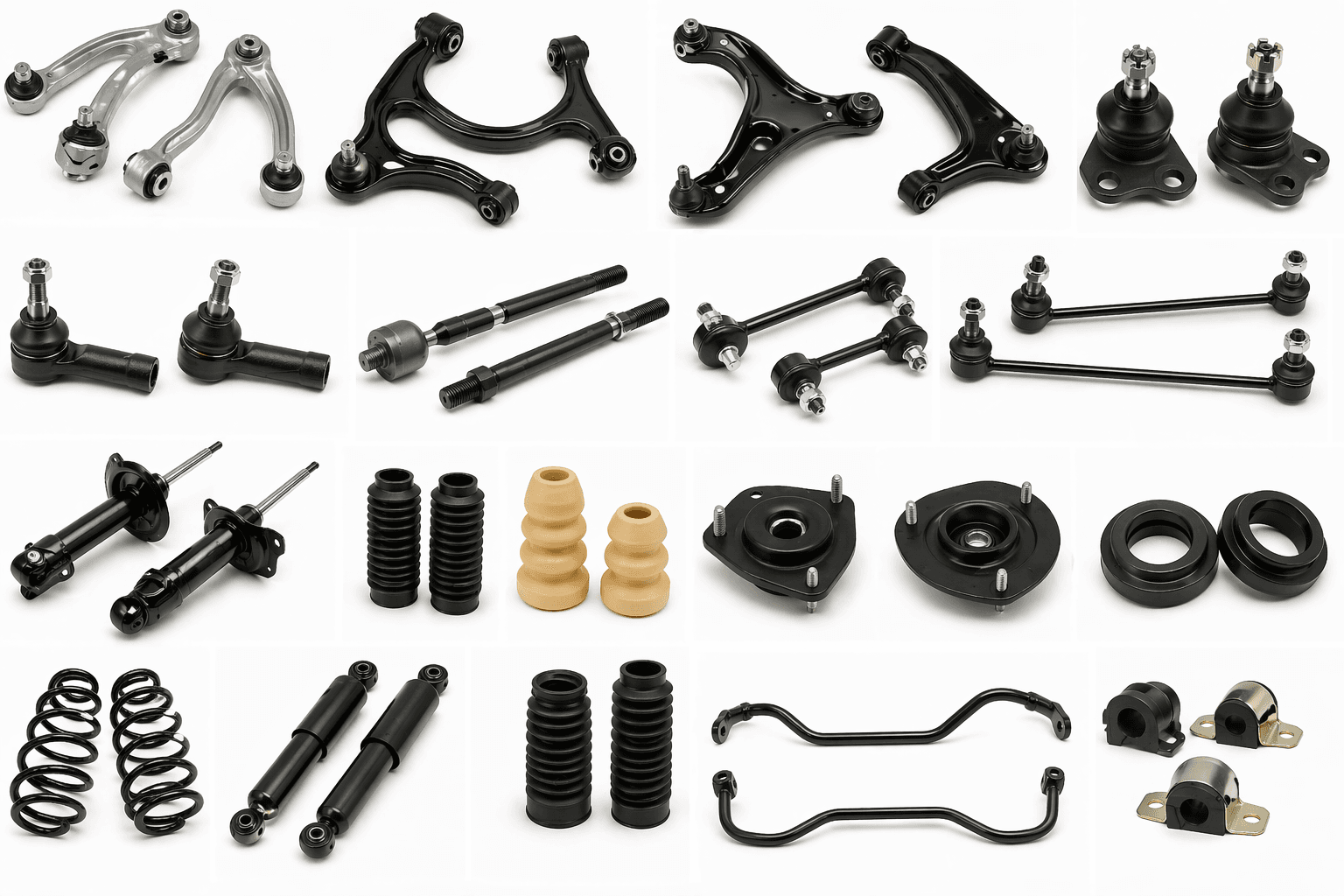
When replacing the Audi A4 8K Front Lower Arms And Upper Arms, the complete front steering and suspension system should be inspected because all of these components operate together and wear in one area can create symptoms similar to worn control arms. The complete Set of 8 covers OEM references 8K0407693T & 8K0407694T & 8K0407151D & 8K0407152D & 8K0407505A & 8K0407506A & 8K0407509A & 8K0407510A for Audi A4 8K models from 2008–2016. One of the first areas to inspect is the condition of all suspension bushes and joints associated with the front suspension assembly. Rubber bushes should be checked for cracking, splitting, deformation, separation or excessive movement. Any joint showing excessive play should be diagnosed before the vehicle is returned to service. Steering tie rod ends are particularly important because they transmit steering movement to the wheels and can produce looseness, knocking or unstable wheel geometry when worn. The steering system should therefore be checked carefully whenever the complaint includes vague steering or uneven tyre wear. Shock absorbers should also be inspected for fluid leakage, physical damage and reduced damping performance. Worn shock absorbers can allow excessive wheel movement and may negatively affect braking stability, tyre contact and ride quality. Strut mounts and related mounting components should be checked where applicable because deterioration can produce noises and vibration. Wheel bearings are another important inspection point. A worn wheel bearing may create humming, grinding, vibration or unwanted wheel movement that can sometimes be confused with suspension-arm problems. Sway bar links should be checked for looseness and worn joints. Sway links are frequently exposed to repeated movement as the suspension reacts to road irregularities. Anti roll link rods should also be inspected because they help connect the anti-roll system to the suspension. Stabiliser sway links can produce knocking or rattling noises when worn, particularly over small bumps and uneven surfaces. The anti-roll bar mounting bushes should be checked for deterioration or excessive movement. Springs should be inspected for physical damage, corrosion or breakage where relevant. Steering rack mounting points and associated steering components should also be evaluated if the driver reports excessive steering movement or unusual noises. Brake components should be visually checked because suspension repair provides an opportunity to inspect nearby components. Brake hoses and sensor wiring should be handled carefully during suspension work to prevent accidental damage. Wheels should be checked for bends or impact damage, especially if the vehicle is regularly driven on roads with severe potholes. Tyres should be inspected for inner-edge wear, outer-edge wear, feathering, cupping or other abnormal tread patterns. Correct tyre pressure should be confirmed because pressure problems can affect handling and tyre wear independently of suspension condition. If abnormal tyre wear exists, the technician should determine whether it is associated with mechanical wear, alignment, tyre pressure or a combination of factors. The mounting points for the Front Lower Arms And Upper Arms should also be inspected before the new components are installed. Damaged or contaminated mounting surfaces should be addressed according to the appropriate repair procedure. Fasteners should be inspected and replaced where the manufacturer or repair procedure requires it. Correct installation technique is particularly important for rubber-bushed suspension components. Once the Set of 8 is installed and all related faults have been addressed, the suspension should be checked for correct movement and secure mounting. A professional wheel alignment should then be carried out. This complete approach helps ensure that the new control arms are not installed into a suspension system that still contains other significant faults. By inspecting the control arms, bushes, tie rod ends, wheel bearings, shock absorbers, sway bar links, sway links, anti roll link rods, stabiliser sway links, tyres and alignment together, the Audi A4 8K can achieve a more comprehensive suspension repair and recover the refined ride comfort and precision handling expected from a premium vehicle.
Why is professional installation recommended for the Audi A4 8K Front Lower Arms And Upper Arms Set of 8?
Professional installation is strongly recommended for the Audi A4 8K Front Lower Arms And Upper Arms Set of 8 because replacing multiple components in a sophisticated multi-link front suspension requires correct identification, positioning, fastening procedures and final geometry checks. This Set of 8 is specified for Audi A4 8K models from 2008–2016 and includes OEM references 8K0407693T & 8K0407694T & 8K0407151D & 8K0407152D & 8K0407505A & 8K0407506A & 8K0407509A & 8K0407510A. Before installation begins, a qualified technician can verify that the supplied components correspond with the suspension configuration of the vehicle. This is important because parts that appear similar may have different mounting positions or application requirements. The technician can also diagnose the original fault before replacing components. Proper diagnosis helps determine whether the noises, vibration, tyre wear or handling problems are actually related to the control arms. During removal, suspension components and fasteners may be exposed to corrosion, road contamination and years of heat and mechanical loading. Appropriate tools and workshop procedures reduce the risk of damaging surrounding components during removal. The technician should inspect each mounting point after the original arms are removed. Related suspension bushes and joints can then be checked while access is available. Correct positioning of every lower and upper arm is important because each component has a specific role within the multi-link suspension geometry. Fasteners should be installed and tightened according to the appropriate repair information. Rubber-bushed suspension components require particular care because incorrect tightening procedures can place unnecessary torsional stress on the bushes. Premature bush deterioration may occur if components are installed incorrectly. Professional installation also reduces the risk of damaging boots, joints or mounting surfaces during assembly. Steering tie rod ends should be inspected while the front suspension is being serviced. Shock absorbers and their associated mounting components should be checked for leakage or deterioration. Wheel bearings should be checked for noise and excessive movement. Sway bar links, sway links, anti roll link rods and stabiliser sway links should be inspected because worn stabiliser components can remain a source of knocking even after the control arms are replaced. Tyres should also be examined for irregular wear patterns. If the old control arms allowed excessive wheel movement, the tyres may already have developed inner-edge wear, outer-edge wear or feathering. A technician can determine whether the tyres remain suitable for continued use. The wheels should also be checked for impact damage if the vehicle has encountered severe potholes. Once the Set of 8 has been installed, the suspension should be checked to confirm that all components are secure and move as intended. A road test may then help verify that the original symptoms have been resolved. However, the repair should not normally end with installation alone. Professional wheel alignment should be carried out after the mechanical work has been completed. Alignment helps establish the correct available wheel-geometry settings and supports predictable steering behaviour. It can also help prevent unnecessary wear on expensive tyres. A properly repaired and aligned front suspension contributes to straight-line stability, braking confidence and controlled cornering. It also helps preserve the premium ride quality and precision handling associated with the Audi A4 8K. Professional installation is therefore recommended not simply because eight components are being changed, but because the quality of the complete repair depends on correct diagnosis, component verification, installation technique, inspection of related suspension parts and accurate final wheel alignment.
Why is a complete Set of 8 a good choice for restoring the premium suspension performance of an Audi A4 8K?
A complete Front Lower Arms And Upper Arms Set of 8 can be an excellent repair choice for an Audi A4 8K when professional inspection confirms wear across multiple front suspension arms, because the vehicle's multi-link suspension relies on several interconnected components to deliver refined ride quality, steering precision and stable wheel control. This Set of 8 is intended for the supplied Audi A4 8K 2008–2016 application and covers OEM references 8K0407693T & 8K0407694T & 8K0407151D & 8K0407152D & 8K0407505A & 8K0407506A & 8K0407509A & 8K0407510A. Premium vehicle handling depends on maintaining the suspension geometry designed into the chassis. Each front control arm helps guide the wheel as it moves through suspension travel. The upper and lower arms work together rather than functioning as unrelated individual parts. Their bushes and joints allow necessary movement while helping prevent unwanted wheel displacement. As these components accumulate mileage and age, rubber bushes can deteriorate and joints can develop excessive movement. The deterioration may initially appear as a small knocking noise or slight reduction in steering precision. As wear progresses, the vehicle may feel increasingly unsettled over uneven roads. Steering response may become less direct. Braking behaviour can feel less controlled because suspension geometry may change as loads transfer toward the front axle. Cornering precision may also decrease when worn joints allow additional wheel movement. These effects can reduce the refined driving characteristics expected from a premium Audi. A complete Set of 8 allows multiple professionally diagnosed worn components to be renewed during the same repair. This can provide a more uniform suspension condition than replacing one severely worn arm while retaining several other heavily aged components. Renewing multiple worn control points can help restore controlled front-wheel movement. More consistent wheel positioning can support precise steering response. Stable suspension geometry can contribute to predictable cornering behaviour. Correct suspension operation also helps the tyres maintain more consistent contact with the road. This is important for braking, acceleration and directional stability. Reducing excessive suspension movement can also help address certain causes of abnormal tyre wear. However, installing a complete control-arm set should always be based on actual vehicle condition and correct fitment verification. Customers should compare the supplied OEM references with the required parts before ordering. Vehicle identification information should be used where additional compatibility confirmation is necessary. The complete suspension should also be inspected because premium vehicle ride quality depends on more than control arms alone. Tie rod ends should be free from excessive play. Shock absorbers should provide effective damping. Wheel bearings should operate smoothly without unwanted movement. Suspension bushes and mounts should remain serviceable. Sway bar links, sway links, anti roll link rods and stabiliser sway links should also be checked because these components influence front suspension behaviour and can create noises when worn. Wheels and tyres should be inspected for damage and irregular wear. Correct tyre pressures should be maintained because tyre condition has a direct influence on ride comfort and steering response. Professional installation is particularly important with a complete Set of 8 because every component must be installed in its correct position. Appropriate tightening procedures should be followed to protect suspension bushes and mounting points. After installation, professional wheel alignment should be completed to help restore the intended wheel geometry. Correct alignment can support even tyre wear and straight-line stability. It also helps the suspension deliver predictable steering and cornering behaviour. When combined with serviceable shock absorbers, steering components, tyres and stabiliser components, correctly installed Front Lower Arms And Upper Arms can contribute significantly to restoring the Audi A4 8K's high-end car suspension characteristics. The objective is not simply to eliminate a suspension noise but to restore controlled wheel movement, refined ride quality, precision handling, steering stability and the balanced road behaviour expected from a properly maintained premium Audi A4 8K.




Reviews
There are no reviews yet.