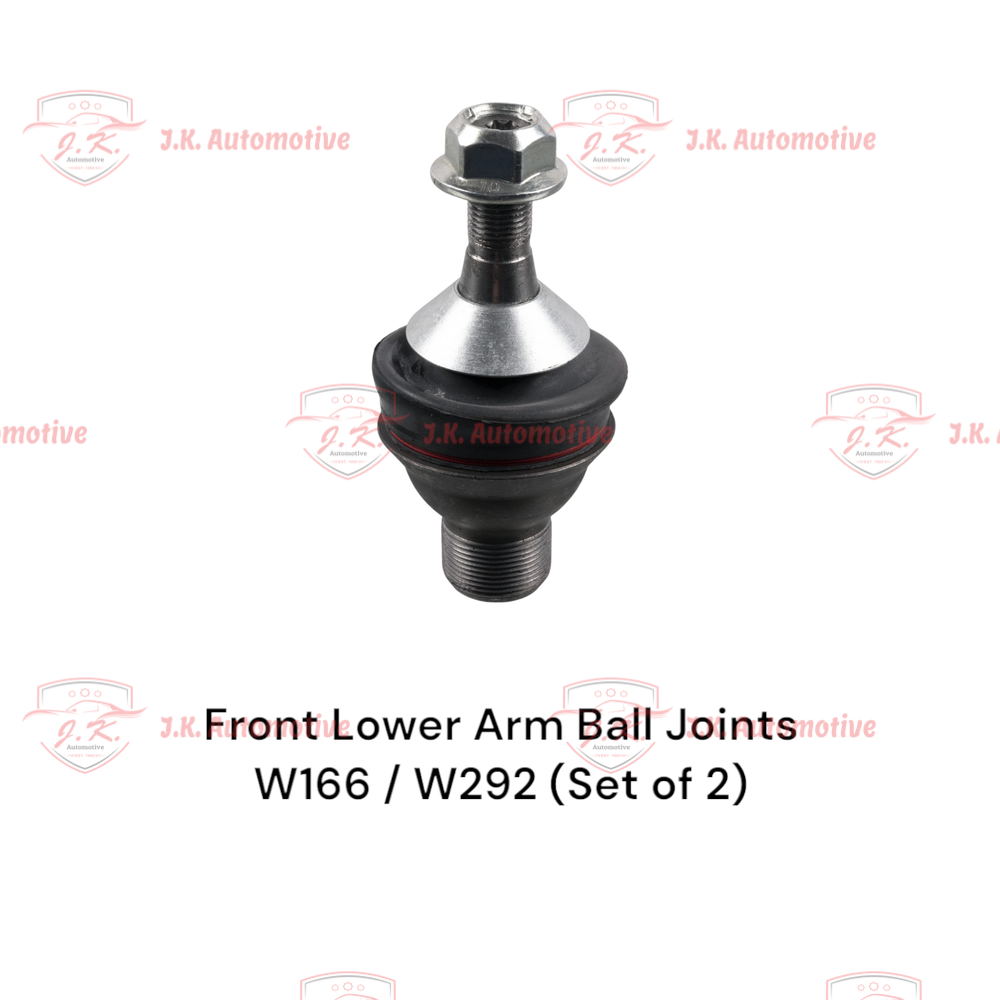
Front Lower Arm Ball Joints For Mercedes-Benz GL Class X166 (Set of 2) – A1663300235 (2012 – 2019)
Front lower arm ball joints are suspension components that connect designated control-arm and steering-knuckle assemblies while allowing controlled movement as the suspension travels and the wheels steer. In the Mercedes-Benz GL Class X166, these joints form part of the front suspension geometry and help accommodate movement between connected components. Their spherical joint construction is designed to permit angular articulation within the limits of the suspension system. The front suspension must maintain wheel alignment and stable tyre contact while responding to changing road conditions. Correctly specified ball joints contribute to this function by providing the intended mechanical connection. As the vehicle moves over uneven roads, suspension arms change position relative to the wheel assemblies. Ball joints allow the required articulation without relying on a completely rigid connection. The product is listed as a set of two front lower arm ball joints for the Mercedes-Benz GL Class X166, covering the supplied year range of 2012 – 2019. The supplied OEM reference is A1663300235. This number should be checked against authoritative Mercedes-Benz parts information before ordering. A single reference in a set listing does not independently confirm both left-hand and right-hand applications. The actual supplied components and their installation positions must be verified. Suspension components can differ according to production date, chassis configuration and equipment. The vehicle identification number is therefore important when confirming fitment. The existing ball joint and control-arm arrangement should also be inspected. Some suspension designs allow a ball joint to be replaced separately, while others may require replacement of a larger assembly. The appropriate repair method must follow the vehicle-specific service information. A worn ball joint can develop excessive clearance within its socket. This may affect suspension precision and create unwanted movement at the wheel assembly. Severe wear can become a safety concern if the joint can no longer maintain its intended connection. Ball joints should therefore be inspected when suspension noise, looseness or unusual tyre wear is reported. However, these symptoms may also originate from bushings, tie rods, wheel bearings or other suspension components. A qualified technician should establish the actual cause before replacing parts. Correct installation may require specialised tools and manufacturer-specified fasteners. Applicable tightening procedures must be followed. Wheel alignment should be assessed after suspension work where required by the service instructions. A new ball joint cannot compensate for bent control arms or damaged mounting points. It also cannot repair unrelated steering or suspension faults. The principal purpose of the product is to restore the intended articulation and connection where the correct ball joint has been identified as requiring replacement. Customers should confirm VIN compatibility and the actual set contents before purchasing through JK Automotive.
Are these ball joints compatible with Mercedes-Benz GL Class X166 from 2012 – 2019?
The product listing identifies the Mercedes-Benz GL Class X166 and retains the supplied vehicle year range of 2012 – 2019. This provides a broad application description but does not establish guaranteed compatibility with every vehicle within that period. Mercedes-Benz suspension components may differ according to production date, vehicle variant, drivetrain and chassis equipment. The X166 designation identifies the vehicle platform, but additional information may be required for precise parts selection. The supplied OEM reference is A1663300235. This number should be compared with the replacement reference specified for the individual vehicle. The vehicle identification number should be checked against authoritative Mercedes-Benz parts information. Any manufacturer-documented replacement or supersession should also be reviewed. A part number appearing in an aftermarket catalogue does not automatically establish compatibility with every X166 configuration. The installation position must be confirmed before purchase. The listing describes front lower arm ball joints supplied as a set of two. However, the quantity of two does not independently establish whether the components are identical or whether distinct left-hand and right-hand versions are required. The actual kit contents should be checked with the seller or supplier. The existing suspension arrangement should be inspected to identify the relevant control arm and ball joint. The component's dimensions, mounting design and connection arrangement must match the intended application. Visual similarity alone is insufficient for a definitive fitment decision. The technician should also confirm whether the joint can be replaced independently under the applicable service procedure. Some suspension assemblies have specific repair limitations. Incorrect component selection may prevent proper installation or affect the intended suspension geometry. A ball joint should never be modified to fit an incompatible mounting arrangement. Customers should avoid purchasing solely because the model name and year range appear to match. The exact VIN and existing part reference provide stronger identification evidence. Where catalogue sources disagree, the discrepancy should be resolved before ordering. Professional inspection can also identify other suspension components requiring attention. Replacement of a ball joint will not repair a worn control-arm bushing or damaged steering component. Correct fasteners and tightening procedures must be used during installation. Suspension geometry should be checked after the repair where specified. The supplied year range of 2012 – 2019 should remain unchanged in the product title. Final compatibility must nevertheless be established for the individual vehicle. JK Automotive customers should confirm the correct application and actual set contents before placing an order.
What are the symptoms of worn front lower arm ball joints?
Worn front lower arm ball joints may cause suspension or steering symptoms when excessive movement develops within the joint. One possible indication is a knocking or clunking sound from the front suspension while driving over uneven road surfaces. Such noise can occur when components move beyond their intended clearances. Drivers may also notice changes in steering precision or an unusual feeling of looseness. In some cases, abnormal tyre wear may develop if suspension geometry is affected. However, these symptoms are not exclusive to worn ball joints. Control-arm bushings can produce similar noises. Worn stabilizer links may also create knocking sounds over bumps. Steering tie rods, wheel bearings and other suspension components can contribute to unwanted movement or vibration. A technician should therefore inspect the complete front suspension rather than replacing ball joints based only on the driver's description. The vehicle should be examined using the appropriate manufacturer diagnostic and inspection procedures. Ball joint movement must be assessed according to the specifications applicable to the particular suspension design. Some joints may have permitted movement characteristics that should not be confused with excessive wear. A damaged protective boot may expose the joint to contamination and moisture. Loss of protection can contribute to deterioration over time. Visible grease leakage or a torn boot may therefore justify closer inspection. A worn ball joint can affect the accuracy of the mechanical connection between suspension components. Severe deterioration may create a significant safety risk. If a joint is suspected of being dangerously loose, the vehicle should not continue in normal use until inspected. The Mercedes-Benz GL Class X166 is a substantial SUV, making correct suspension component condition especially important. The supplied replacement product is listed as a set of two front lower arm ball joints. Replacement should be based on verified condition and the applicable repair requirements. Both sides of the suspension may be inspected during the same service. However, replacing both sides should not be assumed mandatory without technical justification. The supplied OEM reference A1663300235 should be checked against the vehicle VIN. The technician should also confirm the correct installation positions. After replacement, related components should be checked for wear or damage. Wheel alignment may be required according to the service procedure. A new ball joint cannot correct problems caused by damaged tyres or bent suspension components. Proper diagnosis and professional installation are essential for a safe repair.
When should Mercedes GL X166 front lower ball joints be replaced?
Front lower arm ball joints should be replaced when inspection identifies wear, damage or a condition that falls outside the manufacturer's acceptable service limits. There is no reliable universal mileage interval that can be applied to every Mercedes-Benz GL Class X166 ball joint. Component condition depends on vehicle use, road conditions, loading, maintenance history and the particular suspension design. The supplied product application covers 2012 – 2019, but this year range does not determine a fixed replacement schedule. Ball joints are normally assessed as part of suspension inspection or when symptoms indicate a possible fault. Knocking noises, steering looseness and unusual tyre wear can justify closer examination. However, these symptoms should not be treated as conclusive proof of ball joint failure. A qualified technician should inspect the suspension using the appropriate service procedure. The joint's permitted movement and physical condition should be evaluated against manufacturer requirements. Protective boots should also be examined for tears or damage. Contamination entering through a damaged boot may contribute to deterioration. The surrounding control arm, bushings and steering components should be inspected at the same time. A worn bushing can produce symptoms similar to those of a damaged ball joint. If the joint has excessive clearance or structural damage, replacement may be necessary. The repair procedure must account for whether the joint is independently serviceable. Some suspension assemblies may require replacement of a larger component rather than only the joint. The correct replacement should be identified using the vehicle VIN and relevant parts documentation. OEM reference A1663300235 is supplied in the product title. Its suitability must be confirmed for the individual vehicle and installation position. The listed product is described as a set of two, but the actual supplied components should be verified. If both sides are being replaced, the technician should confirm the correct parts for each position. Installation may involve suspension components under significant mechanical load. Suitable tools and safe working procedures are essential. Any manufacturer-specified replacement fasteners should be used. Fasteners must be tightened according to the correct service instructions. The suspension should be inspected after installation. Wheel alignment should be checked or adjusted where required. The vehicle should not be returned to normal use if unresolved suspension looseness remains. Timely replacement of confirmed worn components helps maintain the intended mechanical integrity of the front suspension. JK Automotive customers should verify fitment before purchasing replacement ball joints.
Why choose a set of two front lower arm ball joints for Mercedes GL X166?
A set of two front lower arm ball joints may be useful when the applicable suspension repair requires components for two verified installation positions. The product is listed for the Mercedes-Benz GL Class X166, with the supplied vehicle year range of 2012 – 2019. Its stated OEM reference is A1663300235. Before purchase, customers should confirm that the supplied reference applies to the intended vehicle and suspension arrangement. The set description should also be checked to establish exactly which components are included. Two supplied ball joints are not necessarily evidence of confirmed left-hand and right-hand fitment. The manufacturer parts catalogue should be used to identify the correct installation positions. Front suspension ball joints provide articulated mechanical connections between designated suspension components. These joints must permit the intended movement while maintaining the required structural connection. Excessive wear can affect suspension precision and create unwanted looseness. Replacement is appropriate when a qualified inspection establishes that the existing component no longer meets service requirements. Purchasing two components together may simplify parts preparation when both positions require the same verified replacement. However, both sides should not automatically be replaced without considering their condition and the applicable repair procedure. The technician should inspect the complete front suspension. Control-arm bushings, tie rods and other related components may also require attention. Replacing ball joints alone will not correct every possible source of suspension noise. The exact replacement component must match the original mounting design and dimensions. A visually similar part should not be forced into an incompatible assembly. The applicable service instructions should establish whether independent ball joint replacement is permitted. Correct tools are important for safe removal and installation. The technician should protect surrounding suspension components from damage. Required replacement fasteners should be identified before beginning the repair. Tightening procedures must follow the manufacturer's specifications. Suspension geometry should be checked after installation where necessary. An alignment inspection may identify additional issues affecting tyre wear or vehicle handling. Customers should avoid unsupported claims that new ball joints guarantee improved comfort or steering performance in every case. Their intended benefit is restoring the specified suspension connection where wear has been confirmed. JK Automotive provides an online platform for automotive spare parts in India. Buyers should review the product details and verify the actual set contents. VIN-based compatibility confirmation remains essential before ordering. Proper component selection and professional installation are the foundations of an appropriate suspension repair.
Can replacing worn ball joints improve steering and handling?
Replacing worn front lower arm ball joints can help restore the intended suspension connection and steering precision when excessive joint clearance has been confirmed as the cause of the problem. Ball joints provide an articulated connection between suspension components and allow the wheel assembly to move through its designed range. In a Mercedes-Benz GL Class X166, the front suspension must respond to steering inputs, braking forces and uneven road surfaces. A ball joint with excessive wear may permit unwanted movement between connected components. This movement can contribute to looseness or inconsistent steering behaviour. The driver may notice knocking sounds or a reduction in steering confidence. However, not every steering complaint originates from a ball joint. Worn tie rods, control-arm bushings, wheel bearings and other components can produce similar symptoms. Incorrect tyre pressure or wheel alignment may also affect vehicle handling. The complete suspension and steering system should therefore be inspected before replacement. The technician must establish whether the existing ball joint exceeds the applicable wear limits. A replacement should only be selected after the correct part has been identified. The supplied OEM reference A1663300235 can assist in this process. It should be confirmed against the vehicle VIN and authoritative parts information. The listed set contains two ball joints, subject to verification of the actual supplied components. The technician should identify the intended installation positions before beginning the repair. Correct component dimensions and mounting arrangements are essential. An unsuitable ball joint can create installation difficulties or compromise suspension geometry. Manufacturer-specified fasteners and installation procedures should be followed. Suspension components should not be modified to accept an incorrect replacement. After installation, the technician should inspect the surrounding components for looseness or damage. Wheel alignment should be checked where required by the service procedure. If worn ball joints were responsible for excessive movement, replacing them with correctly fitted components can help restore the intended suspension function. Nevertheless, this does not guarantee that every noise or handling problem will disappear. Other faults may remain and require separate repairs. A ball joint replacement does not repair bent suspension arms or damaged steering components. The vehicle should be checked for safe operation before being returned to normal driving. Customers should avoid treating replacement ball joints as a performance upgrade. Their primary purpose is to restore the specified mechanical connection when the original components are worn. Accurate diagnosis and professional installation are essential for achieving the intended repair outcome.
Does OEM A1663300235 identify a front lower suspension ball joint?
OEM reference A1663300235 is identified in automotive parts catalogues as a Mercedes-Benz lower suspension ball joint or supporting joint. Manufacturer and aftermarket listings associate the reference with selected Mercedes-Benz SUV suspension applications, including the GL Class X166. This makes the reference relevant to the product category described in the listing. However, the exact application must still be checked against the individual vehicle. A parts catalogue may contain restrictions relating to production date, equipment or installation position. The vehicle VIN should therefore be used to confirm the required replacement. The supplied product is described as a set of two front lower arm ball joints. A single OEM reference in a set description does not automatically prove that both positions use identical components. The actual supplied parts and installation positions should be verified. The technician should compare the replacement components with the manufacturer's specified suspension arrangement. Physical dimensions and connection details must match the original requirements. Some suspension ball joints are supplied as separate components. Others may be incorporated into a larger control-arm assembly depending on the design. The applicable service information should establish whether independent replacement is permitted. The presence of a matching OEM number does not eliminate the need to inspect the mounting arrangement. Incorrect component selection can result in improper seating or installation. The protective boot and joint housing should be inspected before fitting. The technician should also identify any required replacement fasteners. Suspension components may be subjected to significant forces during driving. Correct installation is therefore essential for maintaining the intended mechanical connection. The joint should not be modified or forced into an incompatible assembly. Applicable tightening procedures should be followed. After installation, the suspension should be inspected for unwanted movement. Wheel alignment should be assessed where required. The supplied vehicle year range is 2012 – 2019 and should remain unchanged in the product title. However, compatibility should not be confirmed solely from this year range. Customers should provide the VIN when requesting fitment assistance. Where possible, the existing component reference can provide additional identification evidence. The product's Stokes Germany branding identifies the aftermarket product line rather than proving original Mercedes-Benz manufacture. Buyers should review the actual product specification before purchase. JK Automotive customers should confirm the OEM reference and vehicle application before ordering. Correct identification helps reduce unnecessary returns and installation problems.
Should both front lower ball joints be replaced together?
Replacing both front lower ball joints during the same service can be appropriate when inspection confirms that both components are worn or when the vehicle-specific repair requirements justify paired replacement. The front suspension operates as a coordinated system, with components on both sides responding to road forces and steering movements. Ball joints on the same axle may experience similar mileage and environmental exposure. However, their actual condition can differ. One joint may become damaged earlier because of an impact, torn protective boot or other localised problem. Replacing both sides is therefore not automatically necessary in every situation. A qualified technician should inspect each ball joint independently. The applicable manufacturer wear limits and inspection procedures should be followed. The condition of the surrounding control arms and bushings should also be assessed. Steering tie rods, wheel bearings and stabilizer components may contribute to similar symptoms. If both lower ball joints require replacement, obtaining a verified set of two may simplify parts preparation. The product listing describes two front lower arm ball joints for the Mercedes-Benz GL Class X166. Its supplied OEM reference is A1663300235. The customer should confirm whether the supplied components match both intended positions. A set quantity alone does not establish left-hand and right-hand compatibility. The vehicle VIN should be checked against the relevant parts information. Correct installation positions and component specifications must be identified. The technician should determine whether the ball joints can be replaced separately from the control arms. Required service tools and fasteners should be prepared before beginning work. Suspension components must be supported safely during removal and installation. The replacement joints should be fitted according to the manufacturer's procedure. Any applicable tightening requirements must be followed. After replacement, the technician should inspect the suspension for remaining looseness. Wheel alignment should be checked or adjusted where required. Replacing both joints cannot correct unrelated faults in other suspension components. The intended benefit is restoring the mechanical connections at positions where wear or damage has been confirmed. Customers should not assume that paired replacement guarantees better handling without a proper diagnosis. The supplied 2012 – 2019 vehicle year range should be preserved while actual compatibility is verified. JK Automotive buyers should confirm the set contents before ordering. A vehicle-specific inspection remains the best basis for deciding whether one or both ball joints need replacement.
Can worn ball joints cause uneven tyre wear in Mercedes GL X166?
Worn front lower arm ball joints may contribute to uneven tyre wear if excessive joint movement affects the intended position or geometry of the wheel assembly. The suspension system is designed to maintain controlled wheel movement under steering, braking and road loads. Ball joints provide articulated connections that allow suspension movement while maintaining the required mechanical relationships. When a joint develops excessive clearance, unwanted movement may occur between connected components. This can influence suspension precision and potentially contribute to abnormal tyre wear. However, uneven tyre wear is not a definitive sign of ball joint failure. Incorrect wheel alignment is another common consideration. Tyre inflation pressure and driving conditions can also affect wear patterns. Worn control-arm bushings or damaged suspension components may change wheel positioning. Steering linkage problems can create additional alignment or handling concerns. The technician should therefore inspect the entire front suspension before identifying the cause. Tyre wear patterns should be assessed together with alignment measurements and component condition. A ball joint should be evaluated using the correct inspection procedure. The manufacturer's permissible movement specifications must be considered. If excessive wear is confirmed, replacement may be required. The supplied product is listed for the Mercedes-Benz GL Class X166, with the year range of 2012 – 2019. OEM reference A1663300235 should be checked against the vehicle VIN. The listing describes a set of two, but the correct installation positions must be confirmed. An unsuitable replacement component can interfere with the intended suspension geometry. Professional installation is important because suspension joints carry significant operating loads. The technician should inspect the surrounding control arms and mounting points. Any damaged or bent components must be addressed separately. After replacement, wheel alignment should be checked where required by the service instructions. Correct alignment can help establish whether the wheel geometry is within the manufacturer's specified range. Existing tyre damage will not disappear after a ball joint replacement. Tyres with substantial or unsafe wear may need separate attention. A new ball joint also cannot compensate for incorrect tyre pressure or defective steering components. Customers should therefore avoid treating ball joint replacement as a guaranteed solution for every tyre wear problem. The appropriate repair depends on accurate identification of the underlying cause. Regular suspension inspection can help detect developing wear before it becomes severe. JK Automotive customers should confirm fitment before purchasing replacement ball joints.
Where can I buy Mercedes GL X166 front lower ball joints online in India?
Customers can purchase the listed front lower arm ball joint set through JK Automotive's online automotive spare-parts platform, subject to current product availability and ordering conditions. The product is identified as Front Lower Arm Ball Joints for Mercedes-Benz GL Class X166, Set of 2, with OEM reference A1663300235. The supplied vehicle year range is 2012 – 2019. Before ordering, the customer should confirm the exact suspension application for the individual vehicle. The vehicle VIN is useful for identifying the required replacement reference. Authoritative Mercedes-Benz parts information should be consulted where available. The OEM reference should be compared with the component specified for the vehicle. Customers should not rely solely on the model name and year range. The actual installation position must also be established. Because the product is sold as a set of two, buyers should confirm exactly which components are included. A single OEM reference does not independently confirm that both sides use identical parts. The replacement joint's dimensions and mounting design should match the vehicle's suspension requirements. Customers should also establish whether the original ball joint can be replaced independently. The workshop should review the applicable service procedure before ordering. Any required fasteners or additional components should be identified in advance. Product photographs may assist identification but are not a substitute for verified parts information. Customers can review the product listing on
https://jkautomotive.co.in/. The displayed price, availability and delivery options should be checked at the time of purchase. Delivery charges and estimated timelines may depend on the destination and selected service. No particular delivery date should be assumed without confirmation. After receiving the product, the customer should inspect the packaging and components. The technician should compare the received parts with the verified suspension requirements. Any discrepancy should be resolved before installation. Professional installation is recommended because ball joints are safety-critical suspension components. Correct tools and tightening procedures must be used. The suspension should be checked for remaining wear or looseness after repair. Wheel alignment should be assessed where required. Existing problems involving tyres, control arms or steering components may require separate attention. The customer should retain purchase and service records for future reference. Accurate VIN-based selection helps reduce unnecessary returns and workshop delays. JK Automotive buyers should prioritise confirmed fitment and safe installation over assumptions based on general vehicle compatibility.



Reviews
There are no reviews yet.