How does high-flow cylindrical air filter 8K0 133 843 D specifically interact with the EA896 / EA897 3.0 V6 TDI engine, Garrett GTB / Honeywell variable-geometry turbocharger, and Torsen mechanical Quattro platform in the Audi Q5 (8RB)?
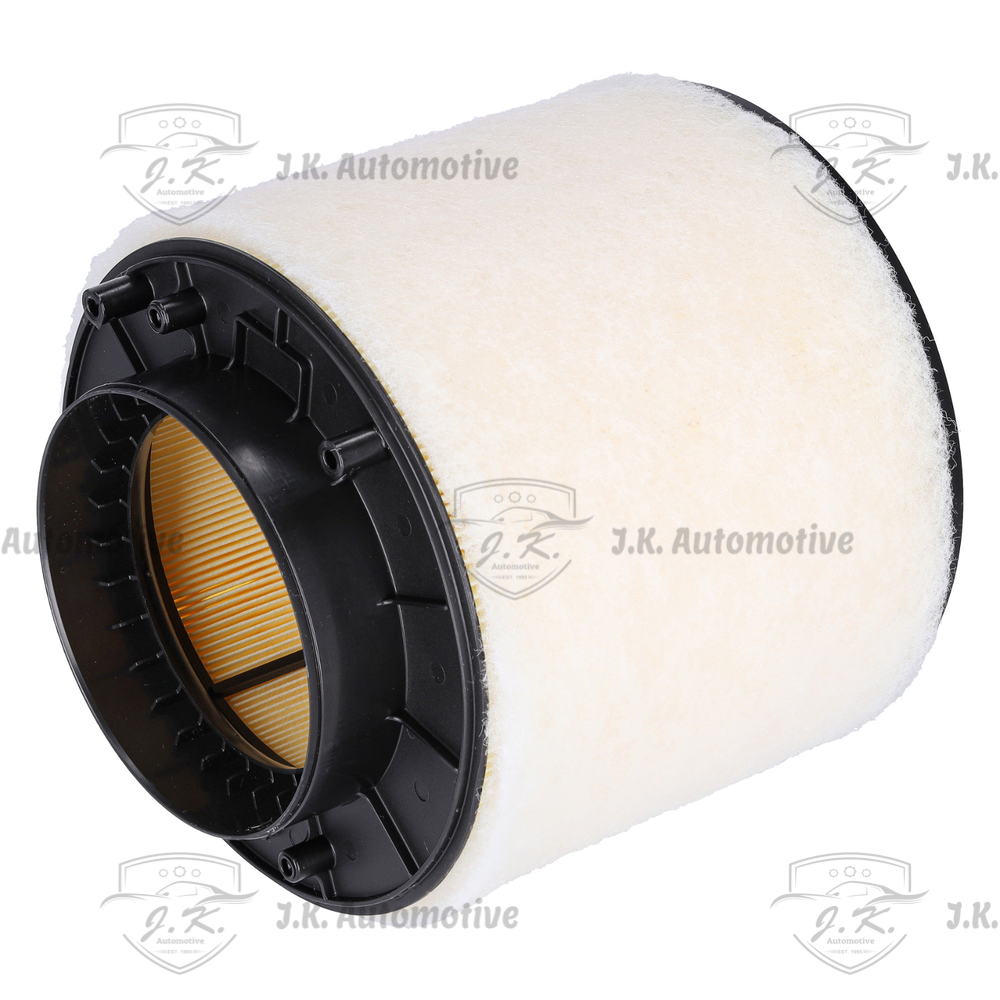
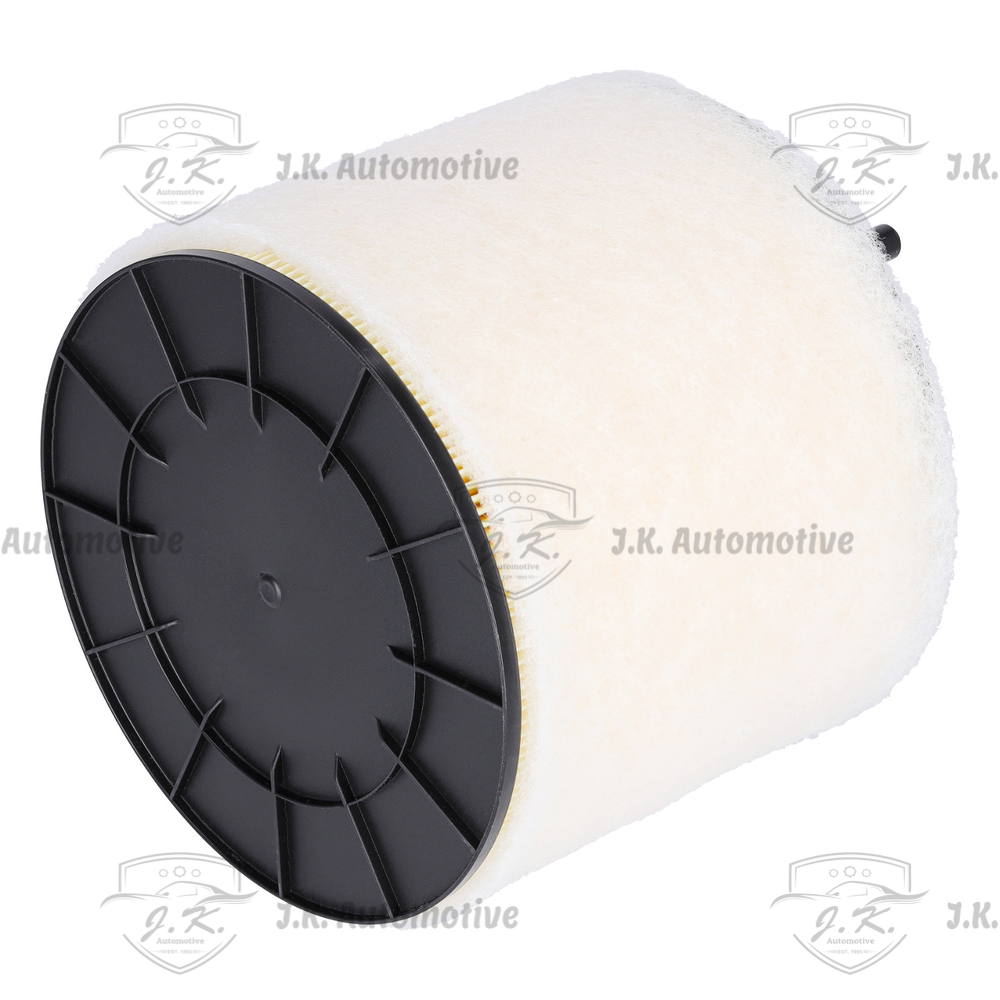
The Audi Q5 (8RB) produced between 2008 and 2017 equipped with the 3.0-liter V6 TDI common-rail turbodiesel engine (delivering 240 PS to 258 PS and up to 580 Nm of torque) relies on an exceptionally high-volume, non-turbulent column of induction air to feed its heavy-duty Garrett GTB-series variable-geometry turbocharger (VGT), high-pressure common-rail fuel injection system operating up to 2,000 bar, and Torsen mechanical center differential Quattro all-wheel-drive platform. Because the 90-degree V6 engine layout inside the Modular Longitudinal Platform (MLP) engine bay requires significantly greater mass airflow rates than a 4-cylinder engine under peak acceleration—often exceeding 600 kilograms of air per hour under full engine load—part number 8K0 133 843 D specifies a specialized high-flow 360-degree cylindrical canister element tailored specifically for the 3.0 V6 TDI airbox geometry. Built with deep radial synthetic microfiber filtration media supported by an internal steel reinforcing mesh cylinder, high-tensile hot-melt pleat stabilization lines, and heavy-duty elastomeric end-cap seals, this filter is engineered to withstand immense differential suction pressures without pleat bunching, wall flexing, or media collapse when the VGT turbocharger spools up to deliver peak boost pressures exceeding 1.6 bar relative. Furthermore, its precision elastomeric end caps form a 100 percent dust-tight, vibration-isolated compression seal against the airbox housing tray, preventing unmetered road grit, fine silica sand, and environmental soot from bypassing the media. By supplying clean, uniform, non-turbulent airflow into the large-diameter turbocharger compressor inlet neck, filter 8K0 133 843 D prevents high-speed compressor blade tip micro-erosion, avoids thermal and voltage telemetry drift on the downstream hot-film Mass Air Flow (MAF) sensor grid, preserves dual intercooler heat transfer efficiency, and enables the Bosch EDC engine management system to execute precise closed-loop fuel injection, active DPF regeneration cycles, and linear, high-torque Torsen Quattro power delivery across all driving conditions.
What advanced diagnostic trouble codes, live parameter shifts, and driving symptoms signal severe intake air restriction on filter 8K0 133 843 D in the Audi Q5 3.0 V6 TDI Quattro?
Diagnosing a restricted, saturated, or physically compromised air filter element under part number 8K0 133 843 D on an Audi Q5 3.0 V6 TDI Quattro requires evaluating physical vehicle performance alongside real-time live parameter logs using VCDS, ODIS, or advanced diagnostic scan tools, as airborne silica sand, highway soot, fine pollen, and organic road debris progressively pack the 360-degree synthetic microfiber pleats and increase static suction resistance across the airbox, forcing the electronically actuated Garrett VGT turbocharger to work significantly harder and spin at elevated shaft speeds to achieve target manifold boost pressures requested by the ECU. Mechanically, the driver will notice pronounced off-the-line throttle hesitation, severe turbo lag during mid-range transient acceleration, delayed boost buildup when overtaking under heavy Torsen Quattro torque transfer, a premature drop-off in top-end horsepower near high RPMs, and elevated diesel fuel consumption as the ECU attempts to compensate for airflow starvation, while the Bosch EDC engine control unit continuously monitors measured airflow mass via the hot-film MAF sensor grid relative to Manifold Absolute Pressure sensor readings, VGT vane position feedback, throttle valve angle, and engine RPM. When measured air mass falls below expected theoretical targets during turbocharger spooling, the ECU automatically scales back diesel fuel injection pulse widths to prevent rich combustion and excessive smoke creation, directly trimming engine torque output, and sustained intake restriction will illuminate the Glow Plug indicator, EPC lamp, or Check Engine Light and store diagnostic trouble codes such as P0101 (Mass Air Flow Sensor Signal Implausible), P0299 (Turbocharger Underboost Regulation Limit Not Reached), P2279 (Intake Air System Leak), or P2002 (Diesel Particulate Filter Efficiency Below Threshold), signaling the technician to inspect and replace filter element 8K0 133 843 D immediately to restore factory performance.
How does maintaining a fresh air filter under part number 8K0 133 843 D protect the Diesel Particulate Filter, EGR valve cooler, intake swirl flaps, and Positive Crankcase Ventilation system in the Audi Q5 3.0 V6 TDI Quattro?
Maintaining an unrestricted, high-flow air filter under part number 8K0 133 843 D directly safeguards the complex emissions control systems, intake manifold swirl flaps, and forced-induction components on the Audi Q5 3.0 V6 TDI Quattro because severe air restriction starves the 6-cylinder combustion chambers of vital oxygen molecules, resulting in an overly rich air-fuel mixture that generates excessive black carbon soot during power strokes. This surplus soot travels directly through the dual-bank Exhaust Gas Recirculation (EGR) valves and gas cooler assembly before passing into the Diesel Particulate Filter (DPF), causing premature soot loading of the ceramic matrix, rapid differential pressure spikes, and frequent, high-temperature active regeneration cycles that dilute engine oil with unburned diesel fuel. Additionally, fine airborne abrasive grit (ranging from 5 to 20 microns) passing through a compromised filter acts as an abrasive compound against the internal intake manifold tumble/swirl flaps and runner control linkages, leading to mechanical binding, position sensor errors (such as P2015), and expensive intake manifold assembly replacement. Furthermore, when the air filter is severely clogged, the Garrett VGT turbocharger generates an abnormally high intake depression vacuum inside the inlet pipe between the airbox and compressor inlet during heavy acceleration, placing an unnatural suction load on the dual-stage Positive Crankcase Ventilation (PCV) pressure-regulating diaphragm integrated within the engine V-valley oil separator assembly, tearing internal rubber membranes and pulling liquid engine oil mist straight out of the crankcase into the charge air piping and twin intercoolers where excess oil coats the intercooler fins, degrades thermal heat transfer efficiency, degrades rubber boost hoses, and bakes into sticky sludge when mixed with recirculated EGR gas vapors, emphasizing the critical importance of timely replacement of filter 8K0 133 843 D.
How do acoustic dampening, cabin refinement, and cold-air intake charge density differ between genuine OEM cylindrical filter 8K0 133 843 D and aftermarket open-element intake kits on the Audi Q5 3.0 V6 TDI Quattro?
The Audi Q5 (8RB) 3.0 V6 TDI Quattro is engineered as a high-performance luxury crossover designed to isolate cabin occupants from unrefined diesel clatter, high-frequency turbocharger spool whistle, diverter valve discharge noise, and low-frequency 6-cylinder induction boom while delivering massive, linear 580 Nm torque across all four wheels via its Torsen center differential, with OEM air filter part number 8K0 133 843 D specifically calibrated by VAG acoustic engineers to act as a primary noise-dampening element inside the sealed factory longitudinal airbox housing, where high-density 360-degree synthetic microfiber pleats and elastomeric end-cap seals absorb high-frequency compressor blade flutter, intake pulsation waves, and valvetrain resonance. In stark contrast, replacing the factory airbox with an aftermarket open-element intake or conical filter removes the sealed acoustic housing completely, introducing loud, unrefined diesel induction roar, harsh turbocharger spooling sounds, and engine bay vibration directly into the passenger cabin—disrupting the vehicle's luxury refinement—while also lacking the thermal shielding provided by the sealed factory airbox housing and drawing warm, stagnant air directly from inside the crowded 3.0 V6 TDI engine compartment rather than cool ambient air channeled straight through the front grille cold-air ducting. Ingesting heated engine bay air significantly reduces intake charge density, causing the Bosch EDC ECU to retard injection timing and reduce turbocharger boost targets to prevent excessive combustion thermal loads, which results in severe thermal heat-soak power losses during warm weather or heavy traffic driving conditions, proving that choosing genuine filter 8K0 133 843 D ensures optimal cabin quietness, maximum cold-air charge density, and consistent engine torque output under all operating conditions.
What specific warning signs, engine symptoms, and dashboard indicator lights tell you that air filter 8K0 133 843 D is completely clogged in your Audi Q5 3.0 TDI?
When the air filter (part number 8K0 133 843 D) in your Audi Q5 3.0 TDI becomes completely packed with road dirt, soot, and dust, your car will give you clear warning signs through both driving behavior and dashboard lights. At first, you will notice that the car feels heavy, slow, and sluggish when you press the gas pedal, especially when trying to pass another vehicle on the highway or driving up steep hills. Because the turbocharger cannot pull in enough clean air, it takes longer to build up boost pressure, creating noticeable throttle lag and poor engine response. You might also notice that your fuel tank drains much faster than usual because the engine computer has to work harder to balance fuel delivery under air starvation. As the air restriction gets worse, the engine computer will detect that the airflow readings do not match what the turbocharger is trying to deliver. This will trigger warning lights on your dashboard, such as the Glow Plug indicator light flashing, the EPC (Electronic Power Control) light turning on, or the Check Engine Light illuminating. If you scan the car using a diagnostic tool, you will find error codes related to low boost pressure (such as P0299 Turbocharger Underboost) or incorrect air sensor signals (such as P0101 Mass Air Flow Sensor Implausible). Replacing the dirty filter with a brand-new 8K0 133 843 D element immediately restores full airflow, clears these engine fault conditions, and brings back smooth, strong engine power. In the Audi Q5 3.0 TDI Quattro, the air filter (part number 8K0 133 843 D) controls the flow of fresh outside air entering the large V6 turbocharger. When fine road dirt, dust, and soot fill the filter's paper folds over time, the turbocharger has to suck much harder to draw in the air it needs. This creates a strong vacuum inside the intake pipe, making the air flow uneven and turbulent as it hits the fast-spinning turbo blades. As a result, the turbocharger works much harder and runs much hotter than normal just to supply enough air to the engine. When you step on the gas pedal, you will feel a delay in acceleration, reduced engine power, and poor throttle response because the engine is not getting enough clean air. If you continue driving with a clogged air filter, this extra stress can damage the turbocharger bearings, wear out the compressor blades, and cause oil to leak into the intake pipes, which is why replacing filter 8K0 133 843 D on time is essential for keeping your engine healthy and strong.
How does a clogged air filter 8K0 133 843 D cause false sensor readings and engine power losses in the Audi Q5 3.0 TDI?
The engine computer in your Audi Q5 3.0 TDI uses an Air Mass Sensor (MAF) located right behind the air filter to measure exactly how much air enters the engine so it can spray the correct amount of diesel fuel. When filter 8K0 133 843 D becomes dirty or bent out of shape, the air coming out of the filter stops flowing smoothly and starts swirling wildly inside the pipe. These irregular air swirls pass over the sensor's delicate wire, sending incorrect signals and wrong measurements to the main engine computer. If the computer thinks less air is entering the engine than there actually is, it cuts back on fuel injection to prevent black smoke, which makes the car feel slow, sluggish, and weak when climbing hills or passing other cars. On the other hand, if the sensor misreads high air amounts, the computer sprays too much fuel, causing unburned diesel, dirty combustion, and high engine temperatures. Replacing your air filter with a fresh 8K0 133 843 D element ensures smooth, steady airflow over the sensor so your engine computer can calculate fuel accurately and deliver smooth power. A common mistake many car owners make is trying to clean a dirty air filter (8K0 133 843 D) using a high-pressure air hose or blowing chemical sprays on it to save money. Even though blowing air from the back might make the filter look clean on the surface by blowing away big leaves or loose dirt, the force of compressed air over 30 PSI tears the invisible micro-fibers inside the filter material. This opens up large microscopic holes in the filter media and breaks the glue strips that hold the filter pleats evenly apart. Once these microscopic tears are made, tiny dust grains, sand, and fine grit will pass straight through the filter and enter your engine, scratching the turbocharger blades, damaging the cylinder walls, and wearing out internal parts. Washing the filter with liquid soap or solvent sprays is just as bad because it dissolves the protective coatings on the fibers and ruins the rubber end seals, allowing dirty air to leak around the sides of the filter box. Air filter 8K0 133 843 D is designed strictly as a single-use part, meaning once it is dirty, you should throw it away and install a brand-new one to protect your engine completely.
How does a clogged air filter 8K0 133 843 D damage the Diesel Particulate Filter (DPF) and the EGR system in the Audi Q5 3.0 TDI?
A dirty air filter does not just affect the intake system; it also causes severe damage to your Audi Q5's expensive exhaust and emissions systems, specifically the Diesel Particulate Filter (DPF) and Exhaust Gas Recirculation (EGR) valve. When the air filter (8K0 133 843 D) is blocked, the V6 diesel engine is starved of oxygen during the combustion process inside the cylinders. Without enough oxygen to burn the diesel fuel completely, the engine produces a large amount of thick black carbon soot during every stroke. This heavy soot flows directly out of the engine cylinders and enters the EGR valve and cooler, where it builds up into sticky carbon crusts that cause the EGR valve to stick open or clog completely. The remaining heavy soot then travels straight into the Diesel Particulate Filter located in your exhaust system. Because the DPF is forced to trap far more soot than it was designed to handle, it fills up very quickly, leading to frequent automatic DPF cleaning cycles (active regenerations). These extra cleaning cycles run at extremely high temperatures, which degrades your engine oil, wastes extra fuel, and eventually causes the ceramic core of the DPF to block permanently. Keeping a fresh air filter 8K0 133 843 D installed allows your engine to burn fuel cleanly with plenty of oxygen, protecting your DPF and EGR valve from premature failure. Driving your Audi Q5 3.0 TDI through harsh winter conditions exposes your air filter (8K0 133 843 D) to unique environmental hazards like highway snow slush, freezing fog, and chemical road salt spray. The front air intake duct on your Audi sits right behind the front grille to catch cold, dense outside air, but during winter driving, it also sucks in fine mist mixed with dissolved road salt and melting snow. When damp air and salt spray hit the filter media, the synthetic fibers trap the water while the heat from the engine bay causes the liquid to evaporate. However, the dissolved salt cannot evaporate; instead, it forms microscopic salt crystals deep inside the tiny pores of the filter material.


Reviews
There are no reviews yet.