How does OEM air filter 4F0 133 843 / 4F0 133 843 B specifically interact with the EA837 3.0 TFSI supercharged engine, Roots-type supercharger, and Quattro system in the Audi A6 C6 (4F2)?
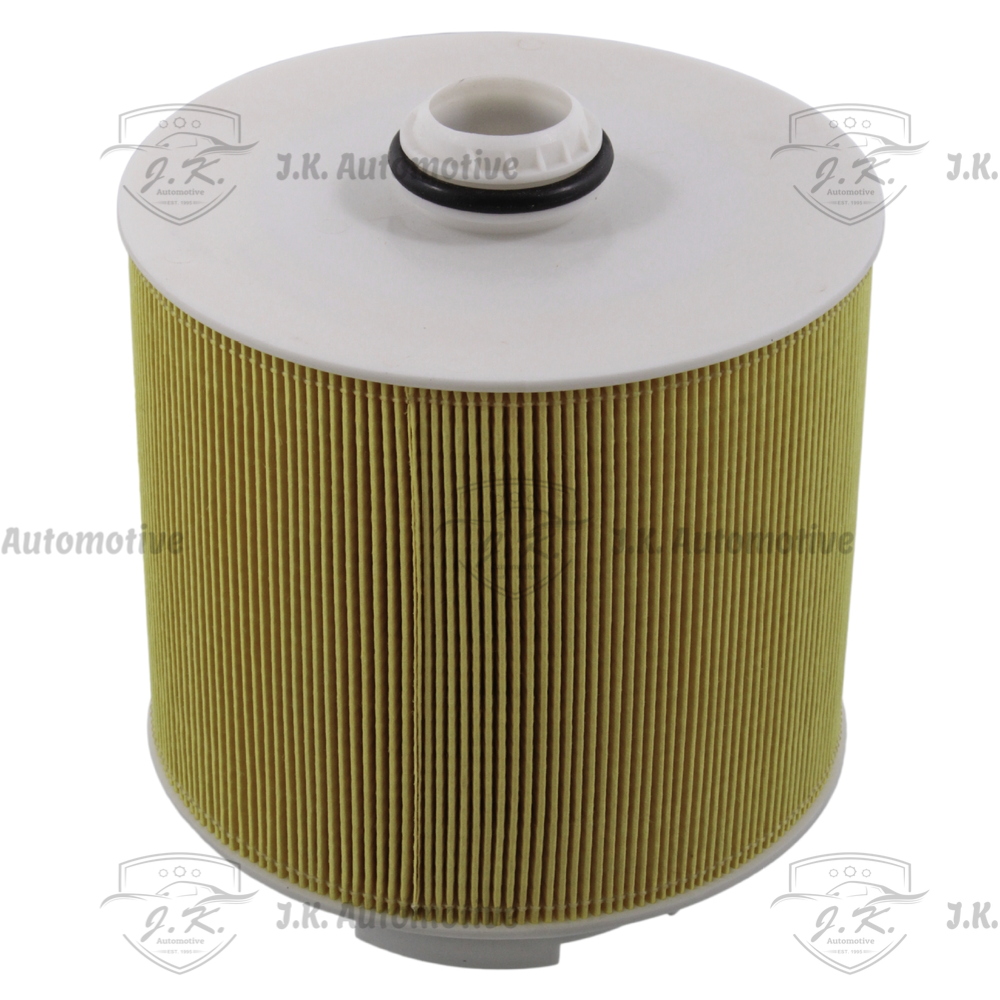
The Audi A6 C6 (4F2) produced from 2008 through 2011 featuring the high-performance 3.0-liter V6 supercharged engine (EA837 family producing 290 PS / 213 kW and 420 Nm of torque) relies on an enormous, continuous volume of dense induction air to feed its belt-driven Eaton TVS Roots-type twin-vortex supercharger. Unlike turbocharged engines that build boost progressively as exhaust gas pressure swells, the mechanical supercharger on the 3.0 TFSI forces instantaneous intake air displacement directly proportional to engine crankshaft RPM, creating immediate, extreme depression vacuum across the intake airbox during wide-open throttle acceleration. OEM air filter part numbers 4F0 133 843 and 4F0 133 843 B specify the high-capacity panel element engineered specifically for the longitudinal C6 chassis airbox packaging. Constructed with multi-layered synthetic microfiber media bound by transverse hot-melt stabilization lines running across the pleat crests, this filter prevents pleat flexing, structural deformation, or media collapse under intense differential suction pressure when the supercharger bypass valve closes and demands maximum airflow volume. Furthermore, the specialized elastomeric polyurethane perimeter frame compresses uniformly inside the airbox housing tray, forming a 100 percent dust-tight, vibration-isolated compression seal that prevents unmetered road grit, silica sand, and environmental soot from bypassing the media and entering the intake plenum. By maintaining clean, non-turbulent airflow into the supercharger rotor pack, filter 4F0 133 843 protects the delicate Teflon coating on the four-lobe Roots rotors from high-speed particle erosion, prevents thermal sensor drift on the downstream intake air temperature and manifold pressure sensors, preserves the efficiency of the dual water-to-air charge air coolers integrated inside the supercharger housing, and ensures that the Siemens/Continental Simos 8.x ECU can execute precise closed-loop fuel injection, bypass flap regulation, and ignition timing strategies across all engine load demands.
What advanced diagnostic trouble codes, live parameter shifts, and driving symptoms signal severe intake air restriction on air filter 4F0 133 843 / 4F0 133 843 B in the Audi A6 C6 3.0 TFSI Quattro?
Diagnosing a restricted, saturated, or physically compromised air filter element under part numbers 4F0 133 843 or 4F0 133 843 B on an Audi A6 C6 3.0 TFSI Quattro requires evaluating physical vehicle performance alongside real-time live parameter logs using VCDS, ODIS, or advanced diagnostic scan tools. As airborne silica sand, highway soot, fine pollen, and organic road debris progressively blind the synthetic microfiber pleats, static suction resistance across the airbox increases dramatically, forcing the mechanically driven Eaton supercharger to draw air across an artificially high depression vacuum. Mechanically, the driver will notice off-the-line throttle hesitation, flat spots during mid-range acceleration, a noticeable loss of high-RPM supercharger kick, sluggish bypass flap transitions, and elevated fuel consumption as the engine management system attempts to compensate for airflow starvation. Diagnostically, the Simos 8.x engine control unit continuously monitors measured airflow mass via the hot-film Mass Air Flow (MAF) sensor grid alongside Manifold Absolute Pressure (MAP) sensors mounted downstream of the intercooler cores relative to throttle valve position, supercharger bypass flap position, and engine RPM. When measured air mass falls below expected theoretical targets during supercharger engagement, the ECU automatically opens the supercharger bypass valve to discharge excess pressure and scales back fuel injection pulse widths to prevent rich combustion, directly cutting engine torque output. Sustained intake restriction will illuminate the EPC (Electronic Power Control) lamp or Check Engine Light (MIL) and store diagnostic trouble codes such as P0101 (Mass Air Flow Sensor Signal Implausible), P0068 (MAP/MAF - Throttle Position Correlation Implausible), P2279 (Intake Air System Leak), or positive long-term fuel trim adaptations (P0171 - System Too Lean Bank 1 / P0174 - System Too Lean Bank 2), signaling the technician to inspect and replace filter element 4F0 133 843 / 4F0 133 843 B immediately to restore baseline performance.
How does maintaining a fresh air filter under part number 4F0 133 843 / 4F0 133 843 B protect the Roots-type supercharger rotors, dual intercooler cores, and PCV breather valve on the Audi A6 C6 3.0 TFSI Quattro?
Maintaining an unrestricted, high-flow air filter under part number 4F0 133 843 / 4F0 133 843 B directly safeguards the expensive mechanical supercharger assembly, dual charge air cooler cores, and internal crankcase ventilation components on the Audi A6 C6 3.0 TFSI. The Eaton TVS supercharger utilizes twin four-lobe rotors coated with a specialized abradable graphite-based seal material engineered to operate with microscopic clearances to maximize displacement efficiency and prevent boost leakage. When an aging, torn, or unreinforced air filter allows microscopic abrasive silica sand particles (ranging from 5 to 20 microns) to bypass the airbox housing, these hard mineral particles strike the high-speed rotating rotors, scouring off the protective abradable coating, causing permanent rotor surface scoring, and permanently degrading supercharger boost efficiency. Furthermore, silica dust passing through the supercharger gets forced into the fine aluminum cooling fins of the twin water-to-air intercooler cores tucked inside the manifold banks, creating a thermal insulating layer that degrades charge-air cooling efficiency and causes heat soak. Additionally, severe intake air restriction forces the supercharger to generate an abnormally high depression vacuum inside the intake pipe between the airbox and throttle body during acceleration. This high vacuum places an unnatural suction load directly on the Positive Crankcase Ventilation (PCV) fine oil separator module situated in the engine V-valley, tearing the PCV internal rubber diaphragm and pulling raw motor oil mist straight out of the crankcase into the intake runners, which bakes onto hot intake valves to form heavy carbon deposits. Installing a clean OEM panel air filter under part number 4F0 133 843 / 4F0 133 843 B guarantees particle retention down to 3 microns, preserving supercharger rotor clearances, keeping intercooler cores clean, preventing PCV oil pullover, and protecting valvetrain longevity.
How do acoustic dampening, cabin refinement, and cold-air intake charge density differ between genuine OEM panel filter 4F0 133 843 / 4F0 133 843 B and aftermarket open-element intake kits on the Audi A6 C6 3.0 TFSI Quattro?
The Audi A6 C6 (4F2) 3.0 TFSI Quattro is engineered as an executive luxury tourer designed to isolate cabin occupants from unrefined mechanical whine, harsh intake resonance, and low-frequency induction boom while delivering smooth, instantaneous V6 supercharged power. OEM air filter part numbers 4F0 133 843 and 4F0 133 843 B are specifically calibrated by VAG acoustic engineers to act as primary noise-dampening elements inside the sealed factory airbox, where high-density synthetic microfiber pleats and an elastomeric polyurethane perimeter frame absorb high-frequency supercharger rotor whine, intake pulsation waves, and bypass flap discharge surges created by the 3.0 TFSI induction tract. In stark contrast, replacing the factory airbox with an aftermarket open-element intake or conical filter removes the sealed acoustic housing completely, introducing loud, unrefined supercharger whine and harsh intake roar directly into the passenger cabin—a characteristic that can become exceptionally fatigue-inducing during long highway cruises. Furthermore, open-element filters lack the thermal shielding provided by the sealed factory airbox housing, drawing warm, stagnant air directly from inside the crowded 3.0 TFSI engine compartment rather than cool ambient air channeled straight through the dedicated front grille cold-air ducting. Ingesting heated engine bay air significantly reduces intake charge density, causing the Simos 8.x ECU to retard ignition timing and open the supercharger bypass flap to prevent engine knock, which results in severe thermal heat-soak power losses during warm weather or aggressive driving conditions. Choosing genuine filter 4F0 133 843 / 4F0 133 843 B ensures optimal cabin quietness, maximum cold-air charge density, and consistent engine torque output under all operating conditions.
How does progressive silica dust loading on air filter 4F0 133 843 / 4F0 133 843 B alter charge air density, twin intercooler thermal efficiency, and combustion heat loads in the Audi A6 C6 3.0 TFSI Quattro?
As fine silica particles, highway road soot, industrial micro-particulates, and organic environmental debris progressively pack the deep synthetic microfiber pleats of air filter 4F0 133 843 / 4F0 133 843 B, the static suction resistance across the airbox assembly spikes dramatically during wide-open throttle acceleration. In the 3.0 TFSI supercharged V6 engine of the Audi A6 C6 Quattro, the mechanically driven Eaton Roots-type supercharger continues to displace air at a fixed mechanical ratio relative to crankshaft RPM, forcing it to draw intake air across an artificially severe depression vacuum. Compressing incoming air across this high vacuum generates intense thermodynamic friction and kinetic heat during the mechanical compression phase between the supercharger rotors, causing charge air exiting the displacement chambers to reach drastically elevated temperatures before passing into the dual liquid-to-air intercooler cores mounted inside the intake manifold banks. Over extended high-load driving cycles, high-speed highway cruising, or warm-weather sport driving scenarios, this elevated thermal load overburdens the secondary intercooler cooling circuit, driving up intake air temperatures (IATs) entering the engine cylinders, which lowers total oxygen mass density per stroke and accelerates thermal stress across the cylinder heads, exhaust valves, and aluminum piston crowns. In high-compression direct-injection supercharged engines, elevated charge air temperatures promote destructive pre-ignition and engine knock. To protect internal engine components and maintain structural integrity, the Simos 8.x ECU detects elevated IAT values via live sensor bus telemetry and automatically opens the supercharger bypass valve while retarding ignition timing, resulting in a noticeable loss of peak horsepower, sluggish transient throttle response, elevated exhaust gas temperatures (EGTs), and increased fuel consumption until a fresh OEM filter element under part number 4F0 133 843 or 4F0 133 843 B is installed to restore baseline thermal and volumetric airflow performance.
How do high suction forces under heavy supercharger boost cause structural pleat collapse on unreinforced aftermarket filters, and why are transverse hot-melt stabilization lines essential on part number 4F0 133 843 / 4F0 133 843 B?
In the high-output 3.0 TFSI supercharged engine of the Audi A6 C6 3.0 TFSI Quattro, maintaining a uniform, non-turbulent, and laminar airflow column through the airbox housing is critical for accurate downstream intake air temperature and mass airflow calculations by the hot-film Mass Air Flow (MAF) sensor and Manifold Absolute Pressure (MAP) sensors. Substandard or budget aftermarket air filters under part number 4F0 133 843 or 4F0 133 843 B often omit the high-tensile hot-melt stabilization beads running transversely across the pleat crests that are characteristic of genuine OEM construction. Under high boost request targets when the mechanical supercharger generates immediate, maximum suction vacuum across the filter media face, unreinforced paper or low-density synthetic pleats bend, flex, and physically collapse together under intense differential pressure drops. When filter pleats bunch against one another, local airflow velocity spikes through the remaining open gaps while creating stagnant, turbulent eddy currents behind the collapsed sections. This non-uniform air distribution disrupts the smooth laminar airflow profile entering the supercharger throttle body inlet, causing severe pressure oscillations and air turbulence across the hot-film MAF sensor grid. Confused by rapidly fluctuating intake manifold pressure and mass airflow feedback, the ECU continuously adjusts supercharger bypass valve angles and fuel injection pulse widths, resulting in noticeable engine surging during aggressive acceleration, inconsistent mid-range torque delivery, and accelerated mechanical wear on the electronic bypass actuator. Maintaining a rigid, structurally stable OEM filter element 4F0 133 843 / 4F0 133 843 B with hot-melt pleat stabilization guarantees uniform air distribution across the entire media surface area under peak supercharger vacuum, protecting valvetrain stability, bypass valve actuation, and boost control integrity.
Why should high-pressure compressed air blow-outs and liquid chemical solvents never be used to clean or recondition synthetic air filter 4F0 133 843 / 4F0 133 843 B on the Audi A6 C6 3.0 TFSI Quattro?
A common but highly damaging maintenance error in commercial garages is attempting to extend the operational service life of dirty air filter element 4F0 133 843 or 4F0 133 843 B using high-pressure compressed air nozzles or chemical solvent sprays during routine vehicle servicing. While blowing compressed air through the clean side of the filter media may dislodge surface leaves, large sand particles, and organic debris, the concentrated air stream (frequently exceeding 30 PSI) permanently ruins the microscopic filtration lattice of the synthetic microfiber matrix. The intense mechanical force of compressed air tears delicate synthetic micro-fibers apart, expanding factory-calibrated 3-micron pore sizes up to 20 microns or larger, while simultaneously snapping the transverse hot-melt stabilization beads away from the pleat crests. Once pleat geometry is disrupted and pore matrix size is enlarged, the filter can no longer trap fine silica dust or airborne road sand when reinstalled in the airbox. Reinstalling a blown-out filter allows fine abrasive grit to pass directly into the intake tract, accelerating supercharger rotor coating erosion, intercooler fin blockage, MAF sensor wire contamination, and cylinder wall wear. Similarly, applying chemical degreasers, cleaning solvents, or aerosol air fresheners breaks down the synthetic binder chemicals within the media and dissolves the elastomeric polyurethane perimeter frame, causing the gasket frame to shrink, warp, lose its elasticity, and leak raw, unfiltered air around the edges. Filter 4F0 133 843 / 4F0 133 843 B is engineered strictly as a dry, single-use replaceable component that must be discarded and replaced with a fresh OEM element whenever dirty or restricted to guarantee complete engine protection.
What specific real-world driving environments and operational conditions necessitate cutting the replacement interval for air filter 4F0 133 843 / 4F0 133 843 B in half on the Audi A6 C6 3.0 TFSI Quattro?
While Audi's official factory maintenance schedule suggests replacing engine air filter 4F0 133 843 / 4F0 133 843 B every 60,000 kilometers (or 4 years), real-world operational environments frequently require reducing this service interval to 30,000 kilometers to protect the 3.0 TFSI supercharged V6 engine and Eaton supercharger assembly. Vehicles operated daily in dense urban traffic endure continuous stop-and-go idling behind heavy commercial diesel trucks and buses, ingesting concentrated amounts of soot, brake dust, and airborne micro-particulates that blind the filter pleats long before reaching distance-based service limits. Similarly, driving regularly on unpaved gravel roads, agricultural routes, or in dry, dusty geographic regions exposes the front cold-air intake grille to massive dust clouds that rapidly pack the deep synthetic pleat valleys of part numbers 4F0 133 843 / 4F0 133 843 B with abrasive silica sand. Furthermore, operating in cold winter climates with heavy road salting causes fine salt mist and slush spray to enter the airbox, where drying salt crystals block the synthetic media pores. Drivers subjecting their Audi A6 C6 3.0 TFSI Quattro to severe urban congestion, dusty rural environments, or extreme winter climates should visually inspect air filter 4F0 133 843 / 4F0 133 843 B every 15,000 kilometers, replacing the element immediately whenever heavy discoloration, pleat distortion, or frame hardening is present to preserve optimal engine torque, fuel efficiency, and supercharger longevity.
How does a compromised polyurethane perimeter frame gasket on air filter 4F0 133 843 / 4F0 133 843 B cause unmetered air bypass, erratic manifold pressure readings, and premature supercharger rotor scoring in the Audi A6 C6 3.0 TFSI Quattro?
The longitudinal airbox assembly in the Audi A6 C6 3.0 TFSI Quattro relies on a precise, airtight compression seal between the lower housing tray and upper airbox lid, sealed entirely by the flexible perimeter frame of air filter 4F0 133 843 / 4F0 133 843 B. Genuine OEM filters utilize a specialized elastomeric polyurethane sealing edge engineered with high elastic memory that maintains constant outward radial pressure against the airbox sealing channels across extreme engine bay temperature fluctuations. When an inferior, counterfeit, or aged filter with hardened, shrunk, or cracked perimeter foam is installed, repeated engine bay heat cycles cause the gasket to lose its elasticity, creating microscopic air gaps along the outer edge of the airbox housing. During heavy supercharger engagement, the high differential vacuum generated inside the airbox draws raw, unmetered atmospheric air through these perimeter gaps, bypassing the filtration media completely. This unmetered false air carries fine airborne silica sand directly into the supercharger throttle inlet, where hard mineral particles collide with the rotating Teflon-coated Roots rotors, causing severe abrasive scoring, clearance degradation, and loss of volumetric displacement efficiency. Furthermore, because this bypass air introduces unmeasured volume into the intake tract past the hot-film MAF sensor, the Simos 8.x ECU receives conflicting data between calculated MAF airflow and actual manifold absolute pressure (MAP) sensors, leading to calculated fuel injection errors, erratic boost delivery, and persistent diagnostic trouble codes such as P0171 (System Too Lean Bank 1), P0174 (System Too Lean Bank 2), or P2279 (Intake Air System Leak). Installing a genuine OEM filter element under part number 4F0 133 843 or 4F0 133 843 B guarantees exact gasket dimensions, total seal memory, and absolute protection against unfiltered bypass airflow across all operating conditions.


Reviews
There are no reviews yet.