How does OEM air filter 059 133 843 B specifically interact with the EA837 2.7 TDI V6 Common Rail engine, variable-geometry turbocharger, and dual intake manifold swirl flap dynamics in the Audi A6 C6 (4F2)?
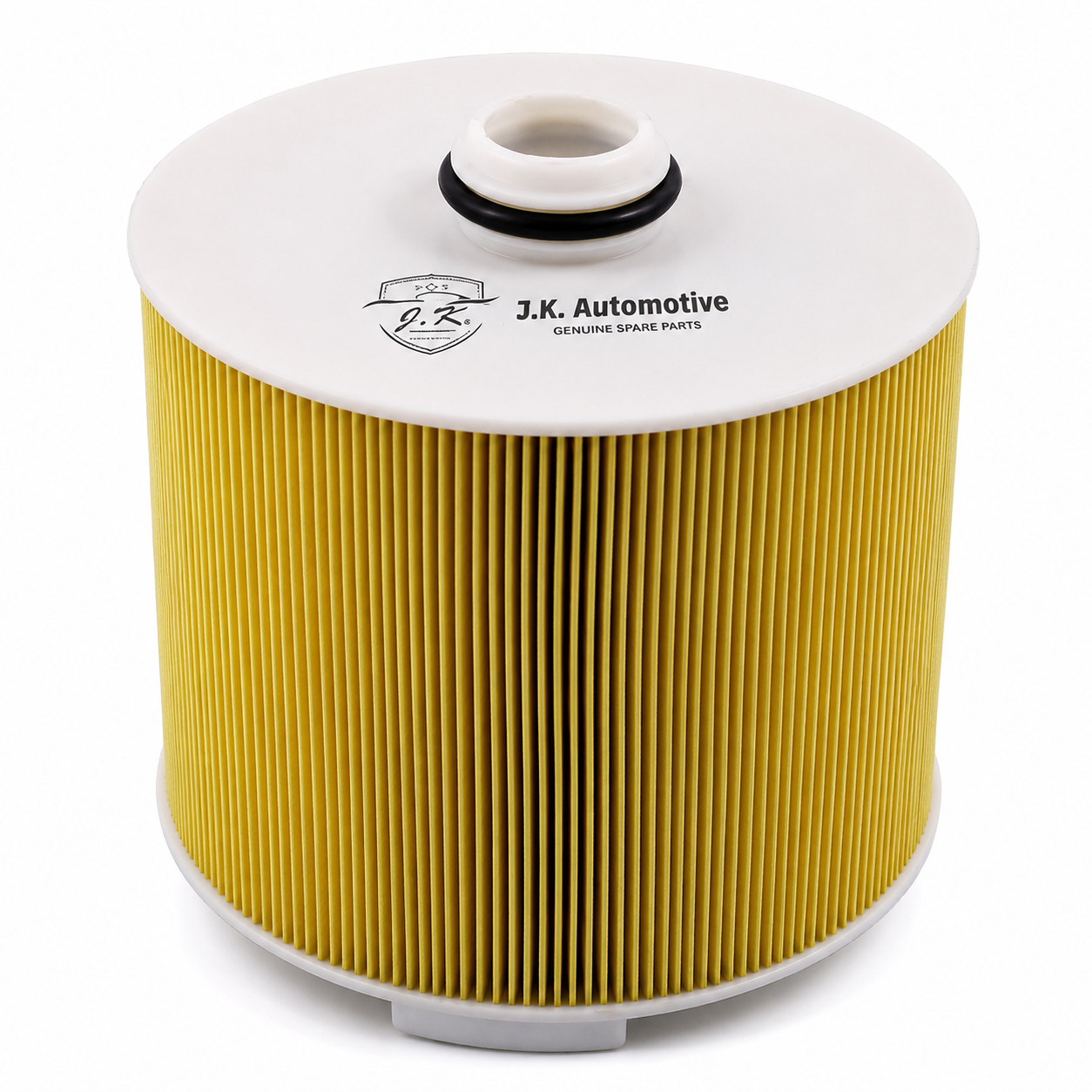
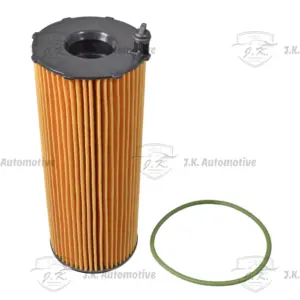
The Audi A6 C6 (4F2) produced from 2005 through 2011 featuring the 2.7-liter V6 TDI common-rail turbodiesel engine (EA837 engine family producing 180 PS / 190 PS and 380 Nm / 400 Nm of torque) depends on a dense, non-turbulent, and uninterrupted column of induction air to feed its variable-geometry turbocharger (VGT) and piezo-actuated common-rail fuel injection system operating at pressures up to 1,600 bar. Because this V6 diesel engine utilizes dual intake manifold channels equipped with electronically controlled swirl flaps to optimize air-fuel swirl patterns at low RPMs before opening fully for high-rpm volumetric efficiency, maintaining precise intake airflow mass and static airbox pressure is critical. OEM air filter part number 059 133 843 B specifies the heavy-duty, high-capacity rectangular panel element engineered specifically for the longitudinal C6 engine bay compartment. Built with multi-layered synthetic microfiber media bound by transverse hot-melt stabilization lines running across the pleat crests, this filter prevents pleat flexing, structural deformation, or media collapse under intense differential suction pressure when the VGT turbocharger spools up to deliver peak boost pressure. Furthermore, the specialized elastomeric polyurethane perimeter frame compresses uniformly inside the airbox housing tray, forming a 100 percent dust-tight, vibration-isolated compression seal that prevents unmetered road grit, silica sand, and environmental soot from bypassing the media and entering the intake plenum. By maintaining clean, non-turbulent airflow into the turbocharger compressor inlet elbow, filter 059 133 843 B protects the delicate aluminum compressor wheel blades from high-speed particle erosion, prevents thermal sensor drift on the downstream hot-film Mass Air Flow (MAF) sensor, preserves the efficiency of the dual charge air coolers, and ensures that the Bosch EDC16 / EDC17 engine management system can execute precise closed-loop fuel injection, boost regulation, and intake swirl flap actuation across all load demands.
What advanced diagnostic trouble codes, live parameter shifts, and driving symptoms signal severe intake air restriction on air filter 059 133 843 B in the Audi A6 C6 2.7 TDI?
Diagnosing a restricted, saturated, or physically compromised air filter element under part number 059 133 843 B on an Audi A6 C6 2.7 TDI requires evaluating physical vehicle performance alongside real-time live parameter logs using VCDS, ODIS, or advanced diagnostic scan tools. As airborne silica sand, highway soot, fine pollen, and organic road debris progressively blind the synthetic microfiber pleats, static suction resistance across the airbox increases dramatically, forcing the electronically controlled variable-geometry turbocharger to work harder and spin at significantly elevated shaft speeds to achieve the target manifold boost pressure requested by the ECU. Mechanically, the driver will notice off-the-line throttle hesitation, pronounced turbo lag during mid-range transient acceleration, delayed boost building when overtaking, a loss of top-end torque, and elevated diesel fuel consumption as the engine management system attempts to compensate for airflow starvation. Diagnostically, the Bosch EDC engine control unit continuously monitors measured airflow mass via the hot-film MAF sensor grid alongside manifold absolute pressure (MAP) sensor readings relative to throttle valve position, VGT vane position, and engine RPM. When measured air mass falls below expected theoretical targets during turbocharger spooling, the ECU automatically scales back diesel fuel injection pulse widths to prevent rich combustion and excessive soot loading, directly cutting engine torque output. Sustained intake restriction will illuminate the Glow Plug indicator, EPC lamp, or Check Engine Light (MIL) and store diagnostic trouble codes such as P0101 (Mass Air Flow Sensor Signal Implausible), P0299 (Turbocharger Underboost Regulation Limit Not Reached), P2279 (Intake Air System Leak), or P2015 (Intake Manifold Flap Position Sensor / Switch Circuit Range/Performance), signaling the technician to inspect and replace filter element 059 133 843 B immediately to restore factory performance.
How does engine air filter 059 133 843 B specifically interact with the 2.7-liter V6 TDI engine, variable-geometry turbocharger (VGT), and C6 platform in the Audi A6 (4F2)?
The third-generation Audi A6 sedan (C6/4F2 chassis) produced from 2005 through 2011 equipped with the 2.7-liter V6 common-rail turbodiesel engine (BSG, BPP, and CANA/CANB engine codes generating up to 190 PS and 400 Nm of torque) relies on an uninterrupted, laminar, and thermally dense column of clean induction air to feed its variable-geometry turbocharger (VGT), 1,600+ bar common-rail fuel injection system, and longitudinal executive chassis platform. Because a high-torque V6 turbodiesel engine operates under high intake vacuum draw to build rapid low-end boost and low emissions, part number 059 133 843 B specifies a high-flow, heavy-duty engine panel air filter element engineered specifically for the longitudinal airbox housing on the right side of the engine compartment. Constructed with deep-pleated synthetic microfiber filtration media held at precise geometric intervals by transverse hot-melt stabilization lines, a rigid composite structural frame, and a high-density elastomeric perimeter sealing ring, this filter element is engineered to resist severe intake depression vacuum without pleat collapse, warping, or media deformation under heavy turbocharger spooling. The precision elastomeric sealing gasket compresses 100 percent flush into the plastic airbox seating channel, forming a dust-tight, vibration-isolated compression seal that prevents unmetered highway grit, fine silica sand, and environmental soot from bypassing the media directly into the VGT compressor inlet neck. By delivering clean, uniform, high-density airflow directly into the turbocharger compressor, filter 059 133 843 B prevents high-speed compressor blade tip micro-erosion, avoids thermal and voltage telemetry drift on the downstream hot-film Mass Air Flow (MAF) sensor grid, preserves charge air intercooler heat transfer efficiency, and enables the Bosch EDC16/EDC17 engine management system to execute precise closed-loop fuel injection, active Diesel Particulate Filter (DPF) regeneration cycles, and linear Tiptronic, Multitronic, or Quattro power delivery across all driving conditions without risking premature mechanical wear on internal engine components.
How do acoustic dampening, cabin refinement, and cold-air intake charge density differ between genuine OEM panel filter 059 133 843 B and aftermarket open-element intake kits on the Audi A6 C6 2.7 TDI?
The Audi A6 C6 (4F2) 2.7 TDI is engineered as a refined luxury executive saloon designed to isolate cabin occupants from unrefined V6 diesel clatter, high-frequency turbocharger spool whistle, diverter valve discharge noise, and low-frequency induction boom while delivering smooth, linear torque. OEM air filter part number 059 133 843 B is specifically calibrated by VAG acoustic engineers to act as a primary noise-dampening element inside the sealed factory airbox, where high-density synthetic microfiber pleats and an elastomeric polyurethane perimeter frame absorb high-frequency compressor blade flutter, intake pulsation waves, and swirl flap seating resonance created by the 24-valve 2.7 TDI valvetrain. In stark contrast, replacing the factory airbox with an aftermarket open-element intake or conical filter removes the sealed acoustic housing completely, introducing loud, unrefined diesel induction roar, harsh turbocharger spooling sounds, and engine bay vibration directly into the passenger cabin—a major contributor to driver fatigue during long highway journeys. Furthermore, open-element filters lack the thermal shielding provided by the sealed factory airbox housing, drawing warm, stagnant air directly from inside the crowded V6 engine compartment rather than cool ambient air channeled straight through the front grille cold-air ducting. Ingesting heated engine bay air significantly reduces intake charge density, causing the Bosch EDC ECU to retard injection timing and reduce turbocharger boost targets to prevent excessive combustion thermal loads, which results in severe thermal heat-soak power losses during warm weather or heavy traffic driving conditions. Choosing genuine filter 059 133 843 B ensures optimal cabin quietness, maximum cold-air charge density, and consistent engine torque output under all operating conditions.
How does progressive silica dust accumulation on air filter 059 133 843 B alter charge air density, intercooler thermal efficiency, and thermal loading in the Audi A6 C6 2.7 TDI?
As fine silica particles, highway road soot, industrial micro-particulates, and organic environmental debris progressively pack the deep synthetic microfiber pleats of air filter 059 133 843 B, the static suction resistance across the airbox assembly spikes dramatically during wide-open throttle acceleration. In the turbocharged EA837 2.7 TDI V6 engine of the Audi A6 C6, the electronically controlled variable-geometry turbocharger (VGT) must adjust its turbine vanes to close more aggressively, forcing the compressor wheel to spin at drastically elevated rotational shaft speeds to overcome this intake starvation vacuum and deliver requested intake manifold boost pressures. Compressing incoming air across an artificially high depression vacuum generates intense thermodynamic friction and kinetic heat during the air compression phase, causing charge air exiting the turbocharger compressor discharge neck to reach drastically elevated temperatures before entering the twin side-mounted charge air coolers. Over extended high-load driving cycles, high-speed highway cruising, or warm-weather towing scenarios, this elevated heat load overburdens the intercooler system, driving up intake air temperatures (IATs) entering the engine cylinders, which lowers total oxygen mass density per stroke and accelerates thermal stress across the cylinder head, sodium-filled exhaust valves, and aluminum piston crowns. In high-pressure common-rail turbodiesel engines, elevated charge air temperatures promote incomplete fuel combustion, higher peak cylinder thermal loads, and excessive black soot creation. To protect internal engine components and maintain structural integrity, the Bosch EDC16 / EDC17 ECU detects elevated IAT values via live sensor bus telemetry and automatically retards fuel injection timing while trimming turbocharger boost targets, resulting in a noticeable loss of peak horsepower, sluggish transient throttle response, elevated exhaust gas temperatures (EGTs), and increased fuel consumption until a fresh OEM filter element under part number 059 133 843 B is installed to restore baseline thermal and volumetric airflow performance.
What advanced live parameter shifts, diagnostic trouble codes, and driving symptoms signal severe intake air restriction on air filter 059 133 843 B in the Audi A6 C6 2.7 TDI?
Diagnosing a restricted, saturated, or physically compromised engine air filter element under part number 059 133 843 B on an Audi A6 C6 2.7 TDI requires evaluating physical vehicle driving characteristics alongside real-time live parameter logs using VCDS, ODIS, or advanced diagnostic scan tools, as airborne silica dust, highway soot, pollen, and road salt spray progressively pack the synthetic microfiber pleats and increase static suction resistance across the airbox housing over extended driving intervals. Mechanically, because the forced-induction 2.7 V6 TDI engine relies heavily on immediate air availability to match high diesel injection pressures under load, a clogged filter starves the VGT compressor of vital air volume, manifesting as pronounced off-the-line throttle hesitation, sluggish transient mid-range acceleration, delayed boost buildup when overtaking under heavy torque transfer, an audible deep groaning induction strain from under the hood, a premature drop-off in top-end torque near redline, elevated diesel fuel consumption as the driver presses deeper on the gas pedal to compensate for lost performance, and noticeable black smoke transients under hard acceleration on non-DPF markets. Diagnostically, the Bosch engine control unit continuously monitors measured airflow mass via MAF sensor readings relative to charge pressure targets, VGT actuator duty cycle, throttle valve position, EGR valve angle, and engine speed. When measured air mass falls below expected theoretical targets during turbocharger spooling, the ECU automatically scales back diesel fuel injection pulse widths to maintain safe combustion stoichiometry and avoid excessive soot production, directly trimming engine torque output. Sustained intake restriction will illuminate the Glow Plug indicator, EPC lamp, or Check Engine Light on the dashboard and store diagnostic trouble codes such as P0101 (Mass Air Flow Sensor Signal Implausible), P0299 (Turbocharger Underboost Regulation Limit Not Reached), P2279 (Intake Air System Leak), or P2002 (Diesel Particulate Filter Efficiency Below Threshold), signaling the technician to inspect and replace filter element 059 133 843 B immediately to restore full factory performance.
Why should high-pressure compressed air blow-outs and liquid chemical solvents never be used to clean or recondition synthetic air filter 059 133 843 B on the Audi A6 C6 2.7 TDI?
A common but highly damaging maintenance error in commercial garages is attempting to extend the operational service life of dirty air filter element 059 133 843 B using high-pressure compressed air nozzles or chemical solvent sprays during routine vehicle servicing. While blowing compressed air through the clean side of the filter media may dislodge surface leaves, large sand particles, and organic debris, the concentrated air stream (frequently exceeding 30 PSI) permanently ruins the microscopic filtration lattice of the synthetic microfiber matrix. The intense mechanical force of compressed air tears delicate synthetic micro-fibers apart, expanding factory-calibrated 3-micron pore sizes up to 20 microns or larger, while simultaneously snapping the transverse hot-melt stabilization beads away from the pleat crests. Once pleat geometry is disrupted and pore matrix size is enlarged, the filter can no longer trap fine silica dust or airborne road sand when reinstalled in the airbox. Reinstalling a blown-out filter allows fine abrasive grit to pass directly into the intake tract, accelerating VGT compressor blade erosion, MAF sensor wire contamination, and cylinder wall wear. Similarly, applying chemical degreasers, cleaning solvents, or aerosol air fresheners breaks down the synthetic binder chemicals within the media and dissolves the elastomeric polyurethane perimeter frame, causing the gasket frame to shrink, warp, lose its elasticity, and leak raw, unfiltered air around the edges. Filter 059 133 843 B is engineered strictly as a dry, single-use replaceable component that must be discarded and replaced with a fresh OEM element whenever dirty or restricted to guarantee complete engine protection.
How does replacing air filter 059 133 843 B protect the Diesel Particulate Filter (DPF), dual EGR valves, intake manifold swirl flaps, and Positive Crankcase Ventilation (PCV) system in the Audi A6 C6 2.7 TDI?
Maintaining an unrestricted, high-flow air filter under part number 059 133 843 B plays a vital role in protecting the complex emissions control architecture, intake manifold swirl flaps, and forced-induction hardware on the 2.7 V6 TDI engine in the Audi A6 C6. When an air filter is neglected and becomes choked with dirt, the resulting oxygen starvation forces the 2.7 TDI engine to burn diesel fuel in a rich combustion state, generating massive amounts of unburned black carbon soot during power strokes. This excessive carbon soot travels directly into the Exhaust Gas Recirculation (EGR) valve, EGR cooler assembly, Selective Catalytic Reduction (SCR) catalysts, and Diesel Particulate Filter (DPF), causing rapid soot loading of the ceramic matrix, high differential pressure spikes, and frequent active regeneration cycles that dilute engine oil with unburned diesel fuel. Furthermore, as soot and oily blow-by vapors recirculate into the intake plenum, they form a thick, sticky sludge on the variable intake manifold swirl flaps and runner control shafts, leading to mechanical binding, position sensor errors (such as P2015), and costly manifold assembly replacement. Additionally, severe air restriction forces the VGT turbocharger to create an abnormally high depression vacuum inside the inlet pipe between the airbox and compressor, placing an extreme suction load on the Positive Crankcase Ventilation (PCV) pressure-regulating diaphragm integrated inside the engine valve cover assembly. This excessive differential vacuum stretches, tears, or ruptures the internal rubber diaphragm, pulling raw motor oil mist straight out of the crankcase into the charge air piping and intercooler where excess oil coats internal cooling fins, degrades thermal heat transfer efficiency, softens rubber boost hoses until structural blow-outs occur, and bakes into carbon sludge, proving that timely replacement of filter element 059 133 843 B is essential for long-term 2.7 TDI engine health.
How does a compromised polyurethane perimeter frame gasket on air filter 059 133 843 B cause unmetered air bypass, erratic manifold pressure readings, and premature turbocharger compressor blade erosion in the Audi A6 C6 2.7 TDI?
The longitudinal airbox assembly in the Audi A6 C6 2.7 TDI relies on a precise, airtight compression seal between the lower housing tray and upper airbox lid, sealed entirely by the flexible perimeter frame of air filter 059 133 843 B. Genuine OEM filters utilize a specialized elastomeric polyurethane sealing edge engineered with high elastic memory that maintains constant outward radial pressure against the airbox sealing channels across extreme engine bay temperature fluctuations. When an inferior, counterfeit, or aged filter with hardened, shrunk, or cracked perimeter foam is installed, repeated engine bay heat cycles cause the gasket to lose its elasticity, creating microscopic air gaps along the outer edge of the airbox housing. During heavy turbocharger boost spooling, the high differential vacuum generated inside the airbox draws raw, unmetered atmospheric air through these perimeter gaps, bypassing the filtration media completely. This unmetered false air carries fine airborne silica sand directly into the turbocharger inlet pipe, where hard mineral particles collide with the leading edges of the VGT compressor wheel spinning at over 150,000 RPM, causing severe abrasive pitting, blade edge erosion, and dynamic shaft imbalance. Furthermore, because this bypass air introduces unmeasured volume into the intake tract past the hot-film MAF sensor, the Bosch EDC16 / EDC17 ECU receives conflicting data between calculated MAF airflow and actual manifold absolute pressure (MAP) sensors, leading to calculated fuel injection errors, erratic boost spikes, and persistent diagnostic trouble codes such as P0299 (Boost Pressure Regulation Underboost) or P2279 (Intake Air System Leak). The precision elastomeric sealing gasket compresses 100 percent flush into the plastic airbox seating channel, forming a dust-tight, vibration-isolated compression seal that prevents unmetered highway grit, fine silica sand, and environmental soot from bypassing the media directly into the VGT compressor inlet neck.

Reviews
There are no reviews yet.