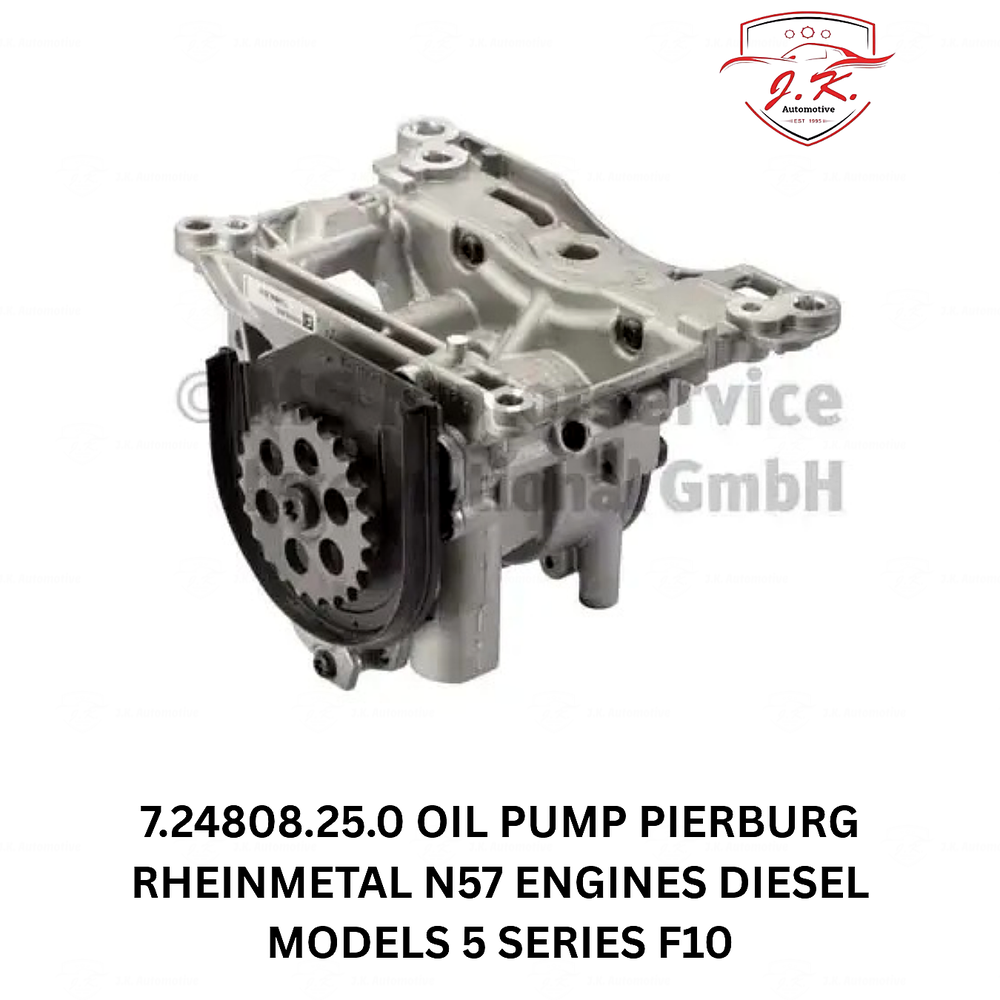
What is the Pierburg Rheinmetall Germany Vacuum/Oil Pump for BMW 5 Series (F10) N57 Diesel Engines – 7.24808.25.0?
The Pierburg Rheinmetall Germany Vacuum/Oil Pump for BMW 5 Series (F10) N57 Diesel Engines – 7.24808.25.0 is an engine-related replacement component listed for compatible BMW 5 Series (F10) vehicles equipped with N57 diesel engines. The supplied Pierburg manufacturer part number is 7.24808.25.0. This component is described as a vacuum/oil pump assembly associated with engine vacuum generation and oil-related functions. Its exact construction and operating responsibilities should be confirmed through the relevant Pierburg technical documentation. Diesel engines commonly require a dedicated vacuum source for certain vehicle systems. A vacuum pump produces pressure below atmospheric pressure to support compatible equipment. This negative pressure can be used by components that cannot rely on intake manifold vacuum alone. In applicable BMW configurations, the brake assistance system uses vacuum to reduce the driver's required braking effort. Certain engine-control actuators may also depend on a controlled vacuum supply. Reliable vacuum generation helps these connected systems operate according to their intended requirements. The BMW 5 Series (F10) is an executive sedan equipped with multiple coordinated engine-management and braking components. Its vacuum-operated equipment forms part of the wider vehicle system where applicable. Insufficient vacuum may interfere with connected components if the required negative pressure cannot be maintained. However, damaged hoses, leaking fittings and faulty check valves may cause similar problems. The oil-related responsibilities of this listed assembly require separate application-specific verification. Engine oil is essential for lubricating moving mechanical components. Proper lubrication reduces friction and helps protect internal engine surfaces from excessive wear. Engine oil also contributes to managing operating temperatures. However, the description vacuum/oil pump does not independently establish that this component supplies the entire engine lubrication circuit. Its precise oil-related duties should be confirmed using BMW and Pierburg manufacturer information. Pierburg Rheinmetall Germany is an established manufacturer of automotive pump and engine-management components. Its products are used in various vehicle applications. BMW 5 Series (F10) identifies the vehicle generation specified in this product listing. N57 identifies the diesel engine family stated in the title. Different engine configurations may require different pump specifications. Therefore, these designations alone do not guarantee compatibility with every BMW F10 diesel vehicle. The vehicle identification number can help establish the original factory specification. The existing pump's identification markings should be compared with the applicable Pierburg catalogue. The replacement assembly must match the original mounting arrangement and mechanical drive connection. Vacuum ports, hoses and relevant sealing surfaces should also correspond with the vehicle's existing installation. Any applicable oil passages must be checked carefully. Professional diagnosis is recommended before replacing the original component. The supplied number 7.24808.25.0 is a Pierburg manufacturer reference rather than an independently confirmed BMW original equipment number. Customers should verify their VIN, original pump reference and manufacturer application before purchasing through JK Automotive Online India.
What is the part number of the Pierburg Vacuum/Oil Pump for BMW 5 Series (F10) N57 diesel engines, and how can compatibility be confirmed?
The supplied Pierburg Rheinmetall Germany vacuum/oil pump part number is 7.24808.25.0. This reference identifies the replacement assembly listed for compatible BMW 5 Series (F10) N57 diesel engine applications. The complete manufacturer number should remain unchanged during catalogue searches, quotations and purchase enquiries. Every digit and punctuation mark is important for accurate product identification. This reference belongs to the Pierburg manufacturer numbering system. It should not automatically be treated as an original BMW part number. Any corresponding BMW OE cross-reference must be confirmed independently through reliable manufacturer catalogue information. The first step in verifying compatibility is identifying the exact BMW model and engine configuration. BMW 5 Series (F10) identifies the vehicle generation provided in the product listing. N57 identifies the stated diesel engine family. However, different factory configurations may have different pump requirements. The vehicle identification number provides useful information for identifying the original engine specification. A suitable BMW parts catalogue should then be consulted. The existing pump may have a stamped manufacturer number or identification label. This information should be compared with the applicable Pierburg application catalogue. The replacement pump's mounting points must match the original engine installation. Its mechanical drive connection must also correspond with the existing assembly. Vacuum outlet positions and hose connections should be checked. Relevant sealing surfaces must be compatible. Any applicable oil passages should also match the intended component arrangement. Similar-looking pump assemblies may have different internal specifications. Visual similarity alone cannot confirm interchangeability. Particular attention should be given to the distinction between Pierburg references 7.24808.25.0 and 7.24808.27.0. These are different supplied manufacturer numbers. The N57N-associated reference 7.24808.27.0 should not automatically be substituted for the N57-listed reference 7.24808.25.0. Any replacement or supersession relationship requires manufacturer confirmation. A qualified technician should inspect the original assembly when the identification is uncertain. The workshop should also diagnose the reported operating problem before ordering parts. Reduced vacuum may result from damaged hoses rather than internal pump failure. Oil leakage may originate from nearby engine components. Oil-pressure warnings can have causes elsewhere in the lubrication system. Appropriate testing helps distinguish these conditions. Customers should provide their vehicle VIN and existing pump reference when requesting fitment assistance. JK Automotive customers should verify the mechanical drive, mounting arrangement, vacuum connections and any applicable oil-related requirements before purchasing. Correct identification helps prevent incompatible purchases and unnecessary installation costs.
How does the Pierburg Rheinmetall Germany Vacuum/Oil Pump work in BMW 5 Series (F10) N57 diesel engines?
The Pierburg Rheinmetall Germany vacuum/oil pump listed under reference 7.24808.25.0 is associated with engine vacuum generation and oil-related functions in the specified BMW 5 Series (F10) N57 diesel application. Its precise mechanical construction should be confirmed through manufacturer documentation. A vacuum pump creates pressure below the surrounding atmospheric pressure. This negative-pressure difference can be used by connected vehicle equipment. Diesel engines commonly require a dedicated vacuum source for certain operating functions. A mechanically driven vacuum pump may use engine rotation to generate the required pressure difference. Vacuum is then delivered through suitable hoses, fittings and passages. In applicable configurations, the brake booster uses vacuum to reduce the driver's required pedal effort. Certain engine-control actuators may also operate using negative pressure. The exact connected components depend on the original vehicle configuration. Reliable vacuum generation supports the intended operation of these systems. If the pump cannot generate sufficient vacuum, connected components may not respond correctly. However, low vacuum does not automatically establish internal pump failure. Damaged hoses can allow unwanted air into the system. Faulty check valves may interfere with vacuum retention. Leaking connections may also reduce available negative pressure. The complete vacuum circuit should therefore be examined before replacing the pump. The oil-related functions of this particular assembly require separate technical verification. Oil-system components can move or manage lubricant through designated passages depending on their construction. Engine oil forms a protective film between moving mechanical surfaces. This film helps reduce friction and protect internal parts. Lubrication also contributes to transferring heat away from certain engine components. Nevertheless, the product title alone does not establish that Pierburg reference 7.24808.25.0 controls the entire engine oil-pressure circuit. The applicable BMW and Pierburg specifications should determine its actual oil-related responsibilities. Proper mechanical drive engagement is important for an engine-driven assembly. Internal mechanical wear may gradually reduce component effectiveness. Damaged seals can permit unwanted leakage. Contamination may also interfere with operation. Vacuum measurements can help establish whether the required negative pressure is available. Relevant oil-system testing may also be necessary where applicable. The existing component should be compared with the replacement specifications. Mounting surfaces, mechanical drive and connections must be compatible. Installation should follow the appropriate BMW workshop procedure. Connected systems should be tested after replacement. Customers should confirm the original pump number and vehicle VIN before purchasing from JK Automotive.
What are the common symptoms of a faulty vacuum/oil pump in BMW 5 Series (F10) N57 diesel engines?
A faulty vacuum/oil pump may produce symptoms involving connected vehicle systems in a BMW 5 Series (F10) N57 diesel engine. The exact symptoms depend on the assembly's verified functions and the nature of the failure. One possible concern is inadequate vacuum generation. In configurations using vacuum-assisted braking, insufficient vacuum can reduce the assistance provided by the brake booster. The brake pedal may feel unusually hard. The driver may need to apply greater force when braking. This is a safety-critical concern requiring immediate professional assessment. A vehicle with impaired brake assistance should not continue to be driven until the problem is resolved. However, a hard brake pedal does not automatically prove internal pump failure. Damaged vacuum hoses may cause similar behaviour. Faulty check valves and leaking connections may also affect available vacuum. Other brake-assistance components may require inspection. Certain engine-control actuators may also use vacuum depending on the BMW configuration. Insufficient negative pressure can interfere with their normal operation. Reduced engine responsiveness may sometimes occur. However, acceleration problems can have several unrelated causes. Turbocharger controls, airflow sensors and other engine-management components may need diagnosis. Oil leakage around the pump assembly may indicate a deteriorated seal or mounting concern. However, lubricant from nearby engine components may accumulate around the pump. The actual source should be identified before recommending replacement. Unusual mechanical noises may also justify inspection. Such noises are not specific evidence of internal pump failure. If the verified assembly performs an oil-pressure-related function, deterioration may affect that particular circuit. Any genuine low-engine-oil-pressure warning requires urgent attention. The driver should stop safely and switch off the engine according to BMW's warning instructions. Continued operation without adequate lubrication can cause severe mechanical damage. Normal oil level does not automatically guarantee sufficient oil pressure. A workshop may perform vacuum measurements to investigate the problem. Connected hoses and fittings should also be examined. Relevant oil-system tests may be required where applicable. Diagnostic trouble codes should be interpreted alongside physical testing. The supplied replacement reference is 7.24808.25.0. Its compatibility with the BMW 5 Series (F10) N57 application should be confirmed. Customers should avoid replacing the pump solely because of general engine symptoms. Professional diagnosis helps reduce unnecessary expenditure and additional mechanical problems. JK Automotive customers should provide their vehicle VIN and existing component reference before ordering.
How often should the Pierburg Rheinmetall Germany Vacuum/Oil Pump be replaced on a BMW 5 Series (F10) N57 diesel engine?
There is no universal replacement mileage that applies to every Pierburg vacuum/oil pump installed on a BMW 5 Series (F10) N57 diesel engine. Component service life depends on mechanical construction, operating conditions and general condition. Engine-driven pumps operate repeatedly while the engine runs. Their internal mechanical components may gradually experience wear. Seals can deteriorate with age and exposure to operating temperatures. Contamination may also affect component operation. However, the precise wear mechanisms depend on the manufacturer's pump design. The supplied manufacturer reference is 7.24808.25.0. Any prescribed maintenance or replacement interval should be confirmed using the relevant manufacturer documentation. A pump does not necessarily require replacement at a fixed mileage. Replacement is generally appropriate when a confirmed mechanical or functional defect exists. Inadequate vacuum generation may justify diagnostic inspection. Changes in brake assistance require immediate attention because driving safety may be affected. Oil leakage around the pump may also need investigation. However, lubricant can originate from surrounding components. A qualified technician should trace the source before recommending replacement. Vacuum hoses should be checked for damage or deterioration. Check valves and connected actuators may also require testing. Oil-pressure warnings should be investigated independently. A genuine low-oil-pressure warning should never automatically be blamed on this pump. Regular engine maintenance supports overall mechanical reliability. The correct oil grade and service intervals should follow BMW requirements. Maintenance records may help identify previous repairs and related faults. Demanding operating conditions can influence general mechanical wear. However, these conditions do not establish a fixed replacement interval for this assembly. When replacement is necessary, the original component number should be checked. The vehicle VIN can help determine the correct factory engine specification. The replacement mounting arrangement and mechanical drive must match the original. Professional installation is important for correct sealing and operation. Relevant gaskets, vacuum hoses and fittings should be inspected during replacement. Any specified lubrication or priming procedure must be followed where applicable. Vacuum generation should be checked after installation. Applicable oil-related functions should also be assessed according to the approved service procedure. Routine engine maintenance should continue after the repair. Customers should not replace the assembly simply because the vehicle has reached a particular mileage. JK Automotive customers should verify Pierburg reference 7.24808.25.0 and the exact BMW 5 Series (F10) N57 configuration before ordering.
Can a faulty Pierburg vacuum/oil pump affect brake assistance, engine performance and lubrication in BMW 5 Series (F10) N57 diesel engines?
A faulty vacuum/oil pump may affect connected systems in a BMW 5 Series (F10) N57 diesel engine, depending on the precise functions of the assembly. The supplied Pierburg manufacturer reference is 7.24808.25.0. Its technical responsibilities should be confirmed using appropriate manufacturer documentation. Vacuum generation is important for components that operate using negative pressure. In applicable vehicle configurations, the brake booster uses vacuum to reduce the physical effort needed at the brake pedal. If vacuum supply becomes insufficient, brake assistance may deteriorate. The driver may experience an unusually hard brake pedal. Greater force may be required during braking. This is a serious safety concern requiring immediate professional attention. A vehicle with impaired brake assistance should not continue to be driven. However, reduced vacuum at the brake booster does not automatically confirm pump failure. Damaged vacuum hoses can allow unwanted air into the system. Faulty check valves can interfere with vacuum retention. Loose fittings and leaking connections can also reduce available negative pressure. A qualified technician should therefore inspect the complete vacuum circuit. Certain engine-control actuators may also require vacuum, depending on the vehicle's configuration. If their supply becomes inadequate, their operation may be affected. Engine responsiveness may sometimes change under these circumstances. However, poor acceleration can have causes unrelated to the vacuum pump. Turbocharger control faults, sensor problems and other engine-management issues may require diagnosis. The oil-related functions of the listed assembly require separate technical verification. Engine oil is important for lubricating moving components and protecting them against excessive wear. Where this assembly performs a verified oil-system function, deterioration could affect that particular circuit. Nevertheless, the product title alone does not establish that reference 7.24808.25.0 supplies the entire engine lubrication system. Any genuine low-engine-oil-pressure warning must be treated as an urgent concern. The driver should stop safely and switch off the engine according to the manufacturer's warning instructions. Continued engine operation without sufficient lubrication can cause severe mechanical damage. Diagnostic testing may involve measuring vacuum at specified locations. Connected hoses, seals and fittings should also be inspected. Relevant oil-system measurements may be required where applicable. Repair decisions should follow diagnostic findings rather than assumptions. A compatible replacement can help restore intended operation when the original pump is confirmed defective. However, replacing it cannot correct unrelated engine or braking-system problems. Customers should verify the original component reference and vehicle VIN before ordering. Professional installation and appropriate post-repair testing are important. JK Automotive customers should confirm manufacturer compatibility before purchasing this replacement assembly.
How can I confirm that Pierburg Rheinmetall Germany Vacuum/Oil Pump 7.24808.25.0 fits my BMW 5 Series (F10) N57 diesel engine?
Confirming compatibility is essential before purchasing a Pierburg Rheinmetall Germany vacuum/oil pump for a BMW 5 Series (F10) N57 diesel engine. The supplied manufacturer part number is 7.24808.25.0. This complete reference should remain unchanged during catalogue searches, quotations and purchase enquiries. BMW 5 Series (F10) identifies the vehicle generation specified in the listing. N57 identifies the diesel engine family supplied in the title. However, these descriptions alone may not establish compatibility with every original equipment configuration. Different versions of the engine may require different components. The first step is to obtain the vehicle identification number. The VIN can help identify the original engine and equipment specification. A suitable BMW parts catalogue should then be consulted. The existing pump may carry stamped identification numbers or a manufacturer label. These markings should be compared with the applicable Pierburg application catalogue. Any corresponding BMW original equipment number must be independently confirmed. The supplied Pierburg reference should not automatically be described as a BMW OE number. The replacement pump's mounting arrangement must match the original engine installation. Its mechanical drive connection should also correspond with the existing assembly. Vacuum outlets and hose connections must be compatible. Relevant sealing surfaces should also match the original installation. Any applicable oil passages must be checked according to manufacturer requirements. Components that appear physically similar may have different internal specifications. Visual similarity alone cannot establish interchangeability. The N57 application should be distinguished from N57N listings. In particular, Pierburg references 7.24808.25.0 and 7.24808.27.0 are different supplied numbers. Their interchangeability should not be assumed without manufacturer confirmation. Any supersession relationship must also be verified through appropriate catalogue information. A qualified technician should establish the cause of the original problem before replacement. Insufficient vacuum may result from leaking hoses rather than internal pump failure. Oil leakage may originate from surrounding engine seals. Oil-pressure warnings may also have unrelated causes within the lubrication system. Diagnostic measurements can help identify these problems. Customers should provide the vehicle VIN and existing component reference when requesting assistance. Associated sealing rings, gaskets and mounting hardware may also need identification. The manufacturer application catalogue should determine the final component selection. JK Automotive customers should verify the complete mechanical and connection requirements before purchasing. Correct identification helps prevent unsuitable orders and unnecessary installation expenses.
What precautions should be taken when installing Pierburg Rheinmetall Germany Vacuum/Oil Pump 7.24808.25.0 on BMW 5 Series (F10) N57 diesel engines?
Installing a vacuum/oil pump on a BMW 5 Series (F10) N57 diesel engine requires accurate part identification and appropriate workshop procedures. The supplied Pierburg manufacturer reference is 7.24808.25.0. Before installation, the technician should verify the replacement against the original assembly. The mounting points must correspond with the intended engine configuration. The mechanical drive arrangement must also match the original component. Vacuum outlets and hose connections should be identified before disassembly. Any applicable oil-related passages should also be examined. The original fault should be diagnosed before replacing the pump. Insufficient vacuum may result from damaged hoses or leaking fittings. Faulty check valves and connected actuators may require separate attention. Oil leakage should be traced to its actual source. The engine should be allowed to cool before relevant service work begins. Appropriate tools and protective equipment should be used. The applicable BMW repair procedure should guide the replacement. Nearby wiring, vacuum hoses and fittings should be handled carefully. Mounting surfaces should be inspected for physical damage. Dirt and loose material must be prevented from entering exposed engine passages. Required gaskets and sealing rings should meet manufacturer specifications. Damaged or designated single-use seals should be replaced as instructed. Fasteners should be examined for wear or damage. Hardware requiring replacement should be changed according to BMW service instructions. Correct tightening procedures are important for preventing leaks and component damage. The pump should never be forced into an incompatible mounting position. Mechanical drive engagement must follow the approved installation procedure. Any specified lubrication or priming requirements should be completed where applicable. The correct preparation method depends on the component's verified construction. Vacuum hoses must be reconnected to their intended positions. Oil-related connections should also be secured correctly where present. Engine oil level should be checked if affected by the repair. After installation, the pump should be inspected for leakage. Vacuum generation should be measured where appropriate. Applicable oil-system operation should also be evaluated. The brake assistance system must be confirmed to function normally before the vehicle returns to service. Remaining warning messages or abnormal symptoms should be investigated separately. A controlled road test may be appropriate after all required safety checks have passed. The repair record should include Pierburg part number 7.24808.25.0. Professional installation helps reduce the risk of mechanical damage and unsafe vehicle operation.
Why should BMW 5 Series (F10) N57 diesel owners consider Pierburg Rheinmetall Germany Vacuum/Oil Pump 7.24808.25.0 for replacement?
Pierburg is an established manufacturer of automotive pump and engine-management components. Its products are used in different vehicle and engine applications. BMW 5 Series (F10) N57 diesel owners may consider a compatible Pierburg replacement when the original pump assembly requires replacement. The supplied manufacturer part number is 7.24808.25.0. The exact vehicle application must be verified before ordering. One reason customers consider Pierburg is the manufacturer's experience producing automotive mechanical components. Vacuum pumps must meet the technical requirements of their intended systems. Reliable negative pressure is important for connected vacuum-operated equipment. In applicable BMW configurations, the brake assistance system uses this vacuum supply. Certain engine-control actuators may also require negative pressure. The precise oil-related responsibilities of the listed assembly should be established through manufacturer technical information. Correct replacement selection is particularly important for mechanically driven engine components. A suitable pump can help restore intended operation when the original assembly is confirmed defective. However, replacing the pump cannot resolve every vacuum-related problem. Damaged hoses may require separate repair. Faulty check valves or connected actuators can also affect system performance. Oil leakage may originate from adjacent engine components. Proper diagnosis helps establish whether the pump requires replacement. Product authenticity is another important purchasing consideration. Customers should examine manufacturer markings and product documentation. The reference on the component should match the ordered item. Warranty coverage and supplier support should also be reviewed. The replacement mounting arrangement must correspond with the engine. Mechanical drive compatibility must be verified. Relevant seals and connections should also be suitable. The original pump reference provides useful identification information. The vehicle VIN can help establish the factory engine configuration. Professional installation is recommended because the component may serve important braking and engine-control systems. Associated vacuum hoses, gaskets and mounting seals should be inspected during replacement. Appropriate vacuum and oil-related system tests should be completed after installation where applicable. Customers should not expect guaranteed improvements in engine power or fuel efficiency simply from fitting a new pump. The main objective is to restore the intended operation of a confirmed defective component. Pierburg reference 7.24808.25.0 should be checked against reliable application information. JK Automotive lists this component for compatible BMW 5 Series (F10) N57 diesel engine applications. Customers should confirm their existing pump number and diagnosed repair requirements before purchasing. Correct fitment and professional installation remain essential.
Is Pierburg Rheinmetall Germany better than other vacuum/oil pump brands for BMW 5 Series (F10) N57 diesel engines when comparing quality, reliability and compatibility?
Pierburg Rheinmetall Germany is an established manufacturer of automotive pump and engine-management components. Other manufacturers also produce vacuum pumps and related replacement engine parts. Choosing between manufacturers requires comparing specific components rather than relying solely on brand reputation. The supplied Pierburg reference for this BMW 5 Series (F10) N57 diesel listing is 7.24808.25.0. Its compatibility must first be confirmed for the intended vehicle. Pump assemblies can differ in internal design and operating characteristics. Their mechanical drive arrangements must match the original engine installation. Mounting points and sealing surfaces are equally important. Vacuum ports and connected hoses must correspond with the vehicle's requirements. Any applicable oil passages must also match the original arrangement. A pump that appears physically similar may have different technical specifications. Manufacturer application information should therefore guide component comparisons. Pierburg has experience manufacturing automotive pump components. However, this does not establish that every Pierburg product is superior to every competing alternative. Other reputable manufacturers may also offer suitable replacement pumps for certain BMW applications. A meaningful comparison requires identifying the exact competing manufacturer part number. That reference should be checked against the same original BMW component. Reliability depends on construction quality, operating conditions and maintenance. Correct installation also contributes to dependable operation. Damaged seals can affect the performance of a new pump. Contamination or incorrect mechanical drive engagement may create further problems. Leaks elsewhere in the vacuum circuit can produce symptoms regardless of pump manufacturer. The underlying fault should therefore be diagnosed before ordering replacement components. Product authenticity is another important consideration. Customers should compare manufacturer markings and supplier documentation. Warranty coverage and technical support should also be reviewed. Price and availability may influence the purchasing decision once technical compatibility has been established. A lower-priced component is not necessarily better value if its specifications are incorrect. A higher price does not automatically establish better durability. Reliable service-life comparisons require suitable application-specific evidence. Without such evidence, universal brand superiority claims cannot be justified. The original pump reference and vehicle VIN should guide the final selection. Pierburg number 7.24808.25.0 must be checked against authoritative manufacturer application data. The N57N-associated reference 7.24808.27.0 should not automatically be treated as an interchangeable alternative. Professional installation remains important regardless of the selected manufacturer. Connected vacuum and applicable oil-related systems should be tested after replacement. Pierburg can be an appropriate choice when the application is confirmed. Competing products may also be suitable when their specifications are verified. The final purchasing decision should prioritise technical compatibility, product authenticity, warranty support and correct installation.
Reviews
There are no reviews yet.