What is the Pierburg Rheinmetall Germany Oil Pump 7.07919.21.0 for Mercedes-Benz B-Class (W246) OM651 diesel engines?
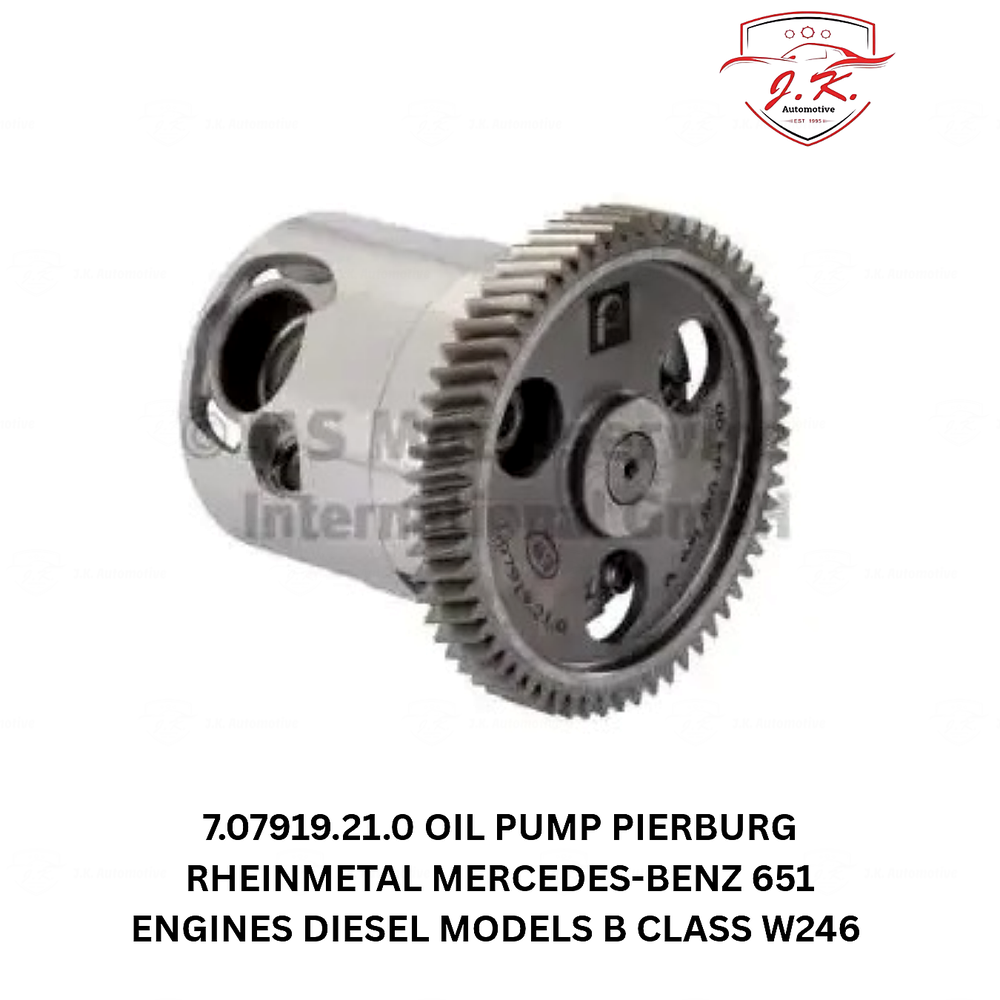
The Pierburg Rheinmetall Germany Oil Pump 7.07919.21.0 is an engine lubrication component designed for compatible Mercedes-Benz diesel engines, including selected B-Class (W246) models equipped with the OM651 engine family. Its main function is to circulate engine oil through the internal lubrication system. Engine oil forms a protective film between moving metal components and helps reduce friction, heat and mechanical wear. The crankshaft bearings, connecting rod bearings, camshaft components and other moving parts depend on adequate lubrication. The turbocharger also requires a reliable oil supply because its rotating assembly operates at very high speeds. The oil pump draws lubricant from the engine sump through the appropriate pickup arrangement and supplies the engine's oil passages. Engine oil then moves through the filtration and lubrication circuit before returning to the sump. This process continues whenever the engine operates. Pierburg 7.07919.21.0 is identified as a variable-displacement oil pump. This means its pumping displacement can vary according to the requirements of the original lubrication-system design. The arrangement can help reduce unnecessary pumping work under certain operating conditions. It does not mean that the engine always operates at one constant oil pressure. Actual oil pressure depends on engine speed, oil temperature, internal clearances and the system's control arrangement. Selected B-Class W246 applications include B 180 CDI, B 200 CDI and B 220 CDI vehicles equipped with OM651 engines. Some OM651 versions have a displacement of 1,796 cc, while others have a displacement of 2,143 cc. These differences make accurate component identification important. The vehicle model name alone cannot guarantee that a particular oil pump will fit. The original Mercedes-Benz equipment number should be checked before ordering. Published comparison references include A6511800400, A6511801301 and A6511801400, along with additional documented numbers. The vehicle VIN can help identify the correct original component. Oil-pressure problems must be diagnosed promptly because inadequate lubrication can damage expensive engine components. However, low oil pressure does not automatically prove that the pump has failed. Incorrect oil, a restricted pickup, internal engine wear or a faulty pressure sensor can create related problems. A qualified technician should establish the actual cause before replacing the pump. When properly matched and installed, Pierburg 7.07919.21.0 can help restore the engine's intended lubrication function. Its purpose is to protect normal mechanical operation rather than increase the manufacturer's rated engine horsepower.
Which Mercedes-Benz B-Class (W246) OM651 diesel variants are compatible with Pierburg Oil Pump 7.07919.21.0?
Pierburg Oil Pump 7.07919.21.0 is catalogued for selected Mercedes-Benz B-Class (W246) vehicles equipped with the OM651 diesel engine family. Relevant applications include certain B 180 CDI, B 200 CDI, B 200 d, B 220 CDI and B 220 d configurations. Some 4MATIC applications also appear in parts catalogues. The W246 range includes OM651.901 and OM651.930 engine versions. These engines are both four-cylinder turbocharged diesels, but their displacements are not identical. The OM651.901 is used in certain 1,796 cc applications. Relevant B 180 CDI versions are listed with approximately 109 horsepower. Some B 200 CDI vehicles with OM651.901 engines produce approximately 136 horsepower. Other B 200 CDI/d versions use the 2,143 cc OM651.930 engine. Selected B 220 CDI/d versions also use OM651.930. Depending on the specific version, power outputs can include approximately 163 hp, 170 hp or 177 hp. However, the model badge or horsepower alone is not sufficient to guarantee oil pump compatibility. Mercedes-Benz may specify different components according to the production configuration and engine variant. The original pump number should therefore be identified through VIN-based parts information. Pierburg 7.07919.21.0 has published OE comparisons including A6511800400, A6511801301, A6511801400, A6511802601 and A6511802801. The applicable reference must be checked against the original equipment specified for the vehicle. If the existing pump carries another number, any approved supersession should be verified. Similar-looking oil pumps must not automatically be considered interchangeable. The mechanical drive, mounting arrangement and lubrication passages must correspond to the original engine specification. The B-Class W246 was also offered with diesel engines outside the OM651 family. In particular, certain B 180 CDI/d applications use OM607 engines. Those vehicles must not automatically be included in an OM651-specific listing. Petrol-powered B-Class versions also require separate engine-specific components. Customers can provide JK Automotive with the full VIN, engine code and original oil pump reference for compatibility verification. A qualified technician should also establish whether the oil pump itself requires replacement. Once the original equipment requirements match Pierburg 7.07919.21.0, it can be considered for the relevant B-Class diesel application. Accurate identification helps avoid incorrect purchases and potentially expensive engine repair complications.
How does the Pierburg variable-displacement Oil Pump 7.07919.21.0 work in Mercedes-Benz B-Class W246 OM651 diesel engines?
Pierburg Oil Pump 7.07919.21.0 operates within the engine lubrication system of compatible Mercedes-Benz B-Class W246 OM651 diesel engines. Its main purpose is to move engine oil to the components that require continuous lubrication. The pump receives lubricant from the sump through the appropriate pickup system. It then supplies the engine's lubrication passages according to the original mechanical and control design. Engine oil passes through the filtration system to help remove contaminants. The circulating oil reaches critical components including crankshaft bearings, connecting rod bearings and camshaft mechanisms. Lubrication helps maintain a protective film between surfaces that move against one another. The turbocharger also depends on clean oil for its internal rotating components. Pierburg 7.07919.21.0 is identified as a variable-displacement pump. Unlike a simple fixed-displacement design, a variable-displacement pump can change the amount of oil displaced during operation. This allows the lubrication system to respond to different engine operating requirements. It may reduce unnecessary pumping effort under certain conditions. The actual control method must correspond to the installed OM651 engine configuration. Oil pressure is influenced by more than pump displacement alone. Engine speed, oil viscosity, temperature and internal bearing clearances also affect lubrication pressure. Cold engine oil behaves differently from oil at normal operating temperature. When the engine starts, the lubrication system must establish suitable oil pressure. As the engine warms up and operating conditions change, adequate oil delivery must continue. A worn or damaged pump may fail to supply the required flow. A restricted oil pickup can also prevent correct delivery even when the pump itself is mechanically functional. Incorrect oil or a damaged oil filter may contribute to lubrication problems. Excessively worn engine bearings can also lead to reduced oil pressure. A malfunctioning pressure sensor may trigger a warning without confirming actual mechanical pressure loss. A technician should therefore measure oil pressure using the manufacturer's specified procedure before recommending pump replacement. If the pump is confirmed defective, the correct original equipment reference must be identified. Pierburg 7.07919.21.0 is a documented replacement option for selected W246 OM651 applications. Correct fitting, proper oil-system preparation and post-repair pressure verification are essential. These steps help ensure the engine receives the lubrication it requires for normal operation.
What are the symptoms of a faulty oil pump in a Mercedes-Benz B-Class (W246) OM651 diesel engine?
A faulty engine oil pump in a Mercedes-Benz B-Class (W246) OM651 diesel engine can produce serious lubrication-related symptoms. One of the most important signs is a red engine oil-pressure warning on the dashboard. This warning must be treated as urgent because insufficient lubrication can rapidly damage internal engine components. The driver should stop the vehicle safely and switch off the engine. Driving should not continue until the cause has been investigated. The oil pump supplies lubricant to critical components such as crankshaft bearings, connecting rod bearings and camshaft mechanisms. When oil delivery is inadequate, the protective film between moving metal surfaces may become insufficient. This can increase mechanical friction and wear. Unusual knocking, tapping or rattling sounds may develop in more serious cases. However, abnormal engine noises can also have unrelated causes. Insufficient lubrication can damage bearing surfaces. The turbocharger can also be affected when its oil supply becomes inadequate. In extreme situations, prolonged oil starvation can result in major engine failure. Some lubrication problems may be detected when a technician measures oil pressure below the manufacturer's specified limits. This is an important diagnostic finding, but it does not automatically establish that the pump itself is faulty. Insufficient engine oil quantity can cause pressure problems. Incorrect viscosity or degraded lubricant can also influence the system. A blocked oil pickup may restrict flow. A damaged oil filter or an issue with its installation may contribute to the complaint. Internal engine wear can create excessive oil leakage through bearing clearances. A faulty pressure sensor may produce an incorrect warning. These possible causes should be distinguished through proper diagnosis. A technician should inspect the oil level, specification and condition. Actual oil pressure should then be measured under the appropriate operating conditions using suitable equipment. The pickup, pump drive and related control arrangement may require further inspection. If the pump is confirmed defective, Pierburg 7.07919.21.0 may be suitable for a verified matching OM651 vehicle. Any damage caused by the original lubrication failure must also be assessed. Replacing the oil pump cannot reverse existing bearing or turbocharger damage. Prompt diagnosis is essential to minimize the risk of further engine damage.
When should Pierburg Oil Pump 7.07919.21.0 be replaced in a Mercedes-Benz B-Class W246 OM651 diesel engine?
Pierburg Oil Pump 7.07919.21.0 should be considered for replacement when diagnostic testing confirms that the original oil pump in a compatible Mercedes-Benz B-Class W246 OM651 diesel engine is defective. The oil pump is not normally replaced during every routine oil service. There is no universal fixed mileage interval requiring this particular pump to be changed on every B-Class diesel vehicle. The component is designed to operate as part of the engine's lubrication system over an extended service life. However, mechanical wear, contamination and damage can affect its performance. A pump that cannot provide the required lubrication delivery may need replacement. A red engine oil-pressure warning requires urgent attention. If it occurs while driving, the vehicle should be stopped safely and the engine switched off. Continuing to operate an engine with inadequate lubrication can cause serious mechanical damage. Before recommending a new pump, a technician should check the engine oil level and condition. The correct oil specification should also be verified. A damaged filter or restricted oil pickup can create problems resembling pump failure. Actual oil pressure should be measured according to the appropriate Mercedes-Benz procedure. The result should be evaluated at the specified engine speed and oil temperature. A faulty pressure sensor should be distinguished from genuine low mechanical oil pressure. Internal bearing wear can also reduce pressure even when the pump is operational. If the pump is confirmed defective, the lubrication system should be checked for contamination and debris. Any related mechanical damage should be evaluated before reassembly. The replacement must correspond to the original Mercedes-Benz OE requirement. Pierburg 7.07919.21.0 has several published OE comparison references that can assist identification. The vehicle VIN should be used to establish the correct application. Professional installation must follow the appropriate OM651 workshop procedure. The lubrication system should be prepared for initial startup according to the manufacturer's instructions. Oil pressure and the absence of leaks should be verified before returning the engine to service. Replacing a genuinely defective pump promptly can prevent further damage, but any existing damage or underlying cause of the lubrication failure must also be addressed.
How can a faulty Pierburg Oil Pump 7.07919.21.0 affect oil pressure, performance and engine life in a Mercedes-Benz B-Class OM651 diesel?
A faulty oil pump can seriously affect the reliability and service life of a Mercedes-Benz B-Class (W246) equipped with an OM651 diesel engine. The lubrication system depends on sufficient oil circulation to protect moving components. Engine oil forms a film that separates metal surfaces under normal operating conditions. This helps limit friction, heat and mechanical wear. The crankshaft bearings depend on a reliable supply of lubricant. Connecting rod bearings also require adequate oil pressure and flow. Camshaft mechanisms and other moving engine components must receive sufficient lubrication. The turbocharger requires clean oil because its rotating assembly operates at very high speeds. When the oil pump cannot deliver the required amount of lubricant, these components may become vulnerable to damage. The protective oil film may become inadequate. Metal-to-metal contact can increase mechanical wear. Local temperatures can rise as friction increases. Unusual engine knocking or tapping may develop if lubrication becomes seriously insufficient. However, these noises may have other causes and should not be attributed to the pump without diagnosis. A genuine loss of oil pressure can lead to bearing damage and turbocharger failure. Severe oil starvation may result in major engine damage or seizure. A red oil-pressure warning should therefore be treated as an urgent condition. The engine should be switched off after stopping safely. Continued driving can turn a repairable lubrication problem into a much more expensive failure. A defective oil pump may not produce an obvious loss of acceleration before damage occurs. This is why pressure warnings and mechanical measurements are more useful than driving performance alone. However, an oil-pressure problem does not automatically establish that the oil pump has failed. Incorrect engine oil, insufficient oil quantity or a blocked pickup can affect lubrication. Internal bearing wear can reduce pressure. A faulty pressure sensor can also produce misleading warnings. A qualified technician should measure actual pressure using the specified test procedure. If the pump is confirmed defective, a correct replacement may restore normal lubrication delivery. Pierburg 7.07919.21.0 is catalogued for selected B-Class W246 OM651 applications. The VIN and original Mercedes-Benz OE reference must be verified before purchase. Any engine damage already caused by oil starvation should also be assessed because replacement of the pump alone cannot repair it.
How can I verify Pierburg Oil Pump 7.07919.21.0 compatibility using the VIN and OEM number of my Mercedes-Benz B-Class (W246)?
The most reliable method of verifying an oil pump for a Mercedes-Benz B-Class (W246) is to identify the correct original equipment number using the vehicle VIN. The VIN is the vehicle's unique identification number. It allows a Mercedes-Benz workshop or qualified parts specialist to retrieve the vehicle's original engine and parts configuration. This is particularly important because the W246 was offered with different diesel engine families. Certain B 180 CDI, B 200 CDI and B 220 CDI versions use OM651 engines. The OM651.901 engine is associated with selected 1,796 cc configurations. The OM651.930 engine is associated with selected 2,143 cc configurations. These engines share a family designation but should not automatically be treated as identical in every component detail. Other W246 diesel versions use different engine families, including OM607. The exact engine designation and production configuration should therefore be established first. The original oil pump number should then be obtained from reliable Mercedes-Benz parts information. Pierburg 7.07919.21.0 has published OE comparison references including A6511800400, A6511801301 and A6511801400. Additional documented references include A6511802601 and A6511802801. These numbers help identify whether the replacement corresponds to the original equipment requirement. However, not every reference necessarily applies to every OM651 configuration. If the existing pump carries a different number, any replacement or supersession relationship must be confirmed. An oil pump should not be selected simply because its housing looks similar. Its mounting points must correspond to the engine block. The mechanical drive and oil passages must also match the original installation. The relevant variable-displacement arrangement must be compatible with the engine's lubrication system. An incorrect pump can lead to inadequate oil supply and serious engine damage. Customers should provide JK Automotive with the complete VIN, engine code and original pump reference when available. A photograph showing the original part number may also assist identification. The technician should separately confirm that the oil pump actually requires replacement. Once the original equipment specification matches Pierburg 7.07919.21.0, the replacement can be considered for the vehicle. Accurate identification helps avoid unnecessary returns, installation delays and potentially expensive engine damage.
What precautions should be followed when installing Pierburg Oil Pump 7.07919.21.0 in a Mercedes-Benz B-Class W246 OM651 diesel engine?
Installation of Pierburg Oil Pump 7.07919.21.0 in a compatible Mercedes-Benz B-Class W246 OM651 engine requires careful preparation because the pump is essential to engine lubrication. The technician should first verify that the replacement corresponds to the original Mercedes-Benz equipment number. The vehicle VIN, engine code and production configuration must be checked. The engine should be switched off and allowed to cool before work begins. The vehicle should be supported safely using appropriate workshop equipment. Access to the pump may require substantial engine disassembly, depending on the engine and vehicle configuration. The correct Mercedes-Benz workshop procedure should be followed rather than a generic oil pump replacement guide. Engine oil should be drained and handled according to the repair instructions. The technician must prevent dirt, old sealing material and other contaminants from entering the lubrication passages. The original pump should be inspected for mechanical wear or visible damage. Its drive mechanism should also be checked. The oil pickup and strainer may require inspection for blockages. Contamination found in the lubrication system may indicate damage elsewhere in the engine. This should be investigated before the new pump is installed. The engine block's mounting surfaces should be checked for damage. Suitable sealing materials and the specified fasteners must be used. The replacement must be positioned correctly. Fasteners should be tightened according to the manufacturer's required sequence and torque specifications. The variable-displacement mechanism and related control arrangement must correspond to the original engine design. Incorrect installation can result in inadequate oil supply. The lubrication system should be prepared for initial startup according to the specified procedure. Any required priming or pre-lubrication steps must be carried out. The correct engine oil specification and suitable filter should be used. Before the engine is returned to normal operation, the technician must verify that oil pressure develops correctly. If the specified pressure is not achieved, the engine should be shut down immediately. The completed repair should be inspected for leaks and abnormal mechanical noises. Oil pressure should be checked under the specified test conditions. Any related diagnostic faults should also be investigated. Professional installation is strongly recommended because errors involving the oil pump may result in major engine damage.
Why should customers consider Pierburg Rheinmetall Germany Oil Pump 7.07919.21.0 for Mercedes-Benz B-Class (W246) OM651 diesel engines?
Pierburg Rheinmetall Germany is an established automotive component manufacturer associated with engine technology and replacement components. Pierburg 7.07919.21.0 is a specifically identified variable-displacement engine oil pump. Its manufacturer reference helps technicians compare the product with original Mercedes-Benz equipment requirements. This is particularly important for the B-Class W246 because the OM651 engine family includes several configurations. Selected B 180 CDI, B 200 CDI and B 220 CDI vehicles are catalogued for this pump. The product's function is to circulate engine oil to components requiring lubrication. These include crankshaft bearings, connecting rod bearings, camshaft mechanisms and other moving engine parts. The turbocharger also requires an adequate oil supply. Correct lubrication helps reduce friction and mechanical wear. If the original pump is defective, a suitable replacement can help restore the intended oil supply. However, choosing an established brand does not eliminate the need for vehicle compatibility verification. The original Mercedes-Benz OE number should be checked. Pierburg 7.07919.21.0 has comparison references including A6511800400, A6511801301, A6511801400, A6511802601 and A6511802801. These references help identify matching applications when used alongside the VIN. Customers should verify the part number marked on the delivered product. The component and packaging should be inspected for visible damage. The pump must be protected from dirt and contamination before installation. A qualified technician should confirm that the oil pump is actually defective. Low oil pressure may result from an incorrect lubricant, insufficient oil quantity or restricted pickup. Internal engine wear can also cause inadequate pressure. A faulty sensor may create a warning without mechanical pump failure. Replacing the pump without diagnosing these conditions may leave the original problem unresolved. The technician should inspect for possible damage caused by previous oil starvation. Professional installation should follow the correct Mercedes-Benz engine procedure. Oil pressure must be verified after fitting. JK Automotive customers can supply their VIN and original pump number for fitment identification. For a confirmed compatible B-Class W246 OM651 vehicle, Pierburg 7.07919.21.0 is a documented replacement option. Its benefit lies in accurate fitment and restoration of the lubrication system rather than unsupported promises of additional engine power.
Why is Pierburg considered a suitable oil pump brand for Mercedes-Benz B-Class (W246) OM651 diesel engines compared with INA, Febi Bilstein and other replacement manufacturers?
Pierburg Rheinmetall, INA, Febi Bilstein and other automotive parts suppliers offer components for different vehicle and engine applications. When comparing oil pumps for a Mercedes-Benz B-Class (W246) OM651 diesel engine, exact technical compatibility should be the first consideration. Pierburg 7.07919.21.0 is a specific variable-displacement oil pump associated with published original equipment comparison references. It is catalogued for selected W246 vehicles equipped with OM651 engines. These details make it possible to verify whether the pump corresponds to the original engine design. However, an oil pump offered by another supplier should not automatically be treated as interchangeable simply because it is advertised for Mercedes-Benz diesel engines. Different pumps can have different mechanical drive arrangements. Their mounting surfaces, lubrication passages and control mechanisms may also vary. The pump must deliver oil according to the engine's original lubrication requirements. The original Mercedes-Benz OE reference should therefore be identified before comparing brands. Pierburg 7.07919.21.0 has documented comparisons including A6511800400 and A6511801301. Other published references should also be evaluated against the individual engine specification. An alternative sold under INA, Febi Bilstein or another manufacturer's name should only be selected when its exact product number is confirmed for the same original equipment application. General brand recognition is not sufficient to establish fitment. Once the technical requirements match, customers may compare warranty conditions, product documentation and availability. Product authenticity should also be considered. An incorrectly specified pump can cause inadequate lubrication and serious engine damage. A lower price is not a good reason to purchase an incompatible component. A higher price does not automatically guarantee better reliability or longer service life. There is no reliable basis for claiming that Pierburg is universally superior to every competing oil pump supplier. The correct choice depends on confirmed specifications and the customer's repair requirements. The original oil-pressure fault should also be diagnosed before ordering any replacement. Problems with oil level, filters, pickup restrictions or worn bearings may require separate repairs. Customers can provide JK Automotive with the vehicle VIN and original pump reference for accurate identification. Once compatibility is established, Pierburg 7.07919.21.0 is a relevant replacement option. Professional installation, correct oil preparation and verification of pressure are more important than unsupported claims of brand superiority. The objective is to protect the engine by restoring the lubrication system's intended operation.


Reviews
There are no reviews yet.