What is the Pierburg Rheinmetall Germany EGR Valve 7.10334.33.0 for Porsche Panamera (970) 3.0 Diesel engines?
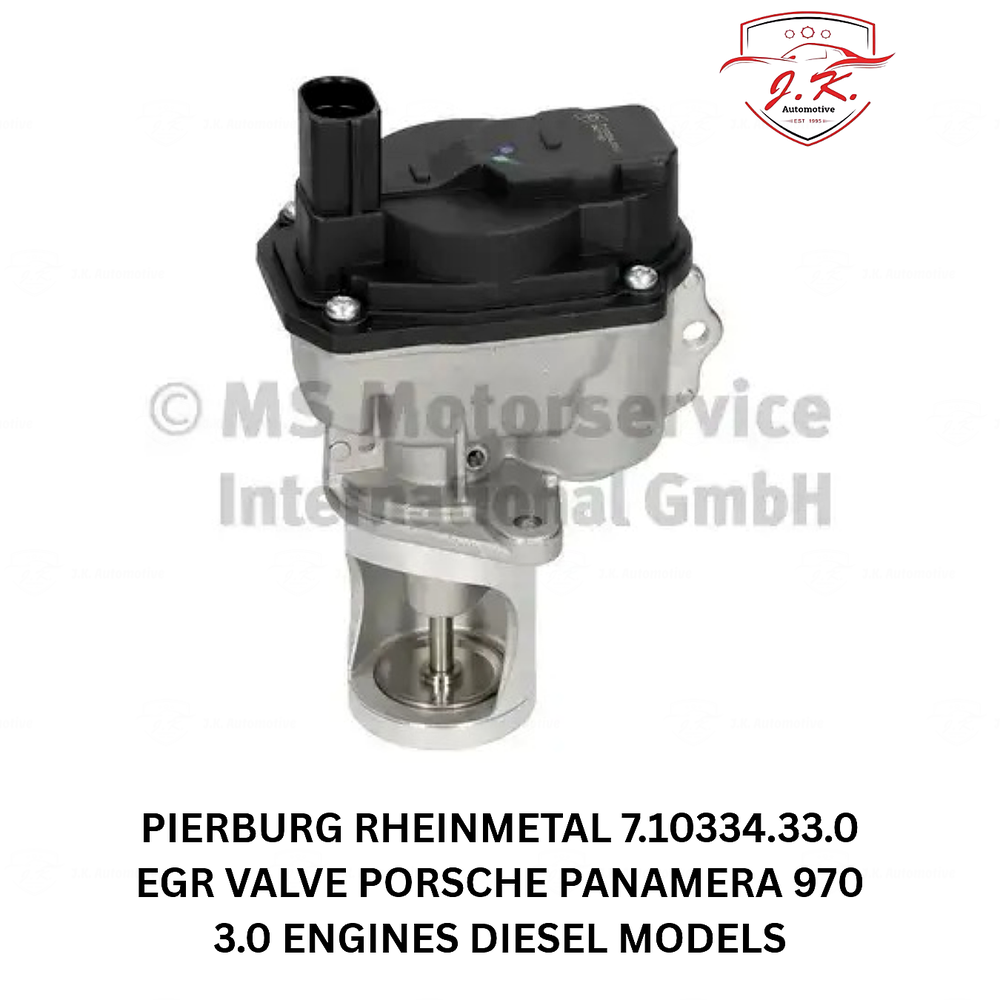
The Pierburg Rheinmetall Germany EGR Valve 7.10334.33.0 is an electrically operated exhaust gas recirculation control valve designed for selected Porsche Panamera (970) vehicles equipped with 3.0-litre V6 diesel engines. EGR stands for Exhaust Gas Recirculation, which is an emissions-control system used in modern diesel engines. The main function of an EGR valve is to regulate how much exhaust gas returns to the engine intake under certain operating conditions. Recirculated exhaust gas helps moderate combustion temperatures and reduce the formation of nitrogen oxides. The Porsche Panamera diesel engine uses electronic engine management to coordinate fuel injection, intake airflow, turbocharger operation and emissions-control functions. The EGR valve operates as part of this connected system. When the engine management unit requests exhaust gas recirculation, the valve adjusts the passage available for exhaust gas flow. This allows the engine to manage the relationship between fresh intake air and recirculated exhaust gases. The required amount of recirculation changes according to engine speed, operating temperature, load and other conditions. An EGR valve does not remain fully open throughout normal driving. Instead, it operates according to commands from the engine control system. Pierburg part number 7.10334.33.0 uses electric operation and is specified for a 12V electrical system. It is also catalogued with a sealing gasket. Selected Panamera 3.0 Diesel applications include engine codes MCR.CB, MCR.CC and MCW.JA. These engine versions have different power outputs, so the exact vehicle application must be checked carefully. An EGR valve that becomes stuck open or closed can interfere with the engine's intended emissions-control operation. Possible symptoms include engine warning lights, hesitation, irregular engine response and stored diagnostic fault codes. However, similar symptoms may also be caused by sensors, electrical connections or other engine-management components. Diagnosis should therefore establish the actual fault before replacement. The manufacturer part number is important because different EGR valve designs may appear similar without being interchangeable. Porsche OE reference numbers should be compared with the original component. Customers should also check the vehicle VIN and engine code. When the replacement is correctly specified and professionally installed, it can help restore the engine's original exhaust gas recirculation function. This component is intended for correct maintenance and repair, not as an engine performance upgrade.
Which Porsche Panamera (970) 3.0 Diesel engine variants are compatible with Pierburg EGR Valve 7.10334.33.0?
Pierburg EGR Valve 7.10334.33.0 is listed for selected Porsche Panamera (970) vehicles equipped with 3.0-litre V6 diesel engines. Relevant application catalogues identify several engine variants within the first-generation Panamera diesel range. One application is the Panamera 3.0 D with engine code MCR.CB, rated at 155 kW or approximately 211 horsepower. Another is the Panamera 3.0 D with engine code MCR.CC, rated at 184 kW or approximately 250 horsepower. A later listed application uses engine code MCW.JA and produces 221 kW or approximately 300 horsepower. These engines have a displacement of 2,967 cc. The first two applications appear in catalogue periods from August 2011 to July 2013. The 300 hp application is listed from July 2013 to October 2016. These periods are manufacturer-catalogue application ranges rather than evidence that every Panamera within the dates uses the same valve. Porsche may specify parts according to engine number, production date, equipment level or emissions configuration. For this reason, the original EGR reference should be checked before ordering. Pierburg 7.10334.33.0 has several published Porsche OE comparison numbers. These include 958 111 051 10, 958 111 051 11 and 958 111 051 30. Other Porsche references appearing in catalogues include PAB 131 503 and PAB 131 503 B. The buyer should use the VIN to establish which original number applies to the vehicle. If a different number is fitted, its replacement relationship should be checked through reliable Porsche parts information. The electrical connector and mounting arrangement must also match the existing installation. The presence of a 3.0-litre diesel engine is not sufficient proof on its own. A Panamera petrol engine or hybrid model should not be assumed compatible with this diesel EGR control valve. Similarly, the valve should not automatically be applied to later Panamera generations. The customer should distinguish the EGR valve from the EGR cooler or bypass controls, because these are different components. A diagnostic inspection should establish which part requires replacement. Buyers can provide their VIN, engine code and original EGR number to JK Automotive for fitment verification. Once these details match the published application, Pierburg 7.10334.33.0 can be considered an appropriate replacement for the selected Panamera diesel vehicle.
How does Pierburg EGR Valve 7.10334.33.0 work in the Porsche Panamera (970) 3.0-litre V6 diesel engine?
The Pierburg EGR Valve 7.10334.33.0 works by regulating the flow of exhaust gas returning to the intake system of compatible Porsche Panamera 3.0-litre V6 diesel engines. Diesel combustion produces the power required to move the vehicle, but it also generates different exhaust emissions. One group of emissions is nitrogen oxides, which can form in larger quantities under high combustion temperatures. The EGR system helps reduce nitrogen oxide formation by allowing a controlled amount of exhaust gas to mix with the intake air. Because exhaust gas contains less oxygen than fresh air, recirculation changes the combustion conditions inside the engine. The engine control unit determines the required EGR activity based on operating conditions. These conditions can include engine speed, load, coolant temperature and intake-air measurements. The control unit sends an electrical command to the EGR valve. The valve's actuator then adjusts the gas-flow opening according to the requested operation. The system may demand different valve positions during light-load driving, acceleration and engine warm-up. This means the valve must respond accurately rather than simply remain open or closed. In the Panamera diesel engine, the EGR system works with other intake and exhaust components. These can include the turbocharger, relevant sensors, exhaust passages and emissions aftertreatment equipment. An EGR cooler may also be involved in reducing the temperature of recirculated exhaust gas. The exact configuration should be established using vehicle-specific technical information. If the valve becomes restricted by deposits, the actual flow may differ from the commanded flow. A failing electrical actuator can also produce incorrect operation. A valve stuck open may allow excessive exhaust gas into the intake during unsuitable operating conditions. This may affect combustion stability or engine response. A valve stuck closed can prevent the expected amount of exhaust gas recirculation. This may contribute to emissions-related diagnostic faults. The engine control unit may detect inconsistencies through relevant sensor measurements. Diagnostic equipment can help technicians investigate these differences. However, a diagnostic fault code does not always identify the failed component by itself. Wiring, sensors and blocked passages may require separate inspection. Pierburg 7.10334.33.0 should be installed only when the original OE reference and vehicle application are confirmed. Correct valve operation supports the manufacturer's emissions-control strategy rather than increasing the engine's rated horsepower.
What are the symptoms of a faulty EGR Valve in a Porsche Panamera (970) 3.0 Diesel engine?
A faulty EGR valve in a Porsche Panamera (970) 3.0 Diesel engine can cause several symptoms involving vehicle performance, engine response and emissions-control operation. One common sign is the illumination of the engine warning light. The engine control unit may record fault codes when EGR flow or valve operation differs from expected values. A driver may notice hesitation when accelerating. Reduced engine response can occur if the quantity of recirculated exhaust gas is not being controlled correctly. Some vehicles may experience rough or unstable idling. An EGR valve that remains open at an unsuitable time can allow too much exhaust gas into the intake. This may reduce the proportion of fresh air available for combustion. In more severe conditions, the engine management system may limit available engine power. The driver may describe this as reduced-power mode or limp mode. A valve that fails to open when requested may result in emissions-related faults. Some faults may occur intermittently and disappear temporarily after the engine is restarted. However, an intermittent symptom does not mean the fault has been repaired. Carbon deposits can interfere with valve movement over time. Electrical problems can also prevent the valve from responding to the engine management system. Damaged wiring, corroded connectors or poor electrical connections may create similar problems. Increased fuel consumption may sometimes be noticed, but it is not a reliable standalone indicator of EGR valve failure. Black exhaust smoke can also occur under certain engine fault conditions. However, turbocharger faults, injector problems, intake leaks and other restrictions may produce similar smoke-related symptoms. Therefore, symptoms alone should not determine whether a new valve is required. A qualified technician should inspect the vehicle using suitable Porsche-compatible diagnostic equipment. Stored trouble codes should be evaluated alongside relevant engine operating data. The technician may need to test the actuator and inspect connected passages. The EGR cooler and other associated components may also require examination. If the EGR valve is confirmed defective, the correct replacement should be selected by part number. Pierburg 7.10334.33.0 is catalogued for selected Panamera 970 diesel configurations. The VIN and Porsche OE reference should be confirmed before purchase. Replacing the actual failed component can help restore normal operation, but fitting a new EGR valve will not correct unrelated faults.
When should Pierburg EGR Valve 7.10334.33.0 be replaced in a Porsche Panamera (970) 3.0 Diesel engine?
Pierburg EGR Valve 7.10334.33.0 should be considered for replacement when proper diagnosis establishes that the original EGR valve in a compatible Porsche Panamera 3.0 Diesel engine has become defective. There is no universal replacement mileage that applies to every Panamera diesel EGR valve. The component works in an environment exposed to hot exhaust gases, soot and changing temperatures. These conditions can contribute to deposits and wear over time. The rate of deterioration depends on engine condition, driving patterns and other operating factors. A vehicle used frequently for short journeys may experience different operating conditions from one driven regularly over longer distances. However, driving pattern alone cannot establish that the valve must be replaced. Engine warning lights or recurring EGR-related fault codes are reasons to investigate the system. Other signs may include hesitation, unstable engine operation or reduced acceleration. These symptoms should not automatically trigger valve replacement because their causes may differ. The technician should begin with a diagnostic examination. Electrical connections should be checked for damage or corrosion. Available engine data can help identify whether the valve responds as expected. The surrounding EGR passages may need inspection for excessive carbon deposits. In some circumstances, deposit-related restrictions can be addressed through an appropriate cleaning procedure. However, cleaning will not reliably repair failed electronics, damaged actuators or severe mechanical wear. A valve that does not respond correctly after suitable testing may require replacement. Damage to the housing or sealing surfaces can also justify repair or replacement. The condition of associated components should be considered before installing a new valve. A restriction elsewhere in the EGR system can produce continuing problems even after replacement. If a new valve is necessary, it must match the original Porsche equipment reference. Pierburg 7.10334.33.0 has published OE comparison numbers for selected Panamera diesel applications. The VIN should be checked for any relevant production or equipment restrictions. Installation should follow vehicle-specific workshop instructions. The correct gasket and sealing procedure must be used. Relevant electronic initialization or adaptation procedures should be performed if required by the manufacturer. The technician should complete post-installation diagnostic checks and inspect for exhaust leaks. Replacing the valve only after confirming the fault helps avoid unnecessary repair costs and supports normal emissions-control operation.
Can a faulty Pierburg EGR Valve 7.10334.33.0 affect performance, fuel consumption and emissions in a Porsche Panamera (970) 3.0 Diesel?
A faulty EGR valve can affect engine performance, fuel consumption and exhaust emissions in a Porsche Panamera (970) equipped with a compatible 3.0-litre V6 diesel engine. The exhaust gas recirculation system controls how much exhaust gas returns to the intake system. Its primary purpose is to help regulate combustion temperatures and reduce nitrogen oxide formation. When the system operates correctly, the engine control unit adjusts exhaust gas recirculation according to the manufacturer's calibration. If the EGR valve becomes stuck open, it may allow excessive exhaust gas to enter the intake during conditions when more fresh air is required. This can interfere with normal combustion. The driver may experience hesitation or reduced acceleration. The engine may also run unevenly at idle. In some situations, the engine control system may restrict available power because a fault has been detected. If the valve remains closed when recirculation is required, the engine may produce higher nitrogen oxide emissions under those operating conditions. The control unit may detect the unexpected behavior and store a diagnostic trouble code. A warning light may appear on the dashboard. Some drivers may notice reduced fuel efficiency while the system is malfunctioning. However, an EGR fault does not produce a predictable percentage change in fuel consumption. Fuel economy depends on driving habits, engine load, vehicle condition, fuel injection and other factors. A problem with the turbocharger or intake system may produce symptoms similar to those of a faulty EGR valve. Engine sensors can also affect how the control unit calculates exhaust gas recirculation. Carbon deposits may restrict movement or reduce the gas flow through the system. Electrical failures can interrupt the actuator's response to commands. For these reasons, the cause should be determined through proper diagnosis. A technician should evaluate stored fault codes and available operating data. The related intake and exhaust passages may require inspection. A faulty EGR cooler or other emissions-control component could also contribute to the problem. If the EGR valve itself is defective, fitting the correct replacement may help restore the engine's intended operating behavior. Pierburg 7.10334.33.0 is listed for selected Panamera 970 diesel applications. The VIN and original OE number should still be verified. Replacing the valve is intended to restore normal emissions-control function rather than increase the engine's original horsepower. A confirmed diagnosis and professional installation are important for obtaining the intended repair result.
How can I verify Pierburg EGR Valve 7.10334.33.0 compatibility using the VIN and OEM number of my Porsche Panamera (970) 3.0 Diesel?
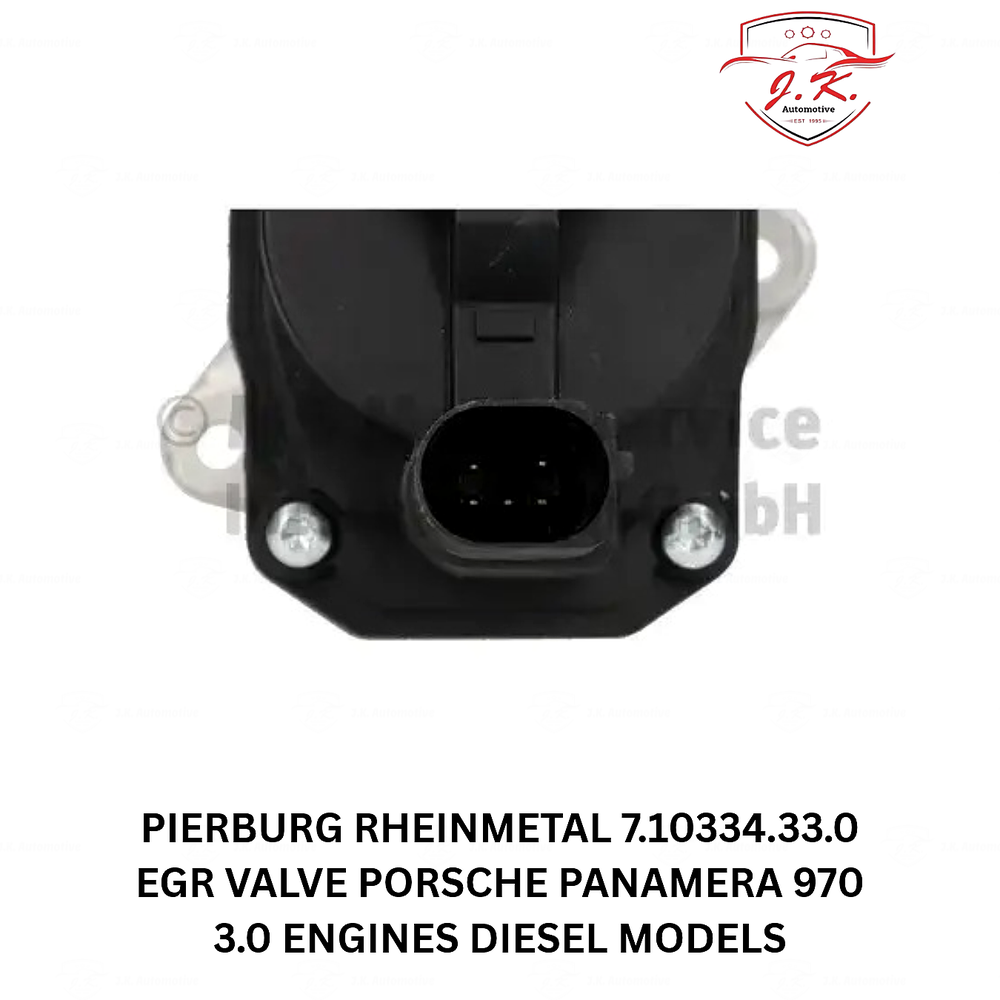
The most reliable method of checking EGR valve compatibility for a Porsche Panamera (970) 3.0 Diesel is to verify the vehicle VIN and original Porsche equipment reference. The VIN identifies the vehicle's original configuration and provides the basis for a manufacturer parts-catalogue lookup. It can help establish the precise model, engine, production details and relevant replacement components. This is particularly important because the Panamera 970 3.0 Diesel was offered in different engine-output versions. Published applications for Pierburg 7.10334.33.0 include 211 hp, 250 hp and 300 hp diesel engines. Some catalogue engine codes associated with these applications are MCR.CB, MCR.CC and MCW.JA. Although these versions share a 3.0-litre V6 diesel configuration, their production dates and component requirements may differ. The engine code should therefore be checked before ordering. The original EGR valve reference should be identified from Porsche parts information. Published Porsche OE comparison numbers for Pierburg 7.10334.33.0 include 958 111 051 10, 958 111 051 11 and 958 111 051 30. Other catalogued Porsche references include PAB 131 503 and PAB 131 503 B. These numbers are comparison references, not proof that all apply to every Panamera diesel vehicle. A buyer should establish which number belongs to the individual vehicle. Where an original reference has changed, the replacement relationship should be confirmed through reliable parts information. The part number on the existing EGR assembly may provide useful additional evidence. A workshop should also inspect the electrical connector and mounting arrangement where necessary. The valve must correspond to the original control system and sealing requirements. Two components can look similar while having different specifications. Customers should also ensure they are identifying the main EGR control valve rather than an EGR cooler or related bypass component. A fault in the wider recirculation system does not automatically establish that this valve needs replacement. Before ordering, the technician should determine the actual failed component. Customers can provide their complete VIN, engine code and existing OE part number to JK Automotive. These details support more accurate fitment identification. Once the correct reference has been confirmed, Pierburg 7.10334.33.0 can be assessed as the replacement. Checking the VIN before purchase reduces the risk of incorrect fitment, unnecessary returns and additional workshop costs.
What installation precautions should be followed when replacing Pierburg EGR Valve 7.10334.33.0 in a Porsche Panamera (970) 3.0 Diesel engine?
Replacing an EGR valve in a Porsche Panamera (970) 3.0 Diesel engine requires careful preparation because the component is connected to the engine's exhaust gas recirculation and electronic control systems. The first step is to verify that Pierburg 7.10334.33.0 matches the vehicle's original EGR reference. The VIN and engine code should be checked before removing the existing component. The vehicle should then be prepared according to the manufacturer's workshop instructions. The engine must be allowed to cool because EGR components carry hot exhaust gases during normal operation. Working on hot exhaust-related components can cause burns. Suitable protective equipment and workshop procedures should be used. Access to the valve may require removing engine covers, ducts or other surrounding components. The precise removal sequence depends on the engine configuration. Electrical connectors must be released carefully without damaging their locking mechanisms. The wiring harness should be inspected for corrosion, broken insulation or loose terminals. These faults may cause incorrect EGR operation even when the valve itself is serviceable. The area around the old valve should be inspected for exhaust leakage and excessive soot deposits. During removal, loose debris must not be allowed to enter open engine passages. The mounting surfaces should be checked for damage. Old sealing material should be removed using an appropriate method. Pierburg 7.10334.33.0 is catalogued with a gasket or seal. The installer should confirm that the supplied seal matches the required installation and determine whether any additional seals or fasteners are necessary. The new valve must be positioned correctly against its mating surfaces. Fasteners should be tightened using the applicable Porsche workshop specifications. Guessing tightening torque can cause damage or sealing problems. The electrical connector must fit securely without being forced. Removed intake ducts, hoses and brackets should be returned to their proper positions. If heavy deposits or restrictions contributed to the original fault, the related passages may need further inspection. Installing a new valve without correcting an existing blockage may not resolve the problem. After installation, diagnostic equipment should be used to review relevant fault codes and operating information. Depending on the specific vehicle management system, initialization or adaptation may be necessary. The manufacturer procedure should determine which electronic steps are required. The technician should then check for leaks, warning messages and abnormal engine operation. A road test and final diagnostic scan may help confirm that the repair has addressed the original complaint. Professional installation is recommended to protect the component and ensure that the EGR system operates correctly.
Why should customers consider Pierburg Rheinmetall Germany EGR Valve 7.10334.33.0 for Porsche Panamera (970) 3.0 Diesel engines?
Pierburg Rheinmetall Germany is an established manufacturer associated with automotive engine-management and emissions-control components. Pierburg EGR Valve 7.10334.33.0 is a specifically identified replacement component for selected vehicle applications. Its manufacturer reference allows customers and technicians to compare the product with the original Porsche equipment number. This is especially useful for the Panamera (970) because its 3.0-litre diesel range includes different engine and power configurations. Published catalogue applications identify selected 211 hp, 250 hp and 300 hp Panamera diesel variants. The product uses electrically controlled operation and is specified for 12V systems. A seal is included according to replacement-parts catalogues. These details help distinguish it from other EGR components. The valve is intended to regulate exhaust gas flow under the control of the engine management system. Correct operation supports the vehicle's original emissions-control strategy. If the existing valve has failed, replacing it with a compatible component may restore normal EGR function. However, choosing Pierburg does not remove the need for proper diagnosis. Engine warning lights or reduced acceleration may result from sensors, wiring faults or restrictions elsewhere in the system. A replacement valve will not correct those unrelated problems. The original OE number should be verified before purchasing. Pierburg 7.10334.33.0 has Porsche OE comparison numbers including 958 111 051 10, 958 111 051 11 and 958 111 051 30. The vehicle VIN should be checked to establish which reference applies to the exact installation. The product received should be inspected before fitting. Its manufacturer part number should correspond to the order. The component should also be checked for visible damage. Professional installation should follow the relevant Porsche repair procedure. Any required sealing and diagnostic operations should be completed. Customers should not expect a new EGR valve to increase engine power beyond the manufacturer's original specification. Its role is to restore correct system operation where the existing component is defective. JK Automotive customers can share their VIN and original part number for fitment verification. For a confirmed compatible Panamera diesel application, Pierburg 7.10334.33.0 is a documented replacement option worth considering. Proper part selection, product authenticity and professional installation are the most important considerations.
Why is Pierburg considered a suitable EGR valve brand for Porsche Panamera (970) 3.0 Diesel engines compared with Valeo, Delphi and BorgWarner?
Pierburg Rheinmetall, Valeo, Delphi and BorgWarner are established automotive component suppliers with product ranges covering various aspects of engine management and emissions-control technology. When comparing their EGR valves for a Porsche Panamera (970) 3.0 Diesel engine, the main priority should be the exact part specification rather than the manufacturer's reputation alone. Pierburg 7.10334.33.0 is a specific electrically operated EGR control valve. It is listed for selected Panamera 970 diesel applications and has documented Porsche OE comparison numbers. This provides a useful starting point for identifying the correct replacement. Some aftermarket catalogues also list alternative EGR valve references from other manufacturers. However, a competing product should only be considered interchangeable when its exact article number is verified for the particular vehicle and OE reference. Similar-looking valves are not necessarily suitable replacements. EGR valves may differ in their electrical connectors, actuator controls, mounting arrangements and internal flow characteristics. Their sealing requirements may also differ. The original Porsche OE part number should therefore be identified first. The VIN and engine code should then be checked using reliable application information. Published references associated with Pierburg 7.10334.33.0 include 958 111 051 10, 958 111 051 11 and 958 111 051 30. A comparable valve from Valeo, Delphi or BorgWarner should be evaluated against the same confirmed original-equipment requirement. Customers may also compare supplied gaskets, installation documentation, warranty conditions and availability. Authentic product identification is important regardless of brand. A product should not be selected merely because its seller describes it as suitable for a Porsche V6 diesel engine. Correct fitment depends on more than engine displacement. Price can be compared after technical compatibility has been established. A lower-priced valve is not a suitable choice if its operating specifications differ from the original component. Likewise, a higher price does not automatically establish superior reliability. There is no sound basis for claiming that Pierburg is universally better than Valeo, Delphi or BorgWarner for all EGR applications. Each manufacturer may offer a valid replacement for a particular OE reference. For the Panamera 970, Pierburg 7.10334.33.0 is an established catalogue option for selected 3.0-litre diesel versions. The original fault should still be diagnosed before replacement. Wiring defects, sensor problems and restricted EGR passages may require different repairs. Buyers should confirm the vehicle VIN and original valve number before ordering. A genuine, correctly specified component installed professionally is more important than an unsupported brand superiority claim. The goal of replacement is to restore the intended EGR operation and emissions management of the Porsche diesel engine.

Reviews
There are no reviews yet.