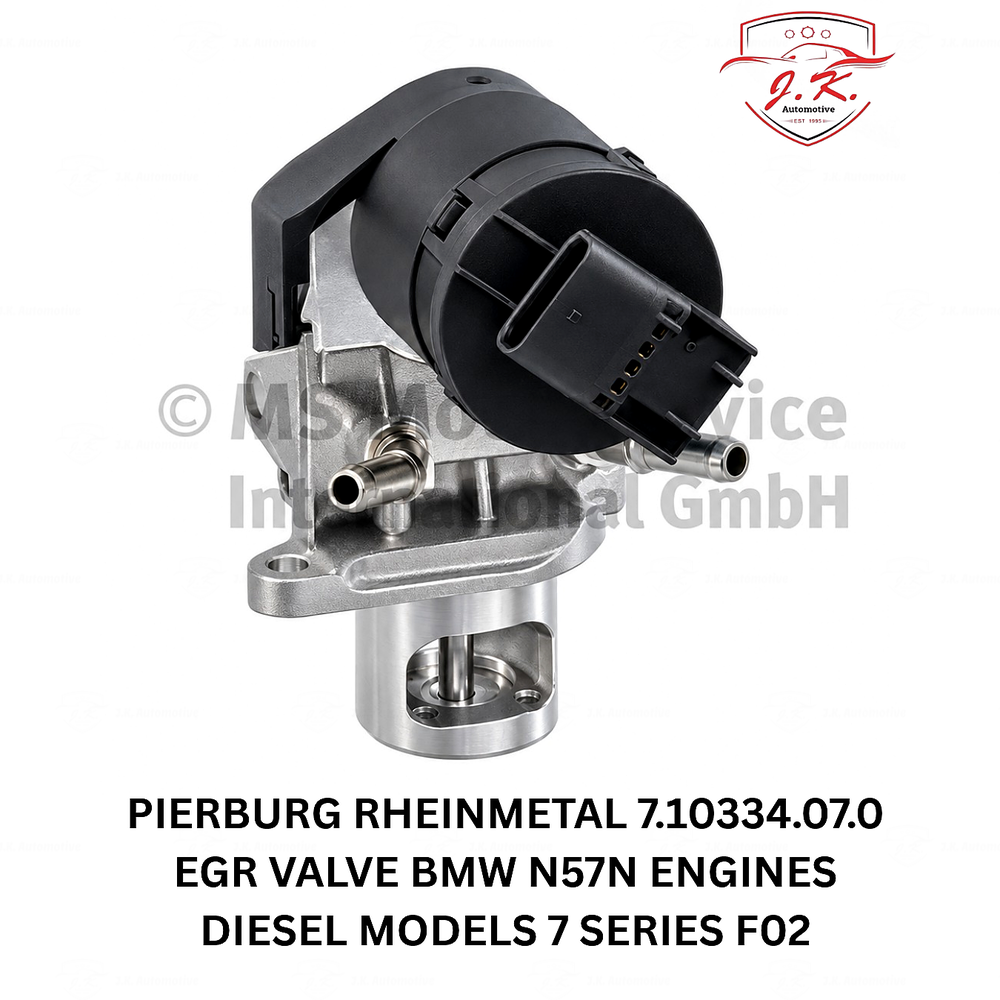
What is the Pierburg Rheinmetall Germany EGR Valve 7.10334.07.0 for BMW 7 Series (F02) N57N diesel engines?
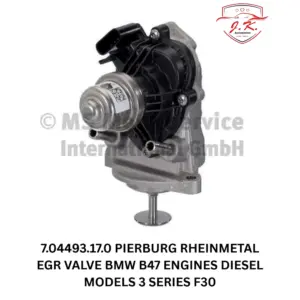
The Pierburg Rheinmetall Germany EGR Valve 7.10334.07.0 is an electrically operated exhaust gas recirculation control valve designed for compatible BMW diesel engine applications, including selected BMW 7 Series (F02) vehicles equipped with the N57 engine family. EGR stands for Exhaust Gas Recirculation, an important part of a modern diesel engine's emissions-control system. The valve regulates the amount of exhaust gas that returns to the intake system during selected engine operating conditions. This process helps manage combustion temperatures and reduce the formation of nitrogen oxides. The BMW N57 engine is a six-cylinder turbocharged diesel engine with electronic engine management. The engine control unit coordinates fuel injection, intake airflow, turbocharger activity and emissions-control functions. The EGR valve works as part of this system rather than operating independently. When the engine requires exhaust gas recirculation, the control unit commands the valve to adjust its opening. The valve then controls the quantity of exhaust gas returning toward the intake. The required amount changes according to engine load, temperature, speed and other operating conditions. The valve is not intended to remain fully open throughout normal driving. Instead, it responds to the operating requirements determined by the engine control system. Pierburg 7.10334.07.0 is specified for a 12V electrical system. It is catalogued as an electrically operated control valve supplied with a seal. Relevant BMW 7 Series applications include selected N57-powered 730d and 740d variants. The F02 long-wheelbase body includes diesel versions such as the 730Ld. However, the N57 and N57N engine designations cover different configurations and production updates. The engine designation alone cannot guarantee that the same EGR valve is fitted to every vehicle. The original BMW equipment reference should therefore be checked before ordering. When the EGR valve fails, it may interfere with the engine's intended exhaust gas recirculation operation. Possible symptoms include warning lights, hesitation, unstable idling and reduced acceleration. Electrical faults or carbon deposits may contribute to incorrect valve operation. Similar symptoms can also result from damaged wiring, sensors or related engine components. Proper diagnosis is necessary before replacement. Customers should check the VIN, engine details and original valve number. When the replacement matches the original equipment requirements, Pierburg 7.10334.07.0 can help restore normal EGR operation. Its purpose is to maintain the original emissions-control system rather than increase engine horsepower.
Which BMW 7 Series (F02) N57N diesel models are compatible with Pierburg EGR Valve 7.10334.07.0?
Pierburg EGR Valve 7.10334.07.0 is listed for selected BMW 7 Series diesel applications that use the N57 engine family. The BMW F02 is the long-wheelbase version of the F01-generation 7 Series. The 730Ld is one of the relevant long-wheelbase diesel models. Certain 740Ld configurations may also appear within the wider F01/F02/F03/F04 family, depending on production and market. The underlying engines use a 3.0-litre six-cylinder diesel configuration. Their displacement is approximately 2,993 cc. Different versions of the N57 engine were offered during the production life of this generation. Early models and later updated N57N engines may have different component specifications. Some parts catalogues identify 730d applications with outputs of 245 hp or 258 hp. Other 740d configurations have higher power outputs. However, these catalogue descriptions frequently cover several body types together. A 730d listed under the F01/F02 family should not automatically be described as an F02 730Ld. The buyer should confirm the actual vehicle body designation. The original BMW equipment reference is also important. Pierburg 7.10334.07.0 has published comparisons including 11717805447, 11717810871 and 11719886714. Additional EGR-related references appear in manufacturer component documentation. The exact number required for an individual vehicle must be verified through the VIN. BMW may revise equipment during production. Different emissions configurations can also influence which valve is required. Therefore, the engine's capacity and horsepower alone are insufficient for component identification. The electrical connector must match the original installation. Mounting surfaces and gas connections should also correspond to the original component. Customers should distinguish the EGR control valve from the EGR cooler and associated bypass parts. These are separate components within the wider recirculation system. A fault involving the cooler does not automatically mean the main valve must be replaced. Customers ordering through JK Automotive can provide their VIN and existing EGR valve number for a compatibility check. Once the original OE reference matches the documented Pierburg application, 7.10334.07.0 can be considered for the appropriate BMW F02 N57 diesel vehicle. This verification helps reduce incorrect orders and installation delays.
How does Pierburg EGR Valve 7.10334.07.0 operate in a BMW F02 N57N six-cylinder diesel engine?
The Pierburg EGR Valve 7.10334.07.0 controls the flow of exhaust gas recirculation in compatible BMW N57 diesel engine applications. The BMW N57 is a turbocharged six-cylinder diesel engine that uses electronically controlled fuel injection. Fresh air enters the engine and is compressed before fuel is injected. Combustion generates mechanical power and also produces exhaust gases. Some of these exhaust gases contain nitrogen oxides. Nitrogen oxide formation is influenced by combustion temperature and operating conditions. The exhaust gas recirculation system helps reduce the formation of these pollutants. It does this by returning a controlled quantity of exhaust gas to the intake system. Recirculated exhaust gas changes the intake mixture and helps moderate combustion temperatures. The engine control unit calculates how much EGR flow is required. It uses information from engine sensors and current operating conditions. Relevant factors can include engine speed, temperature, load and intake-air measurements. The control unit sends an electrical command to the EGR valve. The valve actuator then adjusts the opening through which exhaust gas passes. This allows the engine to regulate recirculation as driving conditions change. The required position is different during light-load driving and stronger acceleration. The valve therefore does not remain permanently open. The EGR cooler and associated passages form part of the wider system. The cooler may reduce the temperature of recirculated exhaust gases before they reach the intake. The turbocharger and intake-air management components also influence engine airflow. All these systems must work together to maintain the intended operating conditions. Over time, carbon and soot deposits may accumulate in the recirculation circuit. Excessive deposits can restrict gas flow or affect valve movement. Electrical defects can also prevent the actuator from responding correctly. A valve stuck open may allow excessive exhaust gas into the intake. A valve stuck closed may prevent the expected recirculation. Either condition can generate diagnostic fault codes. A technician should examine the valve, wiring and relevant engine data before recommending replacement. Pierburg 7.10334.07.0 should only be fitted after confirming the original BMW OE number. Correct installation can help restore the intended emissions-control operation rather than increase the engine's rated power.
What are the common symptoms of a faulty EGR valve in a BMW 7 Series (F02) N57N diesel engine?
A faulty EGR valve in a BMW 7 Series (F02) equipped with a compatible N57 diesel engine can produce several symptoms involving engine response and emissions-control operation. One common indication is the illumination of an engine management warning light. The engine control unit may store diagnostic trouble codes when the EGR valve does not respond as expected. A driver may experience hesitation during acceleration. Reduced engine response can occur if the intended balance between fresh intake air and recirculated exhaust gas is disturbed. Some vehicles may develop rough or unstable idling. An EGR valve stuck open can allow excessive exhaust gas into the intake during unsuitable operating conditions. This can interfere with combustion stability. A valve stuck closed may prevent the recirculation required by the engine control system. This may generate emissions-related diagnostic faults. In more significant cases, the engine management system may restrict available power. Drivers may describe this as limp mode or reduced-power operation. However, loss of power does not prove that the EGR valve has failed. Turbocharger problems, intake leaks and fuel-injection faults can produce similar symptoms. Changes in fuel consumption may also be noticed. Fuel economy alone is not a reliable indicator of EGR valve failure. Exhaust smoke can occur under certain engine fault conditions. However, smoke may also result from other problems affecting fuel delivery or airflow. Carbon deposits may prevent the EGR valve from moving smoothly. Damaged electrical connectors can interrupt actuator operation. Wiring defects may produce EGR-related diagnostic codes even when the valve mechanism is functional. The EGR cooler and surrounding passages may also need inspection. A coolant leak should be investigated separately because it can involve the cooler rather than the valve. A qualified technician should begin with an appropriate diagnostic scan. Stored trouble codes should be examined alongside relevant live operating information. Electrical connections and actuator operation may require testing. If mechanical sticking or electrical failure is confirmed, replacement may be necessary. Pierburg 7.10334.07.0 is listed for selected BMW N57 applications. The vehicle VIN and original equipment reference must be confirmed before purchasing. Correct diagnosis helps ensure that the actual defective component is replaced.
When should Pierburg EGR Valve 7.10334.07.0 be replaced in a BMW F02 N57N diesel engine?
Pierburg EGR Valve 7.10334.07.0 should be considered for replacement when diagnosis confirms that the original EGR control valve in a compatible BMW F02 N57 diesel engine is defective. There is no universal fixed mileage interval that applies to every EGR valve used in this engine family. The component operates in an environment exposed to hot exhaust gases and combustion byproducts. Soot and carbon deposits may accumulate over time. Excessive deposits can restrict normal valve movement. The rate of accumulation depends on engine condition, driving patterns and the operation of other emissions-control components. Some vehicles may experience EGR problems earlier than others. High mileage alone does not mean that the valve requires replacement. Engine warning lights or recurring EGR-related fault codes are reasons to investigate the system. Hesitation, unstable idling and reduced acceleration may also justify inspection. However, these symptoms may have several possible causes. A technician should begin by reviewing stored diagnostic trouble codes. Relevant engine operating data should then be examined. The electrical connector and wiring harness should be checked for damage. The EGR valve may require testing through suitable diagnostic functions. Carbon deposits in nearby passages should also be inspected where relevant. Cleaning may sometimes be appropriate when deposits are the primary problem and the valve remains electrically and mechanically serviceable. However, cleaning cannot reliably repair failed electronic components or severe mechanical wear. A valve that fails functional testing may require replacement. The condition of the EGR cooler should also be considered. A defective cooler requires its own diagnosis and repair. Installing a new EGR valve without correcting a blocked passage or wiring fault may leave the original problem unresolved. Once replacement is justified, the correct BMW OE reference must be verified. Pierburg 7.10334.07.0 should only be selected after the VIN and manufacturer catalogue application are confirmed. The technician should use the installation instructions applicable to this exact valve and engine. Appropriate seals and fastening procedures must be followed. Post-installation checks should confirm correct operation and the absence of leaks or remaining diagnostic faults. Replacing the valve after accurate diagnosis helps avoid unnecessary expense and supports normal emissions-control maintenance.
Can a faulty Pierburg EGR Valve 7.10334.07.0 affect engine performance, fuel consumption and emissions in a BMW F02 N57N diesel?
A faulty EGR valve can affect engine response, fuel consumption and exhaust emissions in a BMW 7 Series (F02) equipped with a compatible N57 diesel engine. The exhaust gas recirculation system regulates the amount of exhaust gas returning to the intake system. Its primary function is to help manage combustion temperatures and reduce nitrogen oxide emissions. When the EGR valve operates correctly, the engine control unit adjusts gas flow according to BMW's original engine calibration. If the valve becomes stuck open, too much exhaust gas may enter the intake when more fresh air is required. This can interfere with normal combustion. Drivers may experience hesitation, sluggish acceleration or uneven engine response. Some vehicles may also develop rough idling. A significant malfunction may cause the engine management system to limit available power. If the valve remains closed when recirculation is requested, the intended EGR flow may not occur. This can increase nitrogen oxide formation under certain operating conditions. The engine management system may detect abnormal operation and store diagnostic trouble codes. A warning light may then appear on the instrument cluster. Some EGR problems develop gradually because of carbon accumulation. Others occur because of electrical actuator faults or wiring damage. A damaged connector can prevent the valve from receiving proper control signals. Fuel consumption can change when the EGR system is malfunctioning. However, no fixed percentage increase applies to every EGR fault. Fuel economy is influenced by driving conditions, traffic, engine load, injection performance and many other factors. A turbocharger fault or intake leak may produce similar complaints. Incorrect air-mass sensor readings can also affect how the engine management system evaluates EGR performance. Problems involving the diesel particulate filter or other exhaust equipment can influence engine behavior. A technician should therefore evaluate the complete relevant system before recommending a new valve. Diagnostic testing can help establish whether the valve responds correctly. Electrical connections and exhaust gas passages may require inspection. If the original valve is confirmed defective, the correctly specified replacement may help restore normal operation. Pierburg 7.10334.07.0 is catalogued for selected BMW N57 applications. The BMW OE number and VIN must still be verified before purchase. Replacement should restore the original emissions-control function rather than promise additional horsepower or guaranteed fuel savings.
How can customers verify Pierburg EGR Valve 7.10334.07.0 compatibility using the VIN and OEM number of a BMW 7 Series (F02)?
The correct EGR valve for a BMW 7 Series (F02) diesel engine should be identified using the vehicle identification number and original equipment reference. The VIN is a unique identifier that allows a BMW workshop or qualified parts specialist to retrieve information about the original vehicle configuration. This information can help establish the body type, engine variant, production details and applicable replacement components. The F02 is the long-wheelbase body within the F01-generation 7 Series range. Relevant diesel configurations include the 730Ld and certain other long-wheelbase applications, depending on market and production. The N57 engine family includes different versions and power outputs. Later updated engines are sometimes identified as N57N. However, the engine name alone does not guarantee that every vehicle uses the same EGR valve. The original BMW part number must also be identified. Pierburg 7.10334.07.0 has published comparison references including 11717805447, 11717810871 and 11719886714. Another related reference found in Pierburg EGR component information is 11717823210. These numbers should be compared with the part specified for the individual vehicle. If the original number differs, an applicable manufacturer replacement or supersession must be verified. Different references should not automatically be treated as interchangeable. The valve's electrical connector should match the vehicle wiring harness. Its mounting arrangement and sealing surfaces must also correspond to the original installation. Similar-looking components may have different internal operating specifications. Production changes and market-specific emissions requirements can influence parts selection. The EGR control valve should be distinguished from the EGR cooler and associated components. An EGR-related diagnostic code does not necessarily mean that the control valve itself has failed. Wiring, sensors and blocked passages may require separate inspection. Customers purchasing through JK Automotive should provide their complete VIN and original EGR valve number. The installed engine specification should also be checked. A photograph of the existing part marking may assist with identification. Once the original equipment requirement matches Pierburg 7.10334.07.0, the component can be considered for replacement. Accurate verification helps avoid unsuitable parts and unnecessary returns. The technician should then follow the correct BMW workshop procedure for the exact engine and valve configuration.
What precautions should be followed when fitting Pierburg EGR Valve 7.10334.07.0 on a BMW F02 N57N diesel engine?
Installing Pierburg EGR Valve 7.10334.07.0 on a compatible BMW 7 Series (F02) N57 diesel engine requires careful identification and correct workshop procedures. The first step is to confirm that the replacement valve matches the original BMW equipment reference. The vehicle VIN and engine details should be checked before removing the existing component. The engine should be allowed to cool before beginning work. Exhaust gas recirculation components are exposed to hot exhaust gases and may remain hot after driving. Suitable protective equipment and workshop safety precautions should be used. Access to the EGR valve may require removal of engine covers, intake ducts or surrounding components. The exact sequence depends on the vehicle's engine configuration. The technician should follow the relevant BMW repair instructions rather than relying on a generic installation procedure. The electrical connector must be disconnected carefully to avoid damaging its locking mechanism. The wiring harness should be inspected for corrosion, broken insulation or loose terminals. These electrical problems can interfere with EGR operation even when the valve is mechanically functional. The surrounding assembly should be checked for carbon deposits and signs of exhaust leakage. During removal, soot and loose debris should be kept out of open intake and exhaust passages. The mounting surfaces should be inspected for damage. Old sealing material should be removed using suitable methods where required. Pierburg 7.10334.07.0 is catalogued with a gasket or seal. The installer should verify that the supplied seal is correct for the specific application. Any additional seals or fasteners required by BMW should be replaced according to the workshop instructions. The new valve must be fitted in the correct orientation. Fasteners should be tightened using the specified procedure and torque values. Guessing the tightening torque can damage the component or cause leakage. All removed hoses, ducts and electrical connections should be restored correctly. If the original fault involved heavy carbon deposits, the related passages may need further inspection. Installing a new valve into an obstructed system may not resolve the problem. After fitting, suitable BMW-compatible diagnostic equipment should be used to check the engine management system. Any required adaptations or initialization procedures should be performed according to the instructions for this exact engine and component. The technician should inspect the completed repair for leaks, warning lights and abnormal operation. A final diagnostic scan and road test can help confirm whether the original fault has been resolved. Professional installation is recommended to protect the new component and restore the intended EGR function.
Why should customers consider Pierburg Rheinmetall Germany EGR Valve 7.10334.07.0 for BMW F02 N57N diesel engines?
Pierburg Rheinmetall Germany is an established manufacturer associated with automotive engine-management and emissions-control components. Pierburg 7.10334.07.0 is a specifically identified electrically operated EGR control valve. Its manufacturer reference allows workshops and customers to compare the replacement against original BMW equipment numbers. This is particularly important for the BMW 7 Series (F02) because the N57 diesel engine family includes different configurations and production updates. The F02 long-wheelbase body may be equipped with different diesel powertrains depending on the model and market. Selected N57-powered 7 Series applications are catalogued for this Pierburg valve. Its technical specifications include electric operation and a 12V system. Aftermarket catalogues also identify the product with a gasket or seal. The valve is intended to regulate exhaust gas recirculation according to the engine management system's commands. Proper EGR function supports BMW's original emissions-control strategy. If the installed valve is defective, a correctly matched replacement may help restore normal operation. However, a recognized manufacturer name alone cannot guarantee vehicle compatibility. The original BMW OE reference must be checked before ordering. Pierburg 7.10334.07.0 has comparison numbers including 11717805447, 11717810871 and 11719886714. These references can assist with identification when used alongside the vehicle VIN. Customers should verify the number printed on the received product or packaging. The manufacturer article number should match the order. Any visible transport damage should be addressed before installation. A qualified technician should confirm that the EGR valve itself requires replacement. Engine warning lights, rough running and reduced acceleration can also result from sensors, wiring or intake restrictions. A new EGR valve will not repair those unrelated problems. The condition of the EGR cooler should be considered where relevant. A leaking or defective cooler may require a different repair. The correct installation procedure must be followed for the specific BMW engine and valve. Professional fitting should include suitable sealing materials and diagnostic checks. Customers purchasing through JK Automotive can supply their VIN and original part number for fitment verification. For a confirmed compatible BMW F02 N57 application, Pierburg 7.10334.07.0 is a relevant manufacturer-identified replacement option. Its intended benefit is restoring normal EGR function rather than increasing engine horsepower.
Why is Pierburg considered a suitable EGR valve brand for BMW 7 Series (F02) N57N diesel engines compared with Valeo, Delphi and BorgWarner?
Pierburg Rheinmetall, Valeo, Delphi and BorgWarner are established automotive component manufacturers associated with various engine-management and emissions-control technologies. When comparing EGR valves for a BMW 7 Series (F02) N57 diesel engine, exact compatibility should be the first consideration. Pierburg 7.10334.07.0 is a specific electrically operated EGR control valve with published BMW OE comparison references. It is catalogued for selected N57-powered BMW applications, including relevant 7 Series configurations. This provides an identifiable basis for replacement-part selection. However, an EGR valve from another manufacturer should not be considered interchangeable simply because it appears similar. Electrical connectors may differ between products. Internal actuator characteristics can also vary. Mounting points, sealing arrangements and gas-flow characteristics must correspond to the original installation. The vehicle VIN should therefore be used to establish the original BMW part requirement. The installed EGR reference should then be checked against the manufacturer's catalogue. Published Pierburg comparison numbers include 11717805447 and 11717810871. Other listed references should also be verified against the individual vehicle. A Valeo, Delphi or BorgWarner replacement should only be selected if its exact article number is documented for the same original equipment application. General brand reputation is not sufficient to establish interchangeability. Customers may compare product documentation, warranty conditions, supplied accessories and seller support after compatibility has been confirmed. Product authenticity is also important. A cheaper valve should not be selected if it lacks the correct specifications. Equally, a higher purchase price does not automatically guarantee improved durability. There is no reliable basis for claiming that Pierburg is universally superior to Valeo, Delphi or BorgWarner in every EGR application. Each manufacturer may supply suitable components for particular engines. The original fault should also be diagnosed before replacement. Electrical defects, faulty sensors and blocked passages may produce symptoms that resemble a defective EGR valve. An EGR cooler fault may require separate investigation. For a BMW F02 application matching Pierburg 7.10334.07.0, this valve is a documented replacement option. JK Automotive customers can provide their VIN and original component number for accurate identification. The best replacement is a genuine, correctly specified valve installed according to the applicable BMW instructions. Accurate fitment and professional diagnosis are more important than unsupported claims of brand superiority. The objective is to restore the vehicle's original emissions-control operation without promising increased engine power or fuel economy.


Reviews
There are no reviews yet.