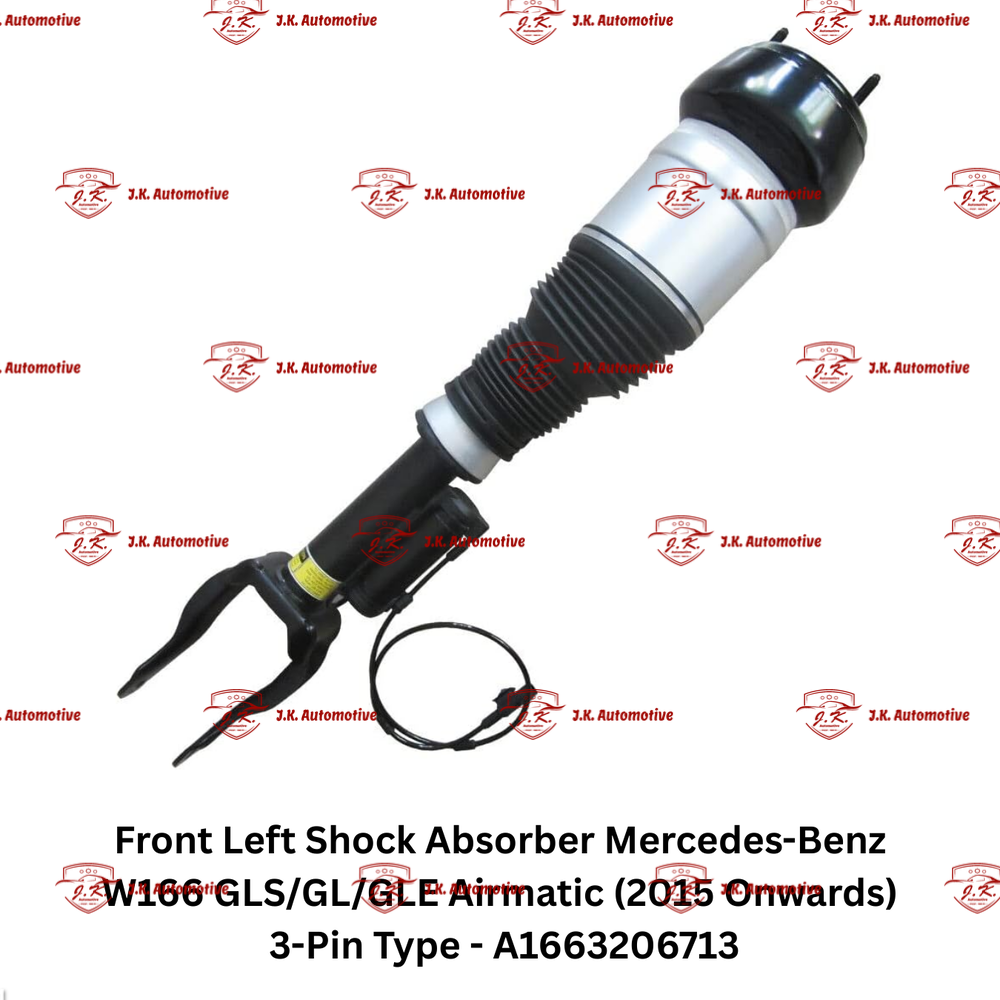
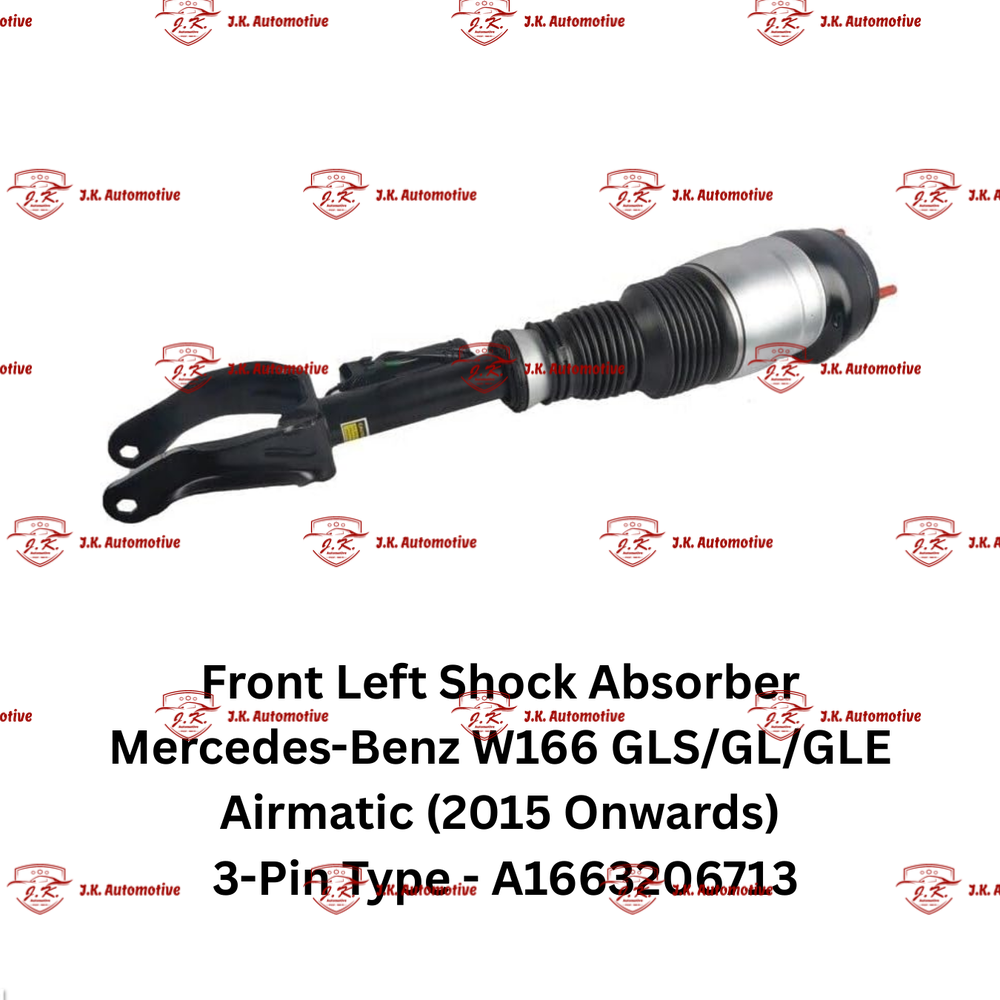
What is the Front Left Airmatic Shock Absorber A1663206713 for Mercedes Benz GLS X166?
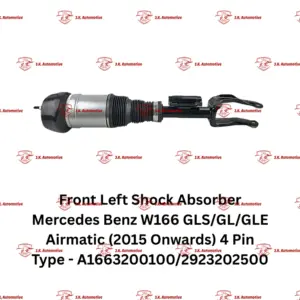
The Front Left Airmatic Shock Absorber A1663206713 is intended for the stated Mercedes Benz GLS X166 application with the supplied 2012–2019 year range and is specifically identified as a Front Left 3 Pin Type component, meaning the vehicle position, electrical connector configuration, suspension type and exact supplied reference should all be confirmed before ordering or installation. An Airmatic shock absorber combines suspension damping requirements with the applicable pneumatic suspension arrangement, allowing the front suspension to respond to changing road conditions while controlling compression and rebound movement. As the front left wheel travels over bumps, depressions, road joints and uneven surfaces, the suspension moves vertically and the damper controls the rate of that movement so the vehicle does not continue oscillating unnecessarily after each road disturbance. The pneumatic side of the applicable Airmatic arrangement works with the vehicle's air-suspension system, while the damping portion controls suspension movement. During braking, load transfers toward the front axle and the front suspension compresses, while acceleration and cornering continually alter the forces acting through the suspension. The shock absorber therefore operates repeatedly during normal driving rather than only when the vehicle encounters large bumps. This product is specifically identified as Front Left, so it should not automatically be installed on the front right side. It is also specifically described as 3 Pin Type, making the electrical connector configuration an important compatibility point. The exact supplied reference is A1663206713 and should remain unchanged during product identification. Before ordering, compare the existing front-left suspension unit with the replacement for reference information, connector configuration, pneumatic connections, mounting arrangement and overall construction. The condition of related suspension components should also be inspected because control arms, bushes, ball joints, mounts, sway bar links, sway links, anti roll link rods and stabiliser sway links can produce symptoms that may initially appear to come from the Airmatic shock. Correct selection should therefore preserve Front Left, Airmatic Shock Absorber, 3 Pin Type, A1663206713, Mercedes Benz GLS X166 and the supplied 2012–2019 application.
How do I confirm A1663206713 Front Left Airmatic Shock Absorber fits my Mercedes Benz GLS X166?
To confirm whether the A1663206713 Front Left Airmatic Shock Absorber fits the stated Mercedes Benz GLS X166, verify the vehicle model and supplied 2012–2019 application, confirm that the vehicle uses the relevant Airmatic front suspension arrangement, establish that the required position is Front Left and compare the existing component's 3 Pin connector, pneumatic connection, mounting arrangement and reference information with the replacement before ordering. Begin with the physical position because this listing specifically identifies a Front Left component and it should not automatically be treated as interchangeable with a front-right unit. Next, inspect the electrical connection on the existing shock absorber because the product is explicitly described as 3 Pin Type. Connector configuration is an important compatibility detail and should be matched rather than assumed from vehicle model alone. Inspect the existing suspension unit for accessible identification information and compare it with the exact supplied reference A1663206713. Keep this number unchanged because even a small variation can identify a different application or component. Physical comparison should include the overall construction of the unit, upper mounting interface, lower mounting arrangement, relevant brackets, pneumatic connection and electrical connector configuration. The replacement should correspond naturally with the existing suspension and should not require cutting, drilling, welding, electrical adaptation or improvised modification to make it fit. VIN-based vehicle information can provide another useful compatibility check, particularly when the suspension history is uncertain. If the vehicle has undergone previous suspension repairs, conversions or accident repairs, direct physical inspection becomes especially important because the installed component may differ from the expected configuration. The surrounding front suspension should also be checked during verification. Inspect control arms and bushes, ball joints, mounts and stabiliser-related components where appropriate. Sway bar links, sway links, anti roll link rods and stabiliser sway links should be checked when knocking is present. Final compatibility should preserve Mercedes Benz GLS X166, Front Left position, Airmatic configuration, 3 Pin Type, A1663206713 and the supplied 2012–2019 year range.
What are the symptoms of a bad Front Left Airmatic Shock Absorber on Mercedes Benz GLS X166?
A deteriorated Front Left Airmatic Shock Absorber on the stated Mercedes Benz GLS X166 may be associated with symptoms such as abnormal front-left ride height, repeated suspension movement after bumps, reduced damping control, increased body movement, unusual behaviour over uneven roads, visible changes in suspension position or suspension-related warnings, but the actual cause should be diagnosed carefully because pneumatic leakage, electrical issues, valve-control problems, compressor performance, sensors, wiring, mounting components and other mechanical suspension parts can produce overlapping symptoms. If the pneumatic portion of the front-left suspension unit cannot retain pressure correctly, the corresponding corner may sit differently after the vehicle has been parked, although a loss of height does not automatically prove that the shock absorber itself is leaking because other parts of the pneumatic system can also lose pressure. If the damping portion has deteriorated, the vehicle may continue moving after road disturbances rather than settling progressively. Drivers may notice increased front-end movement during braking or a less controlled feeling over repeated bumps. The distinction between a pneumatic problem and a damping problem is important because they involve different diagnostic paths. Inspect the front-left unit and its pneumatic connection for evidence that warrants further testing. The complete air-suspension system should be considered when a height-related concern is present because air lines, valve-control components and pressure-generation components may also influence system behaviour. Electrical faults should be investigated separately where the 3 Pin connection, wiring or associated system is involved. Mechanical noises should not automatically be blamed on the Airmatic shock because control arms, bushes, ball joints, mounts and stabiliser-related components can generate knocking. Sway bar links, sway links, anti roll link rods and stabiliser sway links should therefore be inspected when noise occurs over smaller road irregularities. Compare the left and right front suspension behaviour because differences can provide useful diagnostic information. Verify the exact A1663206713 reference and Front Left 3 Pin Type configuration before replacement. A proper diagnosis should distinguish pneumatic leakage, damping deterioration, electrical concerns and unrelated suspension wear rather than replacing the component solely from one symptom.
What does 3 Pin Type mean for Mercedes Benz GLS X166 Front Left Airmatic Shock Absorber A1663206713?
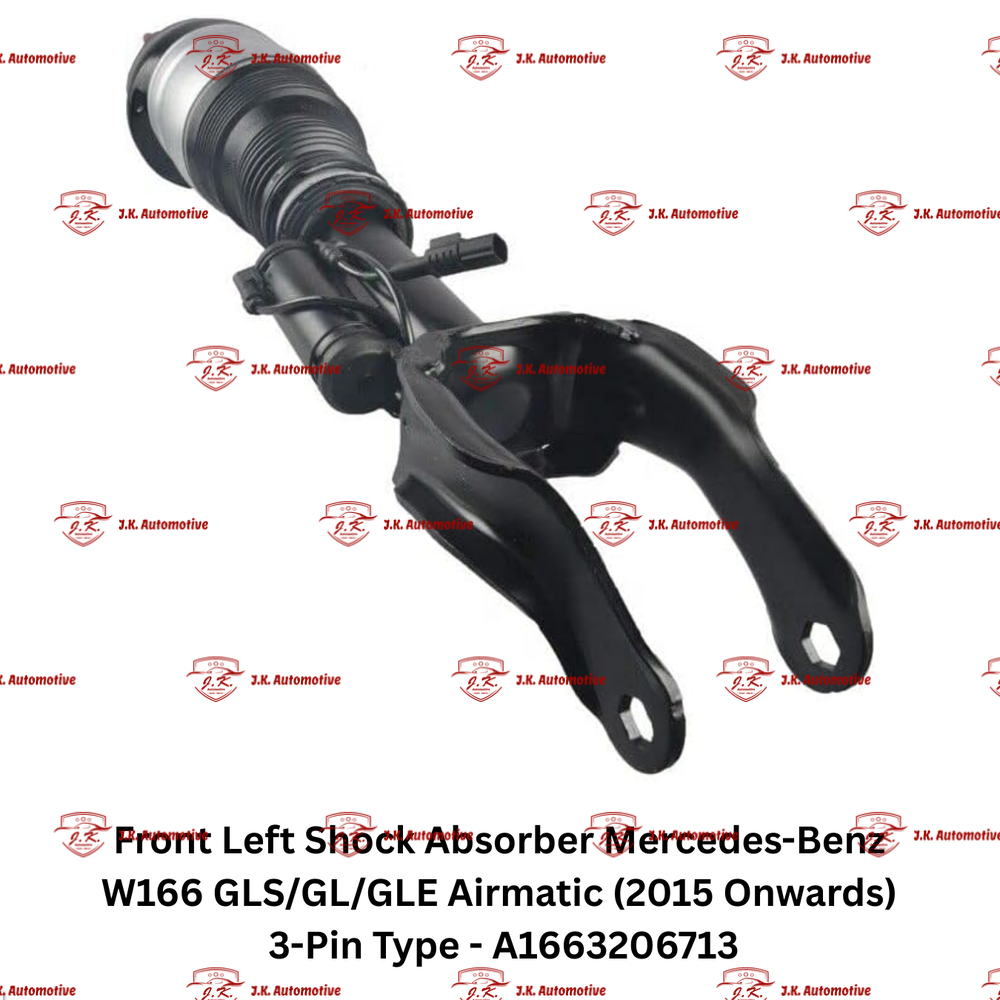
The 3 Pin Type description for the Mercedes Benz GLS X166 Front Left Airmatic Shock Absorber A1663206713 refers to the stated electrical connector configuration associated with this particular product, and it is an important compatibility detail that should be physically confirmed against the component currently installed on the vehicle before ordering because two suspension units intended for similar vehicle applications should not automatically be considered interchangeable if their electrical connections or other interfaces differ. Start by locating the relevant electrical connector on the existing front-left suspension unit and verify the connector arrangement rather than relying only on the vehicle model or year. The listing specifically states 3 Pin Type, so the replacement should correspond with the actual connector configuration required by the vehicle. Connector shape, orientation and associated wiring interface should also correspond naturally; the number of pins should not be treated as the only compatibility check. Avoid cutting, splicing or modifying the vehicle wiring merely to install a component with an incompatible connector. The exact reference A1663206713 should also be verified because the part number provides another important identification point. Position is equally important because the product is specifically Front Left and should not automatically be substituted for a front-right component. The pneumatic connection and mechanical mounting arrangement should also be compared before installation. A correct replacement should correspond with the existing component's overall construction, mounting interfaces, air connection and electrical connection without forced modification. If the vehicle has undergone previous suspension conversion or repair, verify what is physically installed because the current configuration may differ from expected parts information. Where available, VIN-based information can be used as an additional compatibility check. The electrical connector should also be inspected for damage, contamination or wiring concerns before fitting a replacement unit because an existing electrical problem may remain after installation if the underlying wiring fault is not addressed. For this product, compatibility should therefore be established from Mercedes Benz GLS X166, Front Left position, Airmatic suspension, 3 Pin Type, exact reference A1663206713 and the supplied 2012–2019 application rather than any one detail in isolation.
Can a leaking Front Left Airmatic Shock Absorber cause the Mercedes Benz GLS X166 to sit lower on one side?
A pneumatic leak affecting the Front Left Airmatic suspension unit can potentially contribute to the stated Mercedes Benz GLS X166 sitting lower at the front-left corner, particularly after the vehicle has remained parked, but a lowered corner should not automatically be treated as proof that the Airmatic shock absorber itself has failed because pressure loss can also occur elsewhere in the pneumatic suspension system and a proper leak diagnosis is necessary before replacing parts. Begin by observing when the height difference appears. If the vehicle reaches an expected position while operating but one corner gradually lowers after being parked, pressure retention should be investigated. Compare the front-left position with the front-right side under similar conditions and on a reasonably level surface. The pneumatic portion of the suspension unit should be inspected along with its connection, but associated air lines and other relevant pneumatic components should also be considered. A system-level pressure problem can produce symptoms that resemble a leaking individual suspension unit. The air-suspension compressor is responsible for generating pressure within the applicable system, while valve-control components distribute or retain pressure as required, so excessive compressor operation may indicate a pressure-loss issue without identifying the exact leak location by itself. Replacing the compressor alone would not solve an unresolved downstream leak, and replacing the shock absorber without confirming the source of pressure loss can produce the same problem. Leak testing should therefore follow an appropriate diagnostic procedure. The damping condition should also be assessed separately because a pneumatic leak and reduced damping performance are different failure modes even though both may involve the same suspension assembly. Electrical diagnosis may also be required when warnings or control issues are present, particularly because this product is specified as 3 Pin Type. Mechanical suspension components should be inspected at the same time when noise or looseness exists. If replacement is confirmed, verify Front Left position, exact reference A1663206713, 3 Pin connector configuration, relevant pneumatic and mechanical interfaces and the supplied Mercedes Benz GLS X166 2012–2019 application before installation.
What should be checked before installing A1663206713 Front Left Airmatic Shock Absorber on Mercedes Benz GLS X166?
Before installing the A1663206713 Front Left Airmatic Shock Absorber on the stated Mercedes Benz GLS X166, verify the exact Front Left position, confirm that the vehicle uses the relevant Airmatic suspension arrangement, check the 3 Pin electrical connector configuration, compare the pneumatic connection and mounting interfaces with the existing component and inspect the surrounding suspension and air-suspension system so that an unrelated fault is not mistaken for shock absorber failure. Begin by confirming the exact supplied reference A1663206713 against suitable vehicle-specific information and any accessible identification on the existing component. Keep the number unchanged throughout verification. Next, inspect the existing electrical connector and confirm the stated 3 Pin configuration, including the physical connector arrangement and condition of the associated wiring. Do not modify or splice wiring simply to accommodate an incompatible component. Compare the pneumatic connection and ensure the replacement corresponds with the existing air-line interface. The upper and lower mounting arrangements, brackets and overall component construction should also be compared before installation. Inspect the pneumatic system if the original complaint involves loss of ride height because a leaking line, valve-related issue or another pressure-retention problem may remain even after replacing the shock absorber. Compressor behaviour should also be considered when the system has been operating excessively, but the source of any pressure loss should be diagnosed rather than assuming the compressor is the primary fault. Check the surrounding mechanical suspension, including control arms, bushes, ball joints and mounts. Sway bar links, sway links, anti roll link rods and stabiliser sway links should be inspected when knocking or looseness is present. Tyres should be checked for abnormal wear and physical condition. Installation should follow an appropriate workshop procedure because the component forms part of a pneumatic suspension system and correct handling of pressure, electrical connections and suspension mounting points is important. After installation, inspect all connections, verify suspension operation and check for pneumatic leakage where appropriate. A suitable functional or road test should confirm suspension behaviour, and wheel alignment or geometry should be evaluated where required. Final verification should preserve Mercedes Benz GLS X166, Front Left, Airmatic, 3 Pin Type, A1663206713 and the supplied 2012–2019 application.
How does the Front Left Airmatic Shock Absorber A1663206713 work on Mercedes Benz GLS X166?
The Front Left Airmatic Shock Absorber A1663206713 for the stated Mercedes Benz GLS X166 operates as part of the applicable front air-suspension arrangement while also controlling compression and rebound movement at the front-left wheel, helping the suspension respond to road irregularities while reducing unnecessary continued oscillation after the wheel passes over bumps, depressions, road joints and uneven surfaces. This product is specifically identified as Front Left and 3 Pin Type for the supplied 2012–2019 application, so position, electrical connector configuration, pneumatic interface and exact reference should all be confirmed before replacement. The pneumatic side of the applicable suspension arrangement works with pressurized air supplied and managed by the vehicle's air-suspension system, while the damping portion controls the speed of suspension movement. When the front-left wheel encounters a raised road surface, the suspension moves through compression. As the wheel travels beyond that disturbance, the suspension returns through rebound. The damper regulates these movements so they occur in a controlled manner rather than allowing repeated uncontrolled oscillation. During braking, additional load transfers toward the front axle and the suspension compresses accordingly. Acceleration changes load distribution, while cornering produces different forces between the left and right sides of the vehicle. The suspension unit therefore operates continuously during ordinary driving. The 3 Pin electrical connection is an important part of the supplied configuration and should match the vehicle-side connection without improvised modification. The pneumatic connection should also correspond correctly because pressure must be transferred and retained through the applicable system. A problem with vehicle height does not automatically prove failure of this individual component because air lines, valve-control components, pressure generation and other pneumatic elements can influence ride height. Likewise, excessive bouncing can indicate damping deterioration even when pneumatic pressure is being retained. Mechanical suspension components including control arms, bushes, ball joints, mounts, sway bar links, sway links, anti roll link rods and stabiliser sway links should also be inspected where symptoms require it. Correct identification should preserve Front Left, 3 Pin Type, A1663206713 and the supplied Mercedes Benz GLS X166 2012–2019 application.
Can a bad Front Left Airmatic Shock Absorber A1663206713 cause suspension warning messages or uneven ride height on Mercedes Benz GLS X166?
A problem affecting the Front Left Airmatic Shock Absorber A1663206713 or its associated pneumatic or electrical connections can potentially be present when the stated Mercedes Benz GLS X166 develops uneven ride height, abnormal suspension behaviour or a suspension-related warning, but these symptoms do not by themselves identify the shock absorber as the failed component because the complete Airmatic system contains additional pneumatic, electrical and mechanical elements that require diagnosis. If the front-left corner becomes lower than the opposite side after the vehicle has remained parked, pressure retention at that corner should be investigated. A pneumatic leak associated with the suspension unit is one possible cause, but air lines, connections and other relevant pneumatic components can also allow pressure loss. Observe whether the height difference occurs immediately, gradually over several hours or only after extended parking because the pattern can help guide diagnosis. If the vehicle repeatedly attempts to restore height, the pressure-generation system may operate more frequently, but excessive compressor activity should be treated as a symptom requiring diagnosis rather than automatic proof that the compressor itself is defective. Electrical concerns also require separate evaluation. This product is specifically described as 3 Pin Type, so the connector and associated wiring should be inspected for secure connection, physical damage or other visible concerns. Where a suspension warning is present, appropriate diagnostic equipment can be used to retrieve relevant fault information and support systematic troubleshooting rather than replacing parts by trial and error. The damping function should also be evaluated independently. A suspension unit may potentially retain pneumatic pressure while its damping performance has deteriorated, producing increased bouncing or reduced control without necessarily creating the same ride-height symptom. Conversely, pressure loss can affect height even when the damping mechanism is not the primary concern. Mechanical front suspension components should also be inspected because worn control arms, bushes, ball joints, mounts and stabiliser-related parts can produce noise or handling symptoms. Verify the exact Front Left position, A1663206713 reference, 3 Pin Type configuration and supplied Mercedes Benz GLS X166 2012–2019 application before replacement.
How can I diagnose whether A1663206713 or another Airmatic component is causing the problem on Mercedes Benz GLS X166?
Diagnosing whether A1663206713 or another Airmatic component is responsible for a suspension problem on the stated Mercedes Benz GLS X166 requires separating pneumatic pressure-loss symptoms, damping symptoms, electrical concerns and mechanical suspension wear rather than assuming that every front-left suspension problem requires replacement of the Airmatic shock absorber. Begin by identifying the primary symptom. If the front-left corner gradually lowers while the vehicle is parked, investigate pressure retention and inspect the applicable pneumatic circuit for leakage. If the vehicle remains at an appropriate height but the front-left suspension repeatedly bounces or takes longer to settle after bumps, damping performance may require closer assessment. If the suspension behaves inconsistently or a warning appears, electrical diagnosis may be necessary. Because this product is specifically identified as 3 Pin Type, inspect the connector and associated wiring for correct engagement and visible damage. Appropriate diagnostic equipment can help identify stored suspension-related fault information where available, but fault information should be interpreted together with physical testing rather than used as the sole reason to replace a component. Inspect the pneumatic connection at the suspension unit and evaluate the associated air line. Other air-suspension components involved in pressure generation, distribution and retention should also be considered if testing indicates a system-level issue. If the compressor appears to operate frequently, investigate whether the system is compensating for pressure loss before condemning the compressor itself. The front-left shock absorber should also be examined mechanically and its damping behaviour compared with the opposite front position. Check the surrounding suspension because control arms, bushes, ball joints and mounts can cause looseness or noise. Sway bar links, sway links, anti roll link rods and stabiliser sway links should be checked when knocking occurs over small bumps. Tyres and wheel geometry should also be considered when the complaint involves handling or irregular wear. If replacement of the suspension unit is confirmed, compare the existing component physically with A1663206713 for position, connector configuration, pneumatic interface and mounting arrangement. This diagnostic approach reduces unnecessary parts replacement and helps identify whether the concern is pneumatic, electrical, damping-related or mechanical.
What other Airmatic and suspension components should be checked when replacing A1663206713 on Mercedes Benz GLS X166?
When replacing the Front Left Airmatic Shock Absorber A1663206713 on the stated Mercedes Benz GLS X166, the related pneumatic, electrical and mechanical suspension components should also be inspected because replacing the suspension unit alone will not correct an unresolved air leak, wiring concern, worn control-arm bush, damaged ball joint, loose mount or another fault elsewhere in the system. Begin with the pneumatic side of the repair. Inspect the relevant air line and connection for condition and correct seating because pressure loss at a connection can create symptoms similar to a leaking suspension unit. If the original complaint involves the vehicle lowering while parked or the compressor operating more frequently than expected, the broader pneumatic system should be tested for pressure loss rather than assuming the new component will automatically solve the problem. Relevant valve-control components and pressure-generation components should be considered according to diagnostic findings. The compressor should not be replaced simply because it has been operating frequently if another leak is causing excessive demand. Next, inspect the electrical connection because this product is specifically identified as 3 Pin Type. Check the vehicle-side connector, wiring and visible condition of the interface before connecting the replacement. Avoid cutting or modifying wiring to make an incompatible component fit. Mechanical inspection should include the applicable upper and lower mounting areas, control arms and their bushes, ball joints and other front suspension joints. Sway bar links, sway links, anti roll link rods and stabiliser sway links should be inspected when knocking or looseness is present. The opposite front suspension position should also be assessed because comparing both sides can reveal differences in ride height, damping behaviour or component condition. Tyres should be checked for pressure, damage and irregular wear. Wheel geometry should be evaluated where suspension work or existing wear can affect alignment. Before installation, compare the replacement with the removed component for overall construction, Front Left position, pneumatic interface, 3 Pin connector and mounting arrangement. After installation, verify connections, check the applicable system for leakage, confirm suspension operation and perform an appropriate functional or road test. All compatibility checking should preserve A1663206713 and the supplied Mercedes Benz GLS X166 2012–2019 application.
How do I know if the Front Left Airmatic Shock Absorber is bad on my Mercedes Benz GLS X166?
The Front Left Airmatic Shock Absorber on the stated Mercedes Benz GLS X166 may require detailed inspection when the front-left corner gradually lowers after parking, the suspension takes longer to settle after bumps, the vehicle develops excessive movement at that corner, the Airmatic system appears to correct the height repeatedly, the compressor operates unusually frequently, a suspension-related warning appears or the vehicle feels less controlled over uneven surfaces, but these symptoms should be diagnosed systematically because pneumatic leakage, damping deterioration, electrical faults and unrelated mechanical suspension wear can produce similar behaviour. Begin by parking the vehicle on a reasonably level surface and observing whether the front-left ride height changes relative to the other corners over time. If that corner gradually drops, investigate the pneumatic system for pressure loss rather than immediately replacing the shock absorber. Inspect the relevant air connection and associated line as well as the suspension unit. Other components responsible for pressure distribution or retention should be considered if testing indicates that the leak is not located at the front-left unit. If the vehicle maintains ride height but continues bouncing after road disturbances, the damping function should be assessed because reduced damping performance can exist without an obvious pneumatic leak. If a warning message or inconsistent suspension behaviour occurs, electrical diagnosis should also be performed. This listing specifies a 3 Pin Type component, making the connector and associated wiring important inspection points. Suitable diagnostic equipment can provide useful fault information, but stored codes should be combined with physical testing before deciding which component requires replacement. Listen for mechanical noises separately because knocking can originate from control-arm bushes, ball joints, mounts, sway bar links, sway links, anti roll link rods or stabiliser sway links rather than from the Airmatic shock itself. Compare the behaviour of both front suspension positions and inspect tyre condition where handling concerns are present. If testing confirms replacement of the Front Left unit, verify the exact A1663206713 reference, Front Left position, 3 Pin connector configuration, pneumatic connection and mounting arrangement before ordering. Compatibility should retain the supplied Mercedes Benz GLS X166 2012–2019 application and should never be based solely on one symptom.




Reviews
There are no reviews yet.