What is the Stokes Germany Front Stabilizer Link Rod Set of 2 for Mercedes-Benz E-Class W213 A2053230717?
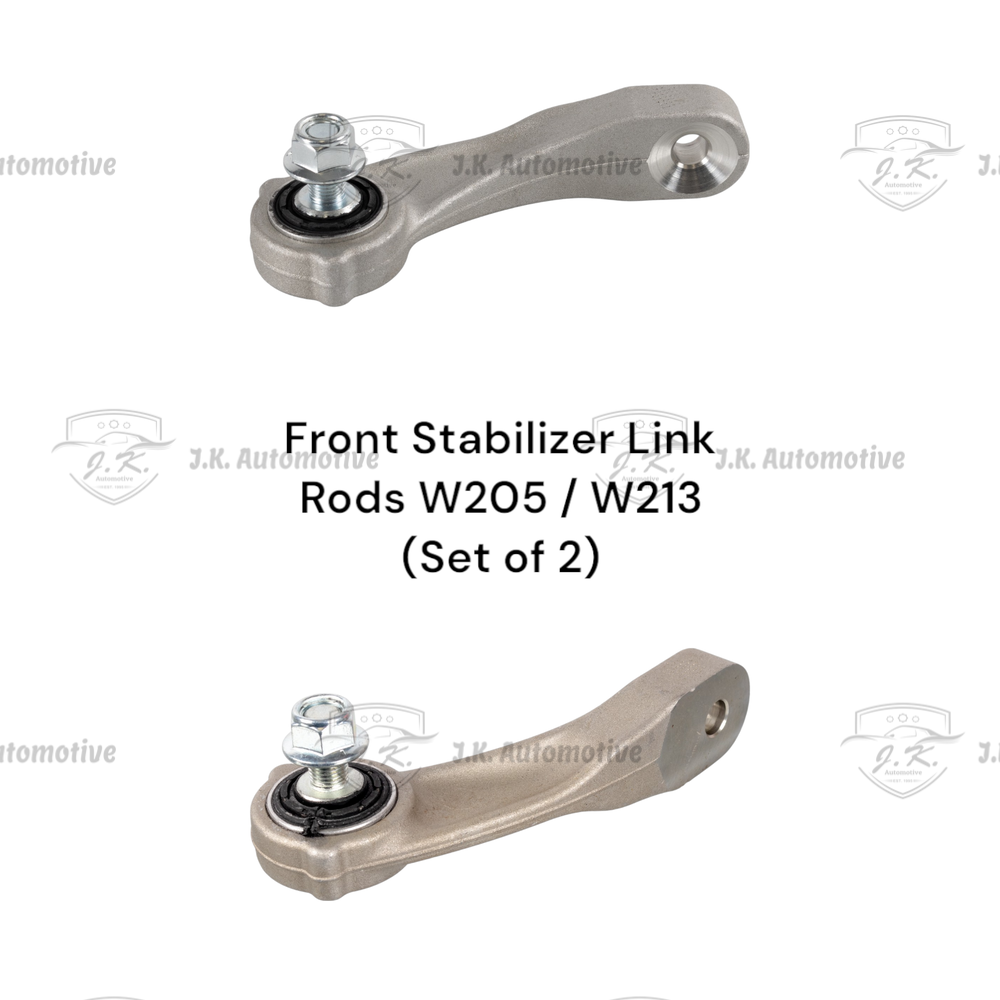
The Stokes Germany Front Stabilizer Link Rod Set of 2 for Mercedes-Benz E-Class W213 is an aftermarket front suspension replacement set designed for the corresponding W213 application. The set contains two front stabilizer link rods, with A2053230717 corresponding to the front-left position and A2053230817 corresponding to the front-right position for the W213 4x2 application. These suspension components are also commonly known as sway bar links, sway links, anti roll link rods and stabiliser sway links. Their primary function is to provide the mechanical connection between the front suspension and the stabilizer or anti-roll bar. During normal driving, the suspension continuously compresses and rebounds as the Mercedes-Benz E-Class W213 travels over potholes, speed breakers, uneven surfaces and changes in road level. The front stabilizer links articulate during these movements while maintaining the required connection with the anti-roll bar. During cornering, the left and right sides of the suspension experience changing loads as vehicle weight transfers laterally. The stabilizer system contributes to controlling excessive body movement, while the sway bar links provide the mechanical connection required for the stabilizer bar to react to suspension movement. Each link contains articulated joints that repeatedly change angle as the suspension moves. With increasing mileage, continuous articulation, vibration, road impacts, dust and environmental exposure can gradually cause wear inside these joints. Excessive joint clearance may eventually contribute to knocking, clunking, tapping or rattling noises from the front suspension. Such noises can become particularly noticeable when travelling over rough roads, potholes or speed breakers. The Stokes Germany set-of-two configuration allows the corresponding front-left and front-right sway links to be replaced together when required. Your current JK Automotive catalogue lists the product as Stokes Germany with A2053230717 and A2053230817 for the E-Class W213 2016–2023. Because this OEM pair is specifically associated with the non-4MATIC/4x2 application in technical catalogues, VIN verification is recommended where the exact drivetrain or suspension configuration is uncertain.
What is the function of sway bar links or front stabilizer links on a Mercedes-Benz E-Class W213?
The sway bar links or front stabilizer links on a Mercedes-Benz E-Class W213 perform an important connecting function within the vehicle's front suspension and anti-roll system. These components may also be called sway links, anti roll link rods and stabiliser sway links, with all of these terms commonly used in the automotive aftermarket for the same general type of suspension component. As the W213 travels over the road, each front wheel moves vertically in response to potholes, bumps, depressions, speed breakers and other irregularities. The suspension must allow this movement while maintaining tyre contact, ride control and vehicle stability. During cornering, the inside and outside sides of the suspension can experience different loading because vehicle weight transfers laterally. The stabilizer or anti-roll bar contributes to managing excessive body roll during these conditions. The front sway bar links provide the mechanical connection through which relevant suspension movement is transmitted to the stabilizer bar. Each stabilizer link contains articulated joints because the suspension and stabilizer bar move relative to each other. These joints must repeatedly articulate while maintaining the mechanical connection. When the joints remain in serviceable condition, they move without excessive unwanted clearance. With extended use, repeated movement, vibration and road impacts can gradually cause internal joint wear. Once excessive free play develops, the joint may move through this clearance whenever suspension loading changes direction. This can contribute to knocking, clunking, tapping or rattling noises from the front suspension. Replacing genuinely worn anti roll link rods helps restore the intended mechanical connection rather than modifying the original suspension design. For the W213 4x2 application, A2053230717 is catalogued as front left and A2053230817 as front right. Teknorot also identifies A2053230717 as a forged-aluminium front-left suspension stabilizer bar link for the W213 4x2 and pairs it with the corresponding front-right component. Overall suspension behaviour still depends on many other components, including control arms, bushes, ball joints, shock absorbers, springs, steering components, tyres and wheel alignment.
What are the common symptoms of worn front stabilizer links or sway links on a Mercedes-Benz E-Class W213?
Worn front stabilizer links or sway links on a Mercedes-Benz E-Class W213 can produce several symptoms, with knocking, clunking, tapping or rattling noises from the front suspension being among the most commonly associated signs. These sounds can become particularly noticeable when the vehicle travels over potholes, speed breakers, broken roads, uneven surfaces or small sharp bumps. Front stabilizer links, also known as sway bar links, sway links, anti roll link rods and stabiliser sway links, contain articulated joints that continuously move as the suspension compresses and rebounds. When these joints are in good condition, they articulate while maintaining the required connection between the suspension and anti-roll bar without excessive unwanted clearance. As vehicle mileage increases, repeated suspension movement, vibration, road impacts and environmental exposure can gradually create wear inside the joints. Once additional clearance develops, the joint can move through this unwanted free play whenever the direction of suspension loading changes. This movement can create the characteristic knocking or clunking noise commonly associated with worn sway links. The sound may initially occur mainly when driving slowly over rough surfaces or speed breakers but can become more noticeable as joint wear progresses. Protective boots around the stabilizer-link joints should also be inspected because damaged boots can allow water, dust and road contamination to reach the joint area and potentially accelerate deterioration. Indian road conditions involving frequent potholes, uneven surfaces and speed breakers can subject suspension components to substantial repeated loading. However, a front suspension knock should not automatically be diagnosed as defective stabilizer links. Stabilizer-bar bushes, control-arm bushes, ball joints, tie-rod ends, shock absorbers, suspension mounts and other components can produce similar symptoms. A technician should therefore inspect the complete front suspension before replacing parts. If excessive play is confirmed in the stabiliser sway links, replacing the worn components removes the unwanted joint clearance and restores the intended connection. For the corresponding W213 application, A2053230717 and A2053230817 form the front-left/front-right 4x2 pair.
Are A2053230717 and A2053230817 the correct front stabilizer link references for Mercedes-Benz E-Class W213?
Yes, A2053230717 and A2053230817 are documented front stabilizer link references for the Mercedes-Benz E-Class W213, but they should be described specifically for the applicable W213/S213 4x2 or rear-wheel-drive configuration rather than being presented as universal references for every W213 variant. RIW's suspension catalogue lists the Mercedes-Benz E-Class W213/S213 4x2 from 2016–2022 with A2053230717 as the Front Left stabilizer link and A2053230817 as the Front Right stabilizer link. Independent TALOSA and DYS catalogues provide the same handed identification, listing A2053230717 as the Front Left stabilizer link and A2053230817 as the Front Right stabilizer link for the E-Class W213 application. These components are commonly referred to as Sway bar links, Sway links, Anti roll link rods, Stabiliser sway links, front drop links, anti-roll-bar links, coupling rods or stabilizer end links. The practical identification for the applicable W213 configuration is therefore Front Left (LH) — A2053230717 and Front Right (RH) — A2053230817. The fact that both numbers begin with A205 should not cause confusion because Mercedes-Benz components can be shared across different chassis families; the 205 prefix does not mean that these links are restricted only to the C-Class W205. RIW specifically cross-lists A2053230717 for both the C-Class W205 and E-Class W213/S213 4x2, confirming that the same OEM reference can have multiple vehicle applications. Genuine Mercedes-Benz parts information also identifies 205-323-07-17 as a left-side suspension stabilizer-bar link and specifies an RWD application without AIRMATIC, reinforcing the importance of checking the actual suspension configuration rather than relying only on the W213 chassis designation. Therefore, a customer should not assume that A2053230717 and A2053230817 automatically fit every Mercedes-Benz E-Class W213. Drivetrain, suspension equipment, production specification and VIN should be checked before ordering because 4MATIC and certain suspension configurations can use different stabilizer-link references. For the applicable 4x2 configuration, however, A2053230717 and A2053230817 form the corresponding left-and-right front pair. The Front Left A2053230717 Sway bar link provides the stabilizer connection on the left side of the front suspension, while Front Right A2053230817 performs the corresponding function on the right side. Both Sway links repeatedly articulate as the front wheels move over potholes, speed breakers, expansion joints, uneven roads and other surface changes. During cornering, the Anti roll link rods operate as part of the stabilizer arrangement while the suspension experiences changing loads between the left and right sides. Over extended service, repeated articulation, road vibration and environmental exposure can gradually contribute to joint wear. Excessive clearance within worn Stabiliser sway links may contribute to tapping, rattling, knocking or clunking noises from the front suspension, particularly over uneven surfaces, although such noises should not automatically be blamed on the stabilizer links because control-arm bushes, ball joints, stabilizer-bar bushes, shock absorbers, suspension mounts and other components can produce similar symptoms. Both links and the surrounding suspension should therefore be inspected before replacement. For your Stokes Germany set, the correct way to present the applicable W213 references is A2053230717 — Front Left (LH) and A2053230817 — Front Right (RH), supplied together as a set of 2. Your JK Automotive catalogue also currently lists this exact pair for the Mercedes-Benz E-Class W213, with OEM Cross Reference A2053230717 & A2053230817.
Should both front sway bar links be replaced together on a Mercedes-Benz E-Class W213?
Replacing both front sway bar links together on a Mercedes-Benz E-Class W213 can be a practical maintenance approach when both original components have accumulated similar mileage and experienced similar operating conditions. The left and right front stabilizer links operate within the same anti-roll system and continuously articulate whenever the front suspension compresses or rebounds. Both components therefore experience vibration, changing mechanical loads, potholes, speed breakers, road impacts, water, dust and environmental exposure throughout their service life. Because the two links normally accumulate the same vehicle mileage, age-related wear may gradually develop on both components. One sway link can start producing an audible knocking or clunking sound before the other because individual road impacts and suspension loading are not always distributed equally between the two sides. This does not necessarily mean that the opposite-side link has experienced no wear. Replacing both links together can therefore be convenient when both components have substantial mileage or show signs of deterioration. This is one advantage of the Stokes Germany set-of-two configuration. However, pair replacement should not replace proper suspension diagnosis. If only one stabiliser sway link has suffered isolated physical damage and the opposite component remains serviceable, a technician can determine the appropriate repair based on actual condition. During replacement, stabilizer-bar bushes, control-arm bushes, ball joints, steering components, shock absorbers and other relevant suspension parts should also be inspected. These components can produce symptoms similar to worn anti roll link rods. Correct left/right positioning is also important because the W213 application uses handed front links. A2053230717 is the front-left reference and A2053230817 is the front-right reference for the 4x2 application. For 4MATIC vehicles, different stabilizer-link references are documented, so drivetrain and VIN verification should be completed before ordering. For maximum fitment accuracy, particularly where AIRMATIC, 4MATIC or another suspension specification is involved, the final part selection should always be verified using the vehicle VIN and the original installed components before installation.
Why should I choose Stokes Germany Front Stabilizer Link Rods for my Mercedes-Benz E-Class W213?
Stokes Germany Front Stabilizer Link Rods provide an aftermarket suspension replacement option for Mercedes-Benz E-Class W213 owners requiring the corresponding front stabilizer-link pair associated with A2053230717 and A2053230817. These suspension components are also commonly searched as sway bar links, sway links, anti roll link rods and stabiliser sway links. Correct vehicle-specific fitment is particularly important when choosing stabilizer links because the replacement components must correspond with the required dimensions, joint construction, mounting arrangement and left/right position. For the W213 4x2 application, independent catalogue information identifies A2053230717 as front left and A2053230817 as front right. The Stokes Germany set-of-two configuration therefore provides a convenient format when the corresponding left and right front sway links require replacement during the same suspension repair. During everyday driving, these components continuously articulate as the suspension compresses and rebounds. Repeated movement, vibration, pothole impacts and changing mechanical loads can gradually wear the articulated joints. When excessive joint clearance develops, the worn links may contribute to knocking, clunking or rattling noises from the front suspension. Replacing genuinely worn links helps restore the intended mechanical connection between the suspension and anti-roll bar. Stokes Germany is an aftermarket brand, so the product should be presented as a Stokes Germany replacement component rather than a Mercedes-Benz Genuine Part. Your current JK Automotive product catalogue identifies the set under Stokes Germany with OEM cross-reference A2053230717 & A2053230817 and compatibility for the E-Class W213 2016–2023. Customers should nevertheless confirm the drivetrain specification because A2053230717/A2053230817 are associated with the non-4MATIC application, while different front link references are documented for 4MATIC. For customers requiring replacement front stabilizer links, sway bar links, sway links, anti roll link rods or stabiliser sway links for the corresponding W213 application, the Stokes Germany set provides a clearly identified aftermarket replacement option. Genuine Mercedes-Benz parts information also identifies 205-323-07-17 as a left-side suspension stabilizer-bar link and specifies an RWD application without AIRMATIC, reinforcing the importance of checking the actual suspension configuration rather than relying only on the W213 chassis designation.
Can worn front stabilizer links cause knocking or clunking noises in a Mercedes-Benz E-Class W213?
Yes, worn front stabilizer links can be one of the common causes of knocking, clunking, tapping or rattling noises from the front suspension of a Mercedes-Benz E-Class W213. These components are also commonly known as sway bar links, sway links, anti roll link rods and stabiliser sway links. Their function is to provide a mechanical connection between the front suspension and the stabilizer or anti-roll bar. Whenever the W213 travels over potholes, speed breakers, broken roads or uneven surfaces, the suspension continuously compresses and rebounds. This movement repeatedly changes the forces passing through the stabilizer links. Each sway bar link contains articulated joints that allow suspension movement while maintaining the required mechanical connection with the anti-roll bar. When these joints remain in good condition, they articulate without excessive unwanted clearance. As mileage increases, repeated suspension movement, vibration, road impacts and environmental exposure can gradually cause internal joint wear. Once excessive clearance develops, the joint can move through this free play whenever suspension loading changes direction. This unwanted movement may produce a metallic knocking, clunking, tapping or rattling noise. The sound may initially be most noticeable when driving slowly over small bumps, rough roads or speed breakers. As joint wear increases, the noise can become more frequent. Protective boots around the joints should also be inspected because damaged boots can allow water, dust and road contamination to enter the joint area and potentially accelerate deterioration. Indian road conditions involving frequent potholes and speed breakers can expose front suspension components to substantial repeated loading. However, a suspension knock should never automatically be diagnosed as defective stabiliser sway links. Stabilizer-bar bushes, control-arm bushes, ball joints, steering joints, shock absorbers and suspension mounts can create similar symptoms. A complete front suspension inspection should therefore be performed before replacing parts. When excessive play is confirmed in the sway links, replacing the worn components helps restore the intended mechanical connection between the suspension and anti-roll bar. For the corresponding W213 4x2 application, A2053230717 is catalogued for the front-left position and A2053230817 for the front-right position.
Are A2053230717 and A2053230817 suitable for all Mercedes-Benz E-Class W213 models?
No, A2053230717 and A2053230817 should not automatically be considered suitable for every Mercedes-Benz E-Class W213 simply because the vehicle belongs to the W213 generation. The exact drivetrain and suspension specification should be verified before ordering. A2053230717 is catalogued as the front-left stabilizer link and A2053230817 as the corresponding front-right stabilizer link for W213 4x2 or non-4MATIC applications. These components may also be described as sway bar links, sway links, anti roll link rods or stabiliser sway links. The distinction between drivetrain configurations is important because Mercedes-Benz W213 4MATIC applications can use different front stabilizer links. A2053230917 and A2053231017 are documented for corresponding 4MATIC applications. Therefore, selecting a stabilizer link only by entering "Mercedes E-Class W213" can result in an incorrect part if the vehicle specification is not considered. OEM-reference matching is one of the most reliable starting points for identifying the required component. The existing front stabilizer-link references should be checked wherever possible. If the original component number cannot be determined, the vehicle VIN should be used with an appropriate Mercedes-Benz parts catalogue to establish the correct application. Production date, drivetrain, suspension package and engineering revisions can affect component selection. Physical comparison during installation provides another useful verification step. The replacement link should correspond with the original component in relevant dimensions, joint orientation and mounting arrangement. Because this Stokes Germany product is supplied as a set of two, the package should contain the corresponding left and right components for the intended application rather than two identical links. A2053230717 corresponds to the left side and A2053230817 to the right side for the applicable configuration. Customers with a 4MATIC W213 should not assume that this pair is correct without VIN verification. Correct identification before installation helps prevent fitment errors, workshop delays and unnecessary returns.
Can replacing worn sway bar links improve the suspension feel of a Mercedes-Benz E-Class W213?
Replacing genuinely worn sway bar links can help restore the intended suspension behaviour of a Mercedes-Benz E-Class W213 when excessive joint clearance has developed in the existing components. Sway bar links, sway links, front stabilizer links, anti roll link rods and stabiliser sway links are different commonly used terms for the same general suspension component in this application. These links provide the mechanical connection between relevant front suspension components and the stabilizer or anti-roll bar. During cornering, the left and right sides of the suspension experience changing loads as vehicle weight transfers laterally. The stabilizer system contributes to managing excessive body movement, while the stabilizer links provide the mechanical path required for the anti-roll bar to react to suspension movement. When the articulated joints inside the links remain in good condition, they move without excessive unwanted clearance. As the components accumulate mileage, repeated movement, vibration, road impacts and environmental exposure can gradually wear these joints. Once excessive clearance develops, the mechanical connection can contain unwanted free play. This may contribute to knocking, clunking or rattling noises and can make the front suspension feel less tight than when the components were in serviceable condition. Replacing genuinely worn sway links removes this excessive joint clearance and restores the intended mechanical connection. A driver may consequently perceive the suspension as quieter or tighter if the previous stabilizer links were substantially worn. However, replacing anti roll link rods should not be presented as a performance modification. The purpose is to restore the normal operation of worn suspension components rather than increase the handling capability beyond the vehicle's original design. Overall suspension behaviour also depends on control arms, bushes, ball joints, shock absorbers, springs, steering components, tyres and wheel alignment. If another component is defective, replacing only the stabiliser sway links will not correct the complete suspension issue. The Stokes Germany set provides the corresponding pair for the applicable W213 configuration, with A2053230717 associated with the front-left position and A2053230817 with the front-right position. Therefore, a customer should not assume that A2053230717 and A2053230817 automatically fit every Mercedes-Benz E-Class W213. Drivetrain, suspension equipment, production specification and VIN should be checked before ordering because 4MATIC and certain suspension configurations can use different stabilizer-link references.
How can I confirm that Stokes Germany A2053230717 Front Stabilizer Link Rods fit my Mercedes-Benz E-Class W213?
The most reliable way to confirm that the Stokes Germany A2053230717 Front Stabilizer Link Rod Set fits a Mercedes-Benz E-Class W213 is to combine OEM-reference verification with the vehicle VIN, drivetrain specification, production information and physical comparison of the existing components. For the corresponding 4x2 or non-4MATIC W213 application, A2053230717 is associated with the front-left stabilizer-link position and A2053230817 with the front-right position. These components may be described in different catalogues as front stabilizer links, sway bar links, sway links, anti roll link rods or stabiliser sway links. Customers should first compare A2053230717 and A2053230817 with the references associated with their existing suspension components wherever possible. Previous workshop invoices, service documentation and appropriate parts catalogues can also provide useful identification information. The vehicle VIN should be checked whenever the exact suspension specification remains uncertain. This is especially important on the W213 because 4MATIC applications can use different front stabilizer-link references. A2053230917 and A2053231017 are associated with corresponding 4MATIC applications, so customers should not order A2053230717/A2053230817 solely because their vehicle is an E-Class W213. During installation, the replacement components should also be physically compared with the removed links. Relevant dimensions, mounting arrangement, joint orientation and left/right positioning should correspond correctly. A suspension component should never be forced into position simply because it appears visually similar. The technician should additionally confirm that the required components are the front links because rear stabilizer links are separate parts. Because the Stokes Germany product is supplied as a set of two, the corresponding left and right front links can be replaced together when required. Using OEM-reference matching, drivetrain identification and VIN verification provides a substantially more reliable fitment process than selecting suspension components based only on the vehicle model and year. For the applicable 4x2 configuration, however, A2053230717 and A2053230817 form the corresponding left-and-right front pair. The Front Left A2053230717 Sway bar link provides the stabilizer connection on the left side of the front suspension, while Front Right A2053230817 performs the corresponding function on the right side. Both Sway links repeatedly articulate as the front wheels move over potholes, speed breakers, expansion joints, uneven roads and other surface changes.
Why is Stokes Germany a European-quality alternative to Lemförder, FAG, FEBI Bilstein and Meyle for Mercedes-Benz E-Class W213 sway bar links?

Reviews
There are no reviews yet.