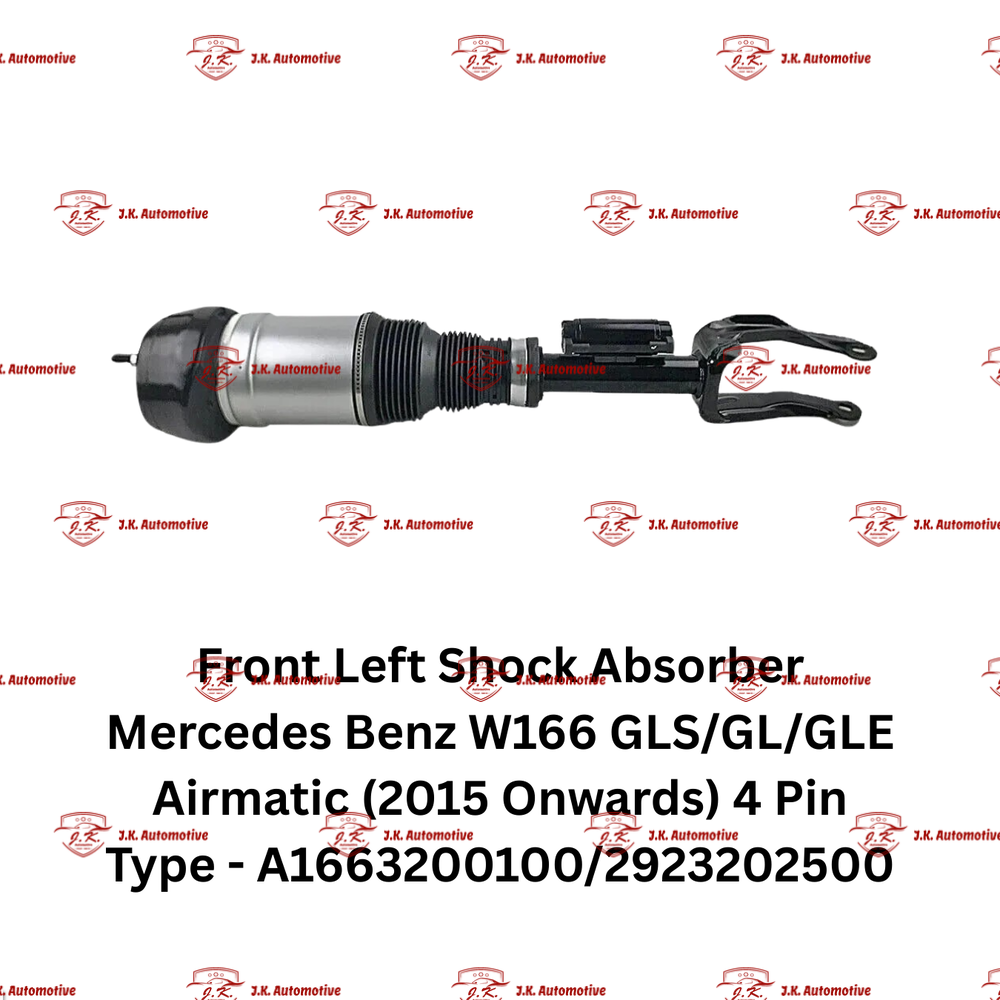
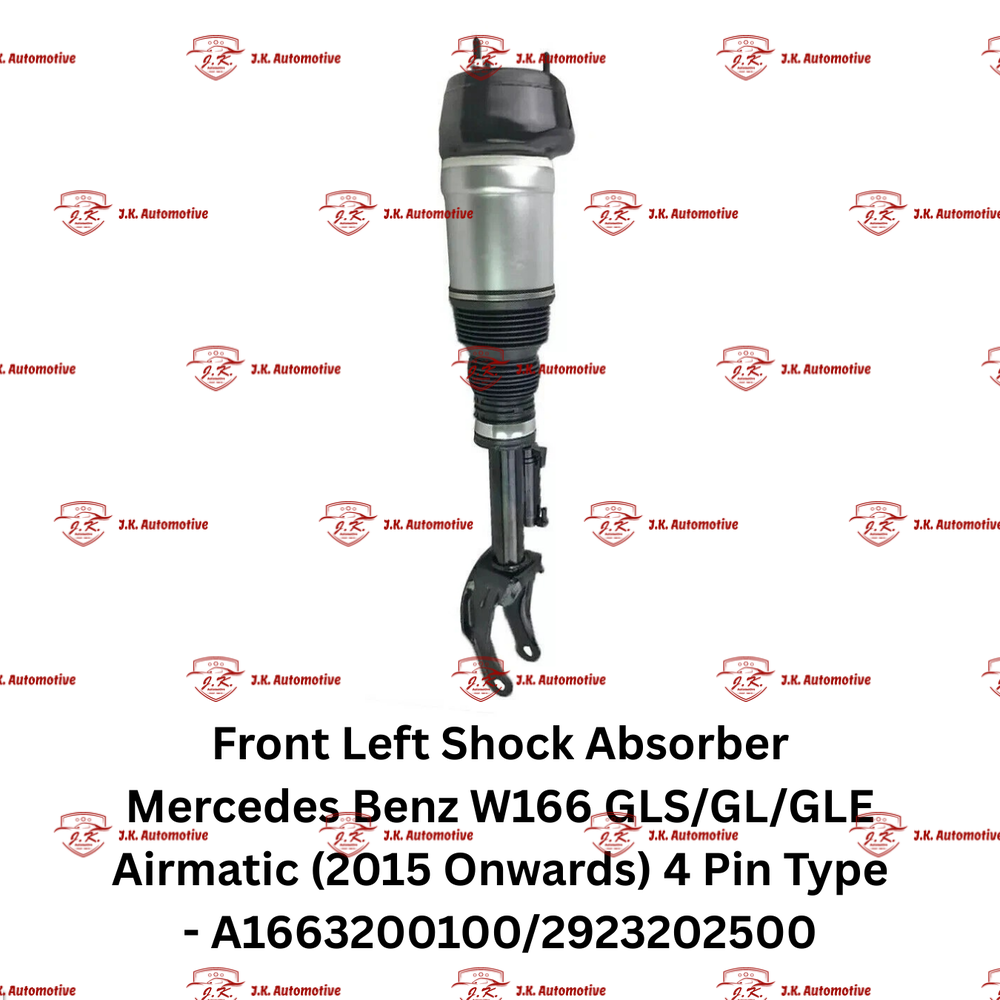
What is the Front Left Airmatic Shock Absorber A1663200100 / A2923202500 for Mercedes Benz GL Class X166?
The Front Left Airmatic Shock Absorber A1663200100 / A2923202500 is intended for the stated Mercedes Benz GL Class X166 4 Pin Type application with supplied year range 2012–2019 and is installed at the front left suspension position, where it forms part of the vehicle's air-suspension and damping arrangement. An Airmatic shock absorber performs an important role because the suspension assembly must respond continuously to bumps, potholes, dips, road undulations, braking, acceleration, cornering and changing vehicle loads while helping control vertical wheel and body movement. The pneumatic side of the suspension works with related components such as the air supply system, pressure lines and associated air-suspension control components, while the damping function helps regulate compression and rebound as the wheel moves relative to the vehicle body. When the front left wheel encounters a bump, the suspension compresses to absorb the road input and subsequently rebounds as the wheel returns toward its normal operating position, while damping helps prevent repeated uncontrolled oscillation. During braking, vehicle load transfers toward the front axle and increases the forces acting through the front suspension, making controlled damping particularly important for maintaining predictable suspension behaviour. Cornering also changes the loading between the left and right sides of the vehicle, so deterioration at the front left suspension position can influence how the vehicle settles and responds to changing road forces. References A1663200100 and A2923202500 are important product-identification points and should remain unchanged during catalog searches and compatibility verification. Because the supplied product is identified as 4 Pin Type, the electrical connector configuration should be checked against the component installed on the vehicle rather than selecting a replacement only from its physical appearance. Possible signs requiring inspection include the front left corner lowering, uneven vehicle height, slower suspension height adjustment, repeated compressor operation, excessive bouncing, reduced damping control, unusual suspension noise or visible deterioration around the suspension unit. These symptoms should be diagnosed systematically because air lines, connectors, sensors, air-suspension control components and other mechanical suspension parts can produce overlapping symptoms. VIN-based verification should be used whenever exact compatibility remains uncertain.
How can I confirm A1663200100 / A2923202500 is correct for Mercedes Benz GL Class X166 4 Pin Type?
Compatibility of the Front Left Airmatic Shock Absorber A1663200100 / A2923202500 with a Mercedes Benz GL Class X166 should be confirmed using the complete references, X166 chassis identification, front left installation position, Airmatic suspension application, supplied 4 Pin Type connector configuration, physical mounting arrangement and VIN information where necessary rather than relying only on vehicle name or supplied production years. The supplied product information identifies this item as Front Left Airmatic Shock Absorber Mercedes Benz GL Class X166 4 Pin Type – A1663200100 / A2923202500 with supplied year range 2012–2019, and these details should remain unchanged during compatibility checking. Begin by comparing references A1663200100 and A2923202500 with available identification information from the existing component, catalog data or vehicle-specific parts information. Useful search variations include Mercedes GL X166 A1663200100, Mercedes X166 A2923202500, A1663200100 Front Left Airmatic Shock, A2923202500 Front Left Airmatic Shock, Mercedes GL Class X166 Front Left Airmatic, Mercedes X166 4 Pin Front Shock and Mercedes GL X166 Front Left Air Suspension Shock. The replacement component should also be compared physically with the existing front left unit, including overall construction, upper and lower mounting arrangements, brackets, pneumatic connection and electrical connector configuration. Because the supplied product is specifically identified as 4 Pin Type, the existing electrical connector should correspond naturally with the replacement component without cutting wiring, modifying terminals, forcing incompatible connectors together or using improvised adapters. The pneumatic connection should also be compared carefully because an air-suspension component must integrate correctly with the applicable pressure-line arrangement. The front left position should be confirmed before installation because a position-specific component should not be assumed interchangeable with the opposite side simply because the overall construction appears similar. The supplied 2012–2019 year range should remain exactly as provided. Where the reference numbers, connector arrangement, physical mounting points or vehicle information do not provide sufficient certainty, VIN-based verification should be used before installation. Combining the exact references, X166 chassis, Front Left position, Airmatic application and 4 Pin Type configuration provides a stronger compatibility check than relying on model and year alone.
What symptoms can indicate a faulty Front Left Airmatic Shock Absorber on Mercedes Benz GL Class X166?
Possible symptoms requiring inspection of the Front Left Airmatic Shock Absorber on a Mercedes Benz GL Class X166 can include the front left corner sitting lower than expected, the vehicle developing an uneven standing height, suspension height changing after the vehicle remains parked, slower recovery toward normal height, frequent or prolonged compressor operation, excessive bouncing, reduced damping control, unusual front suspension movement, knocking or other suspension noises, changes in braking or cornering behaviour and visible deterioration around the suspension unit, although none of these symptoms by itself proves that A1663200100 / A2923202500 requires replacement. Air suspension combines pneumatic operation with mechanical damping and related electronic control, so diagnosis should separate a pressure-loss concern from a deterioration in damping performance wherever possible. If the front left corner lowers after the vehicle has remained parked, the suspension system should be checked for possible pressure loss rather than automatically replacing the shock absorber. The air suspension unit, pressure-line connection and related pneumatic components should be inspected systematically for leakage. If the vehicle remains at the expected height but continues bouncing excessively after bumps or takes longer to settle after road disturbances, the damping function requires closer assessment. Frequent compressor operation can indicate that the system is repeatedly attempting to restore or maintain pressure, but this symptom can also be associated with leakage elsewhere in the pneumatic system. The valve block, pressure lines, other air suspension units and related connections should therefore be considered during diagnosis. The supplied 4 Pin Type connector and accessible wiring should be inspected for physical damage, contamination, corrosion, loose engagement or previous modification. Mechanical suspension components should also be examined because control arms, bushes, ball joints, sway bar links, sway links, anti roll link rods, stabiliser sway links, wheel bearings and tyres can produce noises or handling symptoms that overlap with shock absorber deterioration. References A1663200100 and A2923202500 should be verified before replacement, and the Front Left position should be confirmed carefully. A complete diagnosis of pneumatic pressure retention, damping performance, electrical connections and surrounding suspension components provides a stronger basis for deciding whether the Airmatic shock absorber requires replacement.
Why can the front left corner of Mercedes Benz GL Class X166 lower when the vehicle is parked?
A front left corner that lowers while a Mercedes Benz GL Class X166 remains parked can indicate a pressure-retention concern somewhere within the applicable air-suspension circuit, but the Front Left Airmatic Shock Absorber A1663200100 / A2923202500 should not automatically be considered faulty until the complete pneumatic system has been inspected. Air suspension relies on maintaining controlled air pressure within the relevant suspension components, pressure lines and connections, and a loss of pressure can gradually change the vehicle's standing height when the compressor is not actively restoring system pressure. If the front left corner lowers noticeably after several hours or overnight while the other corners remain closer to their expected positions, the front left air suspension circuit deserves detailed inspection. The applicable suspension unit should be checked for signs of air leakage, while the pneumatic connection and pressure line should be examined for damage, incorrect seating or deterioration. A leak test can help determine whether pressure is escaping from the suspension unit, line connection or another part of the pneumatic circuit. The air-suspension valve block and associated distribution system should also be considered because internal pressure-control issues can sometimes influence how air is retained or distributed between suspension circuits. Compressor operation should be observed because frequent or extended compressor activity after starting the vehicle may indicate that the system is repeatedly restoring pressure lost while parked. However, compressor activity alone does not identify the precise leak location. Ride-height sensing and related control information may also need to be considered where the physical pneumatic system does not reveal an obvious problem. If the vehicle maintains its standing height but demonstrates excessive bouncing or poor settling over bumps, attention should shift toward damping performance rather than assuming a pneumatic leak. The 4 Pin Type connector and accessible wiring should also be inspected. References A1663200100 and A2923202500, X166 chassis, Front Left position and supplied 2012–2019 application should be verified before ordering replacement parts. A systematic leak test and suspension diagnosis are therefore preferable to replacing the front left Airmatic shock solely because the vehicle lowers while parked.
Why is the 4 Pin Type important for Mercedes Benz GL Class X166 Front Left Airmatic Shock Absorber?
The 4 Pin Type specification is an important compatibility detail for the Front Left Airmatic Shock Absorber A1663200100 / A2923202500 for the stated Mercedes Benz GL Class X166 application because correct Airmatic suspension fitment involves more than matching the vehicle model, chassis, front left position and physical appearance of the suspension unit; the applicable electrical connector configuration must also correspond with the arrangement installed on the vehicle. Suspension units that appear broadly similar externally can use different electrical connector configurations or be intended for different suspension specifications, so visual similarity alone should not be treated as sufficient evidence of compatibility. Before ordering or installing the replacement component, inspect the electrical connector on the existing front left suspension unit and compare it directly with the replacement to confirm the supplied 4 Pin Type configuration. The connector should correspond naturally with the vehicle-side connection without cutting wires, changing terminals, splicing the harness, forcing incompatible plugs together or using improvised adapters. References A1663200100 and A2923202500 should also be verified because connector pin count should not be used as the only identification method. Relevant searches can include Mercedes X166 A1663200100 4 Pin, Mercedes GL X166 A2923202500, A1663200100 Front Left Airmatic, A2923202500 Front Left Shock, Mercedes X166 Front Left Airmatic Shock and Mercedes GL Class X166 4 Pin Shock Absorber. Physical verification should also include overall suspension-unit construction, upper and lower mounting points, brackets and pneumatic connection. The front left position should be confirmed because position-specific mounting or component arrangements should not be assumed interchangeable between sides. Accessible wiring should be checked for damage, corrosion, contamination or previous modification before installation. The supplied 2012–2019 year range should remain unchanged during catalog preparation. VIN-based verification should be used whenever exact compatibility remains uncertain. Correct selection therefore combines the exact references, X166 chassis, Front Left position, Airmatic application, 4 Pin Type connector, physical mounting configuration and vehicle-specific verification.
What should be inspected before installing A1663200100 / A2923202500 Front Left Airmatic Shock on Mercedes Benz GL Class X166?
Before installing the Front Left Airmatic Shock Absorber A1663200100 / A2923202500 on the stated Mercedes Benz GL Class X166 4 Pin Type application, the complete front left suspension area and related air-suspension components should be inspected systematically so that pneumatic leaks, damaged pressure lines, connector concerns, worn mechanical suspension components or other faults are not overlooked during replacement. Begin by confirming references A1663200100 and A2923202500, X166 chassis, Front Left position, Airmatic application, supplied 4 Pin Type configuration and supplied year range 2012–2019 against the component removed from the vehicle and available vehicle information. Compare the replacement suspension unit directly with the existing component, including overall construction, upper and lower mounting points, bracket locations, pneumatic connection and electrical connector arrangement. The 4 Pin Type connector should correspond naturally with the vehicle-side connection, and accessible wiring should be inspected for damage, corrosion, contamination, loose terminals or previous modifications. The pneumatic pressure line and its connection should be checked for damage, contamination or incorrect seating because a compromised line or fitting can create pressure-loss symptoms even when the suspension unit itself is functional. The broader air-suspension system should be evaluated where appropriate, including compressor operation, valve-block behaviour, pressure retention and the condition of other pneumatic components. If the vehicle has been lowering while parked, leak testing should be performed rather than assuming the replacement suspension unit alone will resolve the concern. Mechanical suspension components should also be inspected, including control arms, bushes, ball joints, sway bar links, sway links, anti roll link rods, stabiliser sway links and relevant mounting hardware. The wheel bearing and tyre should be checked for abnormal play, damage or irregular wear that may indicate an additional suspension or geometry concern. Where exact compatibility cannot be established from references, connector type and physical comparison, VIN-based verification should be used before installation. Professional installation is recommended, followed by appropriate leak testing, standing-height observation, suspension-function checks and evaluation of damping behaviour to confirm that the front left suspension operates correctly after replacement.
How does the Front Left Airmatic Shock Absorber affect ride quality and suspension control on Mercedes Benz GL Class X166?
The Front Left Airmatic Shock Absorber A1663200100 / A2923202500 contributes to suspension control on the stated Mercedes Benz GL Class X166 4 Pin Type application by combining the functions associated with the applicable air-suspension arrangement and controlled damping at the front left wheel position while the vehicle responds to bumps, potholes, road undulations, braking, acceleration, cornering and changing vehicle loads. The pneumatic suspension arrangement works with related components such as the compressor, valve block, pressure lines, suspension units and associated control components to maintain and adjust the applicable suspension condition, while the damping function regulates compression and rebound as the wheel moves relative to the vehicle body. When the front left wheel encounters an uneven road surface, the suspension compresses to accommodate the road input and subsequently rebounds as it returns toward its operating position, while controlled damping helps reduce repeated oscillation and allows the vehicle body to settle progressively. During braking, vehicle load transfers toward the front axle and increases the forces acting through the front suspension, making effective damping important for managing front-end movement. Acceleration changes the load distribution in the opposite direction, while cornering produces lateral load transfer between the left and right suspension positions. A deterioration in pneumatic pressure retention can produce symptoms such as the front left corner lowering or slow height recovery, whereas deterioration in damping can produce excessive bouncing or slower settling after bumps, so these functions should be evaluated separately during diagnosis. Compressor operation should also be observed because repeated or prolonged operation can indicate that the pneumatic system is attempting to compensate for pressure loss, although the precise source may be the suspension unit, pressure line, connection, valve block or another pneumatic component. The supplied 4 Pin Type electrical connector and accessible wiring should be inspected for correct engagement, physical damage, contamination, corrosion or previous modification. Mechanical suspension components including control arms, bushes, ball joints, sway bar links, sway links, anti roll link rods, stabiliser sway links, wheel bearings and tyres should also be examined because wear in these areas can influence ride quality and suspension behaviour. References A1663200100 and A2923202500 should be verified before installation, together with the Front Left position, X166 chassis and 4 Pin Type configuration.
Can A1663200100 / A2923202500 Front Left Airmatic Shock cause the Mercedes Benz GL Class X166 to sit unevenly?
A concern involving the Front Left Airmatic Shock Absorber A1663200100 / A2923202500 can potentially be associated with an uneven standing height on the stated Mercedes Benz GL Class X166 if pressure is not being retained correctly within the applicable front left air-suspension circuit, but an uneven vehicle position should not automatically be treated as proof that the shock absorber itself has failed because several pneumatic, mechanical and control-related factors can influence suspension height. If the front left corner gradually lowers while the vehicle remains parked, the applicable suspension unit, pneumatic connection and pressure line should be inspected for leakage. Leak testing can help determine whether pressure is escaping from the suspension unit or an external connection, while standing-height observations over a controlled period can help establish whether the concern develops immediately or gradually. The valve block should also be considered because it participates in pneumatic pressure distribution, and an internal pressure-control concern can sometimes affect how pressure is retained within individual suspension circuits. Compressor behaviour should be evaluated because frequent or prolonged operation after the vehicle is started may indicate that the system is repeatedly attempting to restore pressure that was lost while parked. However, compressor operation alone does not identify the failed component, so replacing the compressor or suspension unit without further diagnosis may not address the underlying cause. Pressure lines and fittings should be examined for damage, contamination or improper seating. Ride-height sensing and relevant electrical information may also require inspection where the pneumatic components do not reveal an obvious leak. The 4 Pin Type connector on the suspension unit and accessible wiring should be checked for damage, corrosion, contamination or loose engagement. If the vehicle maintains its standing height correctly but exhibits excessive bouncing, poor settling or reduced control after bumps, damping performance should be investigated separately. References A1663200100 and A2923202500, Front Left position, X166 chassis and supplied 2012–2019 application should be verified before replacement. A systematic diagnosis involving standing-height observation, leak testing, compressor operation, valve-block assessment, pressure-line inspection and damping evaluation provides a stronger basis for identifying the actual source of an uneven front suspension height.
Can a faulty Front Left Airmatic Shock Absorber cause frequent compressor operation on Mercedes Benz GL Class X166?
A pneumatic pressure loss associated with the front left suspension circuit can contribute to more frequent or prolonged air-suspension compressor operation on a Mercedes Benz GL Class X166 because the system may repeatedly attempt to restore the required pressure or vehicle height, but frequent compressor activity should not automatically be interpreted as confirmation that the Front Left Airmatic Shock Absorber A1663200100 / A2923202500 is leaking. The compressor supplies pressurised air to the applicable pneumatic suspension system, while the valve block, pressure lines, connections and suspension units participate in distributing and retaining that pressure. If pressure gradually escapes from the front left suspension unit or its pneumatic connection, the vehicle may lower at that corner while parked and the compressor may subsequently operate when the system attempts to restore the suspension condition. However, leakage elsewhere in the pneumatic system can produce similar behaviour, making systematic leak diagnosis important before component replacement. The front left suspension unit should be inspected for potential leakage, and the pressure-line connection should be examined carefully for damage, contamination or incorrect seating. Relevant pneumatic lines should also be checked for visible deterioration or conditions that could allow pressure loss. The valve block should be considered because internal sealing or pressure-distribution concerns can influence how pressure is maintained in individual circuits. Compressor operation should be evaluated together with standing-height behaviour rather than in isolation. If the vehicle remains level for extended periods and the compressor still operates unusually often, additional system diagnosis may be necessary. The supplied 4 Pin Type connector and accessible wiring should also be inspected because electrical connection concerns can complicate suspension diagnosis. Mechanical damping should be assessed separately because excessive bouncing or slow settling after bumps may indicate a damping concern even when pneumatic pressure is retained correctly. References A1663200100 and A2923202500 should be checked before replacement, along with the X166 chassis, Front Left position and 4 Pin Type configuration. A complete inspection of the suspension unit, pressure lines, valve block, compressor behaviour and related connections provides a stronger diagnostic approach than replacing a component solely because compressor activity has increased.
What should be checked after installing A1663200100 / A2923202500 Front Left Airmatic Shock on Mercedes Benz GL Class X166?
After installing the Front Left Airmatic Shock Absorber A1663200100 / A2923202500 on the stated Mercedes Benz GL Class X166 4 Pin Type application, the front left suspension assembly and related pneumatic and electrical connections should be checked carefully before the vehicle returns to normal use so that mounting, pressure retention, connector engagement and damping operation can be evaluated systematically. Begin by confirming that the suspension unit is seated correctly at its upper and lower mounting positions and that applicable brackets and mounting hardware have been installed and secured according to the required repair procedure. The pneumatic pressure-line connection should be inspected to ensure that it is correctly positioned and has not been damaged, contaminated, twisted or incorrectly seated during installation. Appropriate leak testing should be performed around the applicable pneumatic connection and suspension unit because a new installation should retain pressure without an avoidable external leak. The 4 Pin Type electrical connector should be fully engaged, and accessible wiring should be checked to ensure that it is not pinched, stretched, twisted or routed against moving or sharp components. The vehicle's standing height should be observed after the suspension system has reached its operating condition, with attention given to whether the front left position corresponds appropriately with the remaining suspension positions. Compressor operation should also be observed because unusually frequent or prolonged activity after replacement can indicate that a pressure-retention concern remains elsewhere in the system. The valve block, pressure lines and other air-suspension units may require additional inspection if the vehicle continues to lower or adjust excessively. Mechanical damping should be evaluated through controlled suspension movement and an appropriate road test, paying attention to excessive bouncing, unusual front movement, knocking or slow settling after road disturbances. Surrounding mechanical components including control arms, bushes, ball joints, sway bar links, sway links, anti roll link rods, stabiliser sway links, wheel bearings and tyres should also be checked if symptoms remain. References A1663200100 and A2923202500 should remain the product-identification points during final verification. Where suspension work can affect geometry or where irregular tyre wear is present, wheel alignment or geometry should be checked as appropriate.
How do I know if the Front Left Airmatic Shock Absorber is bad on my Mercedes Benz GL Class X166?

Reviews
There are no reviews yet.